
 Tweet
Georgia PM Meets Muslim Community Leaders
October 7, 2013
(Civil.Ge) — PM Ivanishvili met with Georgian Muslim community leaders in his private seaside residence in Ureki on October 5.
State Minister for Reintegration, Paata Zakareishvili, whose portfolio also includes relations with minorities, and head of the government of Adjara Autonomous Republic Archil Khabadze were also present at the meeting.
In a brief video footage from the meeting, released by PM’s office, Ivanishvili says “rough actions” in respect of removing minaret in the village of Chela by the authorities “was a huge shame.”
“It was an open and frank conversation on multiple issues, among them about a mosque that has to be built in Batumi… Mainly Sunni muftis from various regions of Georgia arrived who talked about problems persisting in their respective regions. Of course the issue of a minaret in the village of Chela was also discussed and certain measures have been planned,” the State Minister for Reintegration said after the meeting.
“For about four hours the Prime Minister was listening to us… He is a very sincere person, who promised assistance,” Jemal Paksadze, the mufti of the Georgian Muslims’ Directorate, said and thanked the PM for discussing problems, which, as he said, have been accumulating for dozens of years already.
“The issue of mosque [in Batumi], as well as of minaret [in the village of Chela], was also discussed. In respect of a mosque [in Batumi] several options are selected and discussion is ongoing now. We are sure that problems will be solved,” Paksadze said.
Georgia PM Meets Muslim Community Leaders Eurasia Review
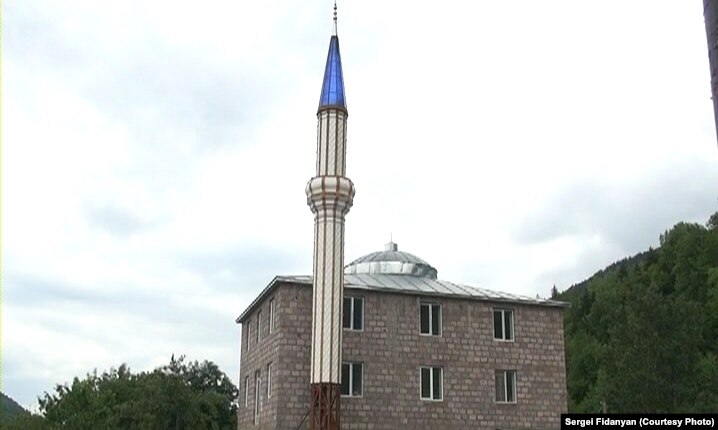
This was the mosque in Chela:
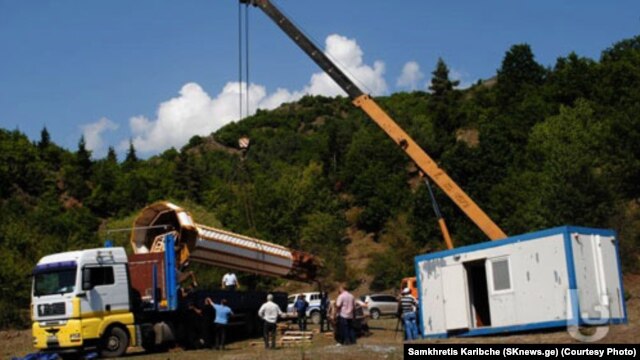
The minaret was removed.
There were protests.
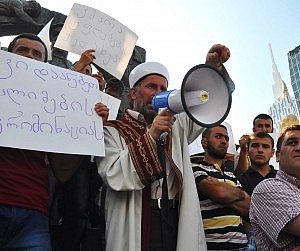

There was violence.
Islam in Georgia has a precarious future and many in Georgia's traditionally Muslim southern region of Adzharia have even become Christians.
The post-communist Georgian flag also contains the Christian cross on it.
Turkey, the OIC and Muslim countries should monitor the situation in Georgia and insist on the rights of Muslim, Jewish and other minorities there.
October 7, 2013
(Civil.Ge) — PM Ivanishvili met with Georgian Muslim community leaders in his private seaside residence in Ureki on October 5.
State Minister for Reintegration, Paata Zakareishvili, whose portfolio also includes relations with minorities, and head of the government of Adjara Autonomous Republic Archil Khabadze were also present at the meeting.
In a brief video footage from the meeting, released by PM’s office, Ivanishvili says “rough actions” in respect of removing minaret in the village of Chela by the authorities “was a huge shame.”
“It was an open and frank conversation on multiple issues, among them about a mosque that has to be built in Batumi… Mainly Sunni muftis from various regions of Georgia arrived who talked about problems persisting in their respective regions. Of course the issue of a minaret in the village of Chela was also discussed and certain measures have been planned,” the State Minister for Reintegration said after the meeting.
“For about four hours the Prime Minister was listening to us… He is a very sincere person, who promised assistance,” Jemal Paksadze, the mufti of the Georgian Muslims’ Directorate, said and thanked the PM for discussing problems, which, as he said, have been accumulating for dozens of years already.
“The issue of mosque [in Batumi], as well as of minaret [in the village of Chela], was also discussed. In respect of a mosque [in Batumi] several options are selected and discussion is ongoing now. We are sure that problems will be solved,” Paksadze said.
Georgia PM Meets Muslim Community Leaders Eurasia Review
This was the mosque in Chela:
The minaret was removed.
There were protests.
There was violence.
Islam in Georgia has a precarious future and many in Georgia's traditionally Muslim southern region of Adzharia have even become Christians.
The post-communist Georgian flag also contains the Christian cross on it.
Turkey, the OIC and Muslim countries should monitor the situation in Georgia and insist on the rights of Muslim, Jewish and other minorities there.