Announcement

Collapse
No announcement yet.

UAE stops $12 billion Turkish energy deal

Collapse
X
 
  • Filter
  • Time
  • Show
Clear All
new posts

  • #31
    Meanwhile while Gul, Erdogan, Davutoglu interfere in Egyptian affairs and insult the Egyptian government, in Turkey.....


    A Death Provokes
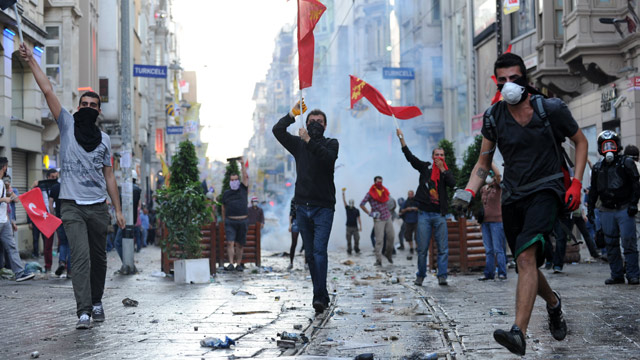
    Anti-government Protests in Turkey


    Riot police fire tear gas during a protest in central Istanbul, Sept. 10, 2013. Turkish police used tear gas to disperse crowds in Istanbul and Ankara who were rallying against the death of a protester earlier in the day, witnesses said. (photo by REUTERS/Osman Orsal)


    Read more: http://www.al-monitor.com/pulse/orig...#ixzz2ei661Phd


    Police Fire Tear Gas In Istanbul As Protests Continue - YouTube


    * * * * * * * * * * * * * * * * * * * * * * *

    Comment


    • #32
      Are Turkish Pilots Abducted in Beirut
      To Be Traded for Captured Iranian Agents?

      A


      Turkish peacekeeper of the United Nations Interim Force in Lebanon (UNIFIL) closes a gate in the village of Shaaytiyeh, southern Lebanon, Aug. 12, 2013. (photo by REUTERS/Ali Hashisho)

      Print


      By: Emre Uslu Translated from Taraf (Turkey).
      ORİJİNAL YAZIYI TÜRKÇE OKUYABİLİRSİNİZ

      Two Turkish Airlines pilots who were on their way to their Beirut hotel after completing an Istanbul-Beirut flight were kidnapped on Aug. 9. Nobody fully understood why the pilots were abducted. Media reports suggested that they were kidnapped by relatives of the Lebanese citizens currently held hostage in Syria. But the investigations have revealed that the real aim of the kidnapping was to exchange them for nine Iranian Revolutionary Guard Corps (IRGC) agents held by the Free Syrian Army (FSA).


      In May 2012, 11 Lebanese citizens were kidnapped by the Syrian opposition in the area of Azaz. Newspapers reported that the abducted were Lebanese Shiite pilgrims who had been visiting the tomb of Imam Ali Reza before returning to Lebanon. Two of the kidnapped were released by mediation efforts of Turkey’s Humanitarian Relief Foundation (IHH), with the support of Turkey’s National Intelligence Service (MIT).

      There were subsequent reports that the kidnapped were actually IRGC personnel. When Iran showed high interest in rescuing the 11 IRGC men, Turkey entered into the process through the MIT and assisted in the release of two of them. But, Turkey’s involvement led to a crisis in its relations with the Syrian opposition. The other nine are still help captive by the Syrian opposition.
      The abduction of the Turkish Airlines pilots is seen as an action planned to rescue these nine IRGC members. According to assessments from security units, Iran arranged for the kidnapping of the pilots to use Turkey in rescuing the nine IRGC men.
      Iran has been using different approaches to rescue its men. During this process, the IHH, which had organized the Mavi Marmara flotilla to Gaza, gained prominence. The FSA is disturbed by the activities of the IHH, which was earlier instrumental in saving journalists and other Iranian captives. The FSA says that the Democratic Union Party (PYD) and Jabhat al-Nusra also benefit from the IHH's actions, and that the foundation's actions to save hostages in Syria indirectly strengthen the hand of Iran. This in turn bothers the regional countries that support the Syrian opposition, Western countries and the FSA.
      According to Turkish assessments, efforts via the IHH have damaged the atmosphere of trust between Turkey and the Syrian opposition. The IHH’s rescue efforts that benefit Iran — and the support the MIT has provided for these efforts — have upset the groups that used to believe and trust in Turkey. Regional countries are said to be at a loss to understand Ankara’s "affection for Iran." They have conveyed their misgivings to Ankara. Other claims say that there are questions about where the IHH assistance sent to the region ends up — whether the recipients are Chechen extremists, Jabhat al-Nusra, the PYD or even Assad regime forces.
      Turkey is becoming a party to clashes in the region and an effective element in an upcoming Sunni-Shiite clash in Lebanon. Many believe that these activities are planned by Iran, step by step, with the goal of dragging Turkey into a quagmire. It was in this context that two Turkish pilots were kidnapped to save the nine IRGC men.
      Assessments said the MIT and the Foreign Ministry using the IHH as an intermediary is understandable up to a point, but all the failed projects the IHH had planned with the MIT served Iranian interests. This makes Turkey an unreliable ally in the Middle East that looks after Iran’s interests. While there were other venues available to save the Turkish pilots, to allow them to become a negotiation card to save the IRGC agents only reinforces this perception of looking after Iran’s interests.


      Read more: http://www.al-monitor.com/pulse/poli...#ixzz2exH5i4hY
      * * * * * * * * * * * * * * * * * * * * * * *

      Comment


      • #33
        1. Turkey (in conjunction with and with the encouragement of the Gulf Arabs) tried to play big brother in the middle east and acting in an arrogant way interfering in the affairs of their "former subjects".

        Turks are big-headed and think they are a super-race, and the AKP was enjoying trying to boss Arabs around with "Neo-Ottoman" behaviour.

        2. Iran and Syria, backed by Russia and China have spoilt the "Neo-Ottoman" party and Shias kidnapped two Turkish pilots.

        If Turkey displeases Iran and Syria more, this can be repeated so that Syria/Lebanon will become a no-go area for Turks and thus Turkey cannot operate there i.e. Iran will have expelled Turkey from the region.

        3. The PKK a while earlier threatened Turkey with all out war if Turkey attacked Syria, this was earlier on in the Syrian conflict but this is one reason why the Turks did not attack Syria.

        The PKK now has units within Turkey's big cities which would attack Turkey's cities and destroy the economy.

        Also Iran threatened to declare war with Turkey if Syria was attacked.

        4. Turks oppressed the Arabs for four centuries. The Arabs were loyal to them as an Islamic duty. The Muslim women of India/Bengal gave gold for the Ottomans. Arab women gave their sons.

        - 1/3 of all Ottoman soldiers in the Gallipoli war were Arabs.

        - The Turks betrayed the Arabs in Libya when they basically handed it over to the Italians.

        - The Turks neglected the Arab world and did not contribute to it in anyway and regarded Arabs as inferior.

        The Albanian Muslims revolted against the Turks and joined Orthodox and Catholic Albanians in breaking away. Albanian Muslims were very prominent in the Ottoman empire with perhaps the biggest number of Viziers.

        Despite this, Turkish-Kemalist propaganda does not teach Turks to hate Albanians as traitors.

        Turks including Alevis, Safawis and others fought Ottoman Turks countless times but Kemalist propaganda does not focus on this.

        In 400 years of Turkish rule, the Arabs hardly ever revolted (bar the Wahabis) then when a few British-inspired tribes from the Hejaz did what Albanians and Alevis did, Kemalist propaganda dubbed all Arabs as "traitors".

        If you mix with Turks you will find that they are deeply racist towards Arabs and hate them ferociously.

        Turkey has no business in the Arab world which it oppressed for 400 years and which, its media and education system, teaches its children to hate.

        Turkey out of the middle east!!


        Example of the rampant anti-Arab racism existent and encouraged in Turkey. An anti-Arab Turkish cartoon.


        Turkey is probably the most anti-Arab country on earth (more than Israel where crude anti-Arab racism would be seen as backwards and primitive) and hatred for Arabs as 1. "Traitors" (Hainleri) 2. Backwards is encouraged by the media, education system and politicians.


        TURKEY OUT OF THE MIDDLE EAST!!
        * * * * * * * * * * * * * * * * * * * * * * *

        Comment


        • #34
          The Ottoman Empire collapsed because they took loans from European banks to build a railway that stretched across the empire. The purpose of the railway was two-fold, to put the Ottoman Empire in debt, and then to have an easy path that cuts right through the Ottoman Empire.

          Now Europe is in debt to China, and China keeps giving toxic loans- knowing that Europe will not be able to pay these loans back.

          Comment


          • #35
            Turkish pilots detail abduction upon return home

            October 20, 2013 12:12 PM

            BEIRUT: Two Turkish Airlines pilots who were released Saturday after spending over two months in captivity in Beirut detailed the moment of their abduction and said their kidnappers did not abuse them.

            Their release was part of a three-way swap deal that also involved the freeing of nine Lebanese pilgrims held in Syria as well as a number of Syrian women detained by President Bashar Assad's government.

            "We were kidnapped within 3-5 minutes [of boarding] the transfer from the airport to the hotel. Some vehicles appeared in front of our bus [and] nearly 10 armed [individuals] got out of three cars,” pilot Murat Akpinar told reporters, according to the Anadolu News Agency.

            “When I looked back I saw three more cars there. Someone pointed a gun at the driver. Someone kicked in the door of the car. I shouted 'do not shoot' in English," he said

            Akpinar along with his co-pilot Murat Agca were snatched on Aug. 9 on their way from Beirut Airport to a hotel. They appeared in two recordings on local media during their time in captivity.

            A previously unknown group calling itself Zuwwar al-Imam Ali al-Reza claimed the kidnapping, saying they would only release the Turkish nationals in exchange for the release of Lebanese held in Syria.

            Relatives of the Lebanese who were abducted on May 22 of last year by Syrian rebels in the Aleppo district of Azaz had repeatedly asked Turkey to help secure the release of their loved ones given Ankara’s staunch support of the Syrian opposition.

            The nine Lebanese Shiites who were on their way home from a pilgrimage in Iran at the time of thier abduction were released Saturday after the Syrian government agreed to the kidnappers’ demand to free over 100 female detainees in Syrian prisons.

            Head of Lebanon’s General Security Maj. Gen. Abbas Ibrahim had negotiated with the Syrian and Turkish sides as part of the mediation efforts to secure the pilgrims' release; however, it was only after Qatar said it would intervene in the matter that the Lebanese were freed.

            The two pilots arrived at the Beirut airport at 9 p.m. on board a Lebanese Army helicopter that took off from the Riyaq military airbase in the Bekaa Valley, east Lebanon.

            Agca and Akpinar were met upon arrival in Beirut by Turkish Ambassador to Lebanon Inan Ozyildiz and Lebanon's caretaker Interior Minister Marwan Charbel, representing President Michel Sleiman, before boarding a plane headed to Istanbul. In Istanbul, the pair were later greeted by Turkish Prime Minister Tayyip Erdogan.

            Speaking to reporters in Turkey, Akpinar said the Lebanese kidnappers had changed their location every three to four days after 3 a.m. on board several vehicles.

            He also thanked Turkish President Abdullah Gul, Erdogan and Turkish Foreign Minister Ahmet Davutoglu for their efforts, saying: "We know that our president [met with] our families and listened to them. Each Turkish citizen knows he's not alone there if something happens to him."

            "When we asked them why they kidnapped us, they told us that their families were kidnapped. First days were a bit constrained, we even went to the toilettes under the control of weapons, however we did not face any violence. We followed the news through 'Turkey's Voice Radio.' We are happy to be released," Akpinar said.

            Agca, who only began working at Turkish Airlines just six months ago, said he and Akpinar supported each other during their time in captivity.


            Read more: Turkish pilots detail abduction upon return home | News , Lebanon News | THE DAILY STAR
            (The Daily Star :: Lebanon News :: Breaking News, Lebanon News, Middle East News & World News | THE DAILY STAR)


            This is clear proof that the Turks essentially control the FSA "rebels".

            FSA forces kidnapped Lebanese Shia.

            The Lebanese Shia knew the Turkish regime is the godfather of these terrorists and so kidnapped two Turks.


            Now the FSA have mysteriously released the Lebanese Shia in return for the freedom of Turks.

            - Turkey needs to stop supporting terrorists and thugs in Syria and destabilizing Syria.

            - Karma is hitting Turkey back with massive riots in Turkey.

            - Neo-Ottomanism is a failed ideology and only applicable to the Balkans or the rights of Muslim minorities e.g. Rohingyas.


            Riots in AKP Turkey.


            [IMG]httphttp://l2.yimg.com/bt/api/res/1.2/fij0sDm6FN6hDJUacOz1iw--/YXBwaWQ9eW5ld3M7Zmk9aW5zZXQ7aD0xMDI0O3E9Nzk7dz0xND M0/http://media.zenfs.com/en_us/News/Reuters/2013-05-18T154433Z_1688016192_GM1E95I1TKZ01_RTRMADP_3_SYRI A-CRISIS-TURKEY-ZONE.JPG[/IMG]


            * * * * * * * * * * * * * * * * * * * * * * *

            Comment


            • #36
              Somebody needs to do to Erdogon what was done to Mosri.
              "If a nation expects to be ignorant and free, in a state of civilization, it expects what never was and never will be".

              "Knowledge will forever govern ignorance; and a people who mean to be their own governors must arm themselves with the power which knowledge gives".

              Comment


              • #37
                Originally posted by Levanaye Zalmaye View Post
                Somebody needs to do to Erdogon what was done to Mosri.
                1. Erdogan is not that bad.

                He has liberalized Turkey and created a freer society than the previous Kemalist establishment. Under him Kurds have more rights including TV stations (which are very basic in their content but better than the Kemalists who outlawed Kurdish and references to Kurds who were called "mountain Turks")

                2. Many of the rioters belong to far left groups or are Kemalists who are themselves enemies of democracy and basic human rights e.g. anti-Kurdish, anti-Muslim etc.

                However though the AKP are far better than the Kemalists and their intolerant fascist ideology, the AKP government in Turkey must realize that they cannot attempt to bully and boss around other Muslim countries. They tried to do this to Bangladesh and we called in their ambassador and slapped sanctions on them e.g. on arrival visa was cancelled.

                Tension arises with Turkey Ghulam Azam?s clemency sought

                Now they have the beginnings of an urban insurgency in their country.

                So as long as they abandon neo-Ottomanism and harassing other Muslim countries e.g. Bangladesh, Egypt, Syria etc they will be fine. Otherwise they will face greater problems.
                * * * * * * * * * * * * * * * * * * * * * * *

                Comment


                • #38
                  Turkey expels Saudi intelligence over diplomatic rift: source

                  Published Friday, November 1, 2013

                  Ankara plans to shut Saudi intelligence offices in Turkey following a series of diplomatic disputes over the conflicts in Syria and Egypt, a well-placed Turkish source told Al-Akhbar.

                  The Saudi intelligence presence in Turkey is mainly there to provide support and training for armed groups fighting in Syria.

                  According to the source, Turkish authorities believe Saudi Arabia's position on Syria is no longer in line with Turkey's interests, as Ankara is reportedly trying to ease tensions with Tehran and Damascus.

                  The historic alliance between Saudi Arabia and Turkey began to crumble following the Saudi-sponsored military overthrow of Egypt's Islamist president Mohammed Mursi on July 3.

                  Turkish Prime Minister Tayyip Erdogan has repeatedly denounced the Egyptian coup and the military crackdown on Mursi's Muslim Brotherhood party.

                  But the tipping point came when Riyadh attempted to diminish Turkey's influence over the opposition Syrian National Council and the National Coalition for Syrian Revolutionary and Opposition Forces, the source said.

                  Saudi foreign minister Saud al-Faisal allegedly told his Turkish counterpart Ahmet Davutoglo that Turkey would no longer play a role in the Syrian conflict even if the regime were to fall, and asked Ankara not to interfere in Egypt's political crisis.

                  According to the source, Turkish officials believe Saudi Arabia, along with Jordan and the United Arab Emirates, are strategically working against the interests of two different regional blocs: Hezbollah, Syria, Iran and Iraq on one front, and Turkey, Qatar, Hamas, and the Muslim Brotherhood on the other.

                  The Turkish source added that Saudi Arabia had attempted to disrupt a prisoner swap deal that saw the release of the nine Lebanese pilgrims held in northern Syria in exchange for two Turkish pilots kidnapped in Beirut.

                  Turkey expels Saudi intelligence over diplomatic rift: source | Al Akhbar English


                  So now Turkey has split with Saudi Arabia over Syria.

                  Turkey has a direct border with Syria whereas Saudi doesn't.

                  Turkey hosts Syrian refugees whereas Saudi doesn't.

                  Turkey has millions of Alevi/Alawis in its country, whereas Saudi doesn't.

                  Turkey has millions of Kurds in its country along with Syria, whereas Saudi doesn't.

                  Turkey is directly affected by Syria and Alawi regions on Turkey e.g. Hatay have launched a virtual urban rebellion, whereas Saudi isn't.

                  Thus Ankara is now trying to kiss and make up with Damascus and Tehran after sponsoring terrorists against the Damascus government.


                  This would mean that the anti-Assad forces would solely be recieving support from Jordan (and more limited support from Iraqi Sunni areas...but not official government support) and having a supply line only from the South i.e. Jordan.

                  More and more it looks like Assad has won the war and Saudi has lost.

                  However the Assad regime of brutal dictator Bashar al-Assad must also change his behaviour and start to act like a civilized human being rather than the power-hungry idiot that he is. The "rebels" are no angels, and though Assad may not be as bad he too is no saint and must be monitored and kept in check.
                  * * * * * * * * * * * * * * * * * * * * * * *

                  Comment


                  • #39
                    Turkey stopped helping al-Qaeda near Syria border: Report


                    A youth sits on a barricade as people carrying their belongings walk at the Syrian border crossing of Bab al-Hawa, at the Syrian-Turkish border October 22, 2013. Picture taken October 22, 2013. REUTERS photo

                    Turkey has recently ceased aiding al-Qaeda-linked groups near the Syrian border, Democratic Union Party (PYD) leader Saleh Muslim has said, according to daily Taraf.

                    The PYD, which is known as the outlawed Kurdistan Workers Partys (PKK) wing in Syria, is fighting in northern Syrian towns against al-Qaeda-affiliated jihadist groups, in particular the al-Nusra Front and the Islamic State of Iraq and the Levant (ISIS).

                    The gangs dont attack us from Turkey anymore, like they used to do. That is good news. We always said this and we continue saying it: We want friendly relations with Turkey. We do not want independence or a federal structure, he was quoted as saying by the daily.

                    Muslim said the recent PYD victories over the militant groups were partially due to the fact Turkey had stopped providing support.

                    The international pressure also had an impact. These groups threaten Turkeys security as well, Muslim said.

                    MIDEAST - Turkey


                    *Turkey is essentially wrapping up their sponsorship of the "rebels" in Syria, and Turkey was their main entry point.

                    Assad it seems has won.

                    The biggest loser in this war are not the Saudis but the Syrians themselves as their country has been destroyed and their lives shattered.

                    The biggest winners are the Kurds.

                    - Kurds have a de facto independent state in Iraq though still connected to the Baghdad government.

                    - Kurds have self-governing regions in Northern Syria.

                    - Kurds are gaining more rights in Turkey and recently "Ne Mutlu Turkum Diyene" slogans (How happy is the one who calls himself a Turk) which symbolizes Kemalist fascism and Turkish chauvinism have been removed from Kurdish parts of Turkey.


                    Ne Mutlu Turkum Diyene sign being removed from Diyarbakir, Turkey's main Kurdish region.


                    Fascist Turkish army forcing nationalism upon youth.

                    "Ne Mutlu Turkum diyene" was a sort of kalima (Islamic declaration of faith) for the fascist Kemalist military and ultra-nationalists who supported them, so its removal is a huge step.

                    It was the Kemalist replacement for "Benim Muslimanim Alhamdulilah" (I am Muslim Alhamdulilah) as prior to the Kemalist Republic, Muslims in Anatolia viewed themselves as Muslims and not Turks.

                    Last edited by Bengal_Tiger; 11-08-2013, 08:13 AM.
                    * * * * * * * * * * * * * * * * * * * * * * *

                    Comment


                    • #40
                      The collapse of Turkey’s Syria policy


                      The Turkish government has been partly responsible for the crisis in Syria, even if it has been trying to shift the blame, writes Jeremy Salt in Ankara

                      The collapse of Turkey’s Syria policy


                      Fighters from Tawhid Brigade, which operates under the Free Syrian Army, run with a stretcher in Base 80 area of Aleppo, 10 November

                      Catastrophic for Syria and disastrous for Turkey — the consequences of Turkey’s intervention in Syria over the past two years can be summed up in this way. While not admitting that they were wrong, the architects of this policy, Turkish Prime Minister Recep Tayyip Erdogan and Foreign Minister Ahmet Davutoglu, now appear to be backing off, at least to the extent of tightening border security and seeking to repair the damage they have caused to relations with neighbouring states.

                      In early August Davutoglu visited Tehran, and now President Hassan Rouhani of Iran has been invited to Ankara. So has Iraqi Prime Minister Nuri Al-Maliki, with Davutoglu due to visit Baghdad in a few days’ time. Both Davutoglu and Erdogan have also shut down the vociferous support they have been expressing for the deposed Egyptian president Mohamed Morsi and his Muslim Brotherhood government. Now they seem to agree that what happens in Egypt is the business of the Egyptian people.

                      By throwing its weight behind an armed movement seeking the overthrow of the Syrian government, the Turkish Justice and Development Party (the Adalet ve Kalkinma Partisi or AKP) took Turkey where no other government had gone since the proclamation of the Turkish Republic in 1923. It provided space for the mobilisation of armed men crossing the border to kill Syrian soldiers and civilians (described as loyalists to the regime of Syrian President Bashar Al-Assad). It backed the establishment of the Free Syrian Army (FSA) and the so-called Syrian National Council, a group of exiles which has been absolutely dysfunctional from the start despite the millions of dollars shovelled its way by Turkey and other “friends” of Syria.
                      There has been no argument that Syria’s oppressive political system needed changing. The starting point of the debate was how and at what cost. With the single exception of open armed intervention, the policy pursued by these so-called “friends” of the Syrian people has been the worst possible option even from the point of view of Syrians who do not like the ruling Syrian Baath Party. There have been no benefits, save for the solidarity engendered amongst the people by this attack on their country. Instead, it has been massive death and destruction all the way.

                      Turkey’s role has been pivotal in the campaign launched by the “Friends of the Syrian People” to bring down the Syrian regime. In the allocation of responsibilities, Saudi Arabia, Qatar and Libya have supplied arms and/or money for bribes and the purchase of weapons. The US has provided intelligence, training and coordination, and perhaps arms, as well as the officially declared “humanitarian” support and provision of non-lethal military equipment. But the opening up of territorial space as a rear base for the armed groups by Jordan and Turkey has been no less of a critical element in the campaign to destroy the government in Damascus.

                      On the “rebel” side the conflict is now completely dominated by Salafist takfiri groups. Over the past three years, tens of thousands of jihadis from all over the world have poured into Syria to join them. The main route is through Turkey. The new arrivals meet their contacts in the southeast of the country and stay in safe houses before being smuggled across the border. In the towns and quarters they have infiltrated in northern Syria the imposition of codes of public dress and behaviour are a pointer to what the whole country can expect if the armed groups ever succeed in establishing their Islamic emirate in Syria.

                      In Al-Raqqa, ISIS (the Islamic State of Iraq and Bilad Al-Sham) has banned women from wearing jeans and men from wearing low-hanging jeans or having their hair cut short. Clothes are no longer allowed to be put on display in shop windows. Hair dressing salons have been closed, and women must wear the hijab and are forbidden from appearing in public by themselves. Harsh punishments up to the point of death have been declared for infractions of the rules. Beatings, public executions and disappearances underline the dangers of not obeying. The brutality of ISIS, Jabhat Al-Nusra and other Islamist groups is well-established, yet only now do the “Friends of the Syrian People” appear to be coming to terms with the consequences of what they have done, not because of actual concern for the Syrian people but because of the threat to their interests across the region and at home.

                      In Turkey’s case the threat is immediate. The country’s Zaman newspaper, until recently a strong supporter of the “revolution” in Syria, reported on 4 November that ISIS had sent two of seven bomb-laden vehicles into the Anliurfa province of the country with the intention of exploding them in Istanbul, Ankara, Izmir or other major Turkish cities. The intelligence sources passing on this information also warned that ISIS was capable of amending its plans and exploding them somewhere in the southeast instead.

                      ISIS had already threatened to launch suicide bomb attacks inside Turkey unless the government opened the border crossings at Bab Al-Hawa and Bab Al-Salameh, which it had closed after ISIS had taken control of the town of Azaz in September. It was ISIS that exploded two car bombs in the Turkish border town of Reyhanli in May, killing more than 50 people (far more according to some sources close to the scene), wounding close to 200 and destroying the municipal offices as well as dozens of shops and cars. The group also carried out the Bab Al-Hawa bombing on 17 September, which killed seven people.

                      At about the same time that intelligence sources were leaking the latest threats to the media, the Turkish military stopped a convoy of three unspecified “vehicles” trying to cross into Syria from Reyhanli. They were loaded with one ton of sulphur (used to make mustard gas) and eight sealed barrels, which were placed under guard pending identification of their contents by chemical, biological and nuclear materials units from the government’s disaster and emergency management directorate. The Turkish military had had to shoot out the vehicles’ tyres to stop them. One man was arrested, but others fled into Syria.

                      Only a few days earlier, a court in Adana had released the main suspect — a Syrian — from a network believed to have been procuring chemical weapons material for the Jabhat Al-Nusra and Ahrar Al-Sham armed groups, on condition that he stay in Turkey until the court reached its decision. When this point is reached it will be interesting to see if he is still around. According to the man’s own lawyer, quoted by a deputy from the opposition People’s Republican Party (CHP), “this is a political trial. Turkey will be embarrassed if there is a conviction.”

                      There are now 600,000 Syrians inside Turkey. Half are inside the camps, and the rest are fending for themselves as best they can. Many have been reduced to begging and sleeping in parks. The refusal of the government to classify these refugees as refugees, but rather as “guests” has kept the UN and other busybodies at arm’s length.

                      However, the depth to which southeastern Turkey has been infiltrated by Salafi takfiris is finally being exposed in the mainstream media. Even in Reyhanli, according to Daniel Dombey writing in the UK Financial Times on 1 November, “wounded fighters can be seen everywhere. The town’s 78,000 refugees outnumber the 60,000 locals. The fighters are in Turkey to rest, recover and regroup before the next onslaught in Syria.” The men praise Erdogan. “Who is our father?” asks a fighter from the Farouk Brigades (FSA units fighting alongside Jabhat Al-Nusra). “Father Erdogan — we worship him,” his comrades reply.

                      In the London Daily Telegraph on 30 October, Ruth Sherlock also reported that hundreds of Al-Qaeda-ISIS recruits were being kept in safe houses in southeastern Turkey before being shifted across the border into Syria. She wrote that “these hideouts are generally apartments rented under false names in villages along Turkey’s frontier with Syria. The recruits sometimes wait for weeks until they are cleared to cross the border. The homes are also used as ‘rest houses’ for Al-Qaeda fighters from the frontline in Syria.” Given the ubiquitous presence of the Turkish army, the police and the MIT, the Turkish national intelligence organisation, in the area it would be difficult to accept that the Turkish government does not know where these people are or cannot track them down, yet this is what officials quoted by Ruth Sherlock insisted.

                      “We have never been soft on this issue. We do not tolerate the presence of extremists and terrorist elements on our soil. If jihadists have crossed, it has been without our knowledge and out of our control,” they said. These denials fly in the face of the government’s support of the FSA despite the atrocities committed by its brigades and its reaction when US President Barack Obama put Jabhat Al-Nusra on the US list of terrorist organisations last December. Officials said that the decision was “premature”, while the head of the SNC at the time, the now-forgotten Muiz Al-Khatib, called on the US to reconsider.
                      In northeastern Syria, for the Kurds Rojova or Western Kurdistan, the conflict between Islamist groups and Kurdish militias underlines the contradiction between the Turkish government’s efforts to reach a Kurdish peace inside Turkey and its opposition to the political aspirations of the Syrian Kurds. In recent fighting the Kurds have routed Jabhat Al-Nusra and ISIS and consolidated their hold on the territory. These developments are viewed with alarm in Ankara, which believes the Kurdish drive for autonomy in northeastern Syria will set the stage for the creation of an expanded Kurdish state linking Iraq and Syria. Yet, it cannot block this prospective development without antagonising the Kurdish government of northern Iraq, with which it has a close political, trade and investment relationship, and undermining its efforts to reach a settlement of the Kurdish question inside Turkey. In this complex situation something obviously has to give.

                      The fighting between the Kurds and the Islamist groups has been brutal. Car bomb attacks have been launched on the Kurdish civilian population. There has been hostage-taking and there have been massacres, with hundreds of people reported to have been killed during an attack on Tal Abyad by Jabhat Al-Nusra and other takfiri groups in early August. At about the same time they were cooperating in the massacre of close to 200 people in attacks on Alawite villages in the Latakia governorate of Syria and the kidnapping of women and children, some of whom their mothers claim to have seen in the videos produced by the armed groups in the aftermath of the chemical weapons attack on the outskirts of Damascus. FSA military chief Salim Idriss said that the FSA had been taking part in the Latakia operation “to a great extent”.
                      The Kurds say that arms continue to pour across the Turkish border. On 25 August — three weeks after the Tal Abyad massacre and four days after the Damascus chemical weapons attack, almost certainly carried out by the armed groups to create the pretext for open armed intervention by the US and its allies — 400 tons of weapons were reported by the armed groups themselves to have been moved into Syria from Turkey’s Hatay province. They were loaded onto 20 trailers, and more weapons were said to be waiting for delivery.

                      Speaking to the Taraf daily, Salih Muslim, the head of the Syrian Kurdish Democratic Union Party (PYD), said that a shipment of arms had also been shifted across the border from Gaziantep province on 2 August and transferred to Arab villages near the Kurdish town of Kobani (Ain Al-Arab), in preparation for an attack on Kobani. “It is impossible to understand how Turkey lets this happen. If the Al-Nusra Front is the enemy, then this should be prevented… When I was meeting with officials in Istanbul, FSA and Al-Nusra members were meeting at a hotel in Gaziantep and making plans to destroy the Kurds. Is it possible that the state did not know about this?” About 70 representatives of the fighting groups were present at the Gaziantep meeting, among them Abdel-Jabbar Al-Uqaidi, a senior FSA military commander. According to Al-Uqaidi, “they [the PYD] are the shabiha [militia] of the regime. Hopefully we will triumph over them.” Shortly thereafter Al-Uqaidi resigned in disgust over fighting between the armed groups and what he called the failure of the international community to give them more help.
                      If another Afghanistan, this time on the shores of the Mediterranean, is being created in Syria, as Turkey’s president Abdullah Gul warned in an interview with the UK newspaper The Guardian while visiting Edinburgh for a British-Turkish Tatli Dil (Sweet Talk) forum, Turkey, even if inadvertently, has done much to set it up by the policy it has pursued. To hear Gul, Erdogan and Davutoglu talk, however, Turkey has been the hapless victim of a crisis brought on by the government in Damascus and the failure of the international community to act forthrightly. Gul even said that the deaths of 100,000 people could have been avoided had his advice been followed.

                      According to media reports appearing in 2011, the advice given to Al-Assad by Turkey was that he enter into dialogue with the Syrian Muslim Brotherhood and even bring it into government. When a CHP deputy repeated this claim in parliament the other day, Davutoglu denied it, claiming that “we didn’t even mention the Muslim Brotherhood during our meetings with Al-Assad.”

                      According to Syrian Foreign Minister Walid Muallim, however, speaking in February 2012, the Brotherhood was the “main bone of contention” in the talks with Erdogan and Davutoglu. “Erdogan kept asking Al-Assad and Syrian officials in every meeting they held to establish dialogue with the Muslim Brotherhood. We kept telling him that the disagreement between the Syrian regime and the Muslim Brotherhood goes back to the 1980s and cannot be resolved that easily,” he said.

                      In fact, the Brotherhood is a proscribed organisation in Syria that has repeatedly sought the overthrow of the Syrian government since the 1960s, leading up to the bloody confrontation in Hama in 1982. If this was advice Al-Assad could not accept, then the option surely was to come up with something more palatable, rather than jumping to the extreme of seeking his overthrow through armed action. It is evident that many thousands of Syrians who are now dead would still be alive had the “Friends of Syria” not intervened in Syria, thereby turning a brush fire into an inferno.

                      Syria is not “dying”, as Gul said, but is rather being killed off by an unholy coalition of outside governments and the armed groups that they have been sponsoring. The Turkish government may be changing its tune now, but it still has to be held responsible for the consequences of the decision it took to confront the Syrian government even if it was not aware at the start what those consequences would be. Gul has said that the response of the international community has been “very disappointing” in the Syrian crisis and the performance of the UN Security Council a “disgrace”. This is precisely the view of the Saudi government, and it is the reason why it recently rejected the seat it was offered on the Security Council.

                      Gul is on safe ground when making these claims because there is now little or no likelihood of direct military intervention in Syria. He should be thankful to Russia and China for blocking the UN Security Council resolutions setting up the pretext for open armed intervention. Had his prime minister and foreign minister got what that they were advocating, a no-fly buffer zone would have been established in northern Syria, most probably triggering a war in the eastern Mediterranean which would have engulfed the entire region. Turkey would have been sucked right into the middle of it.

                      Gul says that “what we tried to do did not work out.” No one could argue with that. His government expected Al-Assad to fall quickly. Instead, more than two years later, 100,000 people have been killed and more than 2.5 million — one 10th of Syria’s population — have been turned into refugees inside or outside their country. Parts of Damascus and other cities now look like Beirut at the height of the civil war in the 1980s. Whole residential and commercial quarters have been destroyed. Factories have been looted and state buildings and infrastructure sabotaged. Repairing this tidal wave of destruction will cost hundreds of billions of dollars, and as a state and society Syria will take decades to recover. Turkey is now suffering the blowback, but that was just something else the AKP government could not see coming when it embarked on its dangerous, destructive and misguided policy. Now its architects are behaving as though the dire consequences of this are all someone else’s fault.

                      The writer is an associate professor of Middle Eastern history and politics at Bilkent University in Ankara, Turkey.

                      The-collapse-of-Turkey


                      1. Turkey has historically oppressed Arabs under the Ottomans and later vilified and demonized them under the Kemalists.

                      Turkey has no place interfering in Arab affairs, a people whom most Turks despise. In fact even when the word Arab ("Arap") is mentioned in Turkish it is always mentioned in a contemptuous and hostile tone and is seen as a slur as the words "gipsy" or "Jew" are in parts of Europe.


                      2. Turkey has also interfered in the affairs of other Muslim countries such as Bangladesh which has applied sanctions on Turkey. Also Egypt which has now recognized the Armenian genocide, the first country in the Muslim world to do so. This was done due to constant Turkish provocation and disrespect for Egypt's sovereignty.

                      3. The only place Turkey has in interfering in foreign states is in protecting Muslims in the Balkans.

                      Balkan and Caucasian Muslims are important part of the Turkish elite and Balkan Muslims received preferential treatment under the Ottomans and then the Republicans.

                      Turkey can also work with other Muslim states to protect the rights of Muslims in regions such as Burma but it cannot interfere in the domestic affairs of other Muslim states. Neo-Ottomanism (bar the Balkans) has failed.

                      Bernard Lewis has failed.


                      Bernard Lewis.
                      Last edited by Bengal_Tiger; 11-15-2013, 04:20 AM.
                      * * * * * * * * * * * * * * * * * * * * * * *

                      Comment


                      • #41
                        Egypt expels Turkish ambassador


                        Egypt downgraded its diplomatic relations with Turkey on Saturday and has asked the Turkish ambassador to leave the country, the foreign ministry spokesman said.

                        The spokesman said the Turkish ambassador to Cairo has been considered persona non grata and will be ordered to leave the country because of Turkey’s continued “interference” in Egyptian internal affairs.

                        Egypt has already recalled its own ambassador to Turkey back to Cairo, he added.

                        The spokesman also accused Ankara of backing unnamed organizations bent on spreading instability, in an indirect reference to Egypt’s Muslim Brotherhood.

                        Turkey was “attempting to influence public opinion against Egyptian interests, supported meetings of organizations that seek to create instability in the country,” said Foreign Ministry Spokesman Badr Abdelatty on Saturday.

                        Turkey continues to support the Muslim Brotherhood and has refused to recognize Egypt’s new rulers as legitimate.

                        The Turkish prime minister had openly criticized the Egyptian military’s assumption of power and its ouster of Islamist President Mohammad Mursi last July.

                        In response, the Turkish President Abdullah Gül said on Satruday that Egypt is undergoing an “extraordinary period” in Egypt and that Turkey hopes the situation is “temporary,” in statements carried by Turkish newspaper Todays Zaman.

                        Gül said Ankara hopes that democracy will be restored in Egypt very soon, and that “Turkey and Egypt are like two halves of one apple in the Mediterranean.”

                        “I hope things will get better,” he added.


                        1. Turkey had been provoking Egypt which is the biggest country in the Arab world, one of the biggest countries in Africa and a proud nation with millennia of history and civilization.

                        2. Turkey's actions in Egypt broke all rules of diplomacy and respect for the national sovereignty of others.

                        3. Bangladesh had to apply sanctions on Turkey earlier this year after the Turkish regime disrespected Bangladeshi sovereignty, lied to the government and supported war criminals by bringing in Turkish fundamentalists and sympathizers of "Jamaat e Islami" under false pretexts.

                        I support Egypt in their decision to protect their national sovereignty.


                        - The Saudi regime support the overthrow of the "Muslim" Brotherhood in Egypt as they see brotherhood ideology as a threat to their own corrupt monarcy. The AKP regime in Turkey however is allied to the Brotherhood, so here it is:

                        Egypt + Saudi v Turkey + Brotherhood

                        - However in Syria, Saudi had been supporting Brotherhood orientated groups against Assad, alongside the help of Turkey so there it was:

                        Turkey + Saudi + Brotherhood v Syria


                        In Syria, Saudi supports anti-Shia rebels so in Syria it is:

                        Saudi + Brotherhood + Anti-Shias v Syria + Shias.

                        In Yemen, Saudi supports Shias against Sunni Brotherhood style part (Islah), so in Yemen it is:

                        Saudi + Shias v Sunni Yemeni Ikhwanis (brotherhood types i.e. Islah).


                        Those with common sense know that the Saudi regime is just about power, greed and survival but for their deluded Salafi followers, Saudi Arabia is a pure land and "dar ut-Tawheed" (land of monotheism).

                        I do not think the Saudis can manage to repress all these forces and win all these mini-wars of theirs in Syria, Egypt, Yemen and elsewhere.
                        * * * * * * * * * * * * * * * * * * * * * * *

                        Comment


                        • #42
                          Turkey's popularity dives in MENA region poll

                          Country's approval in the region decreases significantly, especially in Egypt and Syria, Turkish think-tank study shows.

                          Umut Uras Last updated: 04 Dec 2013 09:54


                          Turkey’s popularity in the Middle East and North Africa (MENA) has shrunk over last three years, with particular sharp drops among the Syrian and Egyptian public, a field study conducted by a Turkish think-tank says.

                          While 78 percent of respondents in the 16 countries subject to the study had a positive view on Turkey in 2011, the percentage declined to 69 percent in 2012 and 59 percent in 2013.

                          Conducting the research for the fifth time, the Turkish Economic and Social Studies Foundation (TESEV) made phone interviews with 2,800 people in Egypt, Jordan, Lebanon, Palestine, Saudi Arabia, Syria, Iraq, Iran, Tunisia, Oman, Bahrain, Qatar, United Arab Emirates (UAE), Kuwait, Yemen and Libya. Respondents were asked questions on their views on Turkey as well as issues related to the MENA region in general.

                          In Egypt, Turkey’s approval rate was registered as 38 percent in 2013, whereas the same data was 84 percent in 2012 and 86 percent in 2011. Syrians' support for Turkey was 22 percent in 2013, dropping from an already low rate of 28 percent in 2012 and 44 percent in 2011.

                          Following the July coup that overthrew Mohamed Morsi, the former Egyptian president, Turkey’s conservative Justice and Development Party government has been an outspoken critic of the new regime, frequently bashing its crackdowns in public statements and expressing support for Muslim Brotherhood-backed Morsi. The countries recently expelled each other's ambassadors.

                          Similarly, Ankara has stood against the regime in Damascus in the Syrian crisis, expressing support for the opposition, harbouring thousands of Syrian refugees and letting armed rebels using its territory in various ways.


                          Syrians think Turkey is ‘unfriendly’

                          Eighty-eight percent of those surveyed in Syria think that the Turkish government has been "unfriendly" towards their country, while the same rate is 68 percent in Egypt. In Iraq, 58 percent of the people polled gave answers in the same direction.

                          Iraq’s Shia dominates government and Ankara have had a thorny relationship for the last couple of years as a result of sectarian tensions and Ankara’s close ties with the Kurdistan Regional Government (KRG) in northern Iraq. Baghdad and the KRG have been in dispute over sharing of oil wealth, land and other issues.

                          Meanwhile, among the interviewees, 90 percent in Libya, 88 percent in Tunisia, 87 percent in Palestine, 80 percent in Gulf Cooperation Council countries (excluding Saudi Arabia), 79 percent in Saudi Arabia and 78 percent in Iran believe the Turkish government is "very friendly" to their country.

                          While 64 percent of the polled think that Turkey’s influence on MENA politics is growing day after day, a decreasing number of people believe Ankara should play a larger role in the region – decreased from 71 percent in 2011 to 60 percent in 2011. Fewer believe Turkey can be a model for the region compared to the previous two years, the rate dropping from 61 in 2011 percent to 51 percent in 2013. The rate is particularly low in Syria, Egypt and Iran, with significant drop in Egyptian approval rate.

                          Respondents increasingly think that Turkey is persuing sectarian policies, with data increasing compared to 2012 in all of the subject countries. Thirty-eight percent said Turkey had been following sectarian policies, an increase of 9 percent from last year. The rate is 54 percent in Syria and 45 percent in Egypt, both increasing significantly.

                          In comparison, 65 percent said Iraq, 62 percent said Syria and 61 percent said Iran had been involved in sectarian policies.


                          Middle East issues

                          Across the MENA region, the UAE is rated first in terms of positive perceptions, followed by Saudi Arabia and Turkey. In 2011 and 2012, Turkey topped the ranking.

                          Among the respondents in 16 countries, 43 percent said the coup was good for Egypt, whereas 46 percent said it was a bad development for the country.

                          Meanwhile, positive views on the Arab Spring have decreased. Only 37 percent said that the process had been good for their country – the ratio was 52 percent in 2011 and 44 percent in 2012.

                          In 2012, economic problems had topped the list of the most important regional issues in all 16 countries except Iraq, while in 2013 political issues and security/terrorism issues were frontrunners in various countries such as Egypt, Lebanon and Tunisia. In Iraq and Libya, the Western presence or threat is seen as the number one issue of importance.

                          When respondents were asked about the most pressing issue in their home country – instead of the whole region – economic issues still far topped the list with 39 percent followed by security/terrorism issues at 22 percent.

                          Economic issues remained the far highest national concern for Iranians at 86 percent while 54 percent in Libya and 30 percent in Syria think security issues or terrorism is the most pressing national problem.

                          Regarding powers outside the region, positive perceptions on Russia and China have increased. The percentage of people thinking these country’s governments are friendly to their country stand at 80 and 71 percent respectively.

                          Turkey's popularity dives in MENA region poll - Middle East - Al Jazeera English
                          * * * * * * * * * * * * * * * * * * * * * * *

                          Comment


                          • #43
                            Erdoğan urges Bangladesh to halt execution of opposition leader


                            12 December 2013 / TODAYSZAMAN.COM, İSTANBUL

                            Prime Minister Recep Tayyip Erdoğan has urged his Bangladeshi counterpart to halt the execution of the country's opposition leader, hours after Bangladesh's Supreme Court cleared the way for the execution of Abdul Quader Mollah, a convicted war criminal.
                            The execution of Mollah, which had been postponed on Tuesday night, is likely to usher in a new wave of political violence ahead of national elections next month. His Islamist party, Jamaat-e-Islami, an ally of the main opposition Bangladesh Nationalist Party (BNP), has warned of "dire consequences" if Mollah is executed.

                            Erdoğan called Bangladeshi Prime Minister Sheikh Hasina on Thursday, asking her to halt the opposition leader's execution.

                            Meanwhile, Foreign Minister Ahmet Davutoğlu spoke with Saudi Foreign Minister Saud al-Faisal for an exchange of views on the execution.

                            Davutoğlu also contacted some of his Western counterparts, including US Secretary of State John Kerry and British Foreign Secretary William Hague, in an effort to prevent the execution of the opposition leader and to discuss ways to maintain stability in Bangladesh.

                            The Foreign Ministry, in a statement issued on Wednesday, said it has followed the developments in Bangladesh closely, as Turkey has deep-rooted relations with the country, and expressed its concerns about the possibility of the execution being carried out.

                            “We are concerned that this execution will cause increased tension in Bangladesh. Turkey believes that the sorrows of the past will not be healed by these kinds of acts, and neither will reconciliation be ensured in this way,” the statement reads.

                            The statement further urged all parts of Bangladesh to act with common sense, taking careful steps to decrease the tension and enable reconciliation. It also expressed Turkey's support for Bangladesh, which it called a “brother and friend.”

                            “Turkey is closely following the situation in Bangladesh, and Davutoğlu has contacted his counterparts to exchange views on how stability can be maintained in the country. Our biggest concern is the emergence of an unstable situation in Bangladesh. Our embassy in Dhaka is also following developments and staying in touch with its Bangladeshi contacts,” said a senior Turkish diplomat, who spoke on condition of anonymity.

                            Mollah, now 65 years old, was convicted of war crimes committed during the nation's war of independence against Pakistan in 1971. His lawyers tried to convince the Supreme Court, which began hearing the case on Wednesday, to rule against the death sentence.

                            If it occurs, Mollah's execution will be the first ruled on by the special trials begun by Prime Minister Hasina in 2010 for people suspected of crimes committed during the war of independence. The government says that Pakistani soldiers, aided by local collaborators, killed 3 million people and raped 200,000 women during the nine-month war.

                            Erdo


                            This is clear violation of all rules of diplomacy and interference in the affairs of a sovereign nation, Bangladesh.

                            The Erdogan regime must be finished. I will support anyone who removes this maglomaniac be it Fethullah Gulen, the Diren Gezi movement. Anyone.


                            Erdogan and Gul are hated by urban middle class Turks and when they attend sports events are often booed.


                            Biran: Why does Erdogan want to stop the execution of someone who murdered hundreds of people, often personally and one of his crimes was the rape of an 11 year old child? Hundreds of thousands of women were also raped by his team. I know, according to Erdogan, as he says himself, women are not equal to me...
                            Erdo
                            * * * * * * * * * * * * * * * * * * * * * * *

                            Comment


                            • #44
                              Bulgarian President Joins FM's Objection to Erdogan 'Thrace' Statement

                              Politics » DIPLOMACY | December 12, 2013, Thursday // 15:53| Views: 268 | Comments: 0


                              Bulgarian President Rosen Plevneliev has said he supports Bulgaria's Foreign Affairs Ministry's statement objecting to a controversial statement Turkish PM Recep Tayyip Erdogan linking Bulgarian territories to Turkish national interests.

                              "The Presidential Institution has fully synchronized itself with the position of the Ministry of Foreign Affairs regarding Turkish PM Erdogan's statement about the scope of the region of Thrace," said Plevneliev in Plovdiv Thursday.

                              The Bulgarian foreign office has stated that the message voiced by Turkey's PM is unconstructive and fails to contribute to good neighborly relations.

                              During a visit to Turkish Thrace Wednesday, Erdogan said that Thrace includes Thessaloniki and Xanti (Greece), Deliorman and Kardzhali (Bulgaria), Skopje and Vardar (Macedonia) and Pristina (Kosovo), among other places.

                              "Thrace is a witness of our history. This region is representative of our entire history," stated thet Turkish PM.

                              Greece has also reacted sharpy to Erdogan's statement.

                              While Thrace is a historical region, parts of which now lie in Bulgaria, Greece and Turkey, the Turkish PM's statement was interpreted as signalling an illicit expansion of the idea of Turkish Thrace.

                              The regions of Deliorman (Ludogorie in northeast Bulgaria), and Skopje, Vardar and Pristina (Western Balkans) have very little to do with the historic Thrace since centuries before the Ottoman invasion of the Balkan peninsula in the 14th century.

                              However, at present they are all home to significant Muslim communities, parts of them Turkish-speaking.

                              - See more at: Bulgarian President Joins FM's Objection to Erdogan 'Thrace' Statement - Novinite.com - Sofia News Agency


                              1. Turkey under Erdogan is acting in a very aggressive manner not just in the Balkans but in the middle east e.g. where it sponsored radical extremists to destabilize and destroy Syria and south Asia where it sent a team of fundamentalists on false pretenses to support members of the radical fundamentalist organization, Jamaat e Islami.


                              2. The Balkans is an unstable region and even as recently as 1974 there was a war with Turks taking over the north of Cyprus.

                              Turkish planes regularly violate Greek airspace to this day and provoke Greece as part of a psychological war of intimidation.

                              Turkey also says that if Greece extends its maritime territory to the standard 12 miles in the Aegean, Turkey will declare war.


                              3. Turkey is building up militarily and planning to create its own fighter jets, ICBMs (global missiles that can reach 10,000 km and hit anywhere in the world).

                              This "neo-Ottomanism" is a threat to world peace and is designed by the US.

                              The US believes in the "clash of civilizations".

                              The US as part of the new world has no problematic borders. It borders fellow white state Canada and to the south Mexico. It is safe from old world ethno-religious wars with the Atlantic ocean.

                              It however believes that its enemies and rivals, i.e. Russia, China, the EU all border civilizational fault lines, particularly Islamic ones which can be used agains them.


                              a: In terms of Russia, the US is planning to use north Caucasian radicals in Chechnya and Dagestan to launch another war in Russia. Dagestan is already in a state of low-intensity war.

                              b: In terms of China it wants to use Turkic Uighurs, who are supported blindly by many ignorant fundamentalists who are blind to the fact that Uighurs have persecuted other Turkic groups such as the Kazakhs and also hate the Hui (ethnic Han Muslims) who are far more religious and respectful of Islam.

                              c: In terms of the EU it wanted to use Bosnia, Kosova and now through its surrogate AKP Turkey it is planning to destabilize the volatile Balkans where there are many Muslims.


                              A key part of the "clash of civilizations" (divide and rule of the old world) is promoting a strong Turkey to cause problems for Russia (supporting militants in the Caucasus), back Uighur separatists in China, and destabilize the Balkans.

                              This however will not succeed due to a number of reasons.

                              a: China and Russia are too strong and know exactly what the US game is. China in particular is far cleverer and shrewder than the US.

                              Proof of Chinese and Russian strength is that they blocked a US invasion/attack in Syria.


                              b: Civil society in Turkey is very much opposed to the Erdogan regime including:

                              i: Urban professional class.
                              ii: Thrace and the Aegean.
                              iii: Turkeys Alevis who could be anything between 20-30% of the population.

                              c: The American regime is weakening e.g. it is planning to cut $100 billion on defence spending.

                              China and Russia on the other hand are getting stronger and will work together to deal with the common American threat.

                              d: Most of the world's Muslims have a sentimental love and respect for Islam but in general (aside from extremists like Pakistanis) they have no real visceral hatred for non-Muslims especially non-Muslim neighbours of theirs. Also when "Islamic organizations" implement pseudo-Islamic shariah laws in Muslim countries people are repulsed by them.

                              This happened in Swat, this happened in Iran, this happened in Afghanistan.

                              Political Islam, which the US sponsor of (and is not real Islam) is heading towards failure.

                              Wahabism is also heading towards failure and is now being severely weakened in its homeland of the dry desert of Najd in "Saudi Arabia".


                              Bin Baz, key Salafi "scholar".


                              Current Saudi "Mufti" and leading Salafi/Wahabi.


                              "Mufti" with Saudi dictator, Abdullah al-Saud. Notice Al-Saud's body language and he does not seem to be particularly warm to the Mufti. Abdullah Al-Saud has curtailed the powers of Wahabis/Salafis in "Saudi" Arabia.


                              This meeting is during a meeting with former Iranian leader, Rafsanjani, another thug. Ironically the man on the left (the "Mufti") would theoratically consider the man on the right, Rafsanjani as an infidel due to be a Shia scholar as according to Wahabis/Salafis, the average Shia is not a disbeliever but their scholars are due to having sufficient knowledge and awareness of their "falsehood".

                              Despite this politics and national interests take priority and the Saudis had to be pleasant to the powerful Iranians.

                              Arab-wannabe Erdogan will not be able to facilitate the US agenda of using political Islam to destabilize the world.


                              There is no deity but Allah and Muhammad solAllahu 'alaihi wa sallam is the messenger of Allah and may Allah help the true believers in their efforts to spread peace and tolerance and to defeat the followers of America in their attempts to spread hate, war and corruption.

                              Ameen, thumma Ameen.
                              Last edited by Bengal_Tiger; 12-12-2013, 12:35 PM.
                              * * * * * * * * * * * * * * * * * * * * * * *

                              Comment


                              • #45
                                The Arab world has lost hope in Turkey

                                Saturday, 22 March 2014


                                Sinem Cengiz

                                This week, Saudi Arabia - the heavyweight of the Arab world - hosted the Jeddah Economic Forum, also known as “the Davos of the Middle East.” It brought together leading politicians, businessmen and academics to discuss economic and social issues in the politically fragile region.

                                In past years, Turkish Prime Minister Recep Tayyip Erdoğan was among the most popular speakers at the event, where he would proudly talk about the success of the “Turkish model.” However, there was no Turkish participation at the forum this year.

                                This absence could be considered an important indication of the strained relations between Ankara and Riyadh over their differing positions towards the military overthrow of Egyptian President Mohammed Mursi last year. Erdoğan’s support for the Muslim Brotherhood leader is not approved of in the Gulf, which until very recently enjoyed close economic and political ties with Turkey.

                                Erdoğan received a hero’s welcome when he visited Saudi Arabia to attend the JEF in 2011. At that year’s forum, Erdoğan - whose popularity among Arabs was increasing - was invited to speak at the session on “Global Leaders.”

                                Turkey “has made great progress in the last eight years,” he said. “We’ve made many reforms, from the economy to foreign policy, from social life to domestic policy. We attach great importance to stability and confidence as the most important elements of economic development and active foreign policy.”

                                Times have changed

                                Erdoğan, who spoke about the success of his region foreign policy, has become the victim of his own dubious choices. The Turkish leadership, which used to praise its foreign policy based on the philosophy of “zero problems with neighbors,” has become the odd man out in the region due to its currently troubled relations with Arab countries.

                                Ankara’s policy towards Egypt has put it at odds not only with Cairo, but also with Gulf states. This comes at a time when Turkey is already under stress from the war in Syria, and has cold relations with Iraq and Iran.


                                Turkey may have preserved its positive image in the eyes of the Arab people, but has lost the support of Arab leaderships due to its regional policy choices. The “Turkish model” that was once honored in the Middle East appears to be declining.

                                Arab countries used to cite Turkey’s economy, democracy, and its simultaneously secular nature and Muslim identity as reasons for being a regional model. Now, however, they seem to have lost their confidence in Erdoğan, particularly after the way he handled the Gezi Park protests.

                                Let us remember what the Turkish prime minister, who attempted to control the judiciary in response to the major ongoing corruption operation, said in his JEF speech in 2011: “We’ve made significant political and judicial reforms to ensure stability and confidence in our country. Thanks to those reforms, the Turkish judiciary became faster, reliable, unbiased and independent.”

                                Losing face

                                Arab countries at that time were impressed by the way Turkey achieved a balance between Islam and modernity, and its policies regarding the West and the Muslim world. They were looking forward to benefitting from the Turkish experience of political and judicial reforms.

                                However, today Arab states are disappointed to see Ankara moving away from the democratic path after the recent political turmoil and corruption scandals.

                                In 2004, Erdoğan told the JEF that Turkey was a “bridge between the European Union and the Middle East.” Ankara has not only burned bridges with the West after the EU criticized government meddling in the judiciary, but also with the Middle East due to its regional policies, particularly towards Egypt and Syria.

                                Turkey has failed in its assessment and interpretation of regional events, and Erdoğan has lost his popular standing in the Middle East.


                                The Erdogan regime has become widely unpopular in the Islamic and Arab world.


                                - Egypt has expelled the Turkish ambassador and recognized the Armenian "genocide".

                                - Bangladesh has implemented sanctions on Turkey and lowered relations.

                                - Saudi Arabia is upset with the Erdogan regime for its support for the radical, "Muslim", brotherhood.

                                - Iran has made it clear it will declare war against Turkey if Turkey attempts to attack Syria.

                                - Syria is ready for war with Turkey and has shot down Turkish fighter planes.


                                The Turkish economy is also said to be heading for a possible major crash.
                                * * * * * * * * * * * * * * * * * * * * * * *

                                Comment

                                Working...
                                X