Announcement

Collapse
No announcement yet.

Chemical Weapons-Syria

Collapse
X
 
  • Filter
  • Time
  • Show
Clear All
new posts

  • Chemical Weapons-Syria

    Witness Report Chemical Weapons Came From Saudi Arabia


    Educate! Syria, Wars and Militarism
    By Dale Gavlak and Yahya Ababneh, www.mintpressnews.com
    August 30th, 2013


    38
    Above: Photo from an Al-Alam video of the discovered chemical materials in Syria’s Jobar showing a Saudi Arabian label on the weapons.
    Syrians In Ghouta Claim Saudi-Supplied Rebels Carried Out Chemical Attack

    Rebels and local residents in Ghouta accuse Saudi Prince Bandar bin Sultan of providing chemical weapons to an al-Qaida linked rebel group.

    This article is a collaboration between Dale Gavlak of Mint Press News and the Associated Press and Yahya Ababneh.
    Ghouta, Syria — As the machinery for a U.S.-led military intervention in Syria gathers pace following last week’s chemical weapons attack, the U.S. and its allies may be targeting the wrong culprit.
    Interviews with people in Damascus and Ghouta, a suburb of the Syrian capital, where the humanitarian agency Doctors Without Borders said at least 355 people had died last week from what it believed to be a neurotoxic agent, appear to indicate as much.
    The U.S., Britain, and France as well as the Arab League have accused the regime of Syrian President Bashar al-Assad for carrying out the chemical weapons attack, which mainly targeted civilians. U.S. warships are stationed in the Mediterranean Sea to launch military strikes against Syria in punishment for carrying out a massive chemical weapons attack. The U.S. and others are not interested in examining any contrary evidence, with U.S Secretary of State John Kerry sayingMonday that Assad’s guilt was “a judgment … already clear to the world.”
    However, from numerous interviews with doctors, Ghouta residents, rebel fighters and their families, a different picture emerges. Many believe that certain rebels received chemical weapons via the Saudi intelligence chief, Prince Bandar bin Sultan, and were responsible for carrying out the dealing gas attack.
    “My son came to me two weeks ago asking what I thought the weapons were that he had been asked to carry,” said Abu Abdel-Moneim, the father of a rebel fighting to unseat Assad, who lives in Ghouta.
    Abdel-Moneim said his son and 12 other rebels were killed inside of a tunnel used to store weapons provided by a Saudi militant, known as Abu Ayesha, who was leading a fighting battalion. The father described the weapons as having a “tube-like structure” while others were like a “huge gas bottle.”
    Ghouta townspeople said the rebels were using mosques and private houses to sleep while storing their weapons in tunnels.
    Abdel-Moneim said his son and the others died during the chemical weapons attack. That same day, the militant group Jabhat al-Nusra, which is linked to al-Qaida, announced that it would similarly attack civilians in the Assad regime’s heartland of Latakia on Syria’s western coast, in purported retaliation.
    “They didn’t tell us what these arms were or how to use them,” complained a female fighter named ‘K.’ “We didn’t know they were chemical weapons. We never imagined they were chemical weapons.”
    “When Saudi Prince Bandar gives such weapons to people, he must give them to those who know how to handle and use them,” she warned. She, like other Syrians, do not want to use their full names for fear of retribution.
    A well-known rebel leader in Ghouta named ‘J’ agreed. “Jabhat al-Nusra militants do not cooperate with other rebels, except with fighting on the ground. They do not share secret information. They merely used some ordinary rebels to carry and operate this material,” he said.
    “We were very curious about these arms. And unfortunately, some of the fighters handled the weapons improperly and set off the explosions,” ‘J’ said.
    Doctors who treated the chemical weapons attack victims cautioned interviewers to be careful about asking questions regarding who, exactly, was responsible for the deadly assault.
    The humanitarian group Doctors Without Borders added that health workers aiding 3,600 patients also reported experiencing similar symptoms, including frothing at the mouth, respiratory distress, convulsions and blurry vision. The group has not been able to independently verify the information.
    More than a dozen rebels interviewed reported that their salaries came from the Saudi government.

    Saudi involvement

    In a recent article for Business Insider, reporter Geoffrey Ingersoll highlighted Saudi Prince Bandar’s role in the two-and-a-half year Syrian civil war. Many observers believe Bandar, with his close ties to Washington, has been at the very heart of the push for war by the U.S. against Assad.
    Ingersoll referred to an article in the U.K.’s Daily Telegraph about secret Russian-Saudi talksalleging that Bandar offered Russian President Vladimir Putin cheap oil in exchange for dumping Assad.
    “Prince Bandar pledged to safeguard Russia’s naval base in Syria if the Assad regime is toppled, but he also hinted at Chechen terrorist attacks on Russia’s Winter Olympics in Sochi if there is no accord,” Ingersoll wrote.
    “I can give you a guarantee to protect the Winter Olympics next year. The Chechen groups that threaten the security of the games are controlled by us,” Bandar allegedly told the Russians.
    “Along with Saudi officials, the U.S. allegedly gave the Saudi intelligence chief the thumbs up to conduct these talks with Russia, which comes as no surprise,” Ingersoll wrote.
    “Bandar is American-educated, both military and collegiate, served as a highly influential Saudi Ambassador to the U.S., and the CIA totally loves this guy,” he added.
    According to U.K.’s Independent newspaper, it was Prince Bandar’s intelligence agency that first brought allegations of the use of sarin gas by the regime to the attention of Western allies in February.
    The Wall Street Journal recently reported that the CIA realized Saudi Arabia was “serious” about toppling Assad when the Saudi king named Prince Bandar to lead the effort.
    “They believed that Prince Bandar, a veteran of the diplomatic intrigues of Washington and the Arab world, could deliver what the CIA couldn’t: planeloads of money and arms, and, as one U.S. diplomat put it, wasta, Arabic for under-the-table clout,” it said.
    Bandar has been advancing Saudi Arabia’s top foreign policy goal, WSJ reported, of defeating Assad and his Iranian and Hezbollah allies.
    To that aim, Bandar worked Washington to back a program to arm and train rebels out of a planned military base in Jordan.
    The newspaper reports that he met with the “uneasy Jordanians about such a base”:
    His meetings in Amman with Jordan’s King Abdullah sometimes ran to eight hours in a single sitting. “The king would joke: ‘Oh, Bandar’s coming again? Let’s clear two days for the meeting,’ ” said a person familiar with the meetings.
    Jordan’s financial dependence on Saudi Arabia may have given the Saudis strong leverage. An operations center in Jordan started going online in the summer of 2012, including an airstrip and warehouses for arms. Saudi-procured AK-47s and ammunition arrived, WSJ reported, citing Arab officials.
    Although Saudi Arabia has officially maintained that it supported more moderate rebels, the newspaper reported that “funds and arms were being funneled to radicals on the side, simply to counter the influence of rival Islamists backed by Qatar.”
    But rebels interviewed said Prince Bandar is referred to as “al-Habib” or ‘the lover’ by al-Qaida militants fighting in Syria.
    Peter Oborne, writing in the Daily Telegraph on Thursday, has issued a word of caution about Washington’s rush to punish the Assad regime with so-called ‘limited’ strikes not meant to overthrow the Syrian leader but diminish his capacity to use chemical weapons:
    Consider this: the only beneficiaries from the atrocity were the rebels, previously losing the war, who now have Britain and America ready to intervene on their side. While there seems to be little doubt that chemical weapons were used, there is doubt about who deployed them.
    It is important to remember that Assad has been accused of using poison gas against civilians before. But on that occasion, Carla del Ponte, a U.N. commissioner on Syria, concluded that the rebels, not Assad, were probably responsible.
    Some information in this article could not be independently verified. Mint Press News will continue to provide further information and updates .
    Dale Gavlak is a Middle East correspondent for Mint Press News and the Associated Press. Gavlak has been stationed in Amman, Jordan for the Associated Press for over two decades. An expert in Middle Eastern Affairs, Gavlak currently covers the Levant region of the Middle East for AP, National Public Radio and Mint Press News, writing on topics including politics, social issues and economic trends. Dale holds a M.A. in Middle Eastern Studies from the University of Chicago. Contact Dale at dgavlak@mintpressnews.com
    Yahya Ababneh is a Jordanian freelance journalist and is currently working on a master’s degree in journalism, He has covered events in Jordan, Lebanon, Saudi Arabia, Russia and Libya. His stories have appeared on Amman Net, Saraya News, Gerasa News and elsewhere.


    http://www.popularresistance.org/wit...-saudi-arabia/
    faye's chauffeur

    Pashton's girlfriend

    I'm a Pashtun Princes


  • #2
    Revealed: Britain sold nerve gas chemicals to Syria 10 months after war began

    1 Sep 2013 07:21 FURIOUS politicians have demanded Prime Minister David Cameron explain why chemical export licences were granted to firms last January – 10 months after the Syrian uprising began.


    Men search for survivors amid debris of collapsed buildings REUTERS/Nour Fourat

    BRITAIN allowed firms to sell chemicals to Syria capable of being used to make nerve gas, the Sunday Mail can reveal today.
    Export licences for potassium fluoride and sodium fluoride were granted months after the bloody civil war in the Middle East began.
    The chemical is capable of being used to make weapons such as sarin, thought to be the nerve gas used in the attack on a rebel-held Damascus suburb which killed nearly 1500 people, including 426 children, 10 days ago.
    President Bashar Assad’s forces have been blamed for the attack, leading to calls for an armed response from the West.
    British MPs voted against joining America in a strike. But last night, President Barack Obama said he will seek the approval of Congress to take military action.
    The chemical export licences were granted by Business Secretary Vince Cable’s Department for Business, Innovation and Skills last January – 10 months after the Syrian uprising began.
    They were only revoked six months later, when the European Union imposed tough sanctions on Assad’s regime.
    Yesterday, politicians and anti-arms trade campaigners urged Prime Minister David Cameron to explain why the licences were granted.
    Dunfermline and West Fife Labour MP Thomas Docherty, who sits on the House of Commons’ Committees on Arms Export Controls, plans to lodge Parliamentary questions tomorrow and write to Cable.
    He said: “At best it has been negligent and at worst reckless to export material that could have been used to create chemical weapons.
    “MPs will be horrified and furious that the UK Government has been allowing the sale of these ingredients to Syria.
    “What the hell were they doing granting a licence in the first place?
    “I would like to know what investigations have been carried out to establish if any of this
    material exported to Syria was subsequently used in the attacks on its own people.”
    The SNP’s leader at Westminster, Angus Robertson MP, said: “I will be raising this in Parliament as soon as possible to find out what examination the UK Government made of where these chemicals were going and what they were to be used for.
    “Approving the sale of chemicals which can be converted into lethal weapons during a civil war is a very serious issue.
    “We need to know who these chemicals were sold to, why they were sold, and whether the UK Government were aware that the chemicals could potentially be used for chemical weapons.
    “The ongoing humanitarian crisis in Syria makes a full explanation around these shady deals even more important.”

    A man holds the body of a dead child Reuters
    Mark Bitel of the Campaign Against Arms Trade (Scotland) said: “The UK Government claims to have an ethical policy on arms exports, but when it comes down to practice the reality is very different.
    “The Government is hypocritical to talk about chemical weapons if it’s granting licences to companies to export to regimes such as Syria.
    “We saw David Cameron, in the wake of the Arab Spring, rushing off to the Middle East with arms companies to promote business.”
    Some details emerged in July of the UK’s sale of the chemicals to Syria but the crucial dates of the exports were withheld.
    The Government have refused to identify the licence holders or say whether the licences were issued to one or two companies.
    The chemicals are in powder form and highly toxic. The licences specified that they should be used for making aluminium structures such as window frames.
    Professor Alastair Hay, an expert in environmental toxicology at Leeds University, said: “They have a variety of industrial uses.
    “But when you’re making a nerve agent, you attach a fluoride element and that’s what gives it
    its toxic properties.
    “Fluoride is key to making these munitions.
    “Whether these elements were used by Syria to make nerve agents is something only subsequent investigation will reveal.”
    The Department for Business, Innovation and Skills said: “The UK Government operates one of the most rigorous arms export control regimes in the world.
    “An export licence would not be granted where we assess there is a clear risk the goods might be used for internal repression, provoke or prolong conflict within a country, be used aggressively against another country or risk our national security.
    “When circumstances change or new information comes to light, we can – and do – revoke licences where the proposed export is no longer consistent with the criteria.”
    Assad’s regime have denied blame for the nerve gas attack, saying the accusations are “full of lies”. They have pointed the finger at rebels.
    UN weapons inspectors investigating the atrocity left Damascus just before dawn yesterday and crossed into Lebanon after gathering evidence for four days.
    They are now travelling to the Dutch HQ of the Organisation for the Prevention of Chemical Weapons.
    It could take up to two weeks for the results of tests on samples taken from victims of the attack, as well as from water, soil and shrapnel, to be revealed.
    On Thursday night, Cameron referred to a Joint Intelligence Committee report on Assad’s use of chemical weapons as he tried in vain to persuade MPs to back military action. The report said the regime had used chemical weapons at least 14 times since last year.
    Russian president Vladimir Putin yesterday attacked America’s stance and urged Obama to show evidence to the UN that Assad’s regime was guilty.
    Russia and Iran are Syria’s staunchest allies. The Russians have given arms and military backing to Assad during the civil war which has claimed more than 100,000 lives.
    Putin said it would be “utter nonsense” for Syria to provoke opponents and spark military
    retaliation from the West by using chemical weapons.
    But the White House, backed by the French government, remain convinced of Assad’s guilt, and Obama proposes “limited, narrow” military action to punish the regime.
    He has the power to order a strike, but last night said he would seek approval from Congress.
    Obama called the chemical attack “an assault on human dignity” and said: “We are prepared to strike whenever we choose.”
    He added: “Our capacity to execute this mission is not time-sensitive. It will be effective tomorrow, or next week, or one month from now.
    “And I’m prepared to give that order.”
    Some fear an attack on Syria will spark retaliation against US allies in the region, such
    as Jordan, Turkey and Israel.
    General Lord Dannatt, the former head of the British Army, described the Commons vote as a “victory for common sense and democracy”.
    He added that the “drumbeat for war” had dwindled among the British public in recent days.


    faye's chauffeur

    Pashton's girlfriend

    I'm a Pashtun Princes


    Comment


    • #3
      Exclusive: Saudi offers Russia deal to scale back Assad support - sources


      • inShare22
      • Share this
      • Email
      • Print


      Related News


      Analysis & Opinion


      Related Topics


      By Khaled Yacoub Oweis and Amena Bakr
      AMMAN/DOHA | Wed Aug 7, 2013 9:53am EDT

      (Reuters) - Saudi Arabia has offered Russia economic incentives including a major arms deal and a pledge not to challenge Russian gas sales if Moscow scales back support for Syrian President Bashar al-Assad, Middle East sources and Western diplomats said on Wednesday.
      The proposed deal between two of the leading power brokers in Syria's devastating civil war was set out by Saudi intelligence chief Prince Bandar bin Sultan at a meeting with Russian President Vladimir Putin in Moscow last week, they said.


      Russia has supported Assad with arms and diplomatic cover throughout the war and any change in Moscow's stance would remove a major obstacle to action on Syria by the United Nations Security Council.
      Syrian opposition sources close to Saudi Arabia said Prince Bandar offered to buy up to $15 billion of Russian weapons as well as ensuring that Gulf gas would not threaten Russia's position as a main gas supplier to Europe.
      In return, Saudi Arabia wanted Moscow to ease its strong support of Assad and agree not to block any future Security Council Resolution on Syria, they said.
      A Gulf source familiar with the matter confirmed that Prince Bandar offered to buy large quantities of arms from Russia, but that no cash amount was specified in the talks.
      One Lebanese politician close to Saudi Arabia said the meeting between Bandar and Putin lasted four hours. "The Saudis were elated about the outcome of the meeting," said the source, without elaborating.
      Putin's spokesman, Dmitry Peskov, could not immediately be reached on Wednesday for comment about the meeting. A Saudi Foreign Ministry official was also not immediately available to respond.
      Putin's initial response to Bandar's offer was inconclusive, diplomats say. One Western diplomat in the Middle East said the Russian leader was unlikely to trade Moscow's recent high profile in the region for an arms deal, however substantial.
      He said Russian officials also appeared skeptical that Saudi Arabia had a clear plan for stability in Syria if Assad fell.
      CHEMICAL WEAPONS
      However, in a possible sign of greater flexibility by Moscow, other diplomats said that in the run-up to the meeting Russia put pressure on Assad to allow in a U.N. mission to investigate the suspected use of chemical weapons.
      The U.N. team is expected to visit Syria next week.
      "This was one of those unannounced meetings that could prove much more important than the public diplomatic efforts being made on Syria," one diplomat said.
      A senior Syrian opposition figure said there had been a "build-up of Russian-Saudi contacts prior to the meeting".
      "Bandar sought to allay two main Russian fears: that Islamist extremists will replace Assad, and that Syria would become a conduit for Gulf, mainly Qatari, gas at the expense of Russia," he said. "Bandar offered to intensify energy, military and economic cooperation with Moscow."
      Saudi Arabia and other Sunni Muslim powers have been strong supporters of the mainly Sunni rebels battling Assad, from Syria's minority Alawite sect, an offshoot of Shi'ite Islam. The rebels have been joined by foreign Sunni jihadis.
      Assad has enjoyed military support from Iran and fighters from Hezbollah and Iraqi Shi'ites.
      Russia has maintained military sales to Syria throughout the two year conflict in which 100,000 people have been killed, and helped block three U.N. draft resolutions criticizing Assad's crackdown on the mainly peaceful protests against him in 2011.
      The Security Council has been considering a possible resolution on aid for Syria for several months and a shift in position by Moscow could alleviate this.
      Ruslan Pukhov, director of the Moscow-based defense think tank CAST, said he had no direct knowledge of the offer, but he would not be surprised if a contract to supply Saudi Arabia with 150 Russian T-90 tanks were revived.
      "There was an order of T-90s that was stopped for mysterious reasons, and if this is a resurrection of that order then we could suspect that the Saudis want something in return and that something could be linked to Syria," said Pukhov, who is close to Russia's Defense Ministry.
      "If the Saudis want Moscow to outright drop Assad, they will refuse the deal, but they may have a more nuanced position, which they could possibly agree to."
      Russia and Saudi Arabia penned an arms contract in 2008 for 150 T-90s as well as more than 100 Mi-17 and Mi-35 attack helicopters as well as BMP-3 infantry fighting vehicles, but the contract has stalled for years.
      Russian newspaper Kommersant reported at the time that the contract was concluded to persuade Moscow to curtail its ties with Iran, though the Kremlin denied that report.
      (Additional reporting by Thomas Grove in Moscow; Writing by Dominic Evans; Editing by Giles Elgood)


      faye's chauffeur

      Pashton's girlfriend

      I'm a Pashtun Princes


      Comment


      • #4
        Syria anti-intervention march in London draws thousands (PHOTOS)

        Published time: August 31, 2013 17:01
        Edited time: September 01, 2013 18:44 Get short URL

        Protestors demonstrate against potential strikes on the Syrian government, at Trafalgar Square in central London August 31, 2013. (Reuters / Olivia Harris)


        Share on tumblr


        Trends
        Syria unrest Tags
        Conflict, Military, Politics, Protest, Syria, UK, USA

        Thousands gathered in Trafalgar Square in London to take part in the ‘Hands off Syria’ rally, protesting against the US-lead military intervention in the Middle Eastern country.
        The demonstrators carried banners, saying “War solves nothing,” “Cut war not welfare,” and “Stop the war coalition” as polls show that opposition against the use of British missiles in Syria stands at two to one among UK citizens.

        One of the speakers on stage – Labour Party MP, Diane Abbott – said that an “illegal” war in Syria “wouldn’t solve anything,” adding that “if the answer is an American military intervention than you have asked the wrong questions.”

        British Pakistani writer, Tariq Ali, stressed that this time the anti-war protest has “the support of an overwhelming majority of the British and the American people,” warning that military intervention will only prolong the Syrian civil war, which started in earnest in March 2011.

        Hundreds of people take part in a protest against military intervention in Syria in central London on August 31, 2013. (AFP Photo / Carl Court)

        The Stop the War Coalition said they expected around 5,000 people to take part in the action, which would also include a march in central London through the Houses of Parliament and Downing Street.

        It’s the second ‘Hands off Syria’ rally to take place in the British capital this week after around a 1,000 gathered in front of the UK government’s headquarters on Wednesday.

        On Thursday, the UK parliament voted against British involvement in a military campaign in Syria, leaving the US without the support of its usual ally.
        Pro-Syria rallies hit US


        Rallies to support Syria were also staged in Washington D.C. The shouts of the protestors: "Obama, hands off Syria" were clearly audible on the coverage from the White House as the US president was about to address the nation on the Syrian issue from the Rose Garden. Obama announced that he would seek approval from the Congress before proceeding with a "limited" strike on Syrian government targets.

        While right across the street, Syrians and Syrian Americans, who support US military intervention, waved Syrian flags and shouted that Assad must go.
        Another protest took place in Iowa City, with a larger rally scheduled for Saturday.
        "Not only is it wrong, in the terms of the reason why we're doing it, the way in which we are doing it is also illegal," the rally's organizer, Ed Flaherty, director of the Iowa chapter of Veterans for Peace, told NBC.
        On Friday, anti-war demonstrations took place in different cities and towns across the US, with hundreds protesting Obama’s plans to strike Syria in the Times Square in New York.
        The Australian capital, Sydney, also saw a rally on Friday as hundreds of protestors demanded: "Obama hear us now and hear us loud, hands off Syria."

        The wave of international protests was sparked by US President, Barack Obama, announcing that Washington was weighing a “limited and narrow” military action against Syria, which wouldn’t involve “boots on the ground.”

        The US intelligence report, released on Friday, assessed with “high confidence” that Syrian government of Bashar Assad is behind an alleged chemical attack in the suburbs of Damascus last week, killing hundreds of civilians.

        Earlier, French president, Francois Hollande, said that the Western coalition may strike Syria before September 4.

        On Saturday, Vladimir Putin urged Washington to present its evidence to the UN Security Council before beginning the attack, with the Russian labeling as “utter nonsense” the idea that the Syrian government used chemical weapons on its own people.

        Hundreds of people protest against military intervention in Syria in central London on August 31, 2013. (AFP Photo / Carl Court)


        Protesters shout slogans and wave the Syrian flag as they demonstrate against military intervention in Syria in central London on August 31, 2013. (AFP Photo / Carl Court)
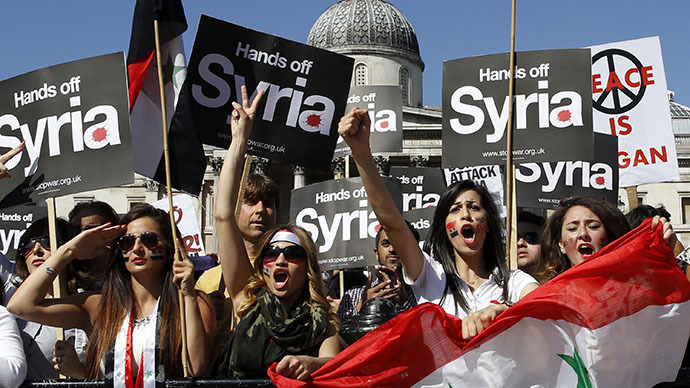

        Thousands gathered in Trafalgar Square in London to take part in the ‘Hands off Syria’ rally, protesting against the US-lead military intervention in the Middle Eastern country.
        faye's chauffeur

        Pashton's girlfriend

        I'm a Pashtun Princes


        Comment


        • #5
          al Nusra Rebels Take Responsibility for Sarin Gas in Syria

          Line Spacing+- AFont Size+- Print This Article


          Dr. Sharon Schuetz view more articles
          31 August 2013 19:55

          Facebook 1635 Twitter 50 1 Google 1 LinkedIn 1
          Related Articles


          The world is breathing a sigh of relief now that Barack Obama decided to go to get Congressional approval before bombing Syria. We all know that the Obama administration refuses to accept the possibility that rebels may be responsible for any of the sarin gas that killed Syrian civilians in March, or the recent attack on August 21st. After a lengthy U.N. investigation into the March incident:
          Carla del Ponte, a member of the U.N. Independent International Commission of Inquiry on Syria, told Swiss TV there were “strong, concrete suspicions but not yet incontrovertible proof,” that rebels seeking to oust Syrian strongman Bashar al-Assad had used the nerve agent.
          But she said her panel had not yet seen any evidence of Syrian government forces using chemical weapons, according to the BBC, but she added that more investigation was needed.
          In May, the Guardian reported that The US and United Nations have cast doubt on by Carla del Ponte’s claims that Syrian rebel forces might have used the nerve agent sarin.
          “We are highly skeptical of any suggestions that the opposition used chemical weapons,” said White House spokesman Jay Carney. “We think it highly likely that Assad regime was responsible, but we have to be sure about the facts before we make any decisions about a response.”
          In July Russia reported it has obtained scientific evidence that indicates Syrian rebels used chemical weapons in a deadly attack in March. According to Moscow’s United Nations envoy Vitaly Churkin:
          Russian experts were let into Syria to examine the site of the attack near Aleppo.
          He says the inquiry has established that the rebels fired a missile containing the nerve agent sarin at the town of Khan al-Assal. The attack killed 26 people including 16 regime troops.
          “The results of the analysis clearly indicate that the ordnance used in Khan al-Assal was not industrially manufactured and was filled with sarin,” Mr Churkin said.
          “The projectile involved is not a standard one for chemical use.”Hexogen, utilized as an opening charge, is not utilized in standard ammunitions. Therefore, there is every reason to believe that it was armed opposition fighters who used the chemical weapons in Khan al-Assal.”
          Obama didn’t accept what Russia had to say either; however in the last couple of days, more info is coming to light about what happened in Syria a few days ago. Dale Gavlak, AP freelance writer and Yahya Ababneh his partner at Mint Press News who directly interviewed the Syrians for this article co-authored this recent report that reveals that the rebels admit that they are responsible for the deaths in Syria. Yahya Ababneh got this information while he was in Syria sitting down with the rebel’s friends and families. Together they wrote in the Mint Press News:
          “From numerous interviews with doctors, Ghouta residents, rebel fighters and their families, a different picture emerges. Many believe that certain rebels received chemical weapons via the Saudi intelligence chief, Prince Bandar bin Sultan, and were responsible for carrying out the deadly gas attack.”
          According to Abu Abdel-Moneim, the father of a rebel fighting to unseat Assad, who lives in Ghouta, “My son came to me two weeks ago asking what I thought the weapons were that he had been asked to carry.”
          Moneim told Yahya Ababneh that his son and 12 other rebels were killed inside of a tunnel used to store weapons provided by a Saudi militant, known as Abu Ayesha, who was leading a fighting battalion. The father described the weapons as having a “tube-like structure” while others were like a “huge gas bottle.”


          Ghouta townspeople said the rebels were using mosques and private houses to sleep while storing their weapons in tunnels.
          Moneim said his son and the others died during the chemical weapons attack….”They didn’t tell us what these arms were or how to use them,” complained a female fighter named ‘K.’ “We didn’t know they were chemical weapons. We never imagined they were chemical weapons.”
          “When Saudi Prince Bandar gives such weapons to people, he must give them to those who know how to handle and use them,” she warned. She, like other Syrians, do not want to use their full names for fear of retribution.
          A well-known rebel leader in Ghouta named ‘J’ agreed. “Jabhat al-Nusra militants do not cooperate with other rebels, except with fighting on the ground. They do not share secret information. They merely used some ordinary rebels to carry and operate this material,” he said.
          “We were very curious about these arms. And unfortunately, some of the fighters handled the weapons improperly and set off the explosions,” ‘J’ said.”
          This article reveals that the sarin gas came from the Saudi government and was stored and used by the rebels who openly admitted it. Are they telling the truth? Who knows? Can this website be trusted? Who knows? Was it a horrible accident that almost became the catalyst for an even greater tragedy? Who knows? Unfortunately, Obama doesn’t want to find out, and that too is a real tragedy.
          Will Barack Obama ever accept the truth if this could be proven? Not likely. Truth doesn’t fit into his plan to replace another Middle Eastern leader with his beloved Muslim Brotherhood. It doesn’t fit his plan to help promote the Muslim Caliphate. It doesn’t fit into his desire to help reduce the United States to Third World status. No. Barack Obama won’t accept the truth because to do so means he would have to do something right for a change, and he just won’t let that happen.


          faye's chauffeur

          Pashton's girlfriend

          I'm a Pashtun Princes


          Comment


          • #6
            faye's chauffeur

            Pashton's girlfriend

            I'm a Pashtun Princes


            Comment


            • #7
              Putin to (Nobel Prize winner) Obama: 'Think about future Syria victims' (FULL VIDEO) - YouTube
              faye's chauffeur

              Pashton's girlfriend

              I'm a Pashtun Princes


              Comment


              • #8
                100% fake. saudis or anybody for that matter wont be dumb enough to put their country name on chemical weapons.

                Comment


                • #9
                  Russia sends spy ship as US prepares for possible Syria strike
                  Priazovye sails from Black Sea naval base as Vladmir Putin says deployment necessary to protect Russian security interest
                  Share 15


                  inShare
                  0
                  Email
                  Reuters in Moscow
                  theguardian.com, Monday 2 September 2013 09.49 BST
                  Vladimir Putin 1/9/13
                  Vladimir Putin said the ship was needed to protect national security interests. Russia has a naval facility in the Syrian port of Tartous. Photograph: Itar-Tass/Barcroft Media
                  Russia is sending a reconnaissance ship to the eastern Mediterranean as the United States prepares for a possible military strike in Syria, it was reported on Monday.

                  The Priazovye left Russia's naval base in the Ukrainian Black Sea port of Sevastopol late on Sunday on a mission "to gather current information in the area of the escalating conflict", the said an unidentified military source quoted by the Interfax news agency. The defence ministry declined immediate comment.

                  Barack Obama said on Saturday he would seek congressional authorisation for punitive military action against Syrian president Bashar al-Assad after what the US says was a sarin gas attack that killed more than 1,400 people.

                  Russia says the US has not proved its case and that it believes the attack was staged by rebels to provoke intervention in the more than two-year-old civil war.

                  Russia is one of Assad's biggest arms suppliers and has a naval maintenance facility in the Syrian port of Tartous. Moscow opposes any military intervention in Syria and has shielded Damascus from pressure at the UN security council.

                  Interfax said the Priazovye would be operating separately from a navy unit permanently stationed in the Mediterranean in a deployment which Russian president Vladimir Putin said is needed to protect national security interests.

                  The defence ministry said last week that new warships would be sent to the Mediterranean to replace others in a long-planned rotation of the ships based there.

                  faye's chauffeur

                  Pashton's girlfriend

                  I'm a Pashtun Princes


                  Comment


                  • #10
                    faye's chauffeur

                    Pashton's girlfriend

                    I'm a Pashtun Princes


                    Comment


                    • #11
                      I hope assad dies in the most horrible fashion. That filthy rafidi giraffe
                      Originally posted by Firdousi
                      Never talk with Afghans about politics. All their political knowledge is limited to conspiracy theories, political demonization and contradictions. No logic, no reason.

                      Comment


                      • #12
                        the evidence against assadists and their alcogolic russian backers.
                        Best evidence yet that Assad carried out 'chemical attack'? - Truthloader - YouTube

                        and this is what they present as evidence against the Free Syrian People.
                        VIDEO EVIDENCE- It was the rebels using chemicals, not Assad! - YouTube

                        Comment


                        • #13
                          psycho


                          his victims
                          Last edited by ډګروال; 09-02-2013, 10:13 AM.

                          Comment


                          • #14
                            did usa find any chemical weapons in iraq? did they find bin laden in afghanistan?
                            faye's chauffeur

                            Pashton's girlfriend

                            I'm a Pashtun Princes


                            Comment


                            • #15
                              ‘I did not join for this’: US military men speak out against Syria strike

                              Published time: September 02, 2013 15:11 Get short URL

                              AFP Photo / Mario Tama


                              Share on tumblr


                              Trends
                              Syria unrest Tags
                              Conflict, Military, Obama, Politics, Syria, USA

                              Many US servicemen are against the looming strike on Syria, Republican Congressman Justin Amash said on Twitter, in an attempt to counter the idea that the country might be overwhelmingly in favor of military action.
                              Amash made his comments after President Barack Obama’s statement, in which he all but promised a strike in retaliation for the supposed use of chemical agents by the Syrian government.
                              The Congressman for Michigan backed up his comments with a multitude of retweets from servicemen.
                              Amash said he had been “hearing a lot from members of our Armed Forces" and said that "the message I consistently hear [is]: Please vote no on military action against Syria."
                              The US Congress is expected to debate and vote on military action soon after it returns from summer recess on September 9.
                              Amash has since been re-tweeting anti-intervention comments sent by members and veterans of the US armed forces. Many cite experiences of Iraq and Afghanistan that have steered them in this direction. Here is a selection of some of those tweets:
                              @repjustinamash 13 year USAF vet here...thanks for actually appreciating our constitution! Vote no to actions in Syria! #constitution
                              — Mr. King (@derekking1980) August 31, 2013
                              Likewise, a number of pictures have been appearing on the Internet, purportedly showing US army and navy service personnel’s discontent at the proposed military intervention in Syria.


                              Image from facebook.com

                              A Syrian pro-government hacker group calling itself the Syrian Electronic Army (SEA) posted the above picture on the US Marines’ website as an example that not all US soldiers are on board with Obama.
                              According to the International Business Times, the SEA went onto the marines’ official website, www.marines.com, and ended up defacing it temporarily to post an emotional message of peace to their “brothers-in-arms” and pleading with them to understand that by agreeing to carry out the strike they are fighting against friendlies and helping their own worst enemy, Al-Qaeda.


                              A screenshot from marines.com


                              Many US servicemen are against the looming strike on Syria, Republican Congressman Justin Amash said on Twitter, in an attempt to counter the idea that the country might be overwhelmingly in favor of military action.
                              faye's chauffeur

                              Pashton's girlfriend

                              I'm a Pashtun Princes


                              Comment

                              Working...
                              X
