Announcement

Collapse
No announcement yet.

Burmese army bombs Buddhist temple

Collapse
X
 
  • Filter
  • Time
  • Show
Clear All
new posts

  • #16
    Over 70 Rohingya homes torched

    Anti-Muslim riots hit Myanmar


    Wednesday, October 02, 2013


    YANGON: President Thein Sein toured Myanmar’s conflict-torn west on Tuesday as anti-Muslim violence once again gripped the state of Rakhine, with Buddhist mobs killing a 94-year-old Muslim woman and torching more than 70 homes, officials and panicked residents said.

    With attacks reported in at least two other villages on the outskirts of Thandwe, where tensions have been mounting for days, the number of causalities could rise.

    More than 700 rioters, some swinging swords, took to the streets in Thabyuchaing, about 20 kilometres north of the coastal town, on Tuesday afternoon, said police officer Kyaw Naing.

    An elderly Muslim woman died from stab wounds in the clashes that followed, the officer said, putting the number of houses set on fire at between 70 and 80.

    Smoldering buildings — and several injured Buddhist Rakhines — were seen by The Associated Press in Shwe Hlay. And a police officer, speaking on condition of anonymity because he did not have authority to speak to the media, said Linthi also was hit by rioters.

    Both villages are about 17 kilometres from Thandwe. The visit by Thein Sein to the divided region was his first since sectarian violence broke out more than a year ago.

    He arrived in the Rakhine state capital of Sittwe under tight security early on Tuesday and was scheduled to travel to several more towns, including Maungdaw to the north and, on Wednesday, Thandwe to the south, said a senior official in the president’s office, declining to be identified because he was not authorised to speak about the sensitive trip.

    He said Thein Sein “is going there to help find a long-term solution to the problem” and would meet with government officials and residents.

    A heavy security presence failed to deter the attackers, however, with witnesses saying soldiers and police made no efforts to step in. A 6pm curfew was imposed.

    Sectarian clashes that began in Rakhine in June 2012 have since morphed into an anti-Muslim campaign that has spread to towns and villages nationwide. So far, more than 240 people have been killed and more than 140,000 have fled their homes, the vast majority of them Muslims.

    Thein Sein, who has been praised for making moves to transition from half a century of military rule, has been criticised for failing to contain the unrest and protect the country’s embattled Muslim minority.

    Many of those targeted so far have been ethnic Rohingyas, considered by many in the country to be illegal migrants from Bangladesh, though many of their families arrived generations ago.

    But in the latest flare-up, the victims were Kamans, another Muslim minority group, whose citizenship is recognised.

    The trouble started on Saturday, when a Buddhist taxi driver alleged he’d been verbally abused by a Muslim shop owner while trying to park his vehicle.

    Hours later, rocks were thrown at the man’s home. And by Sunday, as anger spread, two houses owned by Muslims were burned to the ground.

    The violence has proven to be a major challenge for Thein Sein’s government, which rights groups say has done little to crack down on religious intolerance and failed to bridge a divide that has left hundreds of thousands of Muslims marginalised, many of them trapped in prison-like camps for those who have been displaced.


    Military ruler, Thein Sein, who now wears civilian clothes. His regime has been widely criticized for its policies of genocide against Rohingya Muslims.


    Initially confined to Rakhine state, sectarian attacks have spread this year into Myanmar’s heartland, ravaging several other cities across the country. At the same time, a Buddhist-led campaign called “969” has taken root nationwide; its supporters urge Buddhists to shop only at Buddhist stores and avoid marrying, hiring or selling their homes or land to Muslims.

    While radical monks have helped fuel the crisis, saying Muslims pose a threat to Buddhist culture and traditions, critics say a failure by the government and society as a whole to speak out is helping perpetuate the violence.

    “Political, religious and community leaders need to condemn hate speech,” Jim Della-Giacoma of the International Crisis Group said in a statement.

    “Those who are spreading messages of intolerance and hatred must not go unchallenged. Otherwise, this issue could come to define the new Myanmar, tarnishing its international image and threatening the success of its transition away from decades of authoritarianism,” he said.

    Muslims, who account for about 4 per cent of Myanmar’s roughly 60 million people, have been the main victims of the violence since it began. But most criminal trials have involved prosecutions of Muslims rather than members of the Buddhist majority.

    Over 70 Rohingya homes torched - thenews.com.pk


    Rohingyas are being murdered and treated like animals in Burma.

    The Muslim world is silent. Indonesia, Turkey, GCC and others must do something or they will be accountable to Allah on the day of judgement.
    * * * * * * * * * * * * * * * * * * * * * * *

    Comment


    • #17
      After Hotel Blast, Western Governments Caution Travelers to Burma

      U.K. Foreign Office warns of “a high threat of terrorism”

      By Per Liljas Oct. 16, 2013Add a Comment


      Burmese soldiers look at the Traders Hotel in Yangon on October 14, 2013 after a blast.


      After a series of explosions in Burma, the latest injuring an American woman at an upscale hotel in Rangoon on Monday night, the United States, France, U.K., and Australia have warned travelers to exercise extreme caution when visiting the country.

      Observers said that the minor explosions were probably meant to cause fear rather than mass casualties, but the British Foreign Office advised that there is “a high threat of terrorism.”

      No one has claimed responsibility for the attacks, but it is believed that they could be aimed at discrediting reform efforts undertaken by the former junta-turned-civilian government.


      Read more: After Hotel Blast, Western Governments Caution Travelers to Burma | TIME.com
      * * * * * * * * * * * * * * * * * * * * * * *

      Comment


      • #18
        The explosion at Traders Hotel, one of the ritziest in the country also known as Myanmar, was the most high-profile in a series of low-intensity bombings that the government alleges is an attempt to tarnish the image of the budding democracy as it emerges from decades of oppressive military rule.

        Officials said the attacks appear to be organized, with a restaurant, two bus stops, Buddhist temples and a market all targeted within the last week. No one has claimed responsibility.

        The homemade time bomb that went off just before midnight Monday at the Traders Hotel was hidden in the bathroom in an American family's room on the ninth floor. There was no indication they had been targeted.

        Hours later, a small bomb went off in Saggaing near Mandalay in the restaurant of a hotel frequented by tourists. It's not clear what role Saw Myint Lwin is alleged to have played.
        Suspect in Burma hotel blast captured on CCTV)


        * Burma is one of the most geo-strategic countries in the world. China needs to pass its ships through the straits of Malacca to transport vital supplies such as oil and other items.

        This is a long route, if it can go through Burma directly to the Indian Ocean it bypasses this route.

        It would be in US interests to stop this from happening.

        [MENTION=3580]asad71[/MENTION]
        * * * * * * * * * * * * * * * * * * * * * * *

        Comment


        • #19
          Burmese army recruits female soldiers as it struggles to tackle rebel groups


          Poor human rights record of Burmese 'Tatmadaw' armed forces gives rise to concerns that women recruits will be abused

          Kate Hodal in Bangkok

          The Guardian, Wednesday 16 October 2013 15.59 BST

          Burma military recruits female soldiers


          Burmese rebels from the All Burma Students Democratic Front North, near Laiza, Kachin state, Burma in 2012. The Burma army is recruiting female soliders to help tackle ethnic rebels


          If you're a single female between the ages of 25 and 30, 1.6 metres (5ft 3in) or taller and weighing less than 59kg (130lbs), then the Tatmadaw – Burma's military – may be looking for you.

          Once limited to working only as nurses in the military, Burmese women are now being actively recruited by the country's ministry of defence, according to an advert in the state-run Myanmar Ahlin newspaper, which stresses that successful candidates will be spared from serving on frontlines and instead be offered posts as second lieutenants.

          A reviled entity now synonymous with human rights abuses and military coups, the Burmese army was once well respected for leading the country to independence from British colonial rule. Nobel laureate Aung San Suu Kyi's father, Aung San, was himself a general and is revered as the heroic "true father" of Burma.

          Today the Burmese army is believed to be one of the largest in the region and manages a budget of $2.4bn, or 12% of total government spending – roughly four times what the country spends on health care, according to official figures.

          Reformist president Thein Sein has made it an apparent priority to sign ceasefires with the country's many rebel ethnic groups, but has struggled to make any headway in the Kachin ethnic area, where a 17-year ceasefire broke down in 2011 and where fierce fighting, including the military's use of fighter jets, took place earlier this year.

          This is the first time that women have been offered such posts with the Tatmadaw, but a military draft adopted in 2011 – when Burma officially moved to quasi-civilian leadership after nearly 50 years of military rule – allows for women between 18 and 27 to be drafted in times of national emergency.

          Women have sometimes been press-ganged to work as porters, says Phil Robertson of Human Rights Watch, who warns that, given the army's abysmal rights record, the new recruits could find themselves sexually abused or harassed.

          "Because there has been a culture of this army physically and sexually abusing women in the field as part of operations, where both rank and file soldiers have been involved in rape and other forms of sexual abuse against women – such as seizing women to porter goods and then raping them at night – then I would wonder … whether senior officers would view these women professionally or try to take advantage of them," Robertson told the Guardian.

          "I think a woman would have to be quite brave to be among the first batch of recruits."


          Burmese army recruits female soldiers as it struggles to tackle rebel groups | World news | The Guardian


          1. The Burmese army are getting kicked by the Kachins (KIA) in the north, who are just one of several major rebel groups.

          2. Due to just one of the rebel groups giving them serious trouble they are now having to call upon women, after having used boys as soldiers.

          3. If the other rebel groups start fighting, and even unite the Burmese army is finished.

          Let alone Islamic volunteers coming in to help the Rohingyas.


          Boy soldiers in Burma.


          Burmese regime now wants to use female soldiers for the army.

          * * * * * * * * * * * * * * * * * * * * * * *

          Comment


          • #20
            After Persecution, Mynamar’s Rohingya Face Erasure

            By Marwaan Macan-Markar on 2:44 pm October 11, 2013.


            Bangkok. An exiled leader of the Rohingyas, a persecuted Muslim minority in Myanmar, is raising the alarm from his London office about the fate of his community. He fears “ethnocide to remove all references to the Rohingyas” if the first census in 30 years goes ahead in the Southeast Asian nation.

            Nurul Islam, president of the Arakan Rohingya National Organisation (ARNO), tells IPS in an interview that he is targeting the United Nations and European governments in the campaign. “We want to put pressure on the Myanmar government to count the Rohingyas in the census, revealing the actual figures of their population.”

            Similar concerns about this stateless ethnic group living along Myanmar’s western border have been expressed by Human Rights Watch (HRW).

            The 12-day census to be held by the end of March next year is expected to cost 58.5 million dollars, immigration and population minister Khin Yi confirmed during a mid-September media briefing in Naypidaw, the administrative capital. The Myanmar government has agreed to commit 15 million dollars, while U.N. assistance is expected to cover five million dollars.

            Western governments are expected to fill in the rest, including 16 million dollars from Britain and 2.8 million dollars from Australia. There have been further pledges by Norway and Switzerland.

            The concerns dogging the 2014 census arise from a slew of discriminatory policies targeting the Rohingyas for decades. Some, such as forced labour, are human rights violations faced by other minorities.

            Others have been unique to the Rohingyas – many are denied proper healthcare and schooling, are prevented from moving out of their villages, and are even stopped from marrying because they are not given approval by local authorities. Local leaders say tens of thousands of Rohingya babies have not been registered.

            They are not officially identified as one of the country’s 135 recognised ethnic groups. The last headcount in 1983 put the national population at 35.4 million, while the registered population during the previous census in 1973 was 28.9 million. These two censuses, held when the country was under the grip of an oppressive military regime, did not recognize the Rohingyas as part of the population.

            Official statements and the local media often refer to the estimated 800,000 Rohingyas as “Bengalis.” By implication the community are considered “outsiders” from neighboring Bangladesh.

            “The term ‘Bengali’ has the connotation of being a foreigner,” says Chris Lewa, head of the Arakan Project, an independent research organization chronicling the plight of the Rohingyas. “Institutionalizing the term ‘Bengali’ is therefore far-reaching beyond simply a rejection of the term ‘Rohingya’ and it is a denial of their rights as Myanmar nationals.”

            “The census will not affect the Rohingyas’ citizenship status,” Janet Jackson, head of the UN Population Fund (UNFPA) Myanmar office, told IPS in an interview. “The controversy around this issue must not be allowed to hamper a complete count of the population, and the conduct of the census should not aggravate tensions around the issue.”

            UNFPA has received assurances from the government to conduct the census “in line with international census standards, [where] every person will be counted, regardless of citizenship or ethnicity.” Jackson expects the population profile for a country that has an estimated 60 million people to embrace “inclusiveness.”

            Such words jar with the reality on the ground since sectarian violence erupted last year between the ethnic Buddhist Arakanese in predominantly Buddhist Myanmar and the Rohingyas.

            Attacks on the Rohingyas in June this year and October last year, which killed nearly 200 people and left 140,000 displaced, earned the Rohingyas some sympathy. HRW described them as victims of “ethnic cleansing” in a report released in April this year.

            That grim assessment has worsened. The Toronto-based Sentinel Project for Genocide Prevention describes Myanmar as “a textbook case” for a country on the brink of genocide. “The machinery of genocide – the complex systematic process designed to eliminate the Rohingyas – is already operating in Burma [as Myanmar was formerly known] and has carried ethnic cleansing and isolation to its current point.

            “Mounting evidence supports allegations that genocide in Burma is currently going on, and may merely be a matter of scale,” revealed the report ‘High Risk of Genocide in Burma’ released by the group in early September. Among the “key indicators of genocidal intent” is the “forced registration of Rohingyas under a ‘foreign’ ethnic identity, thus attempting to provide documentary denial of the existence of the group.”

            After Persecution, Mynamar's Rohingya Face Erasure - The Jakarta Globe
            * * * * * * * * * * * * * * * * * * * * * * *

            Comment


            • #21
              Hundreds of Rohingyas flee from Pauktaw township


              FRIDAY, 15 NOVEMBER 2013 15:43 KALADAN PRESS NEWS - KALADAN PRESS

              Boats carrying Rohingyas fleeing recent violence in Pauktaw township in Arakan state landed in Bangladesh on Nov. 12. Hussain, one of the passengers, told Kaladan Press Network by telephone, three boats carrying a total of 200 people left Pauktaw on Nov. 10 arriving in the evening at several locations in Cox Bazaar District.

              One of the boats carrying 60 people landed near Enani village. Another was reportedly on route to Mosh Khali Island, but stopped in the Dal Ghata area. The third one, which Hussain was on, arrived near Shamlapur area carrying 100 people; 25 women and 30 children were on board. Some of the 200 people were immediately arrested by Bangladesh police, but most managed to hide in nearby villages. In Bangladesh their future is uncertain, at any time they could be picked up by police.


              The already volatile situation in Arakan state for Muslims has worsened following recent violence resulting in the deaths of three Rohingyas and one Rakhine women in early November. One Rohingya man was murdered by Rakhine villagers when collecting firewood in the forest. Another two were killed and four wounded after riot police opened fire during clashes. In what appeared to be a revenge attack carried out by several Rohingya men a Rakhine woman was murdered and another injured in the following days.

              In Pauktaw township the situation remains tense with many of the remaining Rohingya villagers being forced into an internally displaced persons (IDPs) camp allegedly for their own security by army and police. Many are afraid because the camp funded by an international aid group is very close to a village with only Buddhist Rakhines.

              As a result of ongoing discrimination at the hands of state security and Rakhine extremists that has escalated after widespread violence broke out over a year ago many Rohingyas see no way out but to board rickety boats for Bangladesh, or make the perilous journey to Malaysia. Many have already drowned trying when their boats capsized.

              A passenger named Du Du Mea told Kaladan Press Network two more boats will soon leave for Bangladesh.

              Hundreds of Rohingyas flee from Pauktaw township


              The Bamar military will never cleanse Arakan of Muslims. Their ethnic cleansing will not succeed.
              * * * * * * * * * * * * * * * * * * * * * * *

              Comment


              • #22
                Burma army soldier accused of raping 7-year-old Kachin girl

                Thursday, 14 November 2013 18:40 Written by Kachin News Group


                Burma Army soldiers in Myitkyina the capital of Kachin state, northern Burma.


                A Burma army soldier based in Shan state has been accused of raping a 7-year-old Kachin girl. Family members of the alleged victim say the incident took place in the girl's home in Muse township on November 11. The alleged perpetrator is a man named Ko Win Htwe from the Theinni (or Hsenwi)-based Light Infantry Battalion No. 323, the young girls' relatives tell the Kachin News Group.

                On the day of the incident in question the girl was left at home alone to look after to her younger sister as her mother worked in a nearby paddy field. Shortly after the rape is alleged to have occurred the girl alerted a neighbor that something had happened.

                Shadan Ja Len, a neighbor of the alleged victim told the Kachin News Group that when the solder first came to the house he asked the girl if she was a girl or a boy. After the victim responded she was a girl, the solider struck the girl and brought her into the home, Shadan Ja Len said.

                “My home is not far from the child's but I didn’t hear the child crying. She ran to my home with her younger sister crying. She said a stranger came to our home and intimidated me", Shadan Ja Len told the Kachin News Group. According to Shadan Ja Len the girl also said that the solder threatened to kill her mother.

                When Shadan Ja Len and another women Daw Win Kyi went to the house the soldier told them that he was there to inquire about food. When the girl's mother came back for lunch the girl recounted what happened. The victim was then taken to hospital and treated for injuries she sustained to her genitals during the incident.

                Several hours after the incident took place a group of villagers detained Ko Win Htwe while he was leaving the area. He was then handed over to local military authorities. Ko Win Htwe's current whereabouts are unknown.

                Human rights groups allege that dozens of Kachin women have been raped by Burma army soldiers since the conflict began in June 2011.

                Burma army soldier accused of raping 7-year-old Kachin girl - Kachin News Group


                *The Kachins are a mainly Christian ethnic group who like the majority Bamars are Mongoloid unlike the Indic Rohingya Muslims.

                The Kachins are fighting for independence/autonomy against the brutal Burmese (Bamar) military.
                * * * * * * * * * * * * * * * * * * * * * * *

                Comment


                • #23
                  OIC Chief Meets Myanmar Muslims: 'I Was Crying'


                  YANGON, Myanmar November 17, 2013 (AP)
                  By ROBIN McDOWELL

                  The secretary general of the world's largest bloc of Islamic countries said emotional visits with members of the long-persecuted Rohingya Muslim community — chased from their homes in Myanmar by Buddhist mobs and arsonists — brought him to tears.

                  "I've never had such a feeling," Ekmeleddin Ihsanoglu said late Saturday, as he and other delegates from the Organization of Islamic Cooperation wrapped up a three-day tour to Myanmar that included talks with the president, government ministers, interfaith groups and U.N. agencies.

                  But he said it was the huge, emotional crowds living in trash-strewn camps outside the Rakhine state capital, Sittwe, that made the biggest impression.

                  "I was crying," Ihsanoglu said.

                  Myanmar, a predominantly Buddhist nation of 60 million, emerged from a half-century of military rule in 2011, but its transition to democracy has been marred by sectarian violence that has left more than 240 people dead and sent another 240,000 fleeing their homes.

                  Most of the victims have been Rohingya. Though many of their families arrived generations ago, all have been denied citizenship by the government.

                  Many children in displacement camps have not gone to school for more than a year. Those who wish to leave — for medical treatment or otherwise — have to pay hefty bribes. Humanitarian aid workers face constant threats by Buddhist Rakhine, who accuse them of being biased in favor of Rohingya.

                  Ihsanoglu said that while visiting the Sittwe camps, he and other members of the IOC delegation were met by crowds of 5,000, but due to the language barrier, they were unable to communicate.

                  "They were desperate. They were afraid. They were happy we were there, but it was a happiness expressed in crying," he said, adding that he was eventually able to offer the Islamic greeting, "Assalam Alaikum," or "May God grant protection and security," and the crowd responded in kind.

                  "I can't explain the feeling I had," he said. "It was very moving."

                  The OIC visit to Myanmar was marred by frequent demonstrations, with thousands turning out to meet the delegates when they landed in Yangon and then Sittwe, some carrying banners that said "OIC get out" or chanting "Stop interfering in our internal affairs."

                  Still, Ihsanoglu called it a success — mostly because it came at the invitation of a government that has largely remained silent about the repeated attacks on minority Muslims.

                  He said he received assurances that the government was seeking to resolve issues of citizenship for its 800,000 Rohingya, but gave no details.

                  "If this issue is not solved, it will be a big problem," he said.

                  Rohingya, excluded from Myanmar's 135 recognized ethnic groups, have for decades endured systematic discriminatory and exclusionary policies, restricting movement, access to education and jobs.

                  Opposition leader Aung San Suu Kyi — who has said little in defense of the religious minority — declined to meet with the OIC delegation.


                  The controversial Aung San Suu Kyi who has recieved international condemnation for her anti-Muslim attitude.

                  She has also been accused by Burmese minorities of being an ethnic Bamar supremacist.


                  Ihsanoglu, head of Muslim world's biggest body, was in tears.
                  * * * * * * * * * * * * * * * * * * * * * * *

                  Comment


                  • #24
                    OIC Delegation Met By Angry Protesters in Sittwe


                    By LAWI WENG / THE IRRAWADDY| Friday, November 15, 2013 |


                    RANGOON — A high-level delegation from the Organization of Islamic Cooperation (OIC) was greeted by an estimated 3,000 protestors Friday, when the group that includes foreign ministers from Islamic countries arrived in western Burma’s troubled Arakan State.

                    A group from the 57-member OIC arrived in Burma on Wednesday to meet with officials and investigate the situation of Rohingya Muslims, who make up the majority of the estimated 140,000 people displaced by two waves of violence in Arakan State last year. At least 192 people were killed in inter-communal violence between Arakanese Buddhists and Rohingya, who the government of Burma does not recognize as citizens.

                    Buddhists have staged demonstrations across the country this week accusing the OIC of trying to interfere in Burmese affairs.

                    On Friday, the delegation landed at about noon at Sittwe Airport, where angry demonstrators held aloft banners saying “Get Out OIC,” and “We Don’t Want OIC.”

                    “Our people arrived here at 7 am. We have over 3,000 people,” Tun Hlaing, an organizer of the protest, told The Irrawaddy. “We all shouted to them that we do not want them to come here.”

                    The Burmese government has approved the visit and reportedly guaranteed the security of delegates, who include OIC Secretary-general Ekmeleddin Ihsanoglu, Turkish Foreign Minister Ahmet Davutoglu and Malaysian, Saudi Arabian, Egyptian, Djiboutian and Bangladeshi officials.

                    Tun Hlaing said the group did not leave the airport, but was taken by Burmese military helicopters to parts of Arakan State where the population is majority Rohingya.

                    “They stayed about 15 minutes and then flew to Maungdaw and Buthitaung,” he said. “We did not get permission to meet them, but we could see them from the distance, and they could even see us shouting at them.”

                    Arakanese Buddhists also held smaller protests Maungdaw and Buthitaung, as well as other townships in Arakan State like Toungup and Mrauk-U.

                    About 1,000 people in Rangoon, mostly Buddhist monks, also marched from Shwedagon Pagoda to Sule Pagoda to demonstrate once again against the OIC visit on Friday. An additional protest was planned at Rangoon International Airport on Saturday to see off the OIC delegation.

                    Tun Kyi, a protester in Toungup Township, said it was his duty to oppose the OIC visit. “We are worried that they [the Rohingya] will get more support from the OIC and they will create more problems for our people,” he said.

                    Tun Kyi claimed the conflict between Buddhists and Muslims in Arakan State is stirred up by international involvement.

                    Arakanese Buddhists in Maungdaw protested when the delegation landed in the town at about 1 pm, one protester said. “It is very simple: If we have to say why we protest, it’s because we do not want them to come,” said the female protester.

                    Protests against the visit of an OIC delegation were also held in Meiktila, Mandalay Division, and Lashio, northern Shan State, on Thursday. Both towns have seen violence targeting Muslim communities since last year.

                    Rights groups have accused Burma’s authorities of allowing, or even facilitating, violence against Muslims. Authorities have granted permission or allowed all of the anti-OIC protests to take place, in contrast to protest for land rights in Burma, for instance, for which permission is notoriously difficult to obtain.

                    Tun Hlaing, the protest organizer in Sittwe, said he had no trouble getting the demonstration approved after applying on Monday. Regulations, which are usually strictly applied when it comes to most protests, demand that permission is sought a week ahead of a demonstration.

                    Many activists fighting for other causes have found themselves sentenced to three months in prison after going ahead with a protest when permission was not forthcoming in time.

                    Although an attempt to visit Burma earlier this year by the OIC was rebuffed, the central government has openly supported the current trip.

                    According to the state-owned New Light of Myanmar, the delegation met with Burma’s Vice President Sai Mauk Kham on Thursday evening in Naypyidaw. The newspaper reported they discussed peace and stability in Arakan State, and rehabilitation efforts in the region.

                    OIC Delegation Met By Angry Protesters in Sittwe | The Irrawaddy Magazine


                    Davutoglu in Burmese-occupied Arakan last year.


                    Turkey has been one of the biggest friends of the oppressed Rohingyas.


                    Turkey has a powerful navy and under a future BNP (current opposition party in Bangladesh) government in Dhaka it is possible that the Turkish navy would be granted rights to use Bangladeshi naval bases to monitor the Rohingya crisis.


                    [MENTION=3580]asad71[/MENTION]
                    * * * * * * * * * * * * * * * * * * * * * * *

                    Comment


                    • #25
                      Aung San Suu Kyi is turning a blind eye to human rights in the name of politics


                      The Burmese politician's visit to Australia will spark praise from politicians – an unhelpful distraction from the extremely serious abuses taking place against Muslims in her homeland

                      Emanuel Stoakes
                      theguardian.com, Tuesday 26 November 2013 22.10 GMT


                      Burmese politician and international celebrity Aung San Suu Kyi flew into Sydney yesterday to begin a brief tour of Australia, during which time she will meet the prime minister and other members of the government.

                      If her recent visits to Europe are anything to go by, the Nobel laureate’s arrival will be a triumphal affair involving inevitable cheering crowds, mutual congratulation and much rhetoric about shared values on display. Politicians will no doubt wish to associate themselves with her image and bask in her fading effulgence, while ordinary Australians will very probably receive the heroine of Burma’s democracy movement with open arms.

                      Yet for all the deserved plaudits she will receive from her hosts, the sheer spectacle of her visit may amount to an unhelpful distraction from extremely serious abuses taking place in her homeland; indeed it may even seem unwarranted, given that the smiling icon has betrayed some of her country’s most vulnerable people.

                      The Rohingya of west Burma are the most needy, despised and endangered ethnic group in the country. The Muslim minority is stateless (unwanted by both Burma and Bangladesh), impoverished and has been subjected to at least three brutal pogroms over the past 40 years, two of them directly at the hands of Burmese government forces. The latest bout of extreme anti-Rohingya persecution in the country’s restive Rakhine state, where the group is remains subjected to ethnic cleansing, endures to this day.

                      When asked about the plight of Muslims during her recent visit to the UK, Suu Kyi told BBC journalist Mishal Husain that there was "no ethnic cleansing” and equivocated about the suffering of both Buddhists and Muslims in a manner that at least one other writer found “chilling” to watch.

                      For the record, there is no parity. Muslims in general, and the Rohingya in particular, have suffered far more from inter-religious clashes over the past two years, during which time children in Meiktila, Central Burma, were burnt alive and well over 100,000 Rohingya have been confined to squalid camps where they are systematically denied aid and where disease is rife. There have been organised attacks on the minority that amounted to crimes against humanity committed by ethnic Rakhine Buddhists, whom Suu Kyi is keen to remind us are suffering too – from fear, not mass slaughter.

                      I have visited the Rohingya IDP camps twice this year, and been informed about a variety of abuses perpetrated against the inmates by police and government forces since June last year, including rape and murder. Human rights reports confirm these allegations. Conditions in parts of the camps, as well as the emotional torment endured by its inhabitants, were wrenching to witness.

                      The Rohingya are edging closer to a final disaster that could amount, in the eyes of several authoritative analysts, to genocide. Yet “mother Suu” remains virtually silent, no doubt in part because the recognition of this people’s plight would amount to political suicide in a country where racial prejudices run deep. The Rakhines have demonstrated their position on the Rohingya with total clarity: through mob attacks and arson; their hatred of the Rohingya has been evident for decades.

                      If her failure on the Rohingya issue isn’t bad enough, Suu Kyi has also neglected to defend poor Burmese farmers in Sagaing Division in the wake of a violent, government-backed crackdown on protests at the Letpadaung Copper mine there last year, in which campaigning monks were allegedly burnt in their sleep by police. Having headed an official panel which produced a report recommending that the project should go ahead, she lectured protesters on the folly of their resistance against the multi-billion-dollar, Chinese-backed project which will result in a loss of livelihood, displacement and serious water pollution for local people. The panel also effectively endorsed police impunity, despite the use of white phosphorous against peaceful protesters.

                      By contrast, Suu Kyi has been outspoken on the need to change the national constitution, which was authored by the old military elite, and widely-regarded as having been designed to prevent her from occupying the office of president. She will be sure to ask for Australia’s support in pressuring Burma to change the charter.

                      It seems impossible to resist the impression that “the Lady” is a paragon no more – and certainly no human rights defender, as she herself reminded journalists recently. Rather, she has begun to act like any other politician: single-mindedly pursuing an agenda, making expedient decisions with one eye on electoral politics, the other on kingmakers in Naypyidaw and the domestic political economy.

                      Australians welcoming her today would do well to remember this, even as media celebration reigns and the lonely, deserted Rohingya stumble toward their collective grave.

                      Aung San Suu Kyi is turning a blind eye to human rights in the name of politics | Emanuel Stoakes | Comment is free | theguardian.com


                      Aung San Suu Kyi is from the Bamar ethnic group that control Burma. She is a Bamar racial supremacist and like other Bamars is racist and anti-Muslim. She has long been praised in the west as some sort of angelic figure representing freedom. She is far from that, but a fascist.
                      * * * * * * * * * * * * * * * * * * * * * * *

                      Comment


                      • #26
                        Myanmar rejects UN Rohingya citizenship appeal
                        Written by
                        AFP


                        Displaced Rohingyas in Rakhine State.


                        Myanmar said Thursday it will not grant citizenship to Muslims identifying themselves as Rohingya, despite renewed pressure by the United Nations which describes the stateless minority as among the world's most persecuted.

                        Hundreds of thousands of Rohingya are estimated to live in Myanmar, mostly in western Rakhine state, which has been rocked by several bouts of deadly sectarian violence.

                        Myanmar views the Rohingya in Rakhine as illegal Bangladeshi immigrants and denies them citizenship.

                        A resolution Tuesday at the United Nations called on Myanmar's government to give the Rohingya full access to citizenship and to end violence against them.

                        But a presidential spokesman said Myanmar would not be pressured into changing its stance over the citizenship issue.

                        "We cannot give citizenship rights to those who are not in accord with the law, whatever the pressure. That is our sovereign right," Ye Htut said in a post on his Facebook page, which he often uses to issue official remarks.

                        Violence in Rakhine State, which last year killed scores and displaced 140,000 people -- mainly Rohingya -- has prompted international concern and condemnation of the government's handling of the minority. Many in Buddhist-majority Myanmar view the Rohingya with hostility, referring to them as "Bengalis" -- an often pejorative term.

                        Ye Htut said the government "totally" refutes the use of word Rohingya adding that only "Bengalis in Rakhine State who are in accord with 1982 citizenship law will get citizenship".


                        That law stipulates that minorities must prove they lived in Myanmar prior to 1823 to obtain nationality -- effectively denying the Rohingya the right to citizenship.

                        A population census -- the first in three decades -- slated for next year does not provide a box for "Rohingya", the Department of Immigration has said.

                        Rejection of the Rohingya extends outside Rakhine and even includes key figures in Myanmar's democratic movement, long courted by the international community.

                        "The Rohingya do not exist under Myanmar's law," said Nyan Win, a spokesman for the National League for Democracy party of Nobel laureate Aung San Suu Kyi, adding he was in "agreement" with the presidential spokesman on the point.

                        Unrest in Rakhine -- and the deprivations that have followed -- have prompted thousands of Muslims to flee Myanmar in rickety and overcrowded boats trying to reach Malaysia and further afield.


                        But scores have died or gone missing in choppy seas.

                        Anti-Muslim sentiment has been fuelled by radical Buddhist monks who see the presence of a Muslim population as a threat.

                        Violence against Muslims spread beyond Rakhine this year, with several other outbreaks of religious conflict that have overshadowed the nation's widely-praised reform drive.

                        Myanmar rejects UN Rohingya citizenship appeal


                        I personally believe that the only solution to the Rohingya crisis is a military one.

                        1. Bangladesh is currently ruled by the pro-Indian traitor Hasina Wajed, who insha'Allah will be out of office soon.

                        Most secularists - who are very powerful in Bangladesh's urban elite - are anti-Rohingya.

                        2. When BNP leader, Khaleda Zia comes in to power, she should work with Turkey and Indonesia to help Rohingya resistance groups expel the Burmese military from northern Arakan.

                        The Burmese military is not a very good one and virtually every ethnic group in Burma now has its own mini-statelet, with their own armies, TV stations, school systems. Only the Rohingyas do not have this.

                        If Khaleda Zia does not do this, then she too is a traitor just like Hasina.


                        Rohingyas with Turkey's foreign minister.


                        Khaleda Zia, most likely to become Bangladeshi prime minister once current prime minister Hasina goes.
                        Last edited by Bengal_Tiger; 02-15-2014, 11:28 AM.
                        * * * * * * * * * * * * * * * * * * * * * * *

                        Comment


                        • #27
                          2 KIA killed fighting in Southern Kachin state

                          Monday, 25 November 2013 20:58 Written by Kachin News Group


                          KIA troops in Kachin state, northern Burma.


                          An officer from the Kachin Independence Army and his subordinate were shot and killed by government troops near the Nam Lim Pa refugee camp in southern Kachin state on November 23, according to KIA colleagues. The incident occurred whilst KIA forces in the area are under orders not to strike at government forces.

                          Reached for comment the head of KIA Battalion 12 Major Labang Jawn Awng confirmed during a phone interview that two men from his battalion, Captain Hpaude Hkang Maw and Palai Naw Lai, were killed during the incident.

                          “Government forces ambushed us on a road. We mistakenly entered an area that was surrounded by them,” said Major Labang Jawn Awng, whose battalion is under the KIA third brigade.

                          The ambush which occurred in the morning triggered heavy fighting that lasted nearly the whole day as the KIA unit successfully fought its way out of the area, according to Jawn Awng. Another KIA soldier sustained a head injury during the fighting Jawn Awng said.

                          It is unknown how many government troops were killed or injured during the fighting.

                          On the same day of the incident, government reinforcements arrived in nearby U Lang Pa, according to KIA officers stationed at the frontline. The reinforcements appear to have come from a base at Kai Htik.

                          On November 19 KIA battalion 12 was ordered by senior commanders at the group’s Laiza headquarters not to attack government troops who captured Nam Lim Pa refugee camp, according to Commander Jawn Awng.

                          Government forces seized the refugee camp shortly after a catholic church operated aid convoy reached the camp. The army's takeover of the camps was made possible because the army deliberately took advantage of the fact that the KIA wouldn't shoot near a humanitarian convoy, according to Commander Jawn Awng.

                          The army troops who seized the camp are under the control of the Bhamo (or Manmaw) based Military Operation Command-21 (MOC-21). Despite orders that the KIA not attack government forces fighting broke out anyways because government forces continued their offensive against the KIA, said Jawn Awng.

                          According to Jawn Awng, the KIA lost 10 soldiers with an additional 10 injured in southern Kachin state over the past two months. He estimated that government casualties were likely significantly higher.

                          2 KIA killed fighting in Southern Kachin state - Kachin News Group

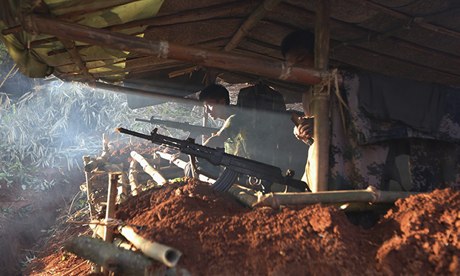
                          The following is a Kachin video from 2 months ago, showing Kachin army fighters taking on the Bamar ("Burmese") army.

                          kachin war - YouTube

                          12.08 it shows Kachin soldiers with missile launchers.


                          13.58=14.04 wounded Kachin soldier being carried by his comrades.


                          Kachin soldier.
                          * * * * * * * * * * * * * * * * * * * * * * *

                          Comment


                          • #28
                            Burma Army Attacks Continue in Kachin State

                            February 12, 2014 • Author: Karen News • Posted in Articles


                            Villagers in the vicinity of Nam Gau flee for their lives. 3 Feb 2014 (Photo: FBR)


                            The conflict, which has lasted for more than two years, has seen the displacement of an estimated 80,000 Kachin people and reports of human rights abuses continue to emerge.
                            Free Burma Rangers, a humanitarian organization that delivers aid to displaced people, expressed concern over ongoing Burma Army attacks, including the alleged looting of a village in January by government forces.
                            FBR said that government troops had occupied Nam Gau Village in Kachin State on January 30, and proceeded to loot it.
                            “They [Burma Army] looted the village, destroyed and scattered the families’ belongings, taking captives and 24 trucks with over 100 tons of wood back to the area between Nam Han and Kong Run.” FBR said in a report from February 9th. Twenty villagers were also captured, and up until yesterday, only half had been released, FBR said.
                            According to the FBR report, Kachin Independence Army (KIA) forces arrived at the village and fought with government troops later that evening and into the next day, with the KIA forces eventually being forced to retreat with three casualties, including one killed.
                            Burma Army offensives had also been reported by FBR as recently as February 7, with the most recent displacements of people being in November and December 2013, when over 2,000 people fled, armed conflict.
                            In the area surrounding Nam Gau village there have been over 200 attacks in the past three years, FBR said.

                            Human Rights Watch in their 2014 World Report criticized Burma’s Government for overseeing continued and serious human rights violations in ethnic states, notably Kachin and Shan States.
                            “Humanitarian access to IDPs has been uneven and insufficient, with some local Burmese army commanders denying access that national-level authorities previously granted.” HRW said.

                            * * * * * * * * * * * * * * * * * * * * * * *

                            Comment


                            • #29
                              Rape Is a Weapon in Burma’s Kachin State, but the Women of Kachin Are Fighting Back

                              By breaking their silence, and documenting the outrages committed, local communities in Kachin are defending themselves against sexual violence from the Burmese military and police

                              By Katya Cengel / Kachin Feb. 11, 2014Add a Comment


                              Galau Dau Yang, 35, stands outside her home in the northern Shan State village of Kut Khaing.
                              Diana Markosian / Reportage by Getty Images

                              Galau Dau Yang, 35, stands outside her home in the northern Shan State village of Kut Khaing. Galau Dau Yang, who is ethnically Kachin, was gang-raped by police. Like in most conflict zones, human rights organizations report that rape is being used as a weapon by the military and police in Kachin State and neighboring Shan State, where many of the refugees have fled


                              She had just finished describing how she had been raped by two men, dressed as policemen, when more police showed up. These police weren’t wearing uniforms, but everyone in the village in Burma’s northern Shan state knew who they were. And that’s when I stopped asking the questions and started being questioned myself.

                              We told the police we had read about the rape case on the Internet. That was the advice of a pastor who was the real source of our information and who had coached us on how to respond if we ran into the authorities. Before the policemen took us to their headquarters, we were able to briefly speak privately with the victim, 35-year-old Galau Dau Yang.

                              I asked her a single question: Did she think she was raped because she was Kachin?

                              Her answer was frank: “Yes.”

                              All the villagers knew we had come to hear Galau Dau Yang’s story. And so did the police who interrupted our interview. Galau Dau Yang said they were the same ones she reported the rape to more than a month before. The ones who assured her the culprits would be found.

                              The Kachin are a majority Christian people concentrated in the north of Burma with their own language, customs, and army. Since the breaking of a truce in mid-2011, fighting between the Kachin Independence Army (KIA) and the Burmese military has killed hundreds and displaced more than 100,000. In common with many conflict zones, human rights organizations report that rape is being used as a weapon by the military and police in Kachin state and neighboring Shan state, where many of the refugees have fled.

                              A recent report on rape by the Women’s League of Burma was widely covered by the local and international press. The report claims sexual violence is being used as a tool by the military against ethnic communities, citing more than 100 documented cases of rape committed by Burma’s army since 2010, the majority in Kachin and northern Shan.

                              Of these cases, almost half were gang rapes and 28 of the victims were either killed or died later from their injuries. Several of the articles referenced the story of a seven-year-old victim whom we also met. Her widely publicized case was moved from military to civilian court — a huge victory for Kachin activists fighting for greater transparency.


                              “We have to voice such kind of cases, just to get the word out to civil society,” said Ja Seng Hkawn Maran of the Kachin Women’s Union and the daughter of the late Kachin leader Maran Brang Seng. She believes the rapes are an official Burmese military dictate and the only way to stop them is by documenting them: “That is why we are shouting.”

                              The authorities deny this vigorously. In an email translated from Burmese, government spokesman Ye Htut said that the army and police do not use sexual assault as a weapon. Individuals who commit rape are punishable by both civilian and military law, he explained, depending on where the crime occurs.

                              “According to our custom, religion and tradition as well as ethics, the military are never permitted or encouraged to do these things,” he wrote. “This is unacceptable because soldiers also have mothers, wives, daughters and nieces. And nobody protects the criminals.”

                              But Akila Radhakrishnam, senior counsel with the Global Justice Center, says that there are very few modern conflicts that don’t include rape, because sexual violence against women is an easy way to erode the resilience of a community under attack. It happened in Rwanda. It happened in Yugoslavia. It is happening in Myanmar.

                              The settlement where Galau Dau Yang lives with her husband and four children was established more than 20 years ago by Kachin fleeing the conflict. Like most in this hilly region near the border with China, Galau Dau Yang’s husband is a farmer. He is also an opium addict and has been for the last five years. It is a common problem in the region.

                              The men who came to Galau Dau Yang’s home and said they were police told her they were looking for drugs. She replied that she didn’t have any and that she hadn’t seen her husband in days. They searched the house anyway. Then they strip searched her and took turns raping her vaginally and anally, she said. Before they left they took her clothes, threatening to use them in framing her on drugs charges if she went to the authorities.

                              A diminutive woman with wispy bangs and a gentle smile, Galau Dau Yang went anyway, first to the hospital, then to the police. She wasn’t alone in her willingness to come forward. Other Kachin women, overcoming feelings of humiliation and the fear of publicity, have bravely done the same. Radhakrishnam calls this openness “particularly unusual.” David Scott Mathieson, a researcher for Human Rights Watch’s Asia division, said it is reflective of the conflict, “which has radicalized the Kachin.”

                              Galau Dau Yang also went to her pastor, Hkun Sun. Religion is one of the battlelines in this predominately Buddhist country and Kachin pastors are called upon to give both earthly and spiritual leadership. Hkun Sun was the one who told the wider world about the case, believing the more people who knew the harder it would be for the case to be covered up. Galau Dau Yang, he said, is sacrificing her privacy for other women.

                              It was another pastor, Naw Zed Aung, who introduced us to Brang and his wife Roi, whose daughter — the seven-year-old — had also been raped. Brang said they decided to tell their story because “We talked to the pastor and the pastor encouraged us to tell everyone.”

                              Like so many others, Brang settled in his village in the hills of northern Shan state years ago, after fighting forced his family to flee their original village. Clad in a longyi, the traditional wrap-around skirt worn by men, and a U.S. Army jacket, he lives with his wife and five children in a two-room bamboo hut with a dirt floor. A wood fire heats the place and the children’s toys include a shampoo bottle top and dried corn husks. The seven-year-old victim uses corn husks to etch pictures of stars in the dirt in front of her home. She has very short hair and likes the color yellow. Since the rape, her parents said she does not play with her siblings and friends like she did before.

                              She was home alone watching the youngest of her siblings, an eight-month-old baby girl, when a soldier approached her and asked if she was a boy or a girl. When she told him she was a girl, he carried her to the bedroom. When she shouted for her mother, he slapped her. After he was done, she ran to a nearby field where her mother was harvesting rice. Later, she told her mother what had happened, how the soldier had taken off his clothes and lay on top of her and how much it hurt. A medical examination revealed swelling in her vagina.

                              The soldier was taken to the police station and later transferred to the custody of the military police. Normally, the case would have ended there. “Jurisdiction for military crimes is completely outside civilian court, and the military within the constitution is also accorded amnesty for its crimes,” explains Radhakrishnam.

                              This time, however, things were different. When weeks passed with no word about what had happened to the soldier who raped Brang’s daughter, the local community sprang into action. They spread the word through their network of pastors, activists, media professionals and politicians. Eventually a trial was held in civilian court — the first such trial that anyone can recall. The prosecution provided a medical report, the girl’s underwear and 11 eyewitnesses, said Khaung Zay, a lawyer for the prosecution. The soldier was sentenced to life in prison — another first.

                              There was a short lived euphoria, followed by the realization that so long as the conflict continues, the use of rape as a weapon will also. And the case, of course, will never close for the victim and her family. “Even though she doesn’t speak about it, we know she is unhappy and we are also unhappy,” says Brang. Rape victims serve a lifetime sentence too.


                              Read more: Rape in Kachin State, Burma | TIME.com http://world.time.com/2014/02/11/bur...#ixzz2tPBC2q5j
                              * * * * * * * * * * * * * * * * * * * * * * *

                              Comment


                              • #30
                                Who Will Stand Up For The Rohingya?

                                Print Email Details Published on Saturday, 15 February 2014 20:39


                                The Myanmar government refuses the Rohingya citizenship and refers to them as Bengalis — the inference being that they are illegal migrants from Bangladesh, and that crimes committed against them will not result in prosecutions../Pic from presstv.irThe Myanmar government refuses the Rohingya citizenship and refers to them as Bengalis — the inference being that they are illegal migrants from Bangladesh, and that crimes committed against them will not result in prosecutions../Pic from presstv.irWHEN I arrived in Yangon, the first thing I was told was that was that my hotel was a very bad one, in a very bad part of town, full of far too many Muslims.

                                Then, a couple of hours later, driving past the Shwedagon pagoda, the taxi driver proffered a prediction: in 2500 years Buddhism will be wiped out. It will be erased by Muslims who, he told me earnestly, kill without compunction. Buddhists — variously described as "peaceful", "non-violent" and "loving" — will be unable to defend themselves.

                                The opposite is closer to reality: the United Nations has demanded the Burmese Government investigate "credible information" of violence against the Rohingya Muslims in Rakhine State between 9 - 14 January, in which 48 men, women and children are thought to have been killed, along with a Buddhist police officer.

                                Access to the region is severely restricted to foreign journalists and aid agencies, so the reports are difficult to verify. At a press conference on 2 February at the Ministry of Foreign Affairs in Yangon, the government refused entry to all foreign journalists and only admitted four local publications, citing "some limits on space". The Burmese Government has refused to verify the reports, and instead accused the United Nations of releasing false information.

                                Nonetheless, Médicines Sans Frontières said they treated 22 patients on 14 January, who were believed to be victims from the Maungdaw township in Rakhine state. NGOs also face controls on their operations; Human Rights Watch released a report in 2013, stating that "the Burmese government is systematically restricting humanitarian aid".

                                The nature of most of the wounds inflicted on the Rohingya Muslims (puncture and blunt force, as well as gunshot) suggests that both security officials and local Rakhine villagers carried out the violence, HRW reported.

                                Last month's violence is the worst since 2012, when sectarian brutality killed hundreds and displaced more than 140,000 people after Buddhist mobs attacked Rohingya Muslims and razed their villages.

                                Following the initial violence, several Rohingya homes were set alight. The government responded predictably by accusing the Muslim minority of lighting the fires themselves, but it is suggested that attacks were carried out by armed, Buddhist mobs with assistance from the security forces. Reports of orders to arrest all Rohingya males over the age of ten are also emerging.

                                The Myanmar government refuses the Rohingya citizenship and refers to them as Bengalis — the inference being that they are illegal migrants from Bangladesh, and that crimes committed against them will not result in prosecutions.

                                Relations between Buddhists and Muslims predominate all other social issues in Burma. The military junta that ruled the country for decades, and whose influence is still very visible, fostered a Buddhist nationalistic identity that remains unchallenged, despite the country’s recent political reforms.

                                No public figure will dare criticise what is becoming an active campaign of ethnic cleansing for fear of what it will mean for his or her popularity.

                                The one person, almost universally respected and loved, who could help put an end to the murder, rape, torture and marginalisation of Burma's Muslim minority is Nobel Prize winner, Aung San Suu Kyi. She has by far the most popular influence in Burmese politics, but rather than speak out against the violence, she has made vague comments that tacitly endorse the government’s deliberate inaction on this crisis. What hope do the Rohingya have if Burma's best-known "peace activist" won't speak out?

                                With no support for the victims or censure of the perpetrators within the government or Buddhist majority population one cannot envisage a domestic solution; rather, Burma's government seems to have no desire to seek one. And with the United Nations' shameful record on protecting the victims of past genocides, one feels there is little hope for the Rohingya, who are becoming more isolated and more vulnerable with each attack.


                                * * * * * * * * * * * * * * * * * * * * * * *

                                Comment

                                Working...
                                X