Announcement

Collapse
No announcement yet.

Burmese army bombs Buddhist temple

Collapse
X
 
  • Filter
  • Time
  • Show
Clear All
new posts

  • #46


    One million stateless people
    Last updated: Tuesday, March 31, 2015 4:21 PM
    One million stateless people

    Tariq A. Al-Maeena


    The Rohingya people of Myanmar are in a hopeless situation. They are a Muslim ethnic minority of roughly one million people, and their mother tongue is Rohingya, an Indo-European language with roots in the Bengali language.

    They reside primarily in northern Rakhine State in western Myanmar, a coastal region of roughly three million residents near the country’s border with Bangladesh. However, countless Rohingya have been internally displaced and live in refugee camps, following conflicts with Rakhine State’s Buddhist majority population. The Rohingya have been termed by a UN report as the most persecuted religious community in the world.

    Under a highly questionable law passed in 1982 by the military government, they were summarily deprived of their nationality unless they could prove that their forefathers had lived in the country in 1832, which is one of the most oppressive laws found anywhere in the world. Since last June, they have been attacked, their villages have been burned and they have been forced to live in refugee camps in their own country or to flee to Bangladesh which already has a large number of Rohingyas who fled during the past few decades due to acute persecution and oppression. As a result of this exodus, there are now large groups of Rohingya refugees in Bangladesh, Thailand, Malaysia, Pakistan, India and Saudi Arabia.

    In 1982, their citizenship was revoked under a new constitution that was established and left them stateless and vulnerable. They were accused of being "darkies who had been brought into Burma (now called Myanmar) as slaves." With their identity status and legal rights revoked, severe restrictions were imposed on the Rohingyas. Their movements and freedom to move about their districts or even between their villages were strictly monitored. They were asked to submit lists to local police authorities of the names of guests or relatives in their homes. Their land rights were confiscated. Rohingya children were not allowed to pursue higher education.

    Today, an estimated one million Rohingya live in Myanmar but they are officially stateless. The government continues to deny them citizenship and Buddhist vigilantes target them with violence. More than 300,000 have been left homeless as their property has been stolen and plundered while the government has refused to act. Many innocent lives have been lost by this act of ethnic cleansing.

    Aung San Suu Kyi, the Nobel Peace Prize Laureate from Myanmar who had been praised for her "indomitable courage" for her struggles against the ruling military junta of yesteryear, has disappointed many as the current leader of the opposition party by her continuous silence and ambivalent attitude toward her Rohingya compatriots.

    Although she did call on the Myanmar government to deploy more troops to the state of Rakhine to stop the bloody purge by Buddhists against Muslims, many felt it was not good enough. Proclaiming that “everyone is responsible for respecting human rights, without discriminating between majority and minority, ethnicity and religion” is a call that is lukewarm at best in the face of mounting violence.

    The Nobel Laureate was criticized for not specifically condemning the violence against the Rohingyas in Myanmar, which left over 200 people dead and more than 110,000 people displaced last year.

    Some attribute her reluctance to stick her neck out to the fear of losing favor among the Buddhist majority, as elections are coming up later this year and she has submitted her candidacy to run for the presidency. Meanwhile the purge and the killings continue.

    Perhaps if she were to dig deep within her conscience, she would rediscover the strength that led her to stand against the formidable ruling military regime in defense of the oppressed which eventually helped garner her the Nobel Peace Prize.

    Today, none are more oppressed in Myanmar than the Rohingyas, and it is Aung San Suu Kyi’s turn to work for their salvation.


    — The author can be reached at talmaeena@aol.com. Follow him on Twitter @talmaeena
    Comment


    • #47
      Myanmar Military Offensive Displaces Kachin Christians


      By Editor on November 23, 20151 Comment


      Myanmar Christians-compressedYANGON, Burma (Morning Star News) – Artillery and air strikes by Burma (Myanmar) government forces on rebel bases in Kachin state in the past week displaced hundreds of ethnic Kachin, a predominantly Christian people long targeted in part because they are not Buddhist.


      Lama Yaw of the Kachin Baptist Convention, who visited areas near Mohnyin where the offensive intensified on Nov. 15, told Morning Star News by phone that 200 civilians took shelter in area churches after attacks by a jet, helicopter gunships and artillery against the Kachin Independence Army (KIA). Another Christian leader in Mohnyin told The Irrawaddy newspaper that some 300 villagers had fled their homes on Thursday (Nov. 19) and were taking shelter in his church.

      Pastor Yaw said area Christians were shaken by the attacks, which continued through the week, as they have long seen civilians and church buildings targeted by government weaponry and soldiers.

      “They dare not go to sleep at home as they fear unexpected attacks, because the Burma Army has done these kinds of attacks and abuses before,” said Pastor Yaw. “Some nearby villagers have gone to sleep at churches in Mohnyin town, as they fear random attacks by the Burma Army.”

      After the Burma Army broke a 17-year ceasefire in 2011, by early 2013 the military had destroyed 66 church buildings in Kachin state, according to a 2013 report by the Kachin Women’s Association of Thailand (KWAT). After making Buddhism the state religion in 1961, the government has tacitly supported military atrocities against civilian Christians.

      “I feel like they intentionally launched the attacks on the day when Christians held worship,” Pastor Yaw said, referring to the dramatic escalation on Nov. 15 of the offensive that began on a smaller scale the previous day. “Also in 2012, they launched intense attacks on Christmas Eve. They chose the day when ethnic Christians were supposed to enjoy Christmas celebrations with happiness.”

      The Kachin are one of several ethnic groups vying for more autonomy, and advocacy organization Christian Solidarity Worldwide (CSW) reports that decades of conflict in the ethnic states have left hundreds of thousands of people internally displaced or as refugees in other countries.
      Connect with Christian News


      “It is obvious that they oppress ethnic minorities who are Christian,” Pastor Yaw said.

      The roots of conflicts with ethnic groups date back to the origins of the country. Before the formation of the Union of Burma in 1948, British rulers administered “Burma Proper” – where the Burman people lived – and “Frontier Areas,” where non-Burman ethnic groups lived separately. The Kachin leaders, however, agreed to join the Union based on the 1947 Panglong Agreement, which allowed great autonomy and the right to secede to the ethnic frontier states.

      But with the assassination of Gen. Aung San, who was leading an interim government, and several of his cabinet members, the agreement was forgotten and continues to be violated.

      Burma on Nov. 8 held its first general elections since the military junta quashed 1990 voting results, but CSW noted political reforms are still fragile.
      “There are reasons for cautious optimism, but Burma continues to face many very significant human rights challenges, particularly in regard to freedom of religion or belief,” CSW notes on its website.

      In the attacks near Mohnyin the past week, the KIA reported two of its soldiers were wounded and that it lost its Brigade 8 stronghold headquarters to the Burma Army. A government information minister reportedly said there are no plans to cease the offensive in Mohnyin, citing a need to “protect public security.”

      The KIA has an estimated 10,000 troops and is the second largest armed, ethnic group. It was not among eight such groups that signed a ceasefire agreement with the government on Oct. 15. Other major ethnic group forces have declined to sign the agreement, including the Shan State Army-North, which has also been the target of recent Burma Army offensives.
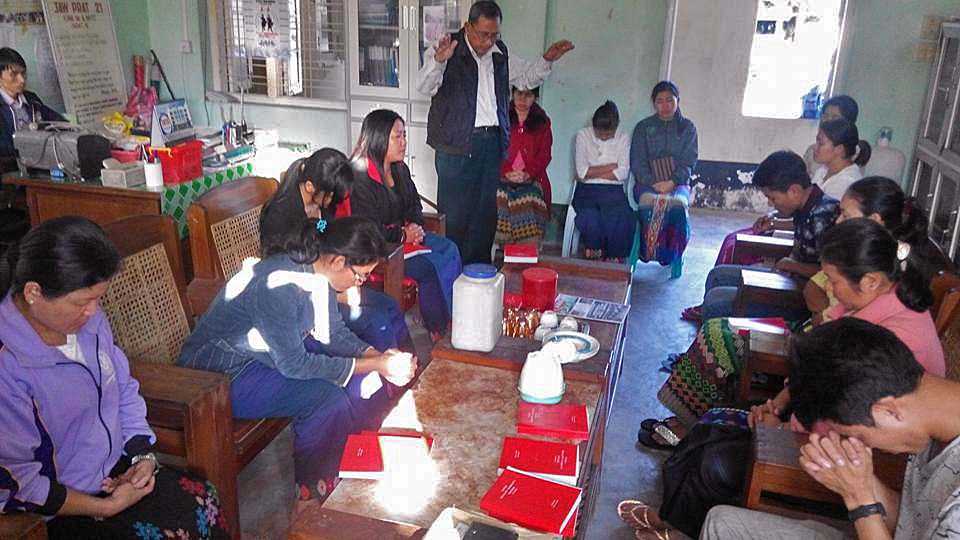
      Pastor Yaw said Christians in the state capital are praying for villagers living near Mohnyin.
      “As soon as we heard civilians fled for safety, we held prayer and pray to God to protect them,” he said. “We are weak, and what we can do is keep praying and relying on God. We believe that God is capable to protect our people.”

      * * * * * * * * * * * * * * * * * * * * * * *

      Comment

      Working...
      X