
 Tweet
The rise of Asia and the new world order
The global economy is undergoing a fundamental change. Despite concerns over slowing growth in the People’s Republic of China, India, and Japan, and the possible dissolution of the eurozone, global economic growth is accelerating.
How can this paradox be explained? If the global economy is shifting toward the more rapidly growing economies, then the world’s growth rate would shift toward the growth rates of the more rapidly growing economies. Thus, even if the growth rates of the PRC and India were to slow, global growth, which is considerably lower than that of both countries, would accelerate.
The growth acceleration will lead to a new world economic order, associated with more rapidly growing countries such as the PRC and India, which are going to have a larger share of the global economy.
The PRC overtook Japan as the world’s second-largest economy in 2010. But, the World Bank noted that this milestone had been reached in 2005 in current purchasing price parity (PPP). In terms of PPP, the PRC will overtake the United States (US) in 2017, according to the International Monetary Fund and India will overtake Japan in PPP in 2012. The US has been the world’s leading economy for more than a century.
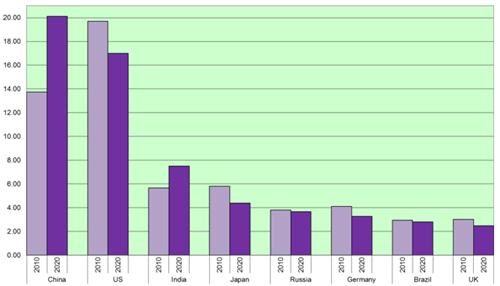
The new world order will look very different in 2020. Asia will boast three of the four biggest economies in the world. As Figure 1 shows, the largest economies in descending order would be the PRC, the US, India, Japan, Russia, Germany, Brazil, and the United Kingdom, based on shares of world GDP expressed in current PPP (the methodology and an earlier data set can be found in Jorgenson and Vu 2011).
Figure 1: New Economic Order 2020
Shares of World GDP (%)
Sources of economic growth
The sources of economic growth are capital input, labor input, and productivity. Everything depends on technology and demography because labor input is essentially driven on the supply side by demography; productivity is driven by technology; and capital input is determined by the growth of the economy.
Sources of economic growth can be classified between the replication of existing technologies and innovation (i.e., production processes and products). Replication entails increasing labor and capital inputs, and output increases in proportion to the rise in input, so there is no contribution to productivity growth. In contrast, innovation entails changes in technology, whereby increases in output exceed the growth of inputs.
Evidence shows that global growth is mostly from replication and not innovation, since productivity explains only a modest proportion of growth, even for rapidly growing countries like China and India.
Projecting world economic growth
Projections show that the world economy will accelerate, with 3.6% growth in 2010–2020, versus 3.3% in 1990–2010, notwithstanding negative demographic trends due to an ageing population and a declining workforce. Labor productivity growth, capital and labor quality, and closing the gap between output and capital will be major sources of the acceleration.
The G8 and G20 countries will continue to grow in 2010–2020, but the BRICS countries (Brazil, Russia, India, PRC) will grow even faster.
Japan’s base case projection for the period of 2010–2020 in labor productivity growth is 1.8%, which is similar to the period of 1990–2010. However, labor force growth is unfavorable. Because of its aging population Japan’s annual average growth shrank for 1990–2010, and is expected to slow even further in 2010–2020. After combining labor productivity and labor force growth, the base case GDP projection of annual growth rate is 0.7%. This figure is lower than Japan’s official growth target for GDP, which is 2% in real and 3% in nominal terms. This projection does not take into account possible policy changes such as increasing immigration and boosting workforce participation of women and the elderly.
The PRC’s growth is expected to slow on negative demography and labor productivity trends. However, its growth rate will remain above 7%. India will grow at 6.5%, a slightly faster rate than in the 1990–2010 period.
Growth will slow for Hong Kong, China; Indonesia; Republic of Korea; Malaysia; Singapore; and Taipei,China, but Asian and global economic expansion as a whole will accelerate, driven by the PRC and India.
The emergence of Asia from the underdevelopment that persisted until the middle of the last century is the great economic achievement of our time. This has created a new model for economic growth built on globalization and the patient accumulation of human and nonhuman capital over decades. The new growth paradigm places a premium on skillful management by public and private authorities. The performance of the leading countries in developing this paradigm – Japan, then the Asian Tigers, and now China and India – has changed the course of economic development in Asia and around the world.
References:
Dale W. Jorgenson and Khuong M. Vu. The rise of developing Asia and the new economic order. Journal of Policy Modelling. Volume 33. Issue 5. September/October 2011.
About Dale Jorgenson
Dale Jorgenson is the Samuel W. Morris University Professor at Harvard University. He was awarded the prestigious John Bates Clark Medal by the American Economic Association in 1971. He is a Past President of the Association (2001) and the Econometric Society (1987). Jorgenson has been honored with membership in the Americal Philosophical Society (1998), the Royal Swedish Academy of Sciences (1989), the U.S. National Academy of Sciences (1978), and the American Academy of Arts and Sciences (1969).
The global economy is undergoing a fundamental change. Despite concerns over slowing growth in the People’s Republic of China, India, and Japan, and the possible dissolution of the eurozone, global economic growth is accelerating.
How can this paradox be explained? If the global economy is shifting toward the more rapidly growing economies, then the world’s growth rate would shift toward the growth rates of the more rapidly growing economies. Thus, even if the growth rates of the PRC and India were to slow, global growth, which is considerably lower than that of both countries, would accelerate.
The growth acceleration will lead to a new world economic order, associated with more rapidly growing countries such as the PRC and India, which are going to have a larger share of the global economy.
The PRC overtook Japan as the world’s second-largest economy in 2010. But, the World Bank noted that this milestone had been reached in 2005 in current purchasing price parity (PPP). In terms of PPP, the PRC will overtake the United States (US) in 2017, according to the International Monetary Fund and India will overtake Japan in PPP in 2012. The US has been the world’s leading economy for more than a century.
The new world order will look very different in 2020. Asia will boast three of the four biggest economies in the world. As Figure 1 shows, the largest economies in descending order would be the PRC, the US, India, Japan, Russia, Germany, Brazil, and the United Kingdom, based on shares of world GDP expressed in current PPP (the methodology and an earlier data set can be found in Jorgenson and Vu 2011).
Figure 1: New Economic Order 2020
Shares of World GDP (%)
Sources of economic growth
The sources of economic growth are capital input, labor input, and productivity. Everything depends on technology and demography because labor input is essentially driven on the supply side by demography; productivity is driven by technology; and capital input is determined by the growth of the economy.
Sources of economic growth can be classified between the replication of existing technologies and innovation (i.e., production processes and products). Replication entails increasing labor and capital inputs, and output increases in proportion to the rise in input, so there is no contribution to productivity growth. In contrast, innovation entails changes in technology, whereby increases in output exceed the growth of inputs.
Evidence shows that global growth is mostly from replication and not innovation, since productivity explains only a modest proportion of growth, even for rapidly growing countries like China and India.
Projecting world economic growth
Projections show that the world economy will accelerate, with 3.6% growth in 2010–2020, versus 3.3% in 1990–2010, notwithstanding negative demographic trends due to an ageing population and a declining workforce. Labor productivity growth, capital and labor quality, and closing the gap between output and capital will be major sources of the acceleration.
The G8 and G20 countries will continue to grow in 2010–2020, but the BRICS countries (Brazil, Russia, India, PRC) will grow even faster.
Japan’s base case projection for the period of 2010–2020 in labor productivity growth is 1.8%, which is similar to the period of 1990–2010. However, labor force growth is unfavorable. Because of its aging population Japan’s annual average growth shrank for 1990–2010, and is expected to slow even further in 2010–2020. After combining labor productivity and labor force growth, the base case GDP projection of annual growth rate is 0.7%. This figure is lower than Japan’s official growth target for GDP, which is 2% in real and 3% in nominal terms. This projection does not take into account possible policy changes such as increasing immigration and boosting workforce participation of women and the elderly.
The PRC’s growth is expected to slow on negative demography and labor productivity trends. However, its growth rate will remain above 7%. India will grow at 6.5%, a slightly faster rate than in the 1990–2010 period.
Growth will slow for Hong Kong, China; Indonesia; Republic of Korea; Malaysia; Singapore; and Taipei,China, but Asian and global economic expansion as a whole will accelerate, driven by the PRC and India.
The emergence of Asia from the underdevelopment that persisted until the middle of the last century is the great economic achievement of our time. This has created a new model for economic growth built on globalization and the patient accumulation of human and nonhuman capital over decades. The new growth paradigm places a premium on skillful management by public and private authorities. The performance of the leading countries in developing this paradigm – Japan, then the Asian Tigers, and now China and India – has changed the course of economic development in Asia and around the world.
References:
Dale W. Jorgenson and Khuong M. Vu. The rise of developing Asia and the new economic order. Journal of Policy Modelling. Volume 33. Issue 5. September/October 2011.
About Dale Jorgenson
Dale Jorgenson is the Samuel W. Morris University Professor at Harvard University. He was awarded the prestigious John Bates Clark Medal by the American Economic Association in 1971. He is a Past President of the Association (2001) and the Econometric Society (1987). Jorgenson has been honored with membership in the Americal Philosophical Society (1998), the Royal Swedish Academy of Sciences (1989), the U.S. National Academy of Sciences (1978), and the American Academy of Arts and Sciences (1969).

Comment