
 Tweet
Shell accused of fuelling violence in
Nigeria by paying rival militant gangs
Oil company rejects watchdog's claims that its local
contracts made it complicit in the killing of civilians
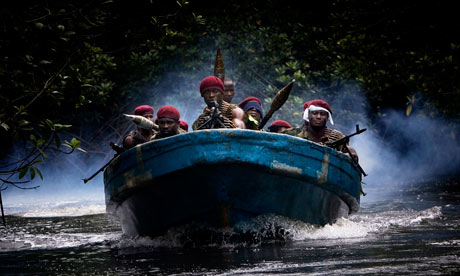
Militants of the Movement for the Emancipation of the Niger Delta travelling between
camps. Photograph: Veronique de Viguerie/Getty Images
Shell has fuelled armed conflict in Nigeria by paying hundreds of thousands
of dollars to feuding militant groups, according to an investigation by the
oil industry watchdog Platform, and a coalition of non-government
organisations.
The oil giant is implicated in a decade of human rights abuses in the Niger
delta, the study says, claiming that its routine payments exacerbated local
violence, in one case leading to the deaths of 60 people and the
destruction of an entire town.
Platform's investigation, which includes testimony from Shell's own
managers, also alleges that government forces hired by Shell perpetrated
atrocities against local civilians, including unlawful killings and systematic
torture.
Shell disputes the report, defending its human rights record and
questioning the accuracy of the evidence, but has pledged to study the
recommendations.
In Counting the Cost: Corporations and Human Rights in the Niger Delta,
Platform says that it has seen testimony and contracts that implicate Shell
in the regular awarding of lucrative contracts to militants. In one case last
year, Shell is said to have transferred more than $159,000 (£102,000) to a
group credibly linked to militia violence.
One gang member, Chukwu Azikwe, told Platform: "We were given money
and that is the money we were using to buy ammunition, to buy this bullet,
and every other thing to eat and to sustain the war." He said his gang and
its leader, SK Agala, had vandalised Shell pipelines. "They will pay ransom.
Some of them in the management will bring out money, dole out money into
this place, in cash."
The gang became locked in competition witha rival group over access to oil
money, with payments to one faction provoking a violent reaction from the
other. "The [rival gang] will come and fight, some will die, just to enable
them to also get [a] share. So the place now becomes a contest ground
for warring factions. Who takes over the community has the attention of
the company."
Platform alleges that it was highly likely that Shell knew that thousands of
dollars paid per month to militants in the town of Rumuekpe was used to
sustain a bitter conflict. "Armed gangs waged pitched battles over access
to oil money, which Shell distributed to whichever gang controlled access
to its infrastructure."
Rumuekpe is "the main artery of Shell's eastern operations in Rivers state",
with aroundabout 100,000 barrels of oil flowing per day, approximately10%
of Shell's daily production in the country. Shell distributed "community
development" funds and contracts via Friday Edu, a youth leader and Shell
community liaison officer, the report said, an exclusive arrangement that
magnified the risk of communal tension and conflict.
By 2005, Edu's monopoly over the resources of the Shell Petroleum
Development Company of Nigeria (SPDC) had sparked a leadership tussle
with Agala's group. The latter was reportedly forced out of the community
and a number of people killed. Dozens of gang members and residents
reportedly died in counter raids by Agala.
The inter-communal violence killed an estimated 60 people, including
women and children, from 2005-08. Thousands more were displaced by
fighting that left homes, schools and churches in ruins. Many still suffer
severe malnutrition, poverty and homelessness.
Platform says the local conflict soon created regional instability. Displaced
villagers were hunted down in the regional capital, Port Harcourt, and killed
in their homes, schools and workplaces. Gangs active in Rumuekpe
collaborated with prominent criminal networks in Rivers state and doubled
as Movement for the Emancipation of the Niger Delta (Mend) militants.
Mend's activity in Rumuekpe seriously disrupted Shell's operations and sent
shockwaves through world markets, the report notes, yet Shell paid little
heed. One of the corporation's managers was alarmingly candid: "One good
thing about their crisis was that they never for one day stopped us from
production."
Platform interviewed Ex-gang members claimed Shell exacerbated the
conflict by providing regular funding to both factions throughout.
In 2006, Shell is alleged to have awarded maintenance contracts relating
to its oil wells, the Trans-Niger pipeline, its booster station and flowstation
to Edu's gang. But after Agala's counter-raid left Rumuekpe "littered" with
corpses, Shell apparently switched sides and started paying Agala. It paid
whoever controlled access, even if they were known criminal gangs,
Platform claims.
The allegations of ex-gang members were largely substantiated by the
testimony of a Shell official, Platform claims. A manager confirmed that in
2006, one of the most violent years, Shell awarded six types of contract in
Rumuekpe. Thousands of dollars flowed from Shell to the armed gangs each
month.
The company eventually terminated some, though not all, of the contracts.
But by then the violence had reached the Shell flowstation. A Shell
manager, whose name has been withheld, is quoted as saying: "Somebody
came in [to the flowstation] and cut off somebody's hand. We had to
vacate the place. We stopped the contract entirely."
Other contracts to "maintain the pipeline right of way" continued
throughout the entire conflict, as did one-off contracts created in
response to specific threats, the report found.
Matthew Chizi, a local youth leader, said: "[Shell] were going to their job,
doing their operation, servicing their manifold. They never cared that
people were dying. They never did anything to call the crisis to order.
Rather they were using military to intimidate the community."
Platform's report offers a damning assessment: "Shell was highly likely to
be aware that it was helping to fuel the conflict in Rumuekpe, since
company workers visited the community on a regular basis. Even if Shell
was somehow unaware of the violence, media reports were publicly
available.
"Members of the community reportedly wrote to Shell to request that the
company stop awarding contracts to gang leaders such as Friday Edu.
Through Shell's routine practices and responses to threats, the company
became complicit in the cycle of violence."It adds: "The Rumuekpe crisis
was entirely avoidable... Shell operated for decades without an MoU,
polluted the community and distributed 'community development' funds
through an individual who had lost the confidence of the community. Once
conflict erupted, Shell paid the perpetrators of gross human rights abuses
as long as they controlled access to oil infrastructure. The cumulative
impact of Shell's mistakes was devastating."
Rumuekpe is just one of several case studies examined by the report which
alleges, that in 2009 and 2010, security personnel guarding Shell facilities
were responsible for extra-judicial killings and torture in Ogoniland. Platform
calls on the corporation to break ties with government forces and other
armed groups responsible for abuses, and to clean up environmental
damage.
Rumuekpe is just one of several case studies examined by the report which
alleges, that in 2009 and 2010, security personnel guarding Shell facilities
were responsible for extra-judicial killings and torture in Ogoniland.
Shell insisted that it respected human rights and was committed to working
with Nigeria to ensure that the country benefited from its natural
resources. "We have long acknowledged that the legitimate payments we
make to contractors, as well as the social investments we make in the
Niger delta region may cause friction in and between communities," a
spokesman said. "We nevertheless work hard to ensure a fair and equitable
distribution of the benefits of our presence.
"In view of the high rate of criminal violence in the Niger delta, the federal
government, as majority owner of oil facilities, deploys government security
forces to protect people and assets. Suggestions in the report that SPDC
directs or controls military activities are therefore completely untrue."
He added: "It is unfortunate that Platform has repeated several old cases,
some of which are unsubstantiated and some proven inaccurate, because
doing so obscures the good work which has been going on for many years.
However, we will carefully examine its recommendations and look forward
to continuing a constructive dialogue with the Nigerian government and
other stakeholders to find solutions to these issues.
Shell accused of fuelling violence in Nigeria by paying rival militant gangs | World news | The Guardian
Nigeria by paying rival militant gangs
Oil company rejects watchdog's claims that its local
contracts made it complicit in the killing of civilians
Militants of the Movement for the Emancipation of the Niger Delta travelling between
camps. Photograph: Veronique de Viguerie/Getty Images
Shell has fuelled armed conflict in Nigeria by paying hundreds of thousands
of dollars to feuding militant groups, according to an investigation by the
oil industry watchdog Platform, and a coalition of non-government
organisations.
The oil giant is implicated in a decade of human rights abuses in the Niger
delta, the study says, claiming that its routine payments exacerbated local
violence, in one case leading to the deaths of 60 people and the
destruction of an entire town.
Platform's investigation, which includes testimony from Shell's own
managers, also alleges that government forces hired by Shell perpetrated
atrocities against local civilians, including unlawful killings and systematic
torture.
Shell disputes the report, defending its human rights record and
questioning the accuracy of the evidence, but has pledged to study the
recommendations.
In Counting the Cost: Corporations and Human Rights in the Niger Delta,
Platform says that it has seen testimony and contracts that implicate Shell
in the regular awarding of lucrative contracts to militants. In one case last
year, Shell is said to have transferred more than $159,000 (£102,000) to a
group credibly linked to militia violence.
One gang member, Chukwu Azikwe, told Platform: "We were given money
and that is the money we were using to buy ammunition, to buy this bullet,
and every other thing to eat and to sustain the war." He said his gang and
its leader, SK Agala, had vandalised Shell pipelines. "They will pay ransom.
Some of them in the management will bring out money, dole out money into
this place, in cash."
The gang became locked in competition witha rival group over access to oil
money, with payments to one faction provoking a violent reaction from the
other. "The [rival gang] will come and fight, some will die, just to enable
them to also get [a] share. So the place now becomes a contest ground
for warring factions. Who takes over the community has the attention of
the company."
Platform alleges that it was highly likely that Shell knew that thousands of
dollars paid per month to militants in the town of Rumuekpe was used to
sustain a bitter conflict. "Armed gangs waged pitched battles over access
to oil money, which Shell distributed to whichever gang controlled access
to its infrastructure."
Rumuekpe is "the main artery of Shell's eastern operations in Rivers state",
with aroundabout 100,000 barrels of oil flowing per day, approximately10%
of Shell's daily production in the country. Shell distributed "community
development" funds and contracts via Friday Edu, a youth leader and Shell
community liaison officer, the report said, an exclusive arrangement that
magnified the risk of communal tension and conflict.
By 2005, Edu's monopoly over the resources of the Shell Petroleum
Development Company of Nigeria (SPDC) had sparked a leadership tussle
with Agala's group. The latter was reportedly forced out of the community
and a number of people killed. Dozens of gang members and residents
reportedly died in counter raids by Agala.
The inter-communal violence killed an estimated 60 people, including
women and children, from 2005-08. Thousands more were displaced by
fighting that left homes, schools and churches in ruins. Many still suffer
severe malnutrition, poverty and homelessness.
Platform says the local conflict soon created regional instability. Displaced
villagers were hunted down in the regional capital, Port Harcourt, and killed
in their homes, schools and workplaces. Gangs active in Rumuekpe
collaborated with prominent criminal networks in Rivers state and doubled
as Movement for the Emancipation of the Niger Delta (Mend) militants.
Mend's activity in Rumuekpe seriously disrupted Shell's operations and sent
shockwaves through world markets, the report notes, yet Shell paid little
heed. One of the corporation's managers was alarmingly candid: "One good
thing about their crisis was that they never for one day stopped us from
production."
Platform interviewed Ex-gang members claimed Shell exacerbated the
conflict by providing regular funding to both factions throughout.
In 2006, Shell is alleged to have awarded maintenance contracts relating
to its oil wells, the Trans-Niger pipeline, its booster station and flowstation
to Edu's gang. But after Agala's counter-raid left Rumuekpe "littered" with
corpses, Shell apparently switched sides and started paying Agala. It paid
whoever controlled access, even if they were known criminal gangs,
Platform claims.
The allegations of ex-gang members were largely substantiated by the
testimony of a Shell official, Platform claims. A manager confirmed that in
2006, one of the most violent years, Shell awarded six types of contract in
Rumuekpe. Thousands of dollars flowed from Shell to the armed gangs each
month.
The company eventually terminated some, though not all, of the contracts.
But by then the violence had reached the Shell flowstation. A Shell
manager, whose name has been withheld, is quoted as saying: "Somebody
came in [to the flowstation] and cut off somebody's hand. We had to
vacate the place. We stopped the contract entirely."
Other contracts to "maintain the pipeline right of way" continued
throughout the entire conflict, as did one-off contracts created in
response to specific threats, the report found.
Matthew Chizi, a local youth leader, said: "[Shell] were going to their job,
doing their operation, servicing their manifold. They never cared that
people were dying. They never did anything to call the crisis to order.
Rather they were using military to intimidate the community."
Platform's report offers a damning assessment: "Shell was highly likely to
be aware that it was helping to fuel the conflict in Rumuekpe, since
company workers visited the community on a regular basis. Even if Shell
was somehow unaware of the violence, media reports were publicly
available.
"Members of the community reportedly wrote to Shell to request that the
company stop awarding contracts to gang leaders such as Friday Edu.
Through Shell's routine practices and responses to threats, the company
became complicit in the cycle of violence."It adds: "The Rumuekpe crisis
was entirely avoidable... Shell operated for decades without an MoU,
polluted the community and distributed 'community development' funds
through an individual who had lost the confidence of the community. Once
conflict erupted, Shell paid the perpetrators of gross human rights abuses
as long as they controlled access to oil infrastructure. The cumulative
impact of Shell's mistakes was devastating."
Rumuekpe is just one of several case studies examined by the report which
alleges, that in 2009 and 2010, security personnel guarding Shell facilities
were responsible for extra-judicial killings and torture in Ogoniland. Platform
calls on the corporation to break ties with government forces and other
armed groups responsible for abuses, and to clean up environmental
damage.
Rumuekpe is just one of several case studies examined by the report which
alleges, that in 2009 and 2010, security personnel guarding Shell facilities
were responsible for extra-judicial killings and torture in Ogoniland.
Shell insisted that it respected human rights and was committed to working
with Nigeria to ensure that the country benefited from its natural
resources. "We have long acknowledged that the legitimate payments we
make to contractors, as well as the social investments we make in the
Niger delta region may cause friction in and between communities," a
spokesman said. "We nevertheless work hard to ensure a fair and equitable
distribution of the benefits of our presence.
"In view of the high rate of criminal violence in the Niger delta, the federal
government, as majority owner of oil facilities, deploys government security
forces to protect people and assets. Suggestions in the report that SPDC
directs or controls military activities are therefore completely untrue."
He added: "It is unfortunate that Platform has repeated several old cases,
some of which are unsubstantiated and some proven inaccurate, because
doing so obscures the good work which has been going on for many years.
However, we will carefully examine its recommendations and look forward
to continuing a constructive dialogue with the Nigerian government and
other stakeholders to find solutions to these issues.
Shell accused of fuelling violence in Nigeria by paying rival militant gangs | World news | The Guardian