
 Tweet
China space station module
awaits launch
Countdown begins to lift-off of Tiangong-1, the first step
towards a permanent Chinese base in orbit
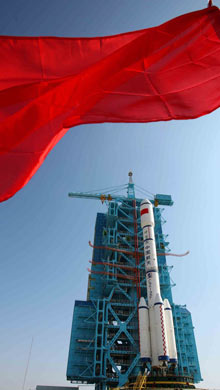
A Long March 2F rockey carrying China's
Tiangong-1 space station module is awaiting
lift-off on Thursday.
China has started the countdown to launch a space station module, the
Tiangong-1, that is the first step in establishing a permanent manned
presence in orbit above the Earth.
A Long March II 2F rocket is scheduled to take off soon after 1.16pm GMT
on Thursday from Jiuquan in Gansu province, carrying the laboratory to an
altitude of 220 miles (350km) where it will circle the planet unmanned while
its systems are tested.
A crew capsule, Shenzhou 8, is to be launched unmanned in November and
carry out docking tests with the Tiangong, which means "heavenly palace".
Manned missions by Chinese astronauts, known as yuhangyuans, are to
begin in 2012, according to Chinese state media.
A backup, Tiangong 2, has been built in case Thursday's launch goes
wrong.
China's eventual aim is to build a 60-tonne space station within 10 years –
it will be about a sixth the mass of the International Space Station.
The Tiangong is believed by international analysts to include docking
technology based on Russian designs.
Yang Liwei in 2003 became the first man put in orbit by China's space
programme, circling the Earth 14 times during 21 hours in orbit. Five others
have followed him in crews of up to three at a time.
The diving bell-shaped Shenzou is similar to the Russian Soyuz but as a
whole the Shenzou is larger and has greater flying capabilities in orbit.
China space station module awaits launch | World news | guardian.co.uk
You can see an animation here: China space station unmanned lab animation - video | Science | guardian.co.uk
-----
China Starts Work on Its
Own Space Hangout
Rebuffed from the U.S.-led space station, China is launching
a module to practice docking at its own station planned for
2020.

China is developing its first full-fledged space
station. Early tests of China's skills at rendezvous
and docking, shown in this artist's illustration, are
set to begin this year.
With the U.S. human space program in transition, China is taking a bold
step toward an independent path to orbit with the launch this week of a
space station testbed.
Tiangong-1 -- Mandarin for "heavenly palace" -- is scheduled to blast off
aboard a Chinese Long March 2F rocket from a launch site in the Gobi
Desert on Sept. 29 or 30, Xinhua, the official Chinese government
information agency reports.
The eight-ton module will serve as an orbital testbed for China to practice
robotic rendezous and docking techniques, a necessary skill for the
assembly and operation of the manned outpost China intends to build
around 2020.
China's next step in space comes as the United States retools its manned
space program, following the retirement this summer of the space shuttles.
NASA has three human spaceflight initiatives under way -- staffing the
International Space Station; supporting development of private sector
space taxis; and designing a government-owned heavy-lift launcher and
capsule for deep space missions beyond the station's 225-mile-high orbit.
China pushed hard to be included in the U.S-led international partnership,
which owns and operates the recently completed $100 billion complex.
Rebuffed, China decided on an independent path to space, with
construction of a space station scheduled to begin around 2020, followed
by missions to the moon.
"They have plans and they are implementing them. They really don't want
to be working with us because we're too hard to work with," space policy
expert Joan Johnson-Freese, with the U.S. Naval War College in Rhode
Island, told Discovery News.
Tiangong 1 will be used to test an autonomous rendezvous and docking
system aboard an unmanned Shenzhou 8 spacecraft China plans to launch
before the end of the year, Gregory Kulacki, China Program manager at the
Union of Concerned Scientists, told Discovery News.
Tiangong 1 is the first in a series of test modules, similar to spacecraft
flown and tested by NASA as part of the Gemini program that preceded the
1969-1972 Apollo moon missions and the 1973-1979 Skylab space station
program.
China's space station will be much smaller than the International Space
Station. It will weigh less than 100 tons, compared to the ISS's 1 million
pounds. It is planned to have a core module, which will serve as living
quarters for a crew, and two laboratory modules.
China says its space station will be used for scientific research. But since
space technology inherently has dual use for military programs, as well as
commercial applications, China's growing sophistication in space is a
concern for some in the United States.
"I imagine it will have some impact on how people think about the U.S.
space program, but I don't think it will have any impact on the Obama
administration's plans," Kulacki said.
That thought rankles former NASA administrator Michael Griffin, among
others.
"In my opinion, China understands what it takes to be a great power. We
have written the script for them," Griffin said at a hearing before a NASA
oversight committee last week.
"They are a near-peer competitor of ours and I would worry very much
about the future of this nation if we were not -- and if we were not seen
by all -- to be a world leader," he said.
"When the Chinese can reach the moon and we cannot, I don't see why
any other nation would regard us as a world leader."
China Starts Work on Its Own Space Hangout : Discovery News
awaits launch
Countdown begins to lift-off of Tiangong-1, the first step
towards a permanent Chinese base in orbit
A Long March 2F rockey carrying China's
Tiangong-1 space station module is awaiting
lift-off on Thursday.
China has started the countdown to launch a space station module, the
Tiangong-1, that is the first step in establishing a permanent manned
presence in orbit above the Earth.
A Long March II 2F rocket is scheduled to take off soon after 1.16pm GMT
on Thursday from Jiuquan in Gansu province, carrying the laboratory to an
altitude of 220 miles (350km) where it will circle the planet unmanned while
its systems are tested.
A crew capsule, Shenzhou 8, is to be launched unmanned in November and
carry out docking tests with the Tiangong, which means "heavenly palace".
Manned missions by Chinese astronauts, known as yuhangyuans, are to
begin in 2012, according to Chinese state media.
A backup, Tiangong 2, has been built in case Thursday's launch goes
wrong.
China's eventual aim is to build a 60-tonne space station within 10 years –
it will be about a sixth the mass of the International Space Station.
The Tiangong is believed by international analysts to include docking
technology based on Russian designs.
Yang Liwei in 2003 became the first man put in orbit by China's space
programme, circling the Earth 14 times during 21 hours in orbit. Five others
have followed him in crews of up to three at a time.
The diving bell-shaped Shenzou is similar to the Russian Soyuz but as a
whole the Shenzou is larger and has greater flying capabilities in orbit.
China space station module awaits launch | World news | guardian.co.uk
You can see an animation here: China space station unmanned lab animation - video | Science | guardian.co.uk
-----
China Starts Work on Its
Own Space Hangout
Rebuffed from the U.S.-led space station, China is launching
a module to practice docking at its own station planned for
2020.
China is developing its first full-fledged space
station. Early tests of China's skills at rendezvous
and docking, shown in this artist's illustration, are
set to begin this year.
With the U.S. human space program in transition, China is taking a bold
step toward an independent path to orbit with the launch this week of a
space station testbed.
Tiangong-1 -- Mandarin for "heavenly palace" -- is scheduled to blast off
aboard a Chinese Long March 2F rocket from a launch site in the Gobi
Desert on Sept. 29 or 30, Xinhua, the official Chinese government
information agency reports.
The eight-ton module will serve as an orbital testbed for China to practice
robotic rendezous and docking techniques, a necessary skill for the
assembly and operation of the manned outpost China intends to build
around 2020.
China's next step in space comes as the United States retools its manned
space program, following the retirement this summer of the space shuttles.
NASA has three human spaceflight initiatives under way -- staffing the
International Space Station; supporting development of private sector
space taxis; and designing a government-owned heavy-lift launcher and
capsule for deep space missions beyond the station's 225-mile-high orbit.
China pushed hard to be included in the U.S-led international partnership,
which owns and operates the recently completed $100 billion complex.
Rebuffed, China decided on an independent path to space, with
construction of a space station scheduled to begin around 2020, followed
by missions to the moon.
"They have plans and they are implementing them. They really don't want
to be working with us because we're too hard to work with," space policy
expert Joan Johnson-Freese, with the U.S. Naval War College in Rhode
Island, told Discovery News.
Tiangong 1 will be used to test an autonomous rendezvous and docking
system aboard an unmanned Shenzhou 8 spacecraft China plans to launch
before the end of the year, Gregory Kulacki, China Program manager at the
Union of Concerned Scientists, told Discovery News.
Tiangong 1 is the first in a series of test modules, similar to spacecraft
flown and tested by NASA as part of the Gemini program that preceded the
1969-1972 Apollo moon missions and the 1973-1979 Skylab space station
program.
China's space station will be much smaller than the International Space
Station. It will weigh less than 100 tons, compared to the ISS's 1 million
pounds. It is planned to have a core module, which will serve as living
quarters for a crew, and two laboratory modules.
China says its space station will be used for scientific research. But since
space technology inherently has dual use for military programs, as well as
commercial applications, China's growing sophistication in space is a
concern for some in the United States.
"I imagine it will have some impact on how people think about the U.S.
space program, but I don't think it will have any impact on the Obama
administration's plans," Kulacki said.
That thought rankles former NASA administrator Michael Griffin, among
others.
"In my opinion, China understands what it takes to be a great power. We
have written the script for them," Griffin said at a hearing before a NASA
oversight committee last week.
"They are a near-peer competitor of ours and I would worry very much
about the future of this nation if we were not -- and if we were not seen
by all -- to be a world leader," he said.
"When the Chinese can reach the moon and we cannot, I don't see why
any other nation would regard us as a world leader."
China Starts Work on Its Own Space Hangout : Discovery News