
 Tweet
Violence 'Affecting Afghan
Children's Mental Health'
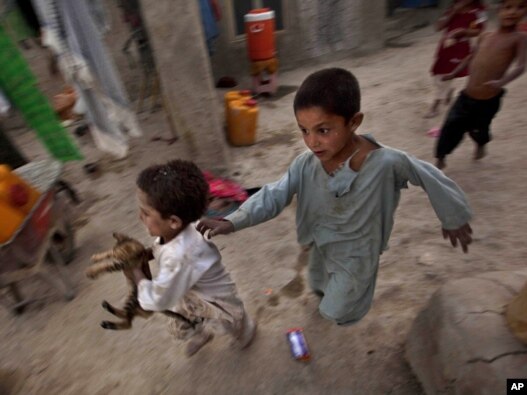
Internally displaced children play at a refugee camp in Kabul in early August.
KABUL -- Human rights officials in Afghanistan have endorsed earlier
findings suggesting that endemic violence is inflicting considerable
psychological trauma and distress on children in that country, RFE/RL's
Radio Free Afghanistan reports.
Afghanistan's Independent Human Rights Commission in Kabul told RFE/RL
that many Afghan children have witnessed acts of violence, seeing people
being killed in bomb attacks or seeing dead bodies on the streets.
A 2009 study by England's Durham University, the first large-scale survey
of Afghan children's mental health, reported that one in five children
suffers from psychiatric disorders, including anxiety, depression, and
posttraumatic stress disorder.
An RFE/RL correspondent in Kabul's Abdul Haq neighborhood -- the scene
of a recent Taliban attack in which six militants launched assaults against
Afghan and international forces -- interviewed some children who had
witnessed the violence.
"We were in the classroom when we heard gunfire behind our school," said
one student. "We all escaped and ran home. A lot of my classmates were
crying saying that we were going to die."
"When we were running from the school, I saw a car pull up by the road,"
Najib, a sixth-grader, told RFE/RL. "A man dressed in women's clothing
came out and shot a policeman and then ran into a building."
Hasib, 15, said the attacks caused panic among his classmates, with some
still traumatized days later. "Psychologically it hit everybody hard," he said.
"Many of us don't eat properly, we have trouble sleeping, and find it hard
to concentrate on our studies."
Children have been some of the worst victims of Afghanistan's nearly three
decades of war.
According to UNICEF, more than 30 percent of children of elementary
school age are working on the streets in Afghanistan and are often their
family's sole breadwinners. That means that millions of children are not
going to school.
Child labor in Afghanistan is also rampant, with many impoverished families
selling their kids into forced labor, sexual exploitation, and early marriage.
Some of the children -- who can be as young as 3 years old -- are
overworked and are suffer from malnutrition and disease.
Violence 'Affecting Afghan Children's Mental Health'
Children's Mental Health'
Internally displaced children play at a refugee camp in Kabul in early August.
KABUL -- Human rights officials in Afghanistan have endorsed earlier
findings suggesting that endemic violence is inflicting considerable
psychological trauma and distress on children in that country, RFE/RL's
Radio Free Afghanistan reports.
Afghanistan's Independent Human Rights Commission in Kabul told RFE/RL
that many Afghan children have witnessed acts of violence, seeing people
being killed in bomb attacks or seeing dead bodies on the streets.
A 2009 study by England's Durham University, the first large-scale survey
of Afghan children's mental health, reported that one in five children
suffers from psychiatric disorders, including anxiety, depression, and
posttraumatic stress disorder.
An RFE/RL correspondent in Kabul's Abdul Haq neighborhood -- the scene
of a recent Taliban attack in which six militants launched assaults against
Afghan and international forces -- interviewed some children who had
witnessed the violence.
"We were in the classroom when we heard gunfire behind our school," said
one student. "We all escaped and ran home. A lot of my classmates were
crying saying that we were going to die."
"When we were running from the school, I saw a car pull up by the road,"
Najib, a sixth-grader, told RFE/RL. "A man dressed in women's clothing
came out and shot a policeman and then ran into a building."
Hasib, 15, said the attacks caused panic among his classmates, with some
still traumatized days later. "Psychologically it hit everybody hard," he said.
"Many of us don't eat properly, we have trouble sleeping, and find it hard
to concentrate on our studies."
Children have been some of the worst victims of Afghanistan's nearly three
decades of war.
According to UNICEF, more than 30 percent of children of elementary
school age are working on the streets in Afghanistan and are often their
family's sole breadwinners. That means that millions of children are not
going to school.
Child labor in Afghanistan is also rampant, with many impoverished families
selling their kids into forced labor, sexual exploitation, and early marriage.
Some of the children -- who can be as young as 3 years old -- are
overworked and are suffer from malnutrition and disease.
Violence 'Affecting Afghan Children's Mental Health'

Comment