
 Tweet
Iranian greens fear disaster
as Lake Orumieh shrinks
Football chants and street protests raise profile of fight to
save Unesco-listed site
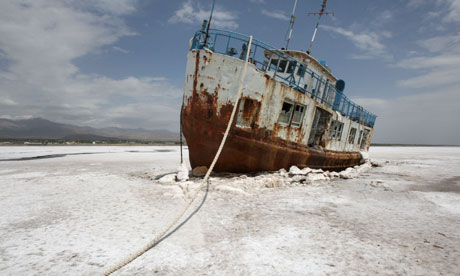
A ship left high and dry on the solidified salt of Lake Orumieh, which has lost half its
surface area. Photograph: Vahid Salemi/AP
The fate of a shrinking salt lake is the last thing you would expect football
fans to chant about – but Iranians are doing all they can to stop a looming
ecological disaster.
Lake Orumieh in north-west Iran, one of the world's largest salt lakes and a
Unesco biosphere reserve, is disappearing due to drought and government
mismanagement, and has become a major cause of concern for
environmental activists and ordinary people in the Islamic republic.
Thousands of Iranians from Tabriz and Orumieh, two cities in Iran's
Azerbaijan region, have come out on streets over the past few weeks in
protest at the government's failure to protect the lake, which has already
lost half of its surface in recent years. Lake Orumieh is situated at the
heart of the region, home to the country's Azeri ethnic minority, whose
activists claim they have been marginalised in recent years.
On Saturday security forces on motorcycles in Tabriz and Orumieh clashed
with thousands of protesters who gathered in scattered groups raising
alarms over the lake's disappearance. Experts have said the salt lake,
crucial to agriculture and tourism, could dry out completely in the next few
years.
Amateur videos posted on YouTube and social networking websites,
believed to have been taken from Saturday's events, show riot police
attacking what appears to be a peaceful protest. Opposition websites said
riot forces wielded batons and used teargas and plastic bullets to disperse
protesters who were chanting "Lake Orumieh is thirsty". Scores of
protesters, including several environmental activists, have been arrested.
The committee of human rights reporters in Iran reported on Monday that
Farank Farid, a prominent women's rights activist, was among the
protesters currently held in custody.
A website affiliated to South Azerbaijan's student movement claimed that
protesters were injured in clashes with security forces. The association for
defence of Azerbaijani political prisoners in Iran reported that eyewitnesses
said at least one person was killed.
"According to the eyewitnesses, a protester was killed by the Iranian riot
police in Tarbiat Street of the city of Tabriz. The body was immediately
removed by the security forces," ADAPP said. The association reported
protesters were chanting "Lake Orumieh is dying! Iran is issuing its
execution", "Long live Azerbaijan".
Protesters blame the gradual drying of the salt lake on the government and
its policies of damming rivers, but officials say drought and global warming
has caused the disaster.
Some 36 dams have been built on rivers on the way to Lake Orumieh.
Etemaad, a reformist newspaper, reported that the water level in Lake
Orumieh falls by 3mm every day.
Experts say the government has refused to acknowledge the severity of
the problem, which could have catastrophic environmental consequences.
Fields of vine, almond and garlic in the region are dependant on Lake
Orumieh. Experts say the intensity of the wind in the region would mean
any salt left behind as the lake dries would destroy flora and fauna in the
surrounding area, and also be harmful to humans.
Unable to stage street protests freely, Iranians have exploited every
opportunity to voice alarm over the lake's fate. Football fans have chanted
slogans in relation to the salt lake in stadiums since April. Activists are
planning to stage another protest on Friday during a football match in
Tehran's Azadi stadium, which holds up to 100,000 people.
Recent unrest in the Azarbaijan region saw familiar scenes to those
witnessed in the aftermath of Iran's post-election protest in 2009.
Some analysts have seen these protests as being inspired by, and a
continuation of, the unrest in 2009 and have even linked them to the
uprisings in the Arab world. But there is little evidence to suggest recent
events are connected to anti-regime movements.
Saturday's protests came after the Iranian parliament refused to fast-track
a bid, proposed by local MPs, to feed the lake with water from a nearby
river. Iran's semi-official Fars news agency published a letter, signed by 22
MPs, urging parliament to act on the issue. Speaking to Khabaronline, a
news website, Javad Jahangirzadeh, an MP for the city of Orumieh, said:
"In my view, the issue [of Lake Orumieh] should not be seen as a security
issue and it should not be politicised. It is a social and environmental issue
which we can rescue and it can be solved by the human."
He added: "Out of 100 people who come and visit me, 99 of them ask
about Lake Orumieh, which shows it has become a sensitive issue for them.
People follow the lake's fate, how can I stay silent and ignore their
demands regarding an issue which shows their interest in the
environment?"
Last year Iran's state television, Press TV, said the lake's problems were
because "declining rainfall, climate change, and rising temperatures
accelerate the evaporation process". were to be blamed.
Environmental experts fear that Lake Orumieh might see the fate of a lake
in neighbouring countries, known as Aral Sea, which was formerly one of
the four largest lakes in the world but has almost disappeared due to
aggressive irrigation projects during the Soviet Union era.
Iranian media were not allowed to report the protests but an official news
agency acknowledged that a gathering had taken place on Saturday.
Iranian greens fear disaster as Lake Orumieh shrinks | Environment | The Guardian
It's sad when preventable destruction of the envornment occurs under irresponsible governments on such a scale.
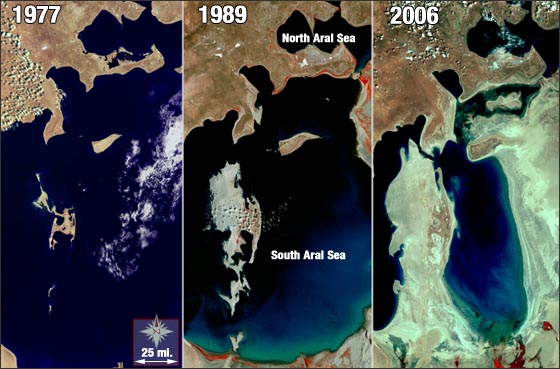
I am sure most of you are aware of the Aral Sea problem but if not, here's the maps:



^ The Aral Sea in the 60s.
It was once the 4th largest lake on Earth but as a result of the USSR's irrigation plans it has shrunk by over 90% in size.
The ecosystem of the Aral Sea and the river deltas feeding into it has
been nearly destroyed, not least because of the much higher salinity. The
receding sea has left huge plains covered with salt and toxic chemicals –
the results of weapons testing, industrial projects, pesticides and fertilizer
runoff – which are picked up and carried away by the wind as toxic dust
and spread to the surrounding area. The land around the Aral Sea is
heavily polluted and the people living in the area are suffering from a lack
of fresh water and health problems, including high rates of certain forms
of cancer and lung diseases. Respiratory illnesses including tuberculosis
(most of which is drug resistant) and cancer, digestive disorders,
anaemia, and infectious diseases are common ailments in the region.
Liver, kidney and eye problems can also be attributed to the toxic dust
storms. Health concerns associated with the region are a cause for an
unusually high fatality rate amongst vulnerable parts of the population.
There is a high child mortality rate of 75 in every 1,000 newborns and
maternity death of 12 in every 1,000 women.[16] Crops in the region are
destroyed by salt being deposited onto the land. Vast salt plains exposed
by the shrinking Aral have produced dust storms, making regional winters
colder and summers hotter.[17][18][19][20]
The Aral Sea fishing industry, which in its heyday had employed some
40,000 and reportedly produced one-sixth of the Soviet Union's entire fish
catch, has been devastated, and former fishing towns along the original
shores have become ship graveyards. The town of Moynaq in Uzbekistan
had a thriving harbor and fishing industry that employed approximately
30,000 people;[21] now it lies miles from the shore. Fishing boats lie
scattered on the dry land that was once covered by water; many have
been there for 20 years. The only significant fishing company left in the
area has its fish shipped from the Baltic Sea, thousands of kilometers
away.
Also destroyed is the muskrat trapping industry in the deltas of Amu Darya
and Syr Darya, which used to yield as much as 500,000 muskrat pelts a
year.[12]
The Orumieh is the 3rd largest salt lake on Earth. Let's hope it doesn't follow the Aral's fate.
According to the Tehran Times the government is supposedly going to try and prevent it.
Iran to use water right in Aras to save Lake Urmia
TEHRAN – Iran’s First Vice President Mohammad Reza Rahimi said on
Monday that Iran will use its water right in Aras River to save dying Lake
Urmia.
He also said that government officials have held several meetings to
explore ways to save the salt water lake, adding it has been decided that
water from other resources would be piped into the lake.
The issue of the shrinkage of Lake Urmia came into the limelight after a
number of people in Urmia and Tabriz staged rallies to protest the
government’s failure to take measures necessary to save the lake.
Iranian officials have said the issue should not be politicized, promising that
they will make every effort to prevent the occurrence of an environmental
disaster.
Iran to use water right in Aras to save Lake Urmia - Tehran Times
It's already lost half of its surface area.
as Lake Orumieh shrinks
Football chants and street protests raise profile of fight to
save Unesco-listed site
A ship left high and dry on the solidified salt of Lake Orumieh, which has lost half its
surface area. Photograph: Vahid Salemi/AP
The fate of a shrinking salt lake is the last thing you would expect football
fans to chant about – but Iranians are doing all they can to stop a looming
ecological disaster.
Lake Orumieh in north-west Iran, one of the world's largest salt lakes and a
Unesco biosphere reserve, is disappearing due to drought and government
mismanagement, and has become a major cause of concern for
environmental activists and ordinary people in the Islamic republic.
Thousands of Iranians from Tabriz and Orumieh, two cities in Iran's
Azerbaijan region, have come out on streets over the past few weeks in
protest at the government's failure to protect the lake, which has already
lost half of its surface in recent years. Lake Orumieh is situated at the
heart of the region, home to the country's Azeri ethnic minority, whose
activists claim they have been marginalised in recent years.
On Saturday security forces on motorcycles in Tabriz and Orumieh clashed
with thousands of protesters who gathered in scattered groups raising
alarms over the lake's disappearance. Experts have said the salt lake,
crucial to agriculture and tourism, could dry out completely in the next few
years.
Amateur videos posted on YouTube and social networking websites,
believed to have been taken from Saturday's events, show riot police
attacking what appears to be a peaceful protest. Opposition websites said
riot forces wielded batons and used teargas and plastic bullets to disperse
protesters who were chanting "Lake Orumieh is thirsty". Scores of
protesters, including several environmental activists, have been arrested.
The committee of human rights reporters in Iran reported on Monday that
Farank Farid, a prominent women's rights activist, was among the
protesters currently held in custody.
A website affiliated to South Azerbaijan's student movement claimed that
protesters were injured in clashes with security forces. The association for
defence of Azerbaijani political prisoners in Iran reported that eyewitnesses
said at least one person was killed.
"According to the eyewitnesses, a protester was killed by the Iranian riot
police in Tarbiat Street of the city of Tabriz. The body was immediately
removed by the security forces," ADAPP said. The association reported
protesters were chanting "Lake Orumieh is dying! Iran is issuing its
execution", "Long live Azerbaijan".
Protesters blame the gradual drying of the salt lake on the government and
its policies of damming rivers, but officials say drought and global warming
has caused the disaster.
Some 36 dams have been built on rivers on the way to Lake Orumieh.
Etemaad, a reformist newspaper, reported that the water level in Lake
Orumieh falls by 3mm every day.
Experts say the government has refused to acknowledge the severity of
the problem, which could have catastrophic environmental consequences.
Fields of vine, almond and garlic in the region are dependant on Lake
Orumieh. Experts say the intensity of the wind in the region would mean
any salt left behind as the lake dries would destroy flora and fauna in the
surrounding area, and also be harmful to humans.
Unable to stage street protests freely, Iranians have exploited every
opportunity to voice alarm over the lake's fate. Football fans have chanted
slogans in relation to the salt lake in stadiums since April. Activists are
planning to stage another protest on Friday during a football match in
Tehran's Azadi stadium, which holds up to 100,000 people.
Recent unrest in the Azarbaijan region saw familiar scenes to those
witnessed in the aftermath of Iran's post-election protest in 2009.
Some analysts have seen these protests as being inspired by, and a
continuation of, the unrest in 2009 and have even linked them to the
uprisings in the Arab world. But there is little evidence to suggest recent
events are connected to anti-regime movements.
Saturday's protests came after the Iranian parliament refused to fast-track
a bid, proposed by local MPs, to feed the lake with water from a nearby
river. Iran's semi-official Fars news agency published a letter, signed by 22
MPs, urging parliament to act on the issue. Speaking to Khabaronline, a
news website, Javad Jahangirzadeh, an MP for the city of Orumieh, said:
"In my view, the issue [of Lake Orumieh] should not be seen as a security
issue and it should not be politicised. It is a social and environmental issue
which we can rescue and it can be solved by the human."
He added: "Out of 100 people who come and visit me, 99 of them ask
about Lake Orumieh, which shows it has become a sensitive issue for them.
People follow the lake's fate, how can I stay silent and ignore their
demands regarding an issue which shows their interest in the
environment?"
Last year Iran's state television, Press TV, said the lake's problems were
because "declining rainfall, climate change, and rising temperatures
accelerate the evaporation process". were to be blamed.
Environmental experts fear that Lake Orumieh might see the fate of a lake
in neighbouring countries, known as Aral Sea, which was formerly one of
the four largest lakes in the world but has almost disappeared due to
aggressive irrigation projects during the Soviet Union era.
Iranian media were not allowed to report the protests but an official news
agency acknowledged that a gathering had taken place on Saturday.
Iranian greens fear disaster as Lake Orumieh shrinks | Environment | The Guardian
It's sad when preventable destruction of the envornment occurs under irresponsible governments on such a scale.
I am sure most of you are aware of the Aral Sea problem but if not, here's the maps:
^ The Aral Sea in the 60s.
It was once the 4th largest lake on Earth but as a result of the USSR's irrigation plans it has shrunk by over 90% in size.
The ecosystem of the Aral Sea and the river deltas feeding into it has
been nearly destroyed, not least because of the much higher salinity. The
receding sea has left huge plains covered with salt and toxic chemicals –
the results of weapons testing, industrial projects, pesticides and fertilizer
runoff – which are picked up and carried away by the wind as toxic dust
and spread to the surrounding area. The land around the Aral Sea is
heavily polluted and the people living in the area are suffering from a lack
of fresh water and health problems, including high rates of certain forms
of cancer and lung diseases. Respiratory illnesses including tuberculosis
(most of which is drug resistant) and cancer, digestive disorders,
anaemia, and infectious diseases are common ailments in the region.
Liver, kidney and eye problems can also be attributed to the toxic dust
storms. Health concerns associated with the region are a cause for an
unusually high fatality rate amongst vulnerable parts of the population.
There is a high child mortality rate of 75 in every 1,000 newborns and
maternity death of 12 in every 1,000 women.[16] Crops in the region are
destroyed by salt being deposited onto the land. Vast salt plains exposed
by the shrinking Aral have produced dust storms, making regional winters
colder and summers hotter.[17][18][19][20]
The Aral Sea fishing industry, which in its heyday had employed some
40,000 and reportedly produced one-sixth of the Soviet Union's entire fish
catch, has been devastated, and former fishing towns along the original
shores have become ship graveyards. The town of Moynaq in Uzbekistan
had a thriving harbor and fishing industry that employed approximately
30,000 people;[21] now it lies miles from the shore. Fishing boats lie
scattered on the dry land that was once covered by water; many have
been there for 20 years. The only significant fishing company left in the
area has its fish shipped from the Baltic Sea, thousands of kilometers
away.
Also destroyed is the muskrat trapping industry in the deltas of Amu Darya
and Syr Darya, which used to yield as much as 500,000 muskrat pelts a
year.[12]
The Orumieh is the 3rd largest salt lake on Earth. Let's hope it doesn't follow the Aral's fate.
According to the Tehran Times the government is supposedly going to try and prevent it.
Iran to use water right in Aras to save Lake Urmia
TEHRAN – Iran’s First Vice President Mohammad Reza Rahimi said on
Monday that Iran will use its water right in Aras River to save dying Lake
Urmia.
He also said that government officials have held several meetings to
explore ways to save the salt water lake, adding it has been decided that
water from other resources would be piped into the lake.
The issue of the shrinkage of Lake Urmia came into the limelight after a
number of people in Urmia and Tabriz staged rallies to protest the
government’s failure to take measures necessary to save the lake.
Iranian officials have said the issue should not be politicized, promising that
they will make every effort to prevent the occurrence of an environmental
disaster.
Iran to use water right in Aras to save Lake Urmia - Tehran Times
It's already lost half of its surface area.