

 Tweet
 Teenage victim becomes a symbol for Syria's revolution
Mutilated body of Hamza al-Khatib given to family as state TV says injuries were faked by conspirators
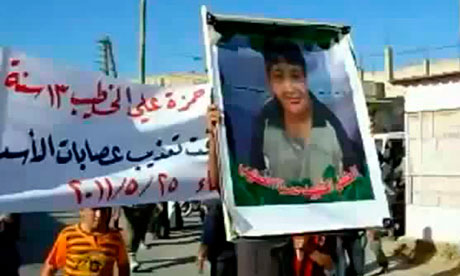 A YouTube image shows a Syrian man holding a picture of 13-year-old Hamza al-Khatib during his funeral in the flashpoint region of Daraa. Photograph: AFP/Getty Images
The new face of the Syrian revolution is chubby, has a winning smile and belongs to a 13-year-old named Hamza al-Khatib.
The boy, from a village called al-Jizah near the southern city of Deraa, has become the most famous victim yet of Syria's bloody chapter of the Arab spring.
Hamza was picked up by security forces on 29 April. On 27 May his badly mutilated corpse was released to his horrified family, who were warned to keep silent.
According to a YouTube video and human rights activists, Hamza was tortured and his swollen body showed bullet wounds on his arms, black eyes, cuts, marks consistent with electric shock devices, bruises and whip marks. His neck had been broken and his penis cut off.
Like Neda Agha-Soltan, the young woman who was shot dead in street protests after Iran's disputed presidential elections two years ago, Hamza has come to symbolise the innocent victims in a struggle for freedom against tyranny and repression.
In the YouTube video, a picture of Hamza is held above his coffin. It shows his angelic grin and thick head of black hair. He is dressed in a polo shirt. Below the gold-framed photo lies his body. "He was taken alive and he was killed because he called for freedom," says the voice-over.
Other grainy clips show crowds holding a banner saying: "The martyr Hamza al-Khatib, killed under torture by Assad's gangs."
Cries of "Allahu Akbar" (God is greatest) were heard at his funeral and pro-democracy protesters have designated this Friday as "Children's Friday" in his memory."
Hamza's violent death is being discussed all over Syria as citizens struggle to come to terms with the brutality that has accompanied the two-month uprising against the regime of President Bashar al-Assad.
The official media are focusing on troops and police who have been killed by "armed terrorist gangs".
Videos of protests on Saturday show crowds chanting for Hamza in towns as far away as Latakia, home to the Assad clan. "The case has upset all of us," said a former security officer and father of four from Homs. "The brutality, especially to children, is only causing more people to come out – as it did in Deraa at the start of the protests."
Several Facebook pages have been started, including one with more than 61,000 followers called "We are all Hamza al-Khatib".
"Hamza has become a poster boy for the Syrian revolution," said Malik al-Abdeh, whose London-based Barada TV broke the story by broadcasting the YouTube clip last Thursday, before it went global on al-Jazeera Arabic on Friday.
"It's the same thing that happened with Mohammed Bouazizi [the vendor who burned himself to death in protest] in Tunisia and Khaled Said [who was killed by police] in Egypt. But this was not another young man. He was just a boy."
Syria's official media have accused al-Jazeera and other satellite channels of peddling propaganda.
State television aired an hour-long programme on Tuesday night on the death of Hamza. Accompanied by a doctor, Akram Shaar, and a psychological doctor, Majdee al-Fares, the presenter promised to expose the "whole truth" of the affair.
The doctors said the marks on Hamza's body were not signs of torture, as activists have alleged, but were faked by conspirators.
The doctors said Hamza died from bullet wounds but that conspirators created the marks on his body, trying to give the people a Syrian equivalent to Bouazizi in order to agitate them.
The programme also showed a pre-recorded conversation with Hamza's father and an uncle who said they trusted a pledge made by Assad to look into the circumstances of Hamza's death. The interior ministry said it would set up a committee to look into the tragedy.
None of Hamza's relatives could be reached for comment. Hamza's father, Ali, 65, was detained on Saturday, according to activists in Damascus. Wissam Tarif, the director of the human rights group Insan, said Hamza's uncle was picked up on Monday and his brother had also been detained.
The Syrian government has not allowed foreign journalists into the country since the uprising began in March. Demands for UN access have been rebuffed.
Syrian activists and rights organisations say more than 1,100 people have been killed and thousands rounded up and tortured in the past 10 weeks, but Hamza's is the most brutal case yet. The fact that the body was returned to the family rather than disposed of was intended to warn off other people, they said.
"This is a message from the state to all protesters," said a human rights expert who runs the Monitoring Protests Facebook page which focuses on abuses during the protests. "They are trying to say, 'We don't spare anyone and if you continue protesting this what we are going to do to you and your kids.' "
The Local Co-ordinating Committees of Syria, the best-organised grassrootsopposition network, said at least 25 children under 18 had been killed since mid-March.
The death toll includes a seven-year-old girl, Majd Ibrahim Airfaee, from Deraa, who was shot in the abdomen on 26 April, and Tamam Hamza Al-Saidawi, aged five, from Homs, who was shot dead in the car he was travelling in with his family in a case that has incensed the city.
Rime Allaf, an associate fellow at the London thinktank Chatham House, said the Syrian government's decision to broadcast a response demonstrated it was aware of how deeply Hamza's case has angered Syrians.
"Even people who have previously not taken sides, or who have been leaning towards the regime, have found this intolerable," she said.
Nidaa Hassan is a pseudonym for a journalist in Syria
Mutilated body of Hamza al-Khatib given to family as state TV says injuries were faked by conspirators


- Shiv Malik, Ian Black and Nidaa Hassan
- guardian.co.uk, Tuesday 31 May 2011 20.42 BST
- Article history
A YouTube image shows a Syrian man holding a picture of 13-year-old Hamza al-Khatib during his funeral in the flashpoint region of Daraa. Photograph: AFP/Getty ImagesThe new face of the Syrian revolution is chubby, has a winning smile and belongs to a 13-year-old named Hamza al-Khatib.
The boy, from a village called al-Jizah near the southern city of Deraa, has become the most famous victim yet of Syria's bloody chapter of the Arab spring.
Hamza was picked up by security forces on 29 April. On 27 May his badly mutilated corpse was released to his horrified family, who were warned to keep silent.
According to a YouTube video and human rights activists, Hamza was tortured and his swollen body showed bullet wounds on his arms, black eyes, cuts, marks consistent with electric shock devices, bruises and whip marks. His neck had been broken and his penis cut off.
Like Neda Agha-Soltan, the young woman who was shot dead in street protests after Iran's disputed presidential elections two years ago, Hamza has come to symbolise the innocent victims in a struggle for freedom against tyranny and repression.
In the YouTube video, a picture of Hamza is held above his coffin. It shows his angelic grin and thick head of black hair. He is dressed in a polo shirt. Below the gold-framed photo lies his body. "He was taken alive and he was killed because he called for freedom," says the voice-over.
Other grainy clips show crowds holding a banner saying: "The martyr Hamza al-Khatib, killed under torture by Assad's gangs."
Cries of "Allahu Akbar" (God is greatest) were heard at his funeral and pro-democracy protesters have designated this Friday as "Children's Friday" in his memory."
Hamza's violent death is being discussed all over Syria as citizens struggle to come to terms with the brutality that has accompanied the two-month uprising against the regime of President Bashar al-Assad.
The official media are focusing on troops and police who have been killed by "armed terrorist gangs".
Videos of protests on Saturday show crowds chanting for Hamza in towns as far away as Latakia, home to the Assad clan. "The case has upset all of us," said a former security officer and father of four from Homs. "The brutality, especially to children, is only causing more people to come out – as it did in Deraa at the start of the protests."
Several Facebook pages have been started, including one with more than 61,000 followers called "We are all Hamza al-Khatib".
"Hamza has become a poster boy for the Syrian revolution," said Malik al-Abdeh, whose London-based Barada TV broke the story by broadcasting the YouTube clip last Thursday, before it went global on al-Jazeera Arabic on Friday.
"It's the same thing that happened with Mohammed Bouazizi [the vendor who burned himself to death in protest] in Tunisia and Khaled Said [who was killed by police] in Egypt. But this was not another young man. He was just a boy."
Syria's official media have accused al-Jazeera and other satellite channels of peddling propaganda.
State television aired an hour-long programme on Tuesday night on the death of Hamza. Accompanied by a doctor, Akram Shaar, and a psychological doctor, Majdee al-Fares, the presenter promised to expose the "whole truth" of the affair.
The doctors said the marks on Hamza's body were not signs of torture, as activists have alleged, but were faked by conspirators.
The doctors said Hamza died from bullet wounds but that conspirators created the marks on his body, trying to give the people a Syrian equivalent to Bouazizi in order to agitate them.
The programme also showed a pre-recorded conversation with Hamza's father and an uncle who said they trusted a pledge made by Assad to look into the circumstances of Hamza's death. The interior ministry said it would set up a committee to look into the tragedy.
None of Hamza's relatives could be reached for comment. Hamza's father, Ali, 65, was detained on Saturday, according to activists in Damascus. Wissam Tarif, the director of the human rights group Insan, said Hamza's uncle was picked up on Monday and his brother had also been detained.
The Syrian government has not allowed foreign journalists into the country since the uprising began in March. Demands for UN access have been rebuffed.
Syrian activists and rights organisations say more than 1,100 people have been killed and thousands rounded up and tortured in the past 10 weeks, but Hamza's is the most brutal case yet. The fact that the body was returned to the family rather than disposed of was intended to warn off other people, they said.
"This is a message from the state to all protesters," said a human rights expert who runs the Monitoring Protests Facebook page which focuses on abuses during the protests. "They are trying to say, 'We don't spare anyone and if you continue protesting this what we are going to do to you and your kids.' "
The Local Co-ordinating Committees of Syria, the best-organised grassrootsopposition network, said at least 25 children under 18 had been killed since mid-March.
The death toll includes a seven-year-old girl, Majd Ibrahim Airfaee, from Deraa, who was shot in the abdomen on 26 April, and Tamam Hamza Al-Saidawi, aged five, from Homs, who was shot dead in the car he was travelling in with his family in a case that has incensed the city.
Rime Allaf, an associate fellow at the London thinktank Chatham House, said the Syrian government's decision to broadcast a response demonstrated it was aware of how deeply Hamza's case has angered Syrians.
"Even people who have previously not taken sides, or who have been leaning towards the regime, have found this intolerable," she said.
Nidaa Hassan is a pseudonym for a journalist in Syria



Comment