
 Tweet
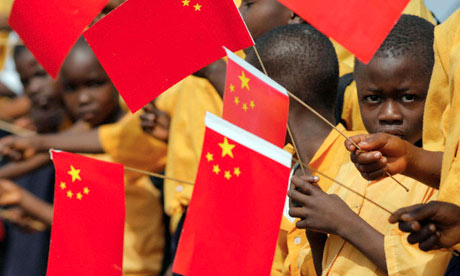
Liberian children hold Chinese flags before the arrival of China's President Hu Jintao. Photograph: Christopher Herwig/Reuters
After more than a century as the world's largest economy, the US will need to adjust to its declining global hegemony
Various observers have noted this week that China's economy will be bigger
than that of the United States in 2016. This comes from the International Monetary Fund's (IMF's) latest projections, which were made in its semi-annual April world economic outlook database. Since 2016 is just a few years away, and it will be the first time in more than a century that the United States will no longer be the world's largest economy, this development will be the object of some discussion – from various perspectives.
First, let's consider the economics. China has been the world's fastest growing economy for more than three decades, growing 17-fold in real (inflation-adjusted) terms since 1980. It is worth emphasising that most of this record growth took place (1980-2000) while the rest of the developing world was doing quite badly by implementing neoliberal policy changes – indiscriminate opening to trade and capital flows, increasingly independent central banks, tighter (and often pro-cyclical) fiscal and monetary policies, and the abandonment of previously successful development strategies.
China clearly did not embrace these policy changes, which were promoted from Washington by institutions such as the IMF, World Bank, and later the WTO. (China did not even join the WTO until 2002.) It is true that China's growth acceleration included a rapid expansion of trade and foreign investment. But these were heavily managed by the state, to make sure that they fitted in with the government's development goals – quite the opposite of what happened in most other developing countries. China's goals included producing for export markets, promoting higher levels of technology (with the goal of transferring technology from foreign enterprises to the domestic economy), hiring local residents for managerial and technical jobs, and not allowing foreign investments to compete with certain domestic industries.
China's economy is still very much state-led, with the government controlling most of the financial system, the exchange rate, and about 44% of the assets of major industrial enterprises. That is why China was able to plow through the world recession with GDP growth of 9.8%, despite losing about 3.7 percentage points of GDP due to falling net exports.
Now for the politics and international implications. First, much of the discussion of China's rise is written from a Washington perspective – that is, from the perspective of an empire. From this view, China's rise is a "threat". Since this view sees the supremacy of Washington and its allies as good for the world, China's rise is also seen as a threat to the world. It is assumed that China will become an empire like the United States, but will not be so "benevolent" as the United States is.
This view is not supported by the facts. To take just current and recent history, it is the United States that invaded Iraq, leading to an estimated million deaths, is occupying Afghanistan, bombing Pakistan and Libya, and threatening Iran. The United States' and its allies' control over many developing countries' economic policies through the IMF, World Bank and other institutions has also caused a lot of damage over the past few decades.
So, a shift of power toward a more multipolar world is likely to give us a more peaceful and just world. In fact, it is already happening: the majority of South America, for example, is now governed by democratic left governments that have produced positive reforms that benefit the majority – something that was practically impossible to achieve while Washington dominated the region. And of course, the vast majority of people in the United States also stand to benefit from a smaller US role in the world, as we transition back to a republic from an empire: less spending on senseless wars, fewer casualties, fewer enemies, less distraction from our real problems at home.
China's foreign policy is mainly geared toward securing the raw materials and trade that will fuel its growth and development. This is done through commercial transactions. Of course, its corporations – like those of the rich countries – have come under criticism in various countries. But China does not try to tell other countries what their foreign policy towards other countries, or their overall economic policies, should be – as the United States often does. This is an important difference between a country that pursues its own national and economic interests, and an empire that seeks to impose its own order on the world.
It is always possible that China, once it becomes a rich country – and this is many years away – could develop imperial ambitions. But so far, its leadership seems to see China as a developing country seeking to become a high-income country, and doesn't see a role for empire-building in this process. "Hide brilliance, cherish obscurity," Chinese leader Deng Xioaping once said.
A few months ago, press reports, using an exchange rate measure of GDP, announced that China had become the world's "second largest economy" just this year. But by a purchasing power parity (PPP) measure, which adjusts for the difference in many prices between China and the US, China had become the second largest economy years ago. A technical matter: if we measure China's economy in dollars at current exchange rates, it reached $5.9tn in 2010, as compared with $14.7tn for the US. By a purchasing power parity measure, its economy reached $10.1tn in 2010. It is that measure that the IMF projects to grow to $18.98tn in 2016, putting the US in second place at $18.81tn.
However, it is likely that even the IMF's PPP measure understates China's GDP: economist Arvind Subramanian has estimated that China's PPP GDP in 2010 was already about even with that of the United States. An IMF spokesperson, quoted this week by the Financial Times, weighed in on the debate:
"The IMF considers that GDP in purchase power parity (PPP) terms is not the most appropriate measure for comparing the relative size of countries to the global economy, because PPP price levels are influenced by non-traded services, which are more relevant domestically than globally … The Fund believes that GDP at market rates is a more relevant comparison. Under this metric, the US is currently 130% bigger than China, and will still be 70% larger by 2016."
It is true that the "market rate" measure is better for some comparisons. But one important place where the PPP measure is more relevant is in military spending. The cost of producing a military plane and training a pilot in China is much lower than in the United States. Washington's current policy is to maintain military supremacy in Asia, but an arms race with China could make the cold war look cheap by comparison. The Soviet Union's economy was just a quarter of United States' economy when we had that arms race. If the US were to have a serious arms race with China, we could forget about Medicare, social security and most of what our federal government spends money on.Fortunately, a new cold war with China is not in the cards for now. But the size of China's economy is another good reason to make sure that it doesn't happen.

Comment