Announcement

Collapse
No announcement yet.

Greg Mortenson to be sued by tribesmen he said kidnapped him

Collapse
X
 
  • Filter
  • Time
  • Show
Clear All
new posts

  • Greg Mortenson to be sued by tribesmen he said kidnapped him

    Greg Mortenson to be sued by tribesmen he said kidnapped him

    Three Cups of Tea author to have lawsuit filed against him by Mansur Khan Mahsud, who says his story is 'lies from A to Z'

    Greg Mortenson to be sued by tribesmen he said kidnapped him | World news | The Guardian
    • Saeed Shah in Lahore
    • guardian.co.uk, Wednesday 20 April 2011 20.25 BST <li class="history">Article history Greg Mortenson poses with schoolchildren in northeastern Afghanistan. The author has been accused of fabricating his autobiography. Photograph: Ho New/Reuters
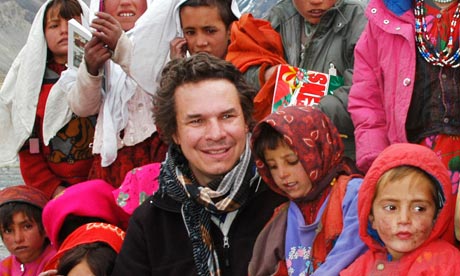
      Greg Mortenson, the author and philanthropist accused of fabricating large parts of his autobiographical writings, is to be sued by the Pakistani tribesmen he claimed kidnapped him.
      In his bestselling books about building schools in Pakistan and Afghanistan, one of the most startling stories tells how he was kidnapped by the Taliban and held hostage in Waziristan, the most dangerous part of Pakistan's western tribal border area with Afghanistan. A photograph in one book showed him with a dozen tribesmen, some armed, who were supposedly holding him captive.
      However, as with much else in the books, Three Cups of Tea and Stones into Schools, the tale is unravelling, following a US television exposé earlier this week.
      Mansur Khan Mahsud, who featured in the photograph, said that Mortenson came to his village of Kot Langer Khel, in the Laddah area of South Waziristan, in July 1996. Mahsud, who is the research director of a thinktank in Islamabad that specialises in the tribal area, said that the Taliban did not appear on the Pakistani side of the border until 2002, following the US-led invasion of Afghanistan.
      "Greg Mortenson came with a relative of mine and he was a guest of the village. He stayed for about 10 days. He was living in the village, sightseeing, taking photographs. He had a really good time," said Mahsud, adding that some of the tribesmen carried guns to protect Mortenson.
      In Mortenson's account, his hosts from the Mahsud tribe have been turned into the then better-known Wazir tribe, while the location has morphed to Razmak, North Waziristan.
      "It's lies from A to Z. There's not one word of truth. If there had been a little exaggeration, that could have been forgiven," said Mahsud. "The way that he's portrayed the Mahsuds, as hash-smoking bandits, is wrong. He's defamed me, my family, my tribe. We are respected people in my area. He's turned us into kidnappers."
      Mahsud said that he had decided to file a lawsuit against Mortenson and was in contact with a lawyer in the US.
      "I am looking into how to sue him," said Mahsud, who only found out about the story in the book when he was contacted in February this year by a whistle-blower, Jon Krakauer, who was featured in the US investigative show 60 Minutes on CBS News.
      The programme raised serious doubts over how many schools Mortenson had actually built in Pakistan and Afghanistan, and even his original story that he vowed to build his first school, for a Pakistani village, after its inhabitants rescued him when he got lost mountaineering. It also questioned the use of the millions in charitable funds he collects each year for the schools.
      Mortenson, whose charity is now under investigation by US authorities, has defended his work, admitting to only "some omissions and compressions".


  • #2
    Hopefully the international press generated over this powerful
    expose by 60 Minutes and Jon Krakauer's mini-book
    will permit some gratis legal counsel for this wronged host,
    Mansur Khan Mahsud.

    It's true: Greg's account made the villagers - supposedly Taliban -
    sound like something out of a Chinese opium den about 100 years ago !

    He or his ghostwriter went to great pains to make sure that the Taliban
    were portrayed as the most dreadful human beings.
    In fact, the description in the text of the book denies them any human status almost !

    There's a clear political indoctrination formula here, as well as attempt to generate
    sensationalistic reading material where otherwise the true story of travels in Pakistan would have
    lacked spice for any average American reader.

    Greg's whole theme was a call to "finance my schools and lure prospective
    madrassah students away from ultimately ending up with the odious Taliban".

    In reality, I bet a total of Zero students left madrassahs and went to his schools!

    So his line was phony.
    But it fit the American govt's political agenda like a glove...
    Last edited by Catya Sher; 04-20-2011, 09:56 PM.

    Comment


    • #3
      ‘Three Cups of Tea,’ Spilled


      Damon Winter/The New York Times

      Nicholas D. Kristof

      On the Ground

      Nicholas Kristof addresses reader feedback and posts short takes from his travels.
      Go to Blog »

      Go to Columnist Page »


      Enlarge This Image

      Nicholas D. Kristof/The New York Times

      Girls studying last year in a school in Afghanistan built and operated by Greg Mortenson.


      Readers' Comments
      Share your thoughts.


      In person, Greg is modest, passionate and utterly disorganized. Once he showed up half-an-hour late for a speech, clumping along with just one shoe — and then kept his audience spellbound with his tale of building peace through schools.


      http://www.nytimes.com/2011/04/21/op...21kristof.html‘Three Cups of Tea,’ Spilled

      By NICHOLAS D. KRISTOF

      One of the people I’ve enormously admired in recent years is Greg Mortenson. He’s a former mountain climber who, after a failed effort to climb the world’s second-highest mountain, K2, began building schools in Pakistan and Afghanistan.
      In person, Greg is modest, passionate and utterly disorganized. Once he showed up half-an-hour late for a speech, clumping along with just one shoe — and then kept his audience spellbound with his tale of building peace through schools.
      Greg has spent chunks of time traipsing through Afghanistan and Pakistan, constructing schools in impossible places, and he works himself half to death. Instead of driving around in a white S.U.V. with a security detail, he wears local clothes and takes battered local cars to blend in. He justly berates himself for spending too much time on the road and not enough with his wife, Tara Bishop, and their children, Amira and Khyber.
      I’ve counted Greg as a friend, had his family over at my house for lunch and extolled him in my column. He gave a blurb for my most recent book, “Half the Sky,” and I read his book “Three Cups of Tea” to my daughter. It’s indisputable that Greg has educated many thousands of children, and he has been nominated for the Nobel Peace Prize.
      And now his life’s work is tottering after a “60 Minutes” exposé and an online booklet by Jon Krakauer, a onetime supporter. Greg is accused of many offenses: misstating how he got started building schools; lying about a dramatic kidnapping; exaggerating how many schools he has built and operates; and using his charity, the Central Asia Institute, “as his personal A.T.M.” The attorney general of Montana, where his charity is based, has opened an inquiry into the allegations.
      I don’t know what to make of these accusations. Part of me wishes that all this journalistic energy had been directed instead to ferret out abuses by politicians who allocate government resources to campaign donors rather than to the neediest among us, but that’s not a real answer. The critics have raised serious questions that deserve better answers: we need to hold school-builders accountable as well as fat cats.
      My inclination is to reserve judgment until we know more, for disorganization may explain more faults than dishonesty. I am deeply troubled that only 41 percent of the money raised in 2009 went to build schools, and Greg, by nature, is more of a founding visionary than the disciplined C.E.O. necessary to run a $20 million-a-year charity. On the other hand, I’m willing to give some benefit of the doubt to a man who has risked his life on behalf of some of the world’s most voiceless people.
      I’ve visited some of Greg’s schools in Afghanistan, and what I saw worked. Girls in his schools were thrilled to be getting an education. Women were learning vocational skills, such as sewing. Those schools felt like some of the happiest places in Afghanistan.
      I also believe that Greg was profoundly right about some big things.
      He was right about the need for American outreach in the Muslim world. He was right that building schools tends to promote stability more than dropping bombs. He was right about the transformative power of education, especially girls’ education. He was right about the need to listen to local people — yes, over cup after cup after cup of tea — rather than just issue instructions.
      I worry that scandals like this — or like the disputes about microfinance in India and Bangladesh — will leave Americans disillusioned and cynical. And it’s true that in their struggle to raise money, aid groups sometimes oversell how easy it is to get results. Helping people is more difficult than it seems, and no group of people bicker among themselves more viciously than humanitarians.
      After my wife and I wrote “Half the Sky,” we decided not to start our own foundation or aid organization but simply to use our book and Web site to point readers to other aid groups — partly because giving away money effectively is such difficult and uncertain work.
      The furor over Greg’s work breaks my heart. And the greatest loss will be felt not by those of us whose hero is discredited, nor even by Greg himself, but by countless children in Afghanistan who now won’t get an education after all. But let’s not forget that even if all the allegations turn out to be true, Greg has still built more schools and transformed more children’s lives than you or I ever will.
      As we sift the truth of these allegations, let’s not allow this uproar to obscure that larger message of the possibility of change. Greg’s books may or may not have been fictionalized, but there’s nothing imaginary about the way some of his American donors and Afghan villagers were able to put aside their differences and prejudices and cooperate to build schools — and a better world.  
      •
      I invite you to visit my blog, On the Ground. Please also join me on Facebook, watch my YouTube videos and follow me on Twitter.
      Last edited by Guest; 04-21-2011, 02:22 AM.

      Comment

      Working...
      X