
 Tweet
I think hegemony is not the appropriate word to use when it comes to free thought...but it is worthwhile to ask what restrained women to establish that "hegemony" and likewise what is restraining Muslims?
-
-
Science & islam
A BBC documentary examining the great leap in scientific knowledge that took place in the Islamic world between the 8th and 14th centuries.
Isaac Newton is, as most will agree, the greatest physicist of all time.
At the very least, he is the undisputed father of modern optics, or so we are told at school where our textbooks abound with his famous experiments with lenses and prisms, his study of the nature of light and its reflection, and the refraction and decomposition of light into the colours of the rainbow.
Yet, the truth is rather greyer; and I feel it important to point out that, certainly in the field of optics, Newton himself stood on the shoulders of a giant who lived 700 years earlier.
For, without doubt, another great physicist, who is worthy of ranking up alongside Newton, is a scientist born in AD 965 in what is now Iraq who went by the name of al-Hassan Ibn al-Haytham.
Most people in the West will never have even heard of him.
As a physicist myself, I am quite in awe of this man's contribution to my field, but I was fortunate enough to have recently been given the opportunity to dig a little into his life and work through my recent filming of a three-part BBC Four series on medieval Islamic scientists.
Modern methods
Popular accounts of the history of science typically suggest that no major scientific advances took place in between the ancient Greeks and the European Renaissance.
But just because Western Europe languished in the Dark Ages, does not mean there was stagnation elsewhere. Indeed, the period between the 9th and 13th Centuries marked the Golden Age of Arabic science.
Great advances were made in mathematics, astronomy, medicine, physics, chemistry and philosophy. Among the many geniuses of that period Ibn al-Haytham stands taller than all the others.
Ibn al-Haytham is regarded as the father of the modern scientific method.
As commonly defined, this is the approach to investigating phenomena, acquiring new knowledge, or correcting and integrating previous knowledge, based on the gathering of data through observation and measurement, followed by the formulation and testing of hypotheses to explain the data.
First shown on BBC4 05/01/2009
Professor Jim Al-Khalili presents Science and Islam
Comment
-
Tormana, it is not a matter of why they haven't established a hegemony, it is a matter of when they do.
When the Muslims have that hegemony, there may be talk of the Europeans who saved and passed on the works of great Arab Scientists and a few Brilliant Europeans who made contributions like Newton.
When the women have that hegemony, there will be etc.
God is made in man's image as it were.Comment
-
you are very confusing, what is your point actually?Originally posted by 3.14159265... View PostComment
-
Without the Arabs, non of that greek mathematical thinking would be possible. The Arabs brought math to the level where people could start playing around with numbers. The Chinese also contributed to this, but the Golden Age's impact was landmark.Originally posted by Toramana View Post
If it was not for Muslim Turks, there would be no pants. They are the originators of it.Comment
-
Read the previous posts!!! 1,2,3,4,5,6-> these are not English numerals, they were taken from the Arabs and modified. Look at the Arab numerals and compare.Originally posted by Toramana View PostComment
-
Also, you all should read up on Bucailism (talks about Islam and science and how they are connected)Comment
-
.Last edited by Levanaye Zalmaye; 12-15-2011, 12:09 PM."If a nation expects to be ignorant and free, in a state of civilization, it expects what never was and never will be".
"Knowledge will forever govern ignorance; and a people who mean to be their own governors must arm themselves with the power which knowledge gives".Comment
-
The first muslim scientists were firmly believers in the Quran and they followed the sunnah. Even the great philosphers did that. Quran is completely compatible with science and positive technology. There is no verse in the quran which is against science, scientist or scholars in other fields than theology.Originally posted by Levanaye Zalmaye View PostLast edited by Guest; 09-21-2010, 11:21 AM.Comment
-
Introduction to the Education System
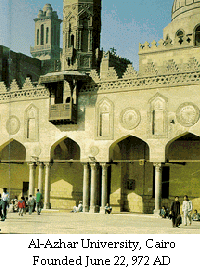 Education in any civilization represents a key tool in educating ones people with the thoughts the civilization is established upon. Over the centuries many nations have codified the manner of educating their youth and developed curriculums to achieve this. History shows us whenever a nation was in the process of being conquered the education system or curriculum was uprooted and replaced to ensure the conquered were also intellectually conquered. Even today the Muslim world is being forced by America to change her education curriculum so as to comply with her ideological views. Hence the Arab states such as Saudi Arabia, Kuwait, Jordan and Egypt have reviewed their curriculums under the pretext of development and compliance with the age. Saudi Arabia even went as far as changing one of the most important religious subjects in its school books, the subject of allegiance and dissociation (al-walaa’ and al-baraa’). Similarly Jordan, Egypt and Kuwait have changed subjects related to jihad.
Education is the method to preserve the Ummah’s culture in the hearts of its children, whether it is prescribed or non-prescribed education. The education curriculum means education regulated by State, with the State responsible for implementing it this would mean setting the starting age, subjects of study and education method. Whereas non-prescribed education is left to Muslims to teach in homes, mosques, via media, periodical publications etc without being subjected to the state. In both cases, however, the State is responsible to ensure that the thoughts and knowledge (being taught) either emanate from the Islamic intellectual doctrine or are built upon it.
The culture taught would be central to the correct development of the ummah’s youth and ensure the correct personalities are nurtured. The culture of any nation is the backbone of its existence and survival. Based on this culture, the Ummah’s civilization is founded; her goals and objective in life are defined. The Ummah is molded by this culture in one melting pot such that the Ummah becomes distinguished from other civilizations.
The Islamic culture is the knowledge built upon the Islamic aqeedah. This would include the science of tawheed, jurisprudence (fiqh), exegesis (tafseer) of the Qur’an and the Prophetic traditions (hadith). The culture would also include all the rules related to understanding such fields such as the knowledge of ijtihaad (scholarly exertion) the Arabic language, classification of the Prophetic traditions (mustalah al-hadith) and science of the foundations of jurisprudence (Usul). All of this is the Islamic culture as all of them in origin come from the Islamic aqeedah. Similarly the history of the Islamic Ummah is a part of this culture due to what it contains of events and incidents about its civilization (hadhara), celebrities (rijal), leaders and scholars. Pre-Islamic Arab poetry is also part of the Islamic culture as this field contains evidences that help us understand the words and syntax of the Arabic language, and consequently help in the making of ijtihaad, tafseer of the Qur’an and understanding hadith.
The Ummah’s culture creates the character of its individuals. It moulds the individual’s intellect and his method of judging things, statements and actions just as it moulds his inclinations, thereby influencing his mentality, disposition (nafsiyya) and behaviour (sulook). Thus the preservation and spread of the Ummah’s culture in society is among the chief responsibilities of the Islamic State. The Soviet Union historically fostered its youth upon Communist culture and attempted to prevent any infiltration of Capitalist or Islamic thought into its culture. The entire West nurtured its children upon its Capitalist culture that is built upon separation of religion from life. It organised and founded its life based upon that basis, and waged wars—as it continues to do so today—to prevent the Islamic culture from penetrating its doctrine and culture. The Islamic State endeavoured to implant the Islamic culture into its children and prevented anyone who calls for any thought not built upon the Islamic aqeedah. The Islamic state would carry its culture to other States and nations via da’wah. This will continue until Allah inherits the earth and whoever resides on it (i.e. until the Day of Judgement).
Among the most important guarantees of preservation of the Ummah’s culture is that its culture be memorised in hearts of its children and preserved in books, together with the Ummah having a State ruling over it and taking care of its affairs according to the rules and articles emanating from the intellectual doctrine of this culture.
Below is a brief overview of how Islam and a future Khilafah state would deal with the education of its people.
• The Islamic aqeedah constitutes the basis upon which the education policy is built. The curriculum and methods of teaching are designed to prevent a departure from this basis. Thus, the education system Islam is composed of the totality of Shari’ah rules related to the education curriculum. The Shari’ah rules related to education emanate from the Islamic aqeedah and they have Shari’ah evidences, such as the subjects of study and separating between male and female students. The methods of teaching are in reality permitted means and styles which Islam considers beneficial in implementing the system and achieving its goals. They are worldly matters susceptible to evolution and change according to what appears most suitable to implement the Shari’ah rules related to education and the Ummah’s basic needs. They can be adopted from experiments, experts, research or other nations.
• The purpose of education in Islam is to form the Islamic personality in thought and behaviour. Therefore all subjects in the curriculum must be chosen on this basis.
• The goal of education is to produce the Islamic personality and to provide people with the knowledge related to life’s affairs. Teaching methods are established to achieve this goal; any method that leads to other than this goal is prevented.
• A distinction is drawn in Islam between the empirical sciences such as mathematics and the cultural sciences such as psychology, sociology and law. The empirical sciences and all that is related to them are taught according to needs of the ummah and are not restricted to any stage of education. The cultural sciences are taught at both primary and secondary levels according to a specific policy that does not contradict Islam. In higher education, these cultural sciences are studied like other sciences provided they do not lead to a departure from the stated policy and goal of education. This is because psychology answers questions such as the composition of humans and peoples behavior, sociology answers questions on why society behave in certain ways and law provides solutions to human problems from sources which would differ depending on the belief system of the nation in question.
• The Islamic culture would be taught at all levels of education. In higher education, departments should be assigned to the various disciplines such as medicine, engineering, physics etc.
• Certain fields require distinctions to be made as they can be linked to foreign culture, hence arts and crafts could be related to science, such as commerce, navigation and agriculture. In such cases, they are studied without restriction or conditions. However, arts and crafts can be connected to a foreign culture and influenced by a particular viewpoint of life, such as painting and sculpting. If this viewpoint of life contradicts the Islamic viewpoint of life, such arts and crafts are not adopted.
• The Islamic State would adopt a curriculum and no curriculum other than that of the State is allowed to be taught. Private schools provided they are not foreign, are allowed as long as they adopt the State’s curriculum and establish themselves on the State’s educational policy and accomplish the goal of education set by the State. Teaching in such schools should not be mixed between males and females, whether for students or teachers; and they should not be specific for a certain deen, madhab, race or color.
• It is an obligation upon the Islamic State to teach every individual, male or female, those things that are necessary for the mainstream of life. This is due to the abundance of evidences which make seeking knowledge obligatory. This should be made obligatory on all youth and provided freely in the primary and secondary levels of education. The State should, to the best of its ability, provide the opportunity for everyone to continue higher education free of charge.
• The Islamic State ought to provide the means of developing knowledge, such as libraries and laboratories, in addition to schools and universities, to enable those who want to continue their research in the various fields of knowledge, like fiqh, Hadith and tafseer of Qur’an, thought, medicine, engineering and chemistry, inventions and discoveries etc. This is done to create an abundance of mujtahideen, outstanding scientists and inventors.
• As Islam has no copyrights and patents once a book has been printed and published, nobody including the author has the right to reserve the publishing and printing rights. However, if the book has not been printed and published, and thus is still an idea, the owner has the right to take payment for transferring these ideas to the public in the same way he can take payment for teaching them. Thus anyone can set up a newspaper, journal or periodical. This will ensure thought develops.Comment
-
Confusing is sometimes good.Originally posted by Maiwand View Post
In this case I was telling Tormana that the reason it appears that Muslims are devoid of scientific ingenuity on a grand and sustained state is because European scientists are writing history.
Khayyam's solution of the cubic is ignored for Cardano's.
Ibn Sina's ideas on momentum are ignored for Newton's.
Al-Biruni's very modern ideas about heliocentricity and geocentricity are ignored for Galelio's.
In conclusions it appears as though Muslims have not contributed greatly, not because they have or have not, but because Europeans wrote the current common scientific history.Comment
-
Maiwand you are confusing an issue.
See first there are two cases.
1) The Arabs of the Golden age were awesome scientists.
2) The Arabs of the Golden age were not awesome scientists.
Now, suppose we accept 1), then we have three scenerios.
1) Islam caused the Arabs of the Golden age to be awesome scientists.
2) Islam not only didn't cause the Arabs of the Golden age to be awesome, but it even represented a hindering like the Evangelical Christians of today are a hindered to science.
3) The case for causality is not so simple and there are forces created by Islam which helped (A peaceful setting, with good communication routes) and there were forces created by Islam which hindered (Consider the life story of Omar Khayyam).Comment
-
^Your logical thinking is very much appreciated.Comment
-
I agree with you to a certain extent. But we have to not forget the fact that Islam as such and the Quran are not against science or scientists, like the Catholic Church and its teachings were against science and scientists of the Middle-ages. So even when some muslim ruler were at some point in time corrupt and were against scientists, it doesn't mean that Islam was against science or that the Quran was against science. It is actually the contrary, Islam, the Quran and the prophet (pbuh) was an inspiration for the scientists of that time, they were motivated by it, it was a positive force directing their efforts. Not one verse of the Quran of saying of the prophet is against science or scientists. God says in many verses of the Quran, that the muslims should do research and think about the world, life, planets etc. We are commanded to search for knowledge and to think critically. As a muslim we should be rational human beings and not blind followers, like in other religions and cults. That's why Islam is the truth and it is completely compatible with scientific truth and knowledge.Originally posted by 3.14159265... View PostComment
-
As is Christianity Maiwand. Have you read the New Testament?
The pope does not represent Christianity as Mullah Umar or Khomeini don't represent Islam.Comment

Comment