Announcement

Collapse
No announcement yet.

Aristotelians Anonymous: Ash;ari Burn-out Clinic

Collapse
X
 
  • Filter
  • Time
  • Show
Clear All
new posts

  • Aristotelians Anonymous: Ash;ari Burn-out Clinic

    Aristotelians Anonymous: The Official Launch - Time For A New Beginning!
    Filed under: Articles
    Monday, November 09 2009 - by Asharis.Com
    Key topics: Aristotelians Anonymous • Intoxication • Kalaam • Liquor Mail to a Friend • Printer friendly

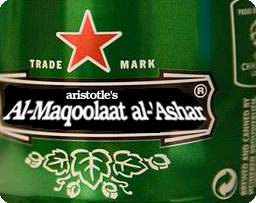
    Welcome to the official launch of Aristotelian's Anonymous - a Detox and support program run in association with our Clinic for victims who compulsively "speak creed under influence" and are unable to let go of this habit which can have devastating effects upon one's intellect, soul, life, and abode in the Hereafter. With this official launch we would like to lay down both the theoretical and practical aspects of our support group as well as introduce a new phraseology that will allow rapid understanding and quick communication of ideas and concepts to help victims.
    Understanding Intoxication
    Medically, Intoxication is generally defined as "an abnormal [mental, psychological] state that is essentially poisoning", and this definition is based around "physical intoxication" brought about through drugs, alcohol, serum or any toxic substance.
    With that broad definition in mind, we should realize, for our purposes at the AA, that there are four types of intoxication:

    • Level 1: Physical Intoxication through substances such as drugs, alcohol, toxic substances and the likes. This affects the body as a whole, as well as the mind. Whilst temporarily befogging the mind and affecting the faculties, it also does long-term damage to the body. This is very obvious and the person intoxicated knows that he or she is intoxicated. Bad company, low self-esteem, as well as poor parenting usually push individuals towards this level of Intoxication.
    • Level 2: Intoxication through lusts and desires, so a person's heart is poisoned with these lusts and desires which invite it to every vice and evil. The person intoxicated with these lusts and desires again recognizes that he or she is so intoxicated and is certainly aware that there is a problem. Overexposure to unlawful things is usually behind this type of poisoning.
    • Level 3: Intoxication through mere thoughts and ideas, so a person's heart and mind are intoxicated with them and they are not necessarily lusts and desires but just thoughts and ideas that consume a person and busy him away from other beneficial and fruitful thoughts. A person may or may not be aware that they are intoxicated with what may only appear to be innocent, non-harmful thoughts. This is usually characteristic of daydreamers and those who think excessively, becoming oblivious to their lives, relationships, responsibilities and surroundings. Notice, how in the first two levels the victim is acutely aware that they have a problem, whereas with level three the tide is turning.
    • Level 4: Intoxication through terms, phrases and definitions, or "intellectual poisoning". This is when a person's mental faculties and thinking are poisoned and compromised with terms, definitions of dubious origin. Now, this is the most insidious of all the types and a person is usually oblivious to this foreign influence. Of all the types this is the most dangerous, it is long-lasting, and extremely difficult to detoxify. This is because a person's entire apparatus of thought and conception is compromised through the false belief that these terms, phrases and definitions are the ultimate reference point for determining truth. Whilst compulsive behaviour in the previous types is easily recognized and traced to the actual Intoxication, in this fourth type, a person is usually deluded and blinded from recognizing the compulsive behaviour this type of Intoxication has lead them to. Most victims in this category have usually been "spiked" and forced into the habit almost unawares.

    Our Detox and support program will be focusing on Level 4 due to its very insidious nature. It is the most difficult and challenging of levels to treat, but hopefully, if we can break that barrier and overcome the hurdle, we are certain the lives of tens of thousands of victims will be turned around put back on track.
    How Are Victims First Introduced to the Bottle?
    As we mentioned in our early announcement about the AA (see here), most victims that we have come across have unfortunately been "spiked". And it works something like this:
    The predator first convinces the victim that the greatest threat and challenge to a Muslim's belief is Atheism (disbelief in a creator). The victim accepts this premise and thus anticipates a remedy. The predator then presents the idea that the ultimate truth is "rationally proving Allaah exists" and that "rationally proving Allaah exists" is the ultimate foundation of a Muslim's faith. The predator may even go as far as to say that if a person does not know how to rationally demonstrate the existence of a creator, he has no faith at all and is not a Muslim. All of this is part of setting up the victim. Note there is a difference between a person affirming his belief in a Creator by simply uttering the two testimonies of faith (which is the very first thing the Messengers called to) and between a person "rationally proving a creator" (see Ibn Hajr on this here and here). The victim by now will have been disarmed, and it is here that the victim is "spiked" with the terms, definitions and classifications that are used as part of the claimed rational demonstration. Once "spiked" the victim is unable to let go of such foreign terms, definitions and classifications when speaking about Allaah the Most High.
    This is the start of a very tiring and wearisome path in which a person has unwittingly set themselves up, after a life-time of abuse, for the condition known as "Ash'ari Burnout". In fact, we have already started treating some cases in our Clinic.
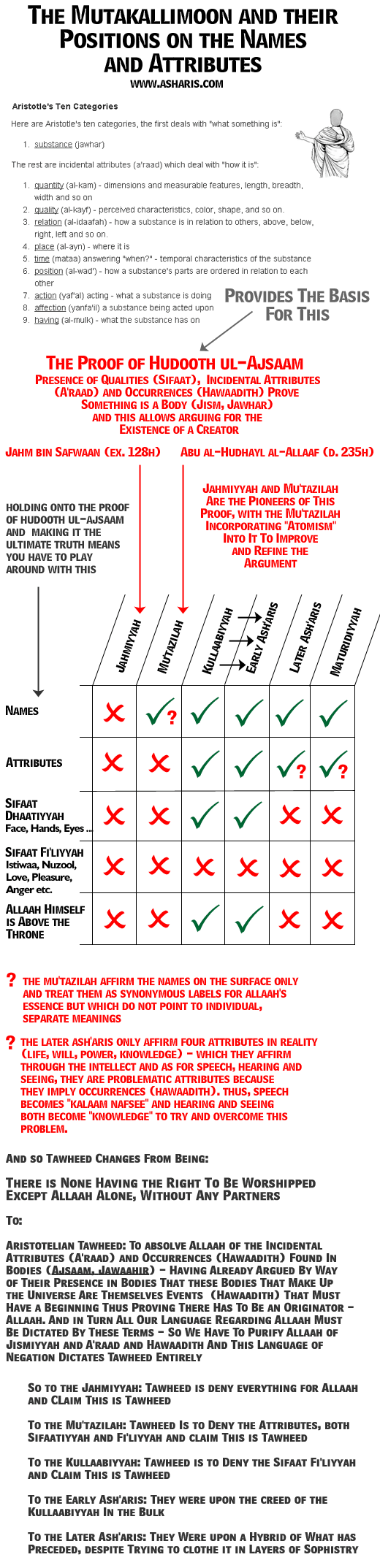
    From both the few clinical studies and the many non-clinical observational studies we have done so far, once spiked, the victims' entire thought patterns and conceptual frameworks are essentially reduced what is found in this diagram:
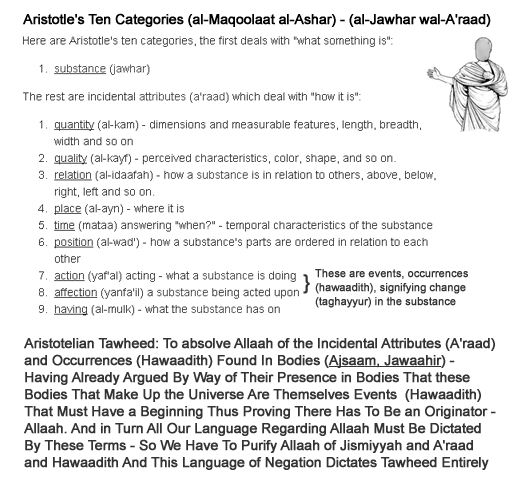
    Once, this has taken place, the victim will be subject to a potential lifetime of bondage to the bottle, and the container can only pour what it has been filled with, as the saying goes.
    For readers with interest, it is probably appropriate to give a brief account of how the "Maqoolaat" were seeded and matured over the centuries.
    The Maqoolaat and hudooth ul-ajsaam (Createdness of Bodies) - A Very Brief and Concise History The first to sow its seeds was Jahm bin Safwan (ex. 128H). He used the basic language and classification of the Maqoolaat (al-jawhar wal-'arad) to devise an argument against the Indian Materialist Philosophers (the Sumaniyyah) to prove the universe is created and must have a creator. So he argued that the bodies (ajsaam, jawaahir) making up the universe are not free of sifaat (qualities), a'raad (incidental attributes) or events, occurrences (hawaadith, a thing doing something or something being done to a thing), and this proves that these bodies too must be occurrences (hawaadith) and since occurrences and events can't go on for infinity and have no beginning there must be a creator.
    So basically a thing can be said to be created, or brought about if it merely has qualities (sifaat) or incidental attributes (a'raad) or events, occurrences (hawaadith) taking place. And included in these three types are such things as color, shape, taste, smell, dimensions, size, borders, place, location, direction, texture, density, movement, rest, motion and so on.
    Now the Mut'azilah came along (with the Ash'aris tailing behind them by about 200 years) and they said regarding what was pioneered by the Jahmiyyah:
    We want to tighten up this a bit more, and what we are going to do is to introduce the notion of the indivisible particle (al-jawhar al-fard, al-juz alladhee laa yatajazza'), and we are going to say that the entire universe is made up of exactly the same, like, indivisible particles - so that now arguing for the createdness of the universe in its entirety has become a whole lot easier. This way, fire, water, wood, flesh, metal, leaves and so on are all made up of exactly the same particles and what makes them different to each other is only the difference in their incidental attributes. So fire is made of the same particles as water, and what makes either of them what they are is just the change in the incidental attributes of the particles they are both made of. So now instead of messing about with all those different qualities and incidental attributes such as color, taste, smell, breadth, depth, height, location, place, texture and so on which are found in all those different types of bodies that make up the universe, and each of which may not be true of all bodies (ajsaam) - we only need to use the two pairs of either rest (as-sukoon) and motion (al-harakah), or combination (al-ijtimaa') and separation (al-iftiraaq) at the level of this indivisible particle to argue the case that the entire universe is created? Why? As we have now said that the whole universe is made up of the same indivisible particle (a concept called "tamaathul ul-ajsaam", the similarity of bodies), our argument that if two indivisible particles came together, or separated from each other, or one came to rest after motion, or went into motion after rest, that they must have been made to do so by an agent (the creator), then this applies to the entire universe through the two notions a) the entire universe is made up of indivisible particles and b) the similarity of bodies (tamaathul ul-ajsaam), that all bodies are made up of like particles - so what can be said about one body can be said about each and every body in the entire universe - and bingo! We've just simplified the proof and made it easily applicable to the entire universe!
    The one who pioneered this for the Mu'tazilah was Abu al-Hudhayl al-Allaaf (d. 235H). Then the Ash'arites came along and particularly al-Baqillani (d. 403H), he formalized it for the Ash'arites, with some subsidiary differences in detail with the Mu'tazilah. Please note that Abu al-Hasan al-Ash'ari himself considered the use of this proof prohibited, and an innovation, and it was not he but al-Baqillani (d. 403H) who formalized it as part of what became known as the Ash'arite creed.
    Now all of this started off with Aristotle's al-Maqoolaat al-Ashar (the Ten Categories) otherwise known as "al-Jawhar al-'Arad" (Substance and Accident) and its associated language and as the whole focus was to argue for the createdness of the bodies (ajsaam) that make up the universe, then it was absolutely necessary that all speech about Allaah is fundamentally and inextricably tied to this same language to ensure this proof was not invalidated.
    Thus, Tawheed was simply reduced to negating from Allaah whatever would amount to qualities (sifaat), incidental attributes (a'raad) and events, occurrences (hawaadith). So the Jahmiyyah negated everything they considered to be sifaat, a'raad and hawaadith, and the Mu'tazilah likewise, and the Kullaabiyyah came along and tried to tread a middle ground, accepting everything except the Sifaat Fi'liyyah (Attributes of Allaah tied to His Will and Power) because they still amounted to occurrences, events (hawaadith), and then the Early Ash'aris simply adopted the bulk of the Kullaabi Creed while the Later Ash'aris (from the late fifth century onwards) reverted to many of the positions of the Jahmiyyah and Mu'tazilah.
    And so we find the only differences between them all (the Mutakallimoon, the Jahmiyyah, Mu'tazilah, Kullaabiyyah and As'hariyyah) are pertaining to what can and cannot be affirmed or rejected for Allaah without invalidating this intellectual proof. This is the true nature of the dispute between those who came "under the influence". And all of the polemics in this regard became a "fine art", and this is what makes up the "fine art" that is supposedly in the textbooks of the Ash'aris.
    We have extensively covered this in many articles on this site and you can refer to them for further information. Our aim here was merely to show how the Vintage 322BC came to be and how it matured over the centuries, and has become very appealing, alluring and of course "intoxicating".
    How Can You Tell Someone Is "Speaking Creed Under Influence"
    The signs of "speaking creed under influence" are very obvious and apparent to the observer, though the victim, due to the insidious nature of that Vintage 322BC, will not be any the wiser. In fact, upon the false premise that rationally proving Allaah's existence was the ultimate goal of the Prophets and Messengers, the victim in his delusion, will be thinking that he is at the peak of mental agility and intellectual brilliance.
    Broadly speaking, when you mention phrases and statements that occur in the revealed texts, (which ought to be left intact, as they have come), you will note the compulsive need to interfere with such revealed texts through the language, terminology, implications and necessities arising from Aristotle's al-Maqoolaat al-Ashar. It is best to demonstrate this with a typical dialogue between a Sunni Muthabbit and Spiked Victim:
    Sunni Muthabbit: Allaah is most-knowledgeable of His Self and His Messenger is the most-knowledgeable of all of the creation of Him, as well as the most eloquent in speech, and from what they have stated is Allaah is "above the heaven" and Allaah is "above the Throne". Spiked Victim: Hey! Hold it right there, are you specifying "where" Allaah is and are you saying that He is confined in a location above the Throne?
    Sunni Muthabbit: Hey, I just simply said that Allah and His Messenger said that Allaah is "above the heaven" and "above the Throne", I said nothing besides what is explicitly in the revealed texts and these statements are free of any false meanings that you are presuming, and statements likes these are found in great abundance in the revealed texts.
    Spiked Victim: See! You said it again. You just spoke of the "whereabouts" of Allaah (al-ayn), and you said He is confined in a location (makaan) and that's an 'arad (incidental attribute) of a jism (body), dude you are bordering on kufr!
    Sunni Muthabbit: Hey, can I smell your breath? I just said that Allah and His Mesenger said that Allaah is "above the heaven" and "above the Throne", I said nothing else and these statements are inherently free of any false meanings you are presuming. This is what the Companions said, and the entirety of the Salaf said, and they transmitted it in clear unambiguous words to the rest of the Ummah, and I don't know what you are saying or where you are bringing these false necessities.
    Spiked Victim: I knew it! You said it again, you've just claimed Allaah is a jism (body) because only bodies have the incidental attribute ('arad) of "location" and "whereness" (al-ayn), and that's kufr man because it opposes the very foundation of belief in Allaah, which is proving that He exists, because only bodies (ajsaam) have shapes, sizes, locations, and directions (meaning, al-kam, al-kayf, al-ayn, al-idaafah and so on) and Allaah is free of all of that!
    Sunni Muthabbit: Now listen up, you've been on that Vintage 322BC again haven't you?! You need to go home, take a cold shower and just relax. I said no such thing that you are presuming or imagining things. I only know the speech of Allaah and His Messenger, and the speech of Allaah and His Messenger is not in need of explanations from the speech of those heretical atheist Philosophers whose language you are intoxicated by whilst claiming at the same time to oppose them and refute them through it!
    You can see from this typical dialogue that "speaking creed under the influence" has obvious and apparent signs, though at times they can be very subtle and hardly discernible. We will be conducting special workshops on some of these specific issues, so if you do know of those who habitually "speak creed under influence", please send them in our direction.
    What About Disciplinary Measures at Aristotelians Anonymous?
    The ruling for drinking intoxicants is forty lashes as the actual hadd (prescribed punishment), and then a further forty as ta'zeer (disciplining, exemplary punishment) at the discretion of the judge (qaadee), and this is usually done with palm-branches (stripped of their leaves). Al-Bukhari reports in his Sahih in Kitab ul-Hudood (Book of Prescribed Punishments) no. 6391:

    عن أنس بن مالك رضي الله عنه:أن النبي صلى الله عليه وسلم ضرب في الخمر بالجريد والنعال، وجلد أبو بكر أربعين.
    From Anas bin Malik (radiallaahu anhu) who said: That the Prophet (sallallaahu alayhi wasallam) in [the hadd punishment] for drinking intoxicants struck [the guilty] with palm-branches and shoes, and Abu Bakr lashed with forty [lashes].
    And there are numerous other narrations in the same book in the Sahih in this regard. Based upon the fact that the one who enters into substance abuse inevitably befogs his mind and does not in reality understand or know what he or she is doing, it is hardly surprising that the Salaf stipulated a similar punishment for those who enter into kalaam abuse, befogging their intellects and subsequently not understanding the reality of what they are saying.
    It is well-known and narrated from Imaam ash-Shaafi'ee (d. 204H) as occurs in Siyar A'laam in Nubulaa of adh-Dhahabi, (10/29) and Sawn ul-Mantiq of as-Suyuti, (no. 65), also in Manaaqib us-Shaafi'ee (1/462), and in Dhamm ul-Kalaam wa Ahlihi of Abu Isma'il al-Harawi (4/294-295) that he said:

    حكمي في أهل الكلام أن يضربوا بالجريد ويحملوا على الإبل و يطاف بهم في العشائر ينادى عليهم هذا جزاء من ترك الكتاب والسنة واقبل على الكلام
    My ruling regarding Ahl ul-Kalam is that they are to be beaten with palm-branches and shoes, carried upon camels and paraded amongst the kinsfolk, it being announced about them, "This is the recompense of the one who abandoned the Book and the Sunnah and turned to kalaam."
    And ash-Shaafi'iee was very severe against Ilm ul-Kalaam and its adherents. In fact, he declared Hafs al-Fard a kaafir for his saying that the Qur'an is created. Many victims who are observed "creeding under the influence" these days and who identify themselves as Ash'aris also speak with the same speech as Hafs al-Fard. However, they vehemently deny that they are in reality saying this, which is an indication that they do not realize they are "poisoned". See here for more details on this subject.
    Imaam ash-Shaafi'ee (d. 204H) said, as reported by as-Suyuti in Sawn al-Mantiq (1/47-48):

    ماجهل الناس ولااختلفوا إلا لتركهم لسان العرب وميلهم إلى لسان ارسطوطاليس
    The people did not become ignorant and nor differ (with each other) except due to their abandonment of the language of the Arabs and their inclination to the language of Aristotle.
    This statement of ash-Shaafi'ee (rahimahullaah) is true both in the affairs of creed (aqidah) and in jurisprudence (fiqh), for both the Metaphysics and the flawed syllogistic and other forms of logic of Aristotle corrupted both of these disciplines for those who turned to the language, logic and Metaphysics of Aristotle.
    Having said all of this, we will not be implementing any of these measures at Aristotelians Anonymous at this point in time, as we believe that effective counseling is always the first step in any correctional facility, and it always tends to pays off in the long term. With extreme and rare cases however, we will keep our options open.
    We would also like to make clear the difference between sound reasoning or argument and the kalaam that is al-jawhar wal-'arad (Aristotle's Ten Categories) for many people confuse between the two, and they refer to both as "Kalaam". We do not prohibit the use of sound reasoning and argument in order to refute what opposes the Book and the Sunnah, however, the Kalaam of al-jawhar wal-'arad is the condemned "intoxicant" that the Salaf reprimanded and many victims wrongly think that such Kalaam is permissible and that it is the same as sound reasoning and argument. It's not. This Kalaam is expressly forbidden, and it is the very Kalaam that the creed of the Jahmiyyah, Mu'tazilah, Kullaabiyyah, Ash'ariyyah and Maturidiyyah is based upon. Go and take a look at any standard Ash'arite textbook. The bulk of the opening of the book will always be spent on detailing Aristotle's al-jawhar wal-'arad, and arguing for the createdness of the universe through this terminology. We will be covering this subject in one of our planned Detox workshops inshaa'Allaah.
    For now, we will suffice with the saying of Ibn Suraij ash-Shaafi'ee (d. 306H) as narrated from him by Abu Ismaa'eel al-Harawi in "Dhamm ul-Kalaam":

    توحيد اهل العلم وجماعة المسلمين أشهد أن لا اله الا الله وان محمدا رسول الله وتوحيد اهل الباطل الخوض في الأعراض والأجسام وانما بعث النبي صلى الله عليه وسلم بانكار ذلك
    The Tawheed of the people of knowledge and the jamaa'ah of the Muslims is "I testify none is worthy of worship except Allaah (alone) and that Muhammad is the Messenger of Allaah". And the Tawheed of the people of falsehood is disputing about al-a'raad (incidental attributes) and al-ajsaam (bodies) and the Prophet (sallallaahu alayhi wasallam) was sent with the rejection of that.
    And an entire treatise could be written just on this statement alone inshaa'Allaah.
    What is the Starting Point?
    The first step in our Detox protocol is to help victims acknowledge that they do have a problem with the bottle. Most victims pass their lives in denial, and as such, will never receive the appropriate counseling and treatment. While it may be plainly obvious to onlookers, victims are rarely conscious that they are under the influence and actually have a personal problem. So we will be spending the first few sessions on helping victims to come to this realization through a program of self-awareness.
    Closing Words
    Well that brings this launch to an end! Thanks for attending. We hope that you enjoyed it and that you found it educational. You should by now have grasped the great amount of work that needs to be done to help the countless victims spiked and left in the lurch out on their own in that big, nasty, vicious world.


    Asharis.Com | The Ash'ari Creed Explained

    [SIZE="4"][B][CENTER][URL="www.quranawsunnat.com"]www.quranawsunnat.com
    [/URL]
    [URL="www.youtube.com/Sangartube"]www.youtube.com/Sangartube
    [/URL][/SIZE]
    Mullah 4 Life! [/CENTER][/B]

  • #2
    Aristotelians Anonymous: 1st Workshop - Admitting Your Creed Is Built Around Aristotle's Maqoolaat Is the First Step to Recovery
    Filed under: Articles
    Thursday, November 12 2009 - by Asharis.Com
    Key topics: Aristotelians Anonymous • Detox • Intoxication • Self Help • Self Awareness • Personal Development Mail to a Friend • Printer friendly

    Following the very successful launch at Aristotelians Anonymous (thanks to all those that popped in, its one of the most popular articles) - we are pleased to announce our first workshop. As you will have gathered from the launch, we do have a serious situation on our hands - souls, intellects and lives are at risk from this insidious and very harmful intoxicant that is behind some of the most tragic accidents in history. Our workshops are aimed at helping victims and sufferers to build up their confidence in facing up to reality and to make strong commitments in effecting real change in their lives. Our core principles are to serve victims and sufferers to help them to recovery and through that bring about unity - by eliminating the menace of Intoxication and poisoning that has led to splitting (of bodies), unruly behaviour, and unwarranted charges of Tajseem (based upon Aristotle's al-Jawhar al-'Arad - see here) against innocent Muslims.
    The AA Presents: Facing Up to the Facts and Realities And Overcoming the First, Big Hurdle: Admission!
    As we mentioned in the launch most victims are introduced to the bottle through predators who convince gullible victims that the veracity and truthfulness of the religion of Islam cannot be ascertained and verified except through an intellectual proof (called "hudooth ul-ajsaam" or "hudooth ul-a'raad fil-ajsaam"), and that without this, Islam itself will be destroyed by all those 'nasty, evil' atheists. This is despite the fact that belief in Allaah's Existence is inherent in every soul, it is deeply and firmly rooted in the fitrah and it is not what the call of the Messengers was based around. Belief in a creator is inherent and implanted in every soul, it is from the fitrah, and Ibn Hajr al-Asqalani refuted the Ash'arites on this issue (see here and here). Once convinced of this erroneous and grossly exaggerated claim, the victim obliges and is duly "spiked" by the predator. A pint of Aristotle's "Maqoolaat" is enough to hook the victim. This then leads to life-long bondage to the bottle of "al-jawhar wal-'arad", and the victim is unable to speak without it. It is made the ultimate criterion of what can and cannot be said of Allaah, in both affirmation and negation, and all the revealed texts are subject to evaluation through the associated language and terminology of this Vintage 322BC. Unfortunately, victims rarely realize that they are intoxicated and "creeding under the influence" and speaking language that is foreign to the revealed Books and sent Messengers. It becomes extremely difficult to convince them about their addiction, that it was by no means an accident, that they were in fact mislead into the whole thing, and that through their indulgence in such frivolity, separation of bodies will occur, and harm the Muslims.
    And often these intoxicated victims will be found lurking on blogs and forums and spluttering "Not above, nor below, nor to the left, nor to the right, nor inside the universe, nor outside the universe, not a jism, nor a jawhar, not an 'arad, not in location, not in direction ..." - and at the same time vehemently denying that they've been anywhere near the bottle! We really do need to help these people. Poor souls.
    This first workshop will focus on bringing facts out in the open and participants are asked to be very honest and frank about what they experience. The first stage in resolving any problem is to admit and acknowledge that there actually is one. If you don't, you will simply continue in your deluded life, none the wiser.

    Important Note to Program Participants: What follows may be very upsetting, disturbing and may bring you to tears. Its not a nice prospect to face having what may have been a whole lifetime of delusion to be shattered in the space of 5-10 minutes. So please be brave, let the facts do the talking, and when it "clicks", don't be afraid to stand up and say, "I admit I have a problem! My terminology, language and phraseology in creed is primarily that of the Metaphysics of the atheist Philosophers themselves and not of that which the Messengers came with" - this is the biggest hurdle you have to get over, and once you've got passed "the denial" stage and put it behind you, its basically all downhill from there. Also don't worry, we are there to help you every stage of the way. You are not alone - and we guarantee your privacy and anonymity at all times.
    Facing the Facts Part 1: Aristotle's "al-Maqoolaat al-Ashar"
    Dear participant, something you should be familiar with if you have been a regular visitor to our site, or if you recently joined our clinic, is Aristotle's ten categories, which famously became known as "al-Maqoolaat al-Ashar". This was a classification to help characterize everything in the observable universe. This Metaphysics and philosophy was current in the Muslim lands in the early part of Islaam, and there were found many atheists and Philosophers that were conversant and learned in this regard. As for these Ten Categories:
    The first deals with "what something is":

    1. substance (jawhar)

    The rest are incidental attributes (a'raad) which deal with "how it is":

    1. quantity (al-kam) - dimensions and measurable features, length, breadth, width and so on
    2. quality (al-kayf) - perceived characteristics, color, shape, and so on.
    3. relation (al-idaafah) - how a substance is in relation to others, above, below, right, left and so on.
    4. place (al-ayn) - where it is
    5. time (mataa) answering "when?" - temporal characteristics of the substance
    6. position (al-wad') - how a substance's parts are ordered in relation to each other
    7. action (yaf'al) acting - what a substance is doing
    8. affection (yanfa'il) a substance being acted upon
    9. having (al-mulk) - what the substance has on

    This philosophy and Metaphysics was current amongst the atheist Philosophers who were present in the Muslim lands in the early period of Islam. And it was upon these classifications and terminologies that Jahm bin Safwan (ex. 128H) and the Mu'tazilah after him, pioneered a proof to demonstrate the universe is created and that it must have a creator. Subsequently, in describing this creator (to those atheists) they were forced to stick to the same language and terminology in describing Allaah that they had used to argue for the existence of the creator, and this forced them to start rejecting much of what is in the Book and the Sunnah. They, the Jahmiyyah and Mu'tazilah, were the pioneers of many of the false ta'weels and tahreefs (distortions) of the revealed texts that got passed through to the later Mutakallimoon (the later Asha'ris and Maturidis).
    When they wrongly considered this rational demonstration of the createdness of the universe (and hence the existence of a Maker), to be the ultimate truth, they then started to deny for Allaah what was stated in the revealed texts and what they presumed and believed to fall into the categories of Aristotle, such as quality, and quantity, and place, and relation and action and so on. So the Jahmiyyah denied everything. The Mu'tazilah affirmed the Names but not any of the attributes.

    It is important to point out here that while the Mutakallimoon used some of these basic notions, ideas, language and classifications of these atheist Philosophers in their theological discourse on the creator and the manner of speech regarding Him, they did not concur with the actual views of Aristotle, such as the belief in an eternal universe, and nor with the entirety of the philosophies of these people.
    Whilst there was also the Platonic philosophy of matter and form (al-maaddah was-soorah) in characterizing the universe, in addition to the Aristotelian substance and incidental attribute (al-jawhar wal-'arad), it was the latter that served the purpose of the Mutakallimoon and which became integral to their version of Tawheed that was fundamentally tied to their intellectual proof of "hudooth ul-ajsaam". Further, if we leave the Emanation doctrine of Plotinus (d. 270CE), another Greek Philosopher, to one side, and look at the essence of his doctrine regarding what he called "the One":
    Plotinus taught that there is a supreme, totally transcendent "One", containing no division, multiplicity or distinction; likewise it is beyond all categories of being and non-being. The concept of "being" is derived by us from the objects of human experience called the dyad, and is an attribute of such objects, but the infinite, transcendent One is beyond all such objects, and therefore is beyond the concepts that we derive from them.
    ...then you - dear participant - should start to recognize the true source of much of the Intoxication that you have been suffering from and which is in truth behind much of your speech in what you say about your Lord. These were some of the philosophies that were present in the Arab lands, and unfortunately, the Jahmiyyah and Mu'tazilah thought they could down bottles of this stuff and still remain sober. It wasn't the case, they got intoxicated and whilst they found a (false, corrupt) way to prove Allaah's existence through this Liquor, when they tried to speak about their Lord, alas, they could not free themselves from that Intoxication.
    And therefore Tawheed became nothing but negating from Allaah, jism (body), and jawhar (substance), and 'arad (incidental attribute), and divisibility (inqisaam) and multiplicity (ta'addud) and distinction (imtiyaaz) and place and location (makaan), and direction (jihah) and space occupation (tahayyuz) and so on. And anything in the revealed texts that hinted at any opposition to this type of Tawheed (the Tawheed of al-Jawhar wal-'Arad) was either rejected (hey, that's just an aahaad hadeeth) or made ta'weel of, if the text could not be rejected (like the verses of the Qur'an or mutawaatir ahaadeeth).
    If this is hard upon you and you are feeling a little vulnerable and sensitive right now, please hold on and remain with us for the full session. You just need to battle those emotions and believe us, you will come out a better person at the end of this. To ease things a little, we'll take a small interlude.

    Small Break: We encourage participants to speak to each other during this break and not to be shy or fearful in making an admission about the true and real source of the language that determines their creed. There's nothing to be ashamed of and nothing to hide. Being frank and honest with your own soul is always the best policy.
    Facing the Facts Part 2: The Jahmiyyah and Mu'tazilah Were the Pioneers of the Intellectual Proof of "hudooth ul-ajsaam"
    As for Jahm bin Safwan (ex. 128H) we have covered that in a separate article so please refer to it here. Basically he was the first to devise a crude form of what became known as the proof of "hudooth ul-ajsaam" or "hudooth ul-a'raad fil-ajsaam" and he argued against the Indian Materialist Philosophers, the Sumaniyyah, that the presence of qualities (sifaat), incidental attributes (a'raad) and events, occurrences (hawaadith, meaning actions) in bodies prove that they are created and therefore must have a creator.
    It was on this basis that he in turn rejected that Allaah could be described with anything at all, trying to make Allaah totally unlike the bodies (ajsaam) that make up the universe, and upon this basis he denied that Allaah spoke to Moses as this would be considered an event, occurrence, that would render Allaah a body, (jism). Or that Allaah took Abraham as His khaleel, intimate friend as this would be considered an event, occurrence (haadithah) and also affection (infi'aal) which is from Aristotle's Maqoolaat. And that Allaah is not above His Throne (following al-Ja'd bin Dirham in that) because aboveness, considered an incidental attribute, necessitates makaan (location) and Jismiyyah (that something is a body). And that the Qur'an is created because if it was Allaah's Speech then as it is comprised of statements which are all other than each other, then it would mean all of these are events, occurrences (hawaadith), meaning actions of Allaah, and this would prove, in accordance with Aristotle's Maqoolaat, that Allaah is a body (jism). So Jahm and the Jahmiyyah wallowed in this until they described Allaah with what amounted to nothingness - fearing that they might liken Him with the created bodies (ajsaam). This is why the Salaf, like Imaam Ahmad and others said about Jahm and the Jahmiyyah that they wish to describe Allaah is if He is "laa shay" (nothing). The reason why they did this was to avoid likening Allaah to anything in the creation, because everything in the creation is, upon the Maqoolaat, either jawaahir (substances, bodies) and the incidental attributes (a'raad) that are found in them, and just by merely affirming an attribute for Allaah, then as that attribute is also found in the creation, then you have likened Allaah to the creation. This was the reasoning of those Jahmites.
    The debates of Jahm bin Safwaan with the Sumaniyyah are well-documented and mentioned in the early books of aqidah, and there are plenty of narrations from the Salaf in this regard that mention how Jahm became confused as a result of these debates he was having with these atheist Philosophers.
    As for the Mu'tazilah, then they too were involved in debates with the atheists and amongst them, the Sumaniyyah. They took the proof of hudooth ul-ajsaam and used it just like the Jahmiyyah, though they made some improvements and refinments to it, most noticeable the incorporation of "Atomism" (the indivisible particle). This was done to simplify the proof and make it more elegant and make it more easier to argue for the createdness of the entire universe (we can cover this in detail in separate articles). The first to document it and formalize this for the Mu'tazilah was Abu al-Hudhayl al-Allaaf (d. 235H).
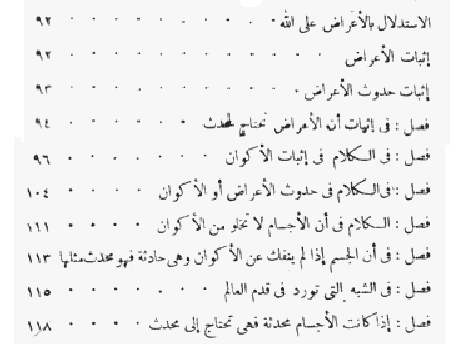
    Here is part of the contents from the book "Sharh Usool il-Khamsah" of al-Qaadee Abdul-Jabbaar (d. 415H), the Mu'tazili, (you can view the book cover here):

    We can see here that al-Qadi Abdul-Jabbar outlines the proof of "hudooth ul-a'raad fil-ajsaam", which is the demonstration of the createdness of bodies (ajsaam) on account of the presence of incidental attributes (a'raad) found within them, amongst which is a subset called akwaan - states of being, a) motion (harakah) and rest (sukoon) and b) combination (ijtimaa'), separation (iftiraaq).
    To summarize what you see above in the contents:
    Using a'raad as a means to prove Allaah's existence; affirming the existence of incidental attributes (a'raad) in bodies; affirming incidental attributes are emergent, occurring; affirming the akwaan (states of being) are emergent, occurring in bodies; affirming that bodies are not devoid of akwaan and a'raad and that this proves they themselves are occurring, emergent; and as bodies are emergent, they must have an originator.
    Now the Mu'tazilah took the crude form used by Jahm bin Safwan (ex. 128H) and refined it somewhat, and they also introduced the idea of "al-Jawhar al-Fard" or "al-juz' alladhee laa yatajazza'" which is the indivisible particle, into this proof to make it easier to argue for the createdness of the entire universe. We will not go into that in too much detail in this session to avoid complicating things.
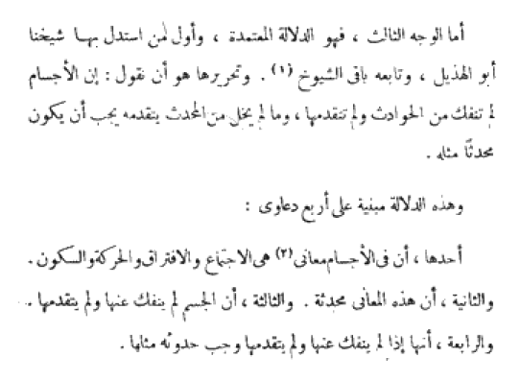
    And here on page 96, al-Qadi Abdul-Jabbaar (d. 415H) is speaking about the ways of establishing the createdness of the universe to prove Allaah's existence, having mentioned two already connected to ajsaam (bodies) and a'raad (their incidental attributes), he then says:

    Which translates as:
    As for the third angle, and this is the evidence that is depended upon, and the first one to seek evidence through it was Abu al-Hudhayl [al-Allaaf, d. 235H], and the other Shuyook [of the Mu'tazilah] followed him in that.
    So he affirms here that al-Allaaf was the first to formalize this for the Mu'tazilah. And then he summarizes it, saying, (and whatever is in square brackets are explanatory additions by us):
    That bodies (ajsaam) are not devoid of occurrences (hawaadith), and they never precede them, and whatever is not free of something new arising within it (Muhdath) by having preceded it, it is necessary that it [too] is Muhdath (newly-arisen, created). And this evidence is based upon four presumed claims:

    • The first: That within bodies there are four meanings, and they are: combination (ijtimaa), separation (iftiraaq), motion (harakah) and rest (sukoon) [these are referred to as akwaan, states of being].
    • The second: That these meanings are newly-arisen (muhdathah) [meaning exist after having not existed]
    • The third: That the body (jism) is never devoid of them [meaning the newly-arisen occurrences, which are the four akwaan]
    • And the fourth: That since [they body (jism)] is never devoid of them, and nor does it precede them, then it is binding that it is newly-arisen (i.e. created) just like them [the four akwaan].

    So this should now be very clear and we see that the Jahmiyyah and the Mu'tazilah were upon this, they were the pioneers, and they were intoxicated by the Maqoolaat, and all of this formed the basis of their "intellectual proof" and in turn the entirety of their speech regarding Tawheed was forced to remain within the confines of this same language, and to avoid invalidating this proof, which they were deluded into thinking was the ultimate truth, they rejected whatever Allaah affirmed for Himself in the revealed texts if it clashed with the necessities of this intellectual proof they devised.
    Facing the Facts Part 3: The Kullaabiyyah and Ash'ariyyah Remained Upon This Same Proof of "hudooth ul-ajsaam"
    The Kullaabiyyah are the followers of Abdullah bin Sa'eed Ibn Kullaab (d. 240H), and whilst they showed rejection against the Jahmiyyah and the Mu'tazilah, they tried to tread a middle ground between Ahl us-Sunnah and these Innovators. However, because in the course of their argumentation with the Jahmiyyah and Mu'tazilah, they wrongly assumed the correctness of some of the underlying usool of the Mu'tazilah, and whilst also holding onto this proof of "hudooth ul-ajsaam" and considering it to be valid, they denied Allaah could be described with actions tied to His will and power (sifaat fi'liyyah, or af'aal ikhtiyaariyyah). And essentially the bulk of the Kullaabi creed was to affirm most of what Ahl us-Sunnah affirmed with the exception of the Sifaat Fi'liyyah. This creed was taken up by Abu al-Hasan al-Ash'ari (d. 324H) and he used to mix with the Kullaabis and attend their gatherings whilst in Baghdad.
    It is important to note that Abu al-Hasan al-Ash'ari did not allow the use of this proof and considered it an innovation (after leaving the Mu'tazilah). However, al-Baqillani (d. 403H), in his formalization of what became known as the Ash'arite creed through his books "at-Tamheed" and "al-Insaaf", brought many things from himself and which were not from al-Ash'ari, and they became part of what became known as the Ash'arite creed.
    We can now take a look at some standard Ash'arite textbooks, the first of which is "at-Tamheed" of al-Qadi Abu Bakr al-Baqillani (d. 403H) - the most important book in the formulation and formalization of what became known as the Ash'arite creed. You can see its cover here.. We see that they made the foundation of their religion upon this same intellectual proof and they just took it from the Mu'tazilah, inclusive of the Atomism that the Mu'tazilah incorporated into the proof to refine and improve it:

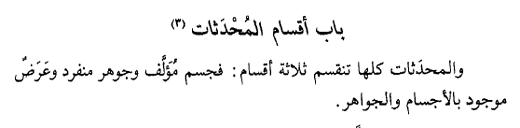
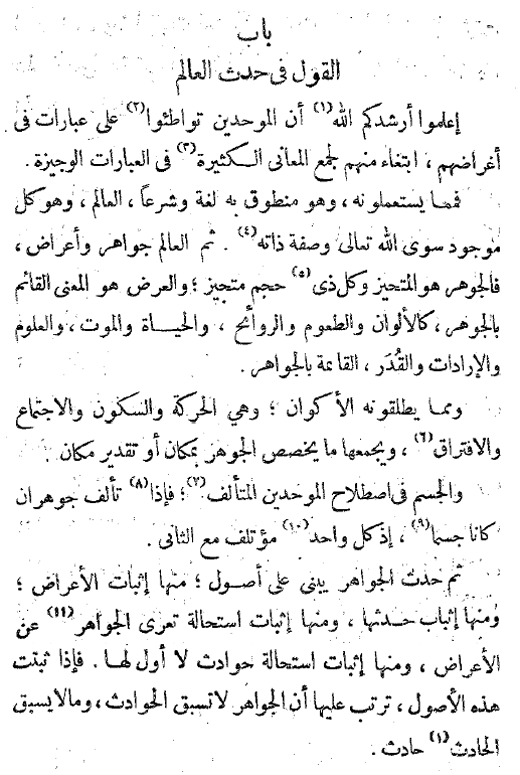
    On page 37 we see the introduction of the Aristotelian classification of what is in the universe into substance (jawhar) and incidental attribute ('arad) or what is more formally referred to as "accident". Then he goes on to explain this for a short while.
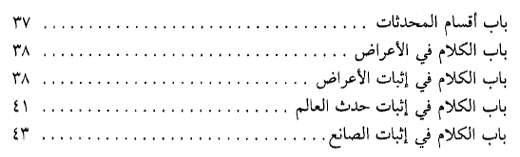
    Then we can move to the contents page and just look at the use of the proof of "hudooth ul-ajsaam" again, meaning the presence of incidental attributes in bodies as proof of their being occurrences in and of themselves (hawaadith) and thus requiring and originator (muhdith).

    In these contents pages, we see the following:
    The categories of created things (meaning, substances and incidental attributes that make up the universe); speech regarding incidental attributes; affirming the incidental attributes; affirming the emergent nature of the universe; affirming the Maker (through what has preceded).
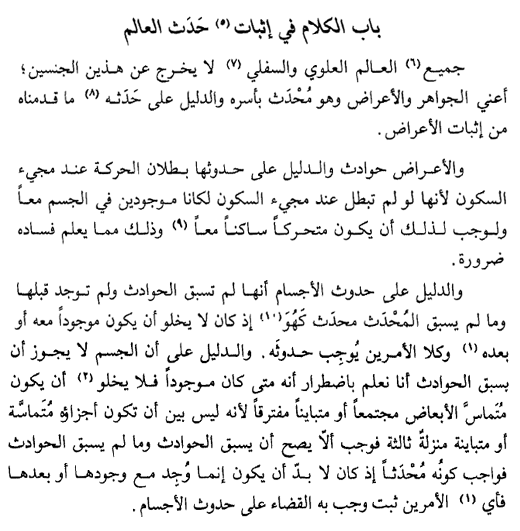
    And we can quote an actual passage here for the sake of completion. Al-Baqillani writes in his "at-Tamheed", (pp. 41-43):

    The translation of which is:
    Chapter: Speech Regarding Affirmation of the Emergence of the Universe All of the universe, its high and its low, does not exit from [being] one of these two types, I mean, substances (al-jawaahir, meaning particles) and incidental attributes (al-a'raad), and in its entirety, it is newly-arisen (i.e. created), and the evidence for its emergence is what we have [previously] covered regarding the affirmation of a'raad (incidental attributes found in bodies).
    And the incidental attributes (a'raad) are newly-arising occurrences (hawaadith), and the evidence for their emergence is the termination of motion (harakah) at the onset of rest (sukoon), because if (motion) was not terminated upon the onset of rest, then would have both been present in the body at the same time, and this would have necessitated that it is both moving and at rest at the same time, and this is from those things whose corruption (i.e. falsehood) is known by necessity.
    And the evidence for the hudooth ul-ajsaam (bodies being newly-arisen, created) is that they do not precede the occurrences (hawaadith, meaning motion and rest), and are not found prior to them, and whatever does not precede that which is Muhdath (newly-occurring, created), then it is also mudhath just like it, since it will not be devoid of the [hawaadith] being present alongside it (its existence), or after its (existence), and both situations necessiate that it is newly-arisen itself.
    And the proof that the body (jism) is not permitted to preceded the hawaadith (occurrences, meaning motion and rest, or combination and separation), is that we know by necessity that when it is present, then either is (individual) parts (i.e. the particles that constitute it) are touching and combined, or are distinct and separate. This is because there is no third situation between them being in contact or being separate, thus it is necessary that it cannot be correct for them to precede the occurrences (hawaadith, i.e.combination and separation) themselves. And whatever does not precede the newly-arisen occurrences, it is necessary that it itself is newly-arisen, since, when it is the case that the (body) is only present alongside the presence of these [occurrences] or after them, then whichever of the two affairs is established, it is necessary to judge by it for the createdness of bodies.
    Al-Baqillani is simply following on with what was pioneered by the Jahmiyyah and the Mu'tazilah - as did all the Ash'aris, although Abu al-Hasan al-Ash'ari himself, after abandoning the Mu'tazilah, declared this method to be an innovation and prohibited its use, though he erroneously considered it to be a valid proof nevertheless - and it was on account of this proof that they were forced to negate, to varying degrees, what Allaah described Himself with. Thus, their speech about Allaah became based entirely around Aristotle's Maqoolaat, negating from Allaah Jismiyyah (being a body) and the incidental attributes (a'raad) and events (hawaadith) of bodies. So when you speak to an Ash'arite, or read their writings, you will now understand the true nature of their speech.

    Oops, hold on! One of our participants has just had enough and stormed out, he's from Malabar in India, and its just got too much for him to handle. We are going to have to take another short break here! He previously paid a visit to our clinic (see here), and he didn't take that too well either as we had to straight-jacket him! Small Break: Whilst we console him and try to bring him back, we encourage participants to have the courage to start coming clean and to start making the admission of guilt. If you are thinking it in your mind, then pluck up the courage to turn to the person on your right and to express it clearly in words. Go ahead, just say it, "Hey buddy, I'm coming out of the closet, my mind, my thinking and my speech is actually intoxicated, and I now admit and acknowledge that there is a problem, my entire speech about Allaah, in affirmation and negation is based around the Maqoolaat of Aristotle!". You will feel an enormous amount of relief and tension when you face the reality, face the facts and say it openly. As we said, this is a new beginning!

    We can resume now ... next we take a look at the book al-Irshaad of Abu al-Mu'aalee al-Juwaynee (d. 478H), otherwise known as Imaam ul-Haramayn, and he is another prominent figure in the Ash'arite madhhab. This is what we find on pages 17-18 (and the section runs through until page 21):

    We don't need to translate all this, we can just put the essence of it which is:
    The universe is made up of jawaahir and a'raad, with a jawhar being a space-occupying object which has "bulk" (i.e. dimension). Then demonstrating that because these substances have incidental attributes (a'raad, akwaan) and are not devoid of them or do not precede them, then it proves they are also occurrences (hawaadith), and following on from that the universe is an occurrence (hadath).
    So we see that the Intoxication of Jahm and the Mu'tazilah has gone a long way, and that the root and source of these people (the Mutakallimoon) is the one and the same.
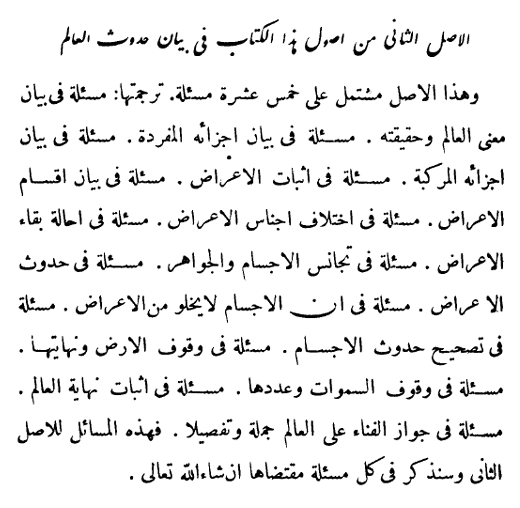
    Next up is Abdul-Qadir al-Baghdadi (d. 429H) and his book "Usool ud-Din". We see this on page 33 where he outlines his treatment of the "hudooth ul-aalam" (occurrence of the universe) and the proof of "hudooth ul-ajsaam" over 30 or so pages:

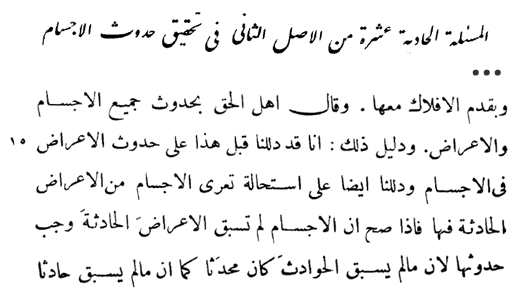
    Here we just have a list of the various issues he is going to discuss whilst covering the intellectual proof of hudooth ul-ajsaam, and here on page 58-59, where after bringing a section heading titled, "The eleventh matter from the second foundation in establishing Hudooth ul-ajsaam", he says a little further down:

    Over the 30 pages in which this topic is covered, we see the same thing mentioned by al-Juwaynee (d. 478H) and al-Baqillani (d. 403H). That the universe is made up of jawaahir and a'raad and the that the incidental attributes found in the bodies are proof that the bodies themselves are occurrences, events (hawaadith), and this proves that the universe is also an occurrence, and must have an originator who is eternal. This is the essence of what he has covered here, leaving out some of the subsidiary details he discusses.

    Self-Awareness Group Session: We are going to break now for a group session. Participants should work in groups of three to four to make discussions whose objectives should be:
    • To trace the foundations of the speech of the Mutakallimoon (speculative Theologians, Jahmiyyah, Mu'tazilah, Ash'ariyyah) to the Maqoolaat of Aristotle
    • To reflect upon their past instances of "speaking creed under the influence" and see how it correlates with what is above
    • To encourage each member of the group discussion - if they have not already done so - to make that verbal admission of "being under the influence" and to come out of the closet.

    To encourage discussion, this diagram should assist participants:

    This group discussion should last for 20-30 minutes.

    Tightening the Ship
    At this point it is important to point out that some of the Later Ash'aris were quite smart and they figured out that the proof of "hudooth ul-ajsaam" is flawed, and realizing that if this proof was criticized and invalidated, it would have serious consequences upon their school, it would undermine everything, so what they started doing was to devise and incorporate other proofs or aspects of them into their theology, so that if "hudooth ul-ajsaam" was shown to false, it would not harm them. When you look at the later Ash'arites such as al-Eejee (d. 756H), and al-Aamidee (d. 631H) you see that they incorporate other notions into the basic idea of "hudooth ul-ajsaam", such as at-takhsees (argument through particularization) and "imkaan and wujoob" (argument through necessary and possible existence) which were not found in the earlier foundational books of the Ash'arites, or at least not made the base and foundation as "hudooth ul-ajsaam" was. So they ended up creating a type of hybrid between Kalaam and Falsafah to seal up this flaw, and prevent themselves from being subject to attack. And this is the nature of Kalaam, it leads a person wandering astray into every valley.

    The Philosophers themselves like Ibn Sina had already noticed a flaw in the argument of "hudooth ul-ajsaam" which allowed them to bolster and strengthen their claim of an eternal universe. However, we will leave that for another article to avoid digressing.
    It's time to bring this workshop to a close now, its been intense for a lot of the participants, and some are close to tears.
    Escaping Delusion Through Positive Affirmations
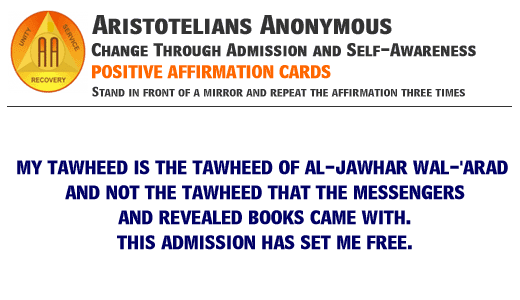
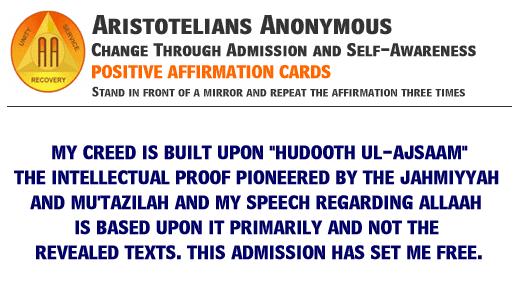
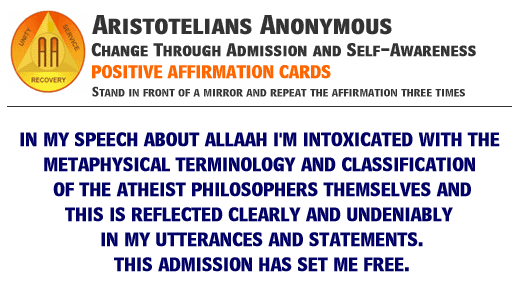
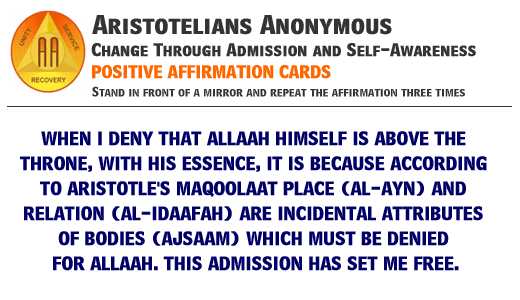
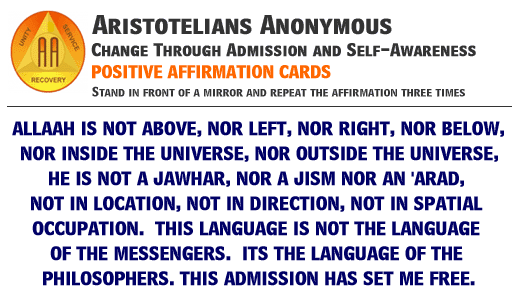
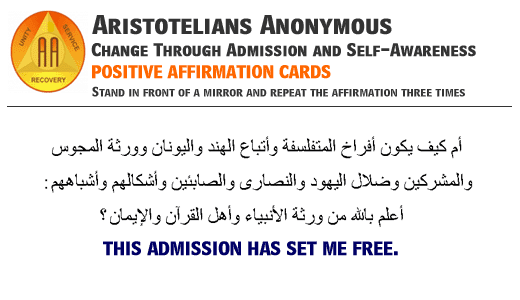
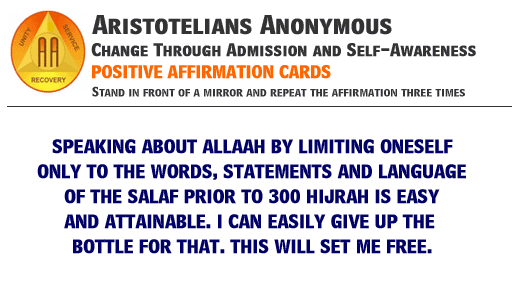
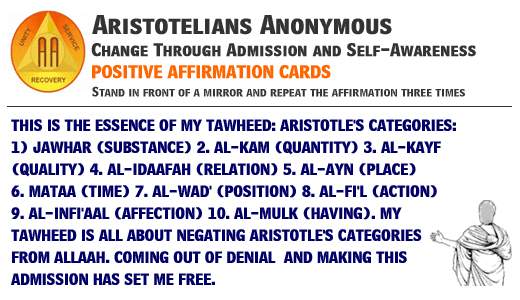
    We would like participants to take these positive affirmation cards we have created. They should prove extremely useful in escaping from the delusion that victims and sufferers find hard to shake off, after years, if not a lifetime, of abuse. We suggest you take these cards and pin them on your refrigerator, bathroom, the inside of your wardrobe, and keep them by the side of your bed. Expressing positive affirmations out aloud are a good way to change your core beliefs about reality and alter your perceptions.
    Here they are:


    Do feel free to make up your own "positive affirmations", they can be a powerful way to eradicate worn-out, old ways of thinking and replace them with new neural patterns that will provide an altered way of perceiving, allowing the escape from delusion. It really is "all in the mind".
    Close of Workshop
    The workshop has now come to an end, thank you for participating! If you would like additional support, do not hesitate to contact us. If you are a third-party observer and know victims and sufferers please do tell them about the AA, and about these workshops. Details of the next workshop will be announced shortly.
    [SIZE="4"][B][CENTER][URL="www.quranawsunnat.com"]www.quranawsunnat.com
    [/URL]
    [URL="www.youtube.com/Sangartube"]www.youtube.com/Sangartube
    [/URL][/SIZE]
    Mullah 4 Life! [/CENTER][/B]

    Comment


    • #3
      Aristotelians Anonymous: 1st Workshop - Admitting Your Creed Is Built Around Aristotle's Maqoolaat Is the First Step to Recovery
      Filed under: Articles
      Thursday, November 12 2009 - by Asharis.Com
      Key topics: Aristotelians Anonymous • Detox • Intoxication • Self Help • Self Awareness • Personal Development Mail to a Friend • Printer friendly

      Following the very successful launch at Aristotelians Anonymous (thanks to all those that popped in, its one of the most popular articles) - we are pleased to announce our first workshop. As you will have gathered from the launch, we do have a serious situation on our hands - souls, intellects and lives are at risk from this insidious and very harmful intoxicant that is behind some of the most tragic accidents in history. Our workshops are aimed at helping victims and sufferers to build up their confidence in facing up to reality and to make strong commitments in effecting real change in their lives. Our core principles are to serve victims and sufferers to help them to recovery and through that bring about unity - by eliminating the menace of Intoxication and poisoning that has led to splitting (of bodies), unruly behaviour, and unwarranted charges of Tajseem (based upon Aristotle's al-Jawhar al-'Arad - see here) against innocent Muslims.
      The AA Presents: Facing Up to the Facts and Realities And Overcoming the First, Big Hurdle: Admission!
      As we mentioned in the launch most victims are introduced to the bottle through predators who convince gullible victims that the veracity and truthfulness of the religion of Islam cannot be ascertained and verified except through an intellectual proof (called "hudooth ul-ajsaam" or "hudooth ul-a'raad fil-ajsaam"), and that without this, Islam itself will be destroyed by all those 'nasty, evil' atheists. This is despite the fact that belief in Allaah's Existence is inherent in every soul, it is deeply and firmly rooted in the fitrah and it is not what the call of the Messengers was based around. Belief in a creator is inherent and implanted in every soul, it is from the fitrah, and Ibn Hajr al-Asqalani refuted the Ash'arites on this issue (see here and here). Once convinced of this erroneous and grossly exaggerated claim, the victim obliges and is duly "spiked" by the predator. A pint of Aristotle's "Maqoolaat" is enough to hook the victim. This then leads to life-long bondage to the bottle of "al-jawhar wal-'arad", and the victim is unable to speak without it. It is made the ultimate criterion of what can and cannot be said of Allaah, in both affirmation and negation, and all the revealed texts are subject to evaluation through the associated language and terminology of this Vintage 322BC. Unfortunately, victims rarely realize that they are intoxicated and "creeding under the influence" and speaking language that is foreign to the revealed Books and sent Messengers. It becomes extremely difficult to convince them about their addiction, that it was by no means an accident, that they were in fact mislead into the whole thing, and that through their indulgence in such frivolity, separation of bodies will occur, and harm the Muslims.
      And often these intoxicated victims will be found lurking on blogs and forums and spluttering "Not above, nor below, nor to the left, nor to the right, nor inside the universe, nor outside the universe, not a jism, nor a jawhar, not an 'arad, not in location, not in direction ..." - and at the same time vehemently denying that they've been anywhere near the bottle! We really do need to help these people. Poor souls.
      This first workshop will focus on bringing facts out in the open and participants are asked to be very honest and frank about what they experience. The first stage in resolving any problem is to admit and acknowledge that there actually is one. If you don't, you will simply continue in your deluded life, none the wiser.

      Important Note to Program Participants: What follows may be very upsetting, disturbing and may bring you to tears. Its not a nice prospect to face having what may have been a whole lifetime of delusion to be shattered in the space of 5-10 minutes. So please be brave, let the facts do the talking, and when it "clicks", don't be afraid to stand up and say, "I admit I have a problem! My terminology, language and phraseology in creed is primarily that of the Metaphysics of the atheist Philosophers themselves and not of that which the Messengers came with" - this is the biggest hurdle you have to get over, and once you've got passed "the denial" stage and put it behind you, its basically all downhill from there. Also don't worry, we are there to help you every stage of the way. You are not alone - and we guarantee your privacy and anonymity at all times.
      Facing the Facts Part 1: Aristotle's "al-Maqoolaat al-Ashar"
      Dear participant, something you should be familiar with if you have been a regular visitor to our site, or if you recently joined our clinic, is Aristotle's ten categories, which famously became known as "al-Maqoolaat al-Ashar". This was a classification to help characterize everything in the observable universe. This Metaphysics and philosophy was current in the Muslim lands in the early part of Islaam, and there were found many atheists and Philosophers that were conversant and learned in this regard. As for these Ten Categories:
      The first deals with "what something is":

      1. substance (jawhar)

      The rest are incidental attributes (a'raad) which deal with "how it is":

      1. quantity (al-kam) - dimensions and measurable features, length, breadth, width and so on
      2. quality (al-kayf) - perceived characteristics, color, shape, and so on.
      3. relation (al-idaafah) - how a substance is in relation to others, above, below, right, left and so on.
      4. place (al-ayn) - where it is
      5. time (mataa) answering "when?" - temporal characteristics of the substance
      6. position (al-wad') - how a substance's parts are ordered in relation to each other
      7. action (yaf'al) acting - what a substance is doing
      8. affection (yanfa'il) a substance being acted upon
      9. having (al-mulk) - what the substance has on

      This philosophy and Metaphysics was current amongst the atheist Philosophers who were present in the Muslim lands in the early period of Islam. And it was upon these classifications and terminologies that Jahm bin Safwan (ex. 128H) and the Mu'tazilah after him, pioneered a proof to demonstrate the universe is created and that it must have a creator. Subsequently, in describing this creator (to those atheists) they were forced to stick to the same language and terminology in describing Allaah that they had used to argue for the existence of the creator, and this forced them to start rejecting much of what is in the Book and the Sunnah. They, the Jahmiyyah and Mu'tazilah, were the pioneers of many of the false ta'weels and tahreefs (distortions) of the revealed texts that got passed through to the later Mutakallimoon (the later Asha'ris and Maturidis).
      When they wrongly considered this rational demonstration of the createdness of the universe (and hence the existence of a Maker), to be the ultimate truth, they then started to deny for Allaah what was stated in the revealed texts and what they presumed and believed to fall into the categories of Aristotle, such as quality, and quantity, and place, and relation and action and so on. So the Jahmiyyah denied everything. The Mu'tazilah affirmed the Names but not any of the attributes.

      It is important to point out here that while the Mutakallimoon used some of these basic notions, ideas, language and classifications of these atheist Philosophers in their theological discourse on the creator and the manner of speech regarding Him, they did not concur with the actual views of Aristotle, such as the belief in an eternal universe, and nor with the entirety of the philosophies of these people.
      Whilst there was also the Platonic philosophy of matter and form (al-maaddah was-soorah) in characterizing the universe, in addition to the Aristotelian substance and incidental attribute (al-jawhar wal-'arad), it was the latter that served the purpose of the Mutakallimoon and which became integral to their version of Tawheed that was fundamentally tied to their intellectual proof of "hudooth ul-ajsaam". Further, if we leave the Emanation doctrine of Plotinus (d. 270CE), another Greek Philosopher, to one side, and look at the essence of his doctrine regarding what he called "the One":
      Plotinus taught that there is a supreme, totally transcendent "One", containing no division, multiplicity or distinction; likewise it is beyond all categories of being and non-being. The concept of "being" is derived by us from the objects of human experience called the dyad, and is an attribute of such objects, but the infinite, transcendent One is beyond all such objects, and therefore is beyond the concepts that we derive from them.
      ...then you - dear participant - should start to recognize the true source of much of the Intoxication that you have been suffering from and which is in truth behind much of your speech in what you say about your Lord. These were some of the philosophies that were present in the Arab lands, and unfortunately, the Jahmiyyah and Mu'tazilah thought they could down bottles of this stuff and still remain sober. It wasn't the case, they got intoxicated and whilst they found a (false, corrupt) way to prove Allaah's existence through this Liquor, when they tried to speak about their Lord, alas, they could not free themselves from that Intoxication.
      And therefore Tawheed became nothing but negating from Allaah, jism (body), and jawhar (substance), and 'arad (incidental attribute), and divisibility (inqisaam) and multiplicity (ta'addud) and distinction (imtiyaaz) and place and location (makaan), and direction (jihah) and space occupation (tahayyuz) and so on. And anything in the revealed texts that hinted at any opposition to this type of Tawheed (the Tawheed of al-Jawhar wal-'Arad) was either rejected (hey, that's just an aahaad hadeeth) or made ta'weel of, if the text could not be rejected (like the verses of the Qur'an or mutawaatir ahaadeeth).
      If this is hard upon you and you are feeling a little vulnerable and sensitive right now, please hold on and remain with us for the full session. You just need to battle those emotions and believe us, you will come out a better person at the end of this. To ease things a little, we'll take a small interlude.

      Small Break: We encourage participants to speak to each other during this break and not to be shy or fearful in making an admission about the true and real source of the language that determines their creed. There's nothing to be ashamed of and nothing to hide. Being frank and honest with your own soul is always the best policy.
      Facing the Facts Part 2: The Jahmiyyah and Mu'tazilah Were the Pioneers of the Intellectual Proof of "hudooth ul-ajsaam"
      As for Jahm bin Safwan (ex. 128H) we have covered that in a separate article so please refer to it here. Basically he was the first to devise a crude form of what became known as the proof of "hudooth ul-ajsaam" or "hudooth ul-a'raad fil-ajsaam" and he argued against the Indian Materialist Philosophers, the Sumaniyyah, that the presence of qualities (sifaat), incidental attributes (a'raad) and events, occurrences (hawaadith, meaning actions) in bodies prove that they are created and therefore must have a creator.
      It was on this basis that he in turn rejected that Allaah could be described with anything at all, trying to make Allaah totally unlike the bodies (ajsaam) that make up the universe, and upon this basis he denied that Allaah spoke to Moses as this would be considered an event, occurrence, that would render Allaah a body, (jism). Or that Allaah took Abraham as His khaleel, intimate friend as this would be considered an event, occurrence (haadithah) and also affection (infi'aal) which is from Aristotle's Maqoolaat. And that Allaah is not above His Throne (following al-Ja'd bin Dirham in that) because aboveness, considered an incidental attribute, necessitates makaan (location) and Jismiyyah (that something is a body). And that the Qur'an is created because if it was Allaah's Speech then as it is comprised of statements which are all other than each other, then it would mean all of these are events, occurrences (hawaadith), meaning actions of Allaah, and this would prove, in accordance with Aristotle's Maqoolaat, that Allaah is a body (jism). So Jahm and the Jahmiyyah wallowed in this until they described Allaah with what amounted to nothingness - fearing that they might liken Him with the created bodies (ajsaam). This is why the Salaf, like Imaam Ahmad and others said about Jahm and the Jahmiyyah that they wish to describe Allaah is if He is "laa shay" (nothing). The reason why they did this was to avoid likening Allaah to anything in the creation, because everything in the creation is, upon the Maqoolaat, either jawaahir (substances, bodies) and the incidental attributes (a'raad) that are found in them, and just by merely affirming an attribute for Allaah, then as that attribute is also found in the creation, then you have likened Allaah to the creation. This was the reasoning of those Jahmites.
      The debates of Jahm bin Safwaan with the Sumaniyyah are well-documented and mentioned in the early books of aqidah, and there are plenty of narrations from the Salaf in this regard that mention how Jahm became confused as a result of these debates he was having with these atheist Philosophers.
      As for the Mu'tazilah, then they too were involved in debates with the atheists and amongst them, the Sumaniyyah. They took the proof of hudooth ul-ajsaam and used it just like the Jahmiyyah, though they made some improvements and refinments to it, most noticeable the incorporation of "Atomism" (the indivisible particle). This was done to simplify the proof and make it more elegant and make it more easier to argue for the createdness of the entire universe (we can cover this in detail in separate articles). The first to document it and formalize this for the Mu'tazilah was Abu al-Hudhayl al-Allaaf (d. 235H).
      Here is part of the contents from the book "Sharh Usool il-Khamsah" of al-Qaadee Abdul-Jabbaar (d. 415H), the Mu'tazili, (you can view the book cover here):

      We can see here that al-Qadi Abdul-Jabbar outlines the proof of "hudooth ul-a'raad fil-ajsaam", which is the demonstration of the createdness of bodies (ajsaam) on account of the presence of incidental attributes (a'raad) found within them, amongst which is a subset called akwaan - states of being, a) motion (harakah) and rest (sukoon) and b) combination (ijtimaa'), separation (iftiraaq).
      To summarize what you see above in the contents:
      Using a'raad as a means to prove Allaah's existence; affirming the existence of incidental attributes (a'raad) in bodies; affirming incidental attributes are emergent, occurring; affirming the akwaan (states of being) are emergent, occurring in bodies; affirming that bodies are not devoid of akwaan and a'raad and that this proves they themselves are occurring, emergent; and as bodies are emergent, they must have an originator.
      Now the Mu'tazilah took the crude form used by Jahm bin Safwan (ex. 128H) and refined it somewhat, and they also introduced the idea of "al-Jawhar al-Fard" or "al-juz' alladhee laa yatajazza'" which is the indivisible particle, into this proof to make it easier to argue for the createdness of the entire universe. We will not go into that in too much detail in this session to avoid complicating things.
      And here on page 96, al-Qadi Abdul-Jabbaar (d. 415H) is speaking about the ways of establishing the createdness of the universe to prove Allaah's existence, having mentioned two already connected to ajsaam (bodies) and a'raad (their incidental attributes), he then says:

      Which translates as:
      As for the third angle, and this is the evidence that is depended upon, and the first one to seek evidence through it was Abu al-Hudhayl [al-Allaaf, d. 235H], and the other Shuyook [of the Mu'tazilah] followed him in that.
      So he affirms here that al-Allaaf was the first to formalize this for the Mu'tazilah. And then he summarizes it, saying, (and whatever is in square brackets are explanatory additions by us):
      That bodies (ajsaam) are not devoid of occurrences (hawaadith), and they never precede them, and whatever is not free of something new arising within it (Muhdath) by having preceded it, it is necessary that it [too] is Muhdath (newly-arisen, created). And this evidence is based upon four presumed claims:

      • The first: That within bodies there are four meanings, and they are: combination (ijtimaa), separation (iftiraaq), motion (harakah) and rest (sukoon) [these are referred to as akwaan, states of being].
      • The second: That these meanings are newly-arisen (muhdathah) [meaning exist after having not existed]
      • The third: That the body (jism) is never devoid of them [meaning the newly-arisen occurrences, which are the four akwaan]
      • And the fourth: That since [they body (jism)] is never devoid of them, and nor does it precede them, then it is binding that it is newly-arisen (i.e. created) just like them [the four akwaan].

      So this should now be very clear and we see that the Jahmiyyah and the Mu'tazilah were upon this, they were the pioneers, and they were intoxicated by the Maqoolaat, and all of this formed the basis of their "intellectual proof" and in turn the entirety of their speech regarding Tawheed was forced to remain within the confines of this same language, and to avoid invalidating this proof, which they were deluded into thinking was the ultimate truth, they rejected whatever Allaah affirmed for Himself in the revealed texts if it clashed with the necessities of this intellectual proof they devised.
      Facing the Facts Part 3: The Kullaabiyyah and Ash'ariyyah Remained Upon This Same Proof of "hudooth ul-ajsaam"
      The Kullaabiyyah are the followers of Abdullah bin Sa'eed Ibn Kullaab (d. 240H), and whilst they showed rejection against the Jahmiyyah and the Mu'tazilah, they tried to tread a middle ground between Ahl us-Sunnah and these Innovators. However, because in the course of their argumentation with the Jahmiyyah and Mu'tazilah, they wrongly assumed the correctness of some of the underlying usool of the Mu'tazilah, and whilst also holding onto this proof of "hudooth ul-ajsaam" and considering it to be valid, they denied Allaah could be described with actions tied to His will and power (sifaat fi'liyyah, or af'aal ikhtiyaariyyah). And essentially the bulk of the Kullaabi creed was to affirm most of what Ahl us-Sunnah affirmed with the exception of the Sifaat Fi'liyyah. This creed was taken up by Abu al-Hasan al-Ash'ari (d. 324H) and he used to mix with the Kullaabis and attend their gatherings whilst in Baghdad.
      It is important to note that Abu al-Hasan al-Ash'ari did not allow the use of this proof and considered it an innovation (after leaving the Mu'tazilah). However, al-Baqillani (d. 403H), in his formalization of what became known as the Ash'arite creed through his books "at-Tamheed" and "al-Insaaf", brought many things from himself and which were not from al-Ash'ari, and they became part of what became known as the Ash'arite creed.
      We can now take a look at some standard Ash'arite textbooks, the first of which is "at-Tamheed" of al-Qadi Abu Bakr al-Baqillani (d. 403H) - the most important book in the formulation and formalization of what became known as the Ash'arite creed. You can see its cover here.. We see that they made the foundation of their religion upon this same intellectual proof and they just took it from the Mu'tazilah, inclusive of the Atomism that the Mu'tazilah incorporated into the proof to refine and improve it:

      On page 37 we see the introduction of the Aristotelian classification of what is in the universe into substance (jawhar) and incidental attribute ('arad) or what is more formally referred to as "accident". Then he goes on to explain this for a short while.
      Then we can move to the contents page and just look at the use of the proof of "hudooth ul-ajsaam" again, meaning the presence of incidental attributes in bodies as proof of their being occurrences in and of themselves (hawaadith) and thus requiring and originator (muhdith).

      In these contents pages, we see the following:
      The categories of created things (meaning, substances and incidental attributes that make up the universe); speech regarding incidental attributes; affirming the incidental attributes; affirming the emergent nature of the universe; affirming the Maker (through what has preceded).
      And we can quote an actual passage here for the sake of completion. Al-Baqillani writes in his "at-Tamheed", (pp. 41-43):

      The translation of which is:
      Chapter: Speech Regarding Affirmation of the Emergence of the Universe All of the universe, its high and its low, does not exit from [being] one of these two types, I mean, substances (al-jawaahir, meaning particles) and incidental attributes (al-a'raad), and in its entirety, it is newly-arisen (i.e. created), and the evidence for its emergence is what we have [previously] covered regarding the affirmation of a'raad (incidental attributes found in bodies).
      And the incidental attributes (a'raad) are newly-arising occurrences (hawaadith), and the evidence for their emergence is the termination of motion (harakah) at the onset of rest (sukoon), because if (motion) was not terminated upon the onset of rest, then would have both been present in the body at the same time, and this would have necessitated that it is both moving and at rest at the same time, and this is from those things whose corruption (i.e. falsehood) is known by necessity.
      And the evidence for the hudooth ul-ajsaam (bodies being newly-arisen, created) is that they do not precede the occurrences (hawaadith, meaning motion and rest), and are not found prior to them, and whatever does not precede that which is Muhdath (newly-occurring, created), then it is also mudhath just like it, since it will not be devoid of the [hawaadith] being present alongside it (its existence), or after its (existence), and both situations necessiate that it is newly-arisen itself.
      And the proof that the body (jism) is not permitted to preceded the hawaadith (occurrences, meaning motion and rest, or combination and separation), is that we know by necessity that when it is present, then either is (individual) parts (i.e. the particles that constitute it) are touching and combined, or are distinct and separate. This is because there is no third situation between them being in contact or being separate, thus it is necessary that it cannot be correct for them to precede the occurrences (hawaadith, i.e.combination and separation) themselves. And whatever does not precede the newly-arisen occurrences, it is necessary that it itself is newly-arisen, since, when it is the case that the (body) is only present alongside the presence of these [occurrences] or after them, then whichever of the two affairs is established, it is necessary to judge by it for the createdness of bodies.
      Al-Baqillani is simply following on with what was pioneered by the Jahmiyyah and the Mu'tazilah - as did all the Ash'aris, although Abu al-Hasan al-Ash'ari himself, after abandoning the Mu'tazilah, declared this method to be an innovation and prohibited its use, though he erroneously considered it to be a valid proof nevertheless - and it was on account of this proof that they were forced to negate, to varying degrees, what Allaah described Himself with. Thus, their speech about Allaah became based entirely around Aristotle's Maqoolaat, negating from Allaah Jismiyyah (being a body) and the incidental attributes (a'raad) and events (hawaadith) of bodies. So when you speak to an Ash'arite, or read their writings, you will now understand the true nature of their speech.

      Oops, hold on! One of our participants has just had enough and stormed out, he's from Malabar in India, and its just got too much for him to handle. We are going to have to take another short break here! He previously paid a visit to our clinic (see here), and he didn't take that too well either as we had to straight-jacket him! Small Break: Whilst we console him and try to bring him back, we encourage participants to have the courage to start coming clean and to start making the admission of guilt. If you are thinking it in your mind, then pluck up the courage to turn to the person on your right and to express it clearly in words. Go ahead, just say it, "Hey buddy, I'm coming out of the closet, my mind, my thinking and my speech is actually intoxicated, and I now admit and acknowledge that there is a problem, my entire speech about Allaah, in affirmation and negation is based around the Maqoolaat of Aristotle!". You will feel an enormous amount of relief and tension when you face the reality, face the facts and say it openly. As we said, this is a new beginning!

      We can resume now ... next we take a look at the book al-Irshaad of Abu al-Mu'aalee al-Juwaynee (d. 478H), otherwise known as Imaam ul-Haramayn, and he is another prominent figure in the Ash'arite madhhab. This is what we find on pages 17-18 (and the section runs through until page 21):

      We don't need to translate all this, we can just put the essence of it which is:
      The universe is made up of jawaahir and a'raad, with a jawhar being a space-occupying object which has "bulk" (i.e. dimension). Then demonstrating that because these substances have incidental attributes (a'raad, akwaan) and are not devoid of them or do not precede them, then it proves they are also occurrences (hawaadith), and following on from that the universe is an occurrence (hadath).
      So we see that the Intoxication of Jahm and the Mu'tazilah has gone a long way, and that the root and source of these people (the Mutakallimoon) is the one and the same.
      Next up is Abdul-Qadir al-Baghdadi (d. 429H) and his book "Usool ud-Din". We see this on page 33 where he outlines his treatment of the "hudooth ul-aalam" (occurrence of the universe) and the proof of "hudooth ul-ajsaam" over 30 or so pages:

      Here we just have a list of the various issues he is going to discuss whilst covering the intellectual proof of hudooth ul-ajsaam, and here on page 58-59, where after bringing a section heading titled, "The eleventh matter from the second foundation in establishing Hudooth ul-ajsaam", he says a little further down:

      Over the 30 pages in which this topic is covered, we see the same thing mentioned by al-Juwaynee (d. 478H) and al-Baqillani (d. 403H). That the universe is made up of jawaahir and a'raad and the that the incidental attributes found in the bodies are proof that the bodies themselves are occurrences, events (hawaadith), and this proves that the universe is also an occurrence, and must have an originator who is eternal. This is the essence of what he has covered here, leaving out some of the subsidiary details he discusses.

      Self-Awareness Group Session: We are going to break now for a group session. Participants should work in groups of three to four to make discussions whose objectives should be:
      • To trace the foundations of the speech of the Mutakallimoon (speculative Theologians, Jahmiyyah, Mu'tazilah, Ash'ariyyah) to the Maqoolaat of Aristotle
      • To reflect upon their past instances of "speaking creed under the influence" and see how it correlates with what is above
      • To encourage each member of the group discussion - if they have not already done so - to make that verbal admission of "being under the influence" and to come out of the closet.

      To encourage discussion, this diagram should assist participants:

      This group discussion should last for 20-30 minutes.

      Tightening the Ship
      At this point it is important to point out that some of the Later Ash'aris were quite smart and they figured out that the proof of "hudooth ul-ajsaam" is flawed, and realizing that if this proof was criticized and invalidated, it would have serious consequences upon their school, it would undermine everything, so what they started doing was to devise and incorporate other proofs or aspects of them into their theology, so that if "hudooth ul-ajsaam" was shown to false, it would not harm them. When you look at the later Ash'arites such as al-Eejee (d. 756H), and al-Aamidee (d. 631H) you see that they incorporate other notions into the basic idea of "hudooth ul-ajsaam", such as at-takhsees (argument through particularization) and "imkaan and wujoob" (argument through necessary and possible existence) which were not found in the earlier foundational books of the Ash'arites, or at least not made the base and foundation as "hudooth ul-ajsaam" was. So they ended up creating a type of hybrid between Kalaam and Falsafah to seal up this flaw, and prevent themselves from being subject to attack. And this is the nature of Kalaam, it leads a person wandering astray into every valley.

      The Philosophers themselves like Ibn Sina had already noticed a flaw in the argument of "hudooth ul-ajsaam" which allowed them to bolster and strengthen their claim of an eternal universe. However, we will leave that for another article to avoid digressing.
      It's time to bring this workshop to a close now, its been intense for a lot of the participants, and some are close to tears.
      Escaping Delusion Through Positive Affirmations
      We would like participants to take these positive affirmation cards we have created. They should prove extremely useful in escaping from the delusion that victims and sufferers find hard to shake off, after years, if not a lifetime, of abuse. We suggest you take these cards and pin them on your refrigerator, bathroom, the inside of your wardrobe, and keep them by the side of your bed. Expressing positive affirmations out aloud are a good way to change your core beliefs about reality and alter your perceptions.
      Here they are:


      Do feel free to make up your own "positive affirmations", they can be a powerful way to eradicate worn-out, old ways of thinking and replace them with new neural patterns that will provide an altered way of perceiving, allowing the escape from delusion. It really is "all in the mind".
      Close of Workshop
      The workshop has now come to an end, thank you for participating! If you would like additional support, do not hesitate to contact us. If you are a third-party observer and know victims and sufferers please do tell them about the AA, and about these workshops. Details of the next workshop will be announced shortly.
      [SIZE="4"][B][CENTER][URL="www.quranawsunnat.com"]www.quranawsunnat.com
      [/URL]
      [URL="www.youtube.com/Sangartube"]www.youtube.com/Sangartube
      [/URL][/SIZE]
      Mullah 4 Life! [/CENTER][/B]

      Comment

      Working...
      X