Announcement

Collapse
No announcement yet.

Former Crristian priests who have Embraced Islam

Collapse
X
 
  • Filter
  • Time
  • Show
Clear All
new posts

  • Former Crristian priests who have Embraced Islam


    And thou wilt find the nearest of them in affection to those who believe (to be) those who say: Lo! We are Christians. That is because there are among them priests and monks, and because they are not proud. When they listen to that which hath been revealed unto the messengers, thou seest their eyes overflow with tears because of their recognition of the Truth.
    They say: Our Lord, we believe. Inscribe us as among the witnesses
    [Qur'an 5:82-83]


    Dr. Jerald F. Dirks - Former minister (deacon) of the United Methodist Church. He holds a Master's degree in Divinity from Harvard University and a Doctorate in Psychology from the University of Denver. Author of The Cross and the Crescent: An Interfaith Dialogue between Christianity and Islam (ISBN 1-59008-002-5 - Amana Publications, 2001). He has published over 60 articles in the field of clinical psychology, and over 150 articles on Arabian horses
    A CHRISTIAN MINISTER’S CONVERSION TO ISLAM
    © 2002 (Abu Yahya) Jerald F. Dirks, M.Div., Psy.D.
    One of my earliest childhood memories is of hearing the church bell toll for Sunday morning worship in the small, rural town in which I was raised. The Methodist Church was an old, wooden structure with a bell tower, two children’s Sunday School classrooms cubbyholed behind folding, wooden doors to separate it from the sanctuary, and a choir loft that housed the Sunday school classrooms for the older children. It stood less than two blocks from my home. As the bell rang, we would come together as a family, and make our weekly pilgrimage to the church.
    In that rural setting from the 1950s, the three churches in the town of about 500 were the center of community life. The local Methodist Church, to which my family belonged, sponsored ice cream socials with hand-cranked, homemade ice cream, chicken potpie dinners, and corn roasts. My family and I were always involved in all three, but each came only once a year. In addition, there was a two-week community Bible school every June, and I was a regular attendee through my eighth grade year in school. However, Sunday morning worship and Sunday school were weekly events, and I strove to keep extending my collection of perfect attendance pins and of awards for memorizing Bible verses.
    By my junior high school days, the local Methodist Church had closed, and we were attending the Methodist Church in the neighbouring town, which was only slightly larger than the town in which I lived. There, my thoughts first began to focus on the ministry as a personal calling. I became active in the Methodist Youth Fellowship, and eventually served as both a district and a conference officer. I also became the regular “preacher” during the annual Youth Sunday service. My preaching began to draw community-wide attention, and before long I was occasionally filling pulpits at other churches, at a nursing home, and at various church-affiliated youth and ladies groups, where I typically set attendance records.
    By age 17, when I began my freshman year at Harvard College, my decision to enter the ministry had solidified. During my freshman year, I enrolled in a two-semester course in comparative religion, which was taught by Wilfred Cantwell Smith, whose specific area of expertise was Islam. During that course, I gave far less attention to Islam, than I did to other religions, such as Hinduism and Buddhism, as the latter two seemed so much more esoteric and strange to me. In contrast, Islam appeared to be somewhat similar to my own Christianity. As such, I didn’t concentrate on it as much as I probably should have, although I can remember writing a term paper for the course on the concept of revelation in the Qur’an. Nonetheless, as the course was one of rigorous academic standards and demands, I did acquire a small library of about a half dozen books on Islam, all of which were written by non-Muslims, and all of which were to serve me in good stead 25 years later. I also acquired two different English translations of the meaning of the Qur’an, which I read at the time.

    To be continued...

  • #2
    That spring, Harvard named me a Hollis Scholar, signifying that I was one of the top pre-theology students in the college. The summer between my freshman and sophomore years at Harvard, I worked as a youth minister at a fairly large United Methodist Church. The following summer, I obtained my License to Preach from the United Methodist Church. Upon graduating from Harvard College in 1971, I enrolled at the Harvard Divinity School, and there obtained my Master of Divinity degree in 1974, having been previously ordained into the Deaconate of the United Methodist Church in 1972, and having previously received a Stewart Scholarship from the United Methodist Church as a supplement to my Harvard Divinity School scholarships. During my seminary education, I also completed a two-year externship program as a hospital chaplain at Peter Bent Brigham Hospital in Boston. Following graduation from Harvard Divinity School, I spent the summer as the minister of two United Methodist churches in rural Kansas, where attendance soared to heights not seen in those churches for several years.
    Seen from the outside, I was a very promising young minister, who had received an excellent education, drew large crowds to the Sunday morning worship service, and had been successful at every stop along the ministerial path. However, seen from the inside, I was fighting a constant war to maintain my personal integrity in the face of my ministerial responsibilities. This war was far removed from the ones presumably fought by some later televangelists in unsuccessfully trying to maintain personal sexual morality. Likewise, it was a far different war than those fought by the headline-grabbing paedophilic priests of the current moment. However, my struggle to maintain personal integrity may be the most common one encountered by the better-educated members of the ministry.
    There is some irony in the fact that the supposedly best, brightest, and most idealistic of ministers-to-be are selected for the very best of seminary education, e.g. that offered at that time at the Harvard Divinity School. The irony is that, given such an education, the seminarian is exposed to as much of the actual historical truth as is known about: 1) the formation of the early, “mainstream” church, and how it was shaped by geopolitical considerations; 2) the “original” reading of various Biblical texts, many of which are in sharp contrast to what most Christians read when they pick up their Bible, although gradually some of this information is being incorporated into newer and better translations; 3) the evolution of such concepts as a triune godhead and the “sonship” of Jesus, peace be upon him; 4) the non-religious considerations that underlie many Christian creeds and doctrines; 5) the existence of those early churches and Christian movements which never accepted the concept of a triune godhead, and which never accepted the concept of the divinity of Jesus, peace be upon him; and 6) etc. (Some of these fruits of my seminary education are recounted in more detail in my recent book, The Cross and the Crescent: An Interfaith Dialogue between Christianity and Islam, Amana Publications, 2001.)
    As such, it is no real wonder that almost a majority of such seminary graduates leave seminary, not to “fill pulpits”, where they would be asked to preach that which they know is not true, but to enter the various counselling professions. Such was also the case for me, as I went on to earn a master’s and doctorate in clinical psychology. I continued to call myself a Christian, because that was a needed bit of self-identity, and because I was, after all, an ordained minister, even though my full time job was as a mental health professional. However, my seminary education had taken care of any belief I might have had regarding a triune godhead or the divinity of Jesus, peace be upon him. (Polls regularly reveal that ministers are less likely to believe these and other dogmas of the church than are the laity they serve, with ministers more likely to understand such terms as “son of God” metaphorically, while their parishioners understand it literally.) I thus became a “Christmas and Easter Christian”, attending church very sporadically, and then gritting my teeth and biting my tongue as I listened to sermons espousing that which I knew was not the case.
    None of the above should be taken to imply that I was any less religious or spiritually oriented than I had once been. I prayed regularly, my belief in a supreme deity remained solid and secure, and I conducted my personal life in line with the ethics I had once been taught in church and Sunday school. I simply knew better than to buy into the man-made dogmas and articles of faith of the organized church, which were so heavily laden with the pagan influences, polytheistic notions, and geo-political considerations of a bygone era.
    As the years passed by, I became increasingly concerned about the loss of religiousness in American society at large. Religiousness is a living, breathing spirituality and morality within individuals, and should not be confused with religiosity, which is concerned with the rites, rituals, and formalized creeds of some organized entity, e.g. the church. American culture increasingly appeared to have lost its moral and religious compass. Two out of every three marriages ended in divorce; violence was becoming an increasingly inherent part of our schools and our roads; self-responsibility was on the wane; self-discipline was being submerged by a “if it feels good, do it” morality; various Christian leaders and institutions were being swamped by sexual and financial scandals; and emotions justified behaviour, however odious it might be. American culture was becoming a morally bankrupt institution, and I was feeling quite alone in my personal religious vigil.
    It was at this juncture that I began to come into contact with the local Muslim community. For some years before, my wife and I had been actively involved in doing research on the history of the Arabian horse. Eventually, in order to secure translations of various Arabic documents, this research brought us into contact with Arab Americans who happened to be Muslims. Our first such contact was with Jamal in the summer of 1991.
    After an initial telephone conversation, Jamal visited our home, and offered to do some translations for us, and to help guide us through the history of the Arabian horse in the Middle East. Before Jamal left that afternoon, he asked if he might: use our bathroom to wash before saying his scheduled prayers; and borrow a piece of newspaper to use as a prayer rug, so he could say his scheduled prayers before leaving our house. We, of course, obliged, but wondered if there was something more appropriate that we could give him to use than a newspaper. Without our ever realizing it at the time, Jamal was practicing a very beautiful form of Dawa (preaching or exhortation). He made no comment about the fact that we were not Muslims, and he didn’t preach anything to us about his religious beliefs. He “merely” presented us with his example, an example that spoke volumes, if one were willing to be receptive to the lesson.
    Over the next 16 months, contact with Jamal slowly increased in frequency, until it was occurring on a biweekly to weekly basis. During these visits, Jamal never preached to me about Islam, never questioned me about my own religious beliefs or convictions, and never verbally suggested that I become a Muslim. However, I was beginning to learn a lot. First, there was the constant behavioural example of Jamal observing his scheduled prayers. Second, there was the behavioural example of how Jamal conducted his daily life in a highly moral and ethical manner, both in his business world and in his social world. Third, there was the behavioural example of how Jamal interacted with his two children. For my wife, Jamal’s wife provided a similar example. Fourth, always within the framework of helping me to understand Arabian horse history in the Middle East, Jamal began to share with me: 1) stories from Arab and Islamic history; 2) sayings of the Prophet Muhammad, peace be upon him; and 3) Qur’anic verses and their contextual meaning. In point of fact, our every visit now included at least a 30 minute conversation cantered on some aspect of Islam, but always presented in terms of helping me intellectually understand the Islamic context of Arabian horse history. I was never told “this is the way things are”, I was merely told “this is what Muslims typically believe”. Since I wasn’t being “preached to”, and since Jamal never inquired as to my own beliefs, I didn’t need to bother attempting to justify my own position. It was all handled as an intellectual exercise, not as proselytising

    Comment


    • #3


      Gradually, Jamal began to introduce us to other Arab families in the local Muslim community. There was Wa’el and his family, Khalid and his family, and a few others. Consistently, I observed individuals and families who were living their lives on a much higher ethical plane than the American society in which we were all embedded. Maybe there was something to the practice of Islam that I had missed during my collegiate and seminary days.
      By December, 1992, I was beginning to ask myself some serious questions about where I was and what I was doing. These questions were prompted by the following considerations. 1) Over the course of the prior 16 months, our social life had become increasingly centered on the Arab component of the local Muslim community. By December, probably 75% of our social life was being spent with Arab Muslims. 2) By virtue of my seminary training and education, I knew how badly the Bible had been corrupted (and often knew exactly when, where, and why), I had no belief in any triune godhead, and I had no belief in anything more than a metaphorical “sonship” of Jesus, peace be upon him. In short, while I certainly believed in God, I was as strict a monotheist as my Muslim friends. 3) My personal values and sense of morality were much more in keeping with my Muslim friends than with the “Christian” society around me. After all, I had the non-confrontational examples of Jamal, Khalid, and Wa’el as illustrations. In short, my nostalgic yearning for the type of community in which I had been raised was finding gratification in the Muslim community. American society might be morally bankrupt, but that did not appear to be the case for that part of the Muslim community with which I had had contact. Marriages were stable, spouses were committed to each other, and honesty, integrity, self-responsibility, and family values were emphasized. My wife and I had attempted to live our lives that same way, but for several years I had felt that we were doing so in the context of a moral vacuum. The Muslim community appeared to be different.
      The different threads were being woven together into a single strand. Arabian horses, my childhood upbringing, my foray into the Christian ministry and my seminary education, my nostalgic yearnings for a moral society, and my contact with the Muslim community were becoming intricately intertwined. My self-questioning came to a head when I finally got around to asking myself exactly what separated me from the beliefs of my Muslim friends. I suppose that I could have raised that question with Jamal or with Khalid, but I wasn’t ready to take that step. I had never discussed my own religious beliefs with them, and I didn’t think that I wanted to introduce that topic of conversation into our friendship. As such, I began to pull off the bookshelf all the books on Islam that I had acquired in my collegiate and seminary days. However far my own beliefs were from the traditional position of the church, and however seldom I actually attended church, I still identified myself as being a Christian, and so I turned to the works of Western scholars. That month of December, I read half a dozen or so books on Islam by Western scholars, including one biography of the Prophet Muhammad, peace be upon him. Further, I began to read two different English translations of the meaning of the Qur’an. I never spoke to my Muslim friends about this personal quest of self-discovery. I never mentioned what types of books I was reading, nor ever spoke about why I was reading these books. However, occasionally I would run a very circumscribed question past one of them.
      While I never spoke to my Muslim friends about those books, my wife and I had numerous conversations about what I was reading. By the last week of December of 1992, I was forced to admit to myself, that I could find no area of substantial disagreement between my own religious beliefs and the general tenets of Islam. While I was ready to acknowledge that Muhammad, peace be upon him, was a prophet of (one who spoke for or under the inspiration of) God, and while I had absolutely no difficulty affirming that there was no god besides God/Allah, glorified and exalted is He, I was still hesitating to make any decision. I could readily admit to myself that I had far more in common with Islamic beliefs as I then understood them, than I did with the traditional Christianity of the organized church. I knew only too well that I could easily confirm from my seminary training and education most of what the Qur’an had to say about Christianity, the Bible, and Jesus, peace be upon him. Nonetheless, I hesitated. Further, I rationalized my hesitation by maintaining to myself that I really didn’t know the nitty-gritty details of Islam, and that my areas of agreement were confined to general concepts. As such, I continued to read, and then to re-read.
      One’s sense of identity, of who one is, is a powerful affirmation of one’s own position in the cosmos. In my professional practice, I had occasionally been called upon to treat certain addictive disorders, ranging from smoking, to alcoholism, to drug abuse. As a clinician, I knew that the basic physical addiction had to be overcome to create the initial abstinence. That was the easy part of treatment. As Mark Twain once said: “Quitting smoking is easy; I’ve done it hundreds of times”. However, I also knew that the key to maintaining that abstinence over an extended time period was overcoming the client’s psychological addiction, which was heavily grounded in the client’s basic sense of identity, i.e. the client identified to himself that he was “a smoker”, or that he was “a drinker”, etc. The addictive behaviour had become part and parcel of the client’s basic sense of identity, of the client’s basic sense of self. Changing this sense of identity was crucial to the maintenance of the psychotherapeutic “cure”. This was the difficult part of treatment. Changing one’s basic sense of identity is a most difficult task. One’s psyche tends to cling to the old and familiar, which seem more psychologically comfortable and secure than the new and unfamiliar.
      On a professional basis, I had the above knowledge, and used it on a daily basis. However, ironically enough, I was not yet ready to apply it to myself, and to the issue of my own hesitation surrounding my religious identity. For 43 years, my religious identity had been neatly labeled as “Christian”, however many qualifications I might have added to that term over the years. Giving up that label of personal identity was no easy task. It was part and parcel of how I defined my very being. Given the benefit of hindsight, it is clear that my hesitation served the purpose of insuring that I could keep my familiar religious identity of being a Christian, although a Christian who believed like a Muslim believed.
      It was now the very end of December, and my wife and I were filling out our application forms for U.S. passports, so that a proposed Middle Eastern journey could become a reality. One of the questions had to do with religious affiliation. I didn’t even think about it, and automatically fell back on the old and familiar, as I penned in “Christian”. It was easy, it was familiar, and it was comfortable.
      However, that comfort was momentarily disrupted when my wife asked me how I had answered the question on religious identity on the application form. I immediately replied, “Christian”, and chuckled audibly. Now, one of Freud’s contributions to the understanding of the human psyche was his realization that laughter is often a release of psychological tension. However wrong Freud may have been in many aspects of his theory of psychosexual development, his insights into laughter were quite on target. I had laughed! What was this psychological tension that I had need to release through the medium of laughter?
      I then hurriedly went on to offer my wife a brief affirmation that I was a Christian, not a Muslim. In response to which, she politely informed me that she was merely asking whether I had written “Christian”, or “Protestant”, or “Methodist”. On a professional basis, I knew that a person does not defend himself against an accusation that hasn’t been made. (If, in the course of a session of psychotherapy, my client blurted out, “I’m not angry about that”, and I hadn’t even broached the topic of anger, it was clear that my client was feeling the need to defend himself against a charge that his own unconscious was making. In short, he really was angry, but he wasn’t ready to admit it or to deal with it.) If my wife hadn’t made the accusation, i.e. “you are a Muslim”, then the accusation had to have come from my own unconscious, as I was the only other person present. I was aware of this, but still I hesitated. The religious label that had been stuck to my sense of identity for 43 years was not going to come off easily.
      Last edited by Guest; 08-28-2010, 02:50 AM.

      Comment


      • #4
        Dr. Dirks adds:

        "About a month had gone by since my wife’s question to me. It was now late in January of 1993. I had set aside all the books on Islam by the Western scholars, as I had read them all thoroughly. The two English translations of the meaning of the Qur’an were back on the bookshelf, and I was busy reading yet a third English translation of the meaning of the Qur’an. Maybe in this translation I would find some sudden justification for…
        I was taking my lunch hour from my private practice at a local Arab restaurant that I had started to frequent. I entered as usual, seated myself at a small table, and opened my third English translation of the meaning of the Qur’an to where I had left off in my reading. I figured I might as well get some reading done over my lunch hour. Moments later, I became aware that Mahmoud was at my shoulder, and waiting to take my order. He glanced at what I was reading, but said nothing about it. My order taken, I returned to the solitude of my reading.
        A few minutes later, Mahmoud’s wife, Iman, an American Muslim, who wore the Hijab (scarf) and modest dress that I had come to associate with female Muslims, brought me my order. She commented that I was reading the Qur’an, and politely asked if I were a Muslim. The word was out of my mouth before it could be modified by any social etiquette or politeness: “No!” That single word was said forcefully, and with more than a hint of irritability. With that, Iman politely retired from my table.
        What was happening to me? I had behaved rudely and somewhat aggressively. What had this woman done to deserve such behaviour from me? This wasn’t like me. Given my childhood upbringing, I still used “sir” and “ma’am” when addressing clerks and cashiers who were waiting on me in stores. I could pretend to ignore my own laughter as a release of tension, but I couldn’t begin to ignore this sort of unconscionable behaviour from myself. My reading was set aside, and I mentally stewed over this turn of events throughout my meal. The more I stewed, the guiltier I felt about my behaviour. I knew that when Iman brought me my check at the end of the meal, I was going to need to make some amends. If for no other reason, simple politeness demanded it. Furthermore, I was really quite disturbed about how resistant I had been to her innocuous question. What was going on in me that I responded with that much force to such a simple and straightforward question? Why did that one, simple question lead to such atypical behaviour on my part?
        Later, when Iman came with my check, I attempted a round-about apology by saying: “I’m afraid I was a little abrupt in answering your question before. If you were asking me whether I believe that there is only one God, then my answer is yes. If you were asking me whether I believe that Muhammad was one of the prophets of that one God, then my answer is yes.” She very nicely and very supportively said: “That’s okay; it takes some people a little longer than others.”
        Perhaps, the readers of this will be kind enough to note the psychological games I was playing with myself without chuckling too hard at my mental gymnastics and behaviour. I well knew that in my own way, using my own words, I had just said the Shahadah, the Islamic testimonial of faith, i.e. “I testify that there is no god but Allah, and I testify that Muhammad is the messenger of Allah”. However, having said that, and having recognized what I said, I could still cling to my old and familiar label of religious identity. After all, I hadn’t said I was a Muslim. I was simply a Christian, albeit an atypical Christian, who was willing to say that there was one God, not a triune godhead, and who was willing to say that Muhammad was one of the prophets inspired by that one God. If a Muslim wanted to accept me as being a Muslim that was his or her business, and his or her label of religious identity. However, it was not mine. I thought I had found my way out of my crisis of religious identity. I was a Christian, who would carefully explain that I agreed with, and was willing to testify to, the Islamic testimonial of faith. Having made my tortured explanation, and having parsed the English language to within an inch of its life, others could hang whatever label on me they wished. It was their label, and not mine.
        It was now March of 1993, and my wife and I were enjoying a five-week vacation in the Middle East. It was also the Islamic month of Ramadan, when Muslims fast from day break until sunset. Because we were so often staying with or being escorted around by family members of our Muslim friends back in the States, my wife and I had decided that we also would fast, if for no other reason than common courtesy. During this time, I had also started to perform the five daily prayers of Islam with my newfound, Middle Eastern, Muslim friends. After all, there was nothing in those prayers with which I could disagree.
        I was a Christian, or so I said. After all, I had been born into a Christian family, had been given a Christian upbringing, had attended church and Sunday school every Sunday as a child, had graduated from a prestigious seminary, and was an ordained minister in a large Protestant denomination. However, I was also a Christian: who didn’t believe in a triune godhead or in the divinity of Jesus, peace be upon him; who knew quite well how the Bible had been corrupted; who had said the Islamic testimony of faith in my own carefully parsed words; who had fasted during Ramadan; who was saying Islamic prayers five times a day; and who was deeply impressed by the behavioural examples I had witnessed in the Muslim community, both in America and in the Middle East. (Time and space do not permit me the luxury of documenting in detail all of the examples of personal morality and ethics I encountered in the Middle East.) If asked if I were a Muslim, I could and did do a five-minute monologue detailing the above, and basically leaving the question unanswered. I was playing intellectual word games, and succeeding at them quite nicely.
        It was now late in our Middle Eastern trip. An elderly friend who spoke no English and I were walking down a winding, little road, somewhere in one of the economically disadvantaged areas of greater ‘Amman, Jordan. As we walked, an elderly man approached us from the opposite direction, said, “Salam ‘Alaykum”, i.e., “peace be upon you”, and offered to shake hands. We were the only three people there. I didn’t speak Arabic, and neither my friend nor the stranger spoke English. Looking at me, the stranger asked, “Muslim?”
        At that precise moment in time, I was fully and completely trapped. There were no intellectual word games to be played, because I could only communicate in English, and they could only communicate in Arabic. There was no translator present to bail me out of this situation, and to allow me to hide behind my carefully prepared English monologue. I couldn’t pretend I didn’t understand the question, because it was all too obvious that I had. My choices were suddenly, unpredictably, and inexplicably reduced to just two: I could say “N’am”, i.e., “yes”; or I could say “La”, i.e., “no”. The choice was mine, and I had no other. I had to choose, and I had to choose now; it was just that simple. Praise be to Allah, I answered, “N’am”.
        With saying that one word, all the intellectual word games were now behind me. With the intellectual word games behind me, the psychological games regarding my religious identity were also behind me. I wasn’t some strange, atypical Christian. I was a Muslim. Praise be to Allah, my wife of 33 years also became a Muslim about that same time.
        Not too many months after our return to America from the Middle East, a neighbour invited us over to his house, saying that he wanted to talk with us about our conversion to Islam. He was a retired Methodist minister, with whom I had had several conversations in the past. Although we had occasionally talked superficially about such issues as the artificial construction of the Bible from various, earlier, independent sources, we had never had any in-depth conversation about religion. I knew only that he appeared to have acquired a solid seminary education, and that he sang in the local church choir every Sunday.

        Comment


        • #5
          .
          My initial reaction was, “Oh, oh, here it comes”. Nonetheless, it is a Muslim’s duty to be a good neighbour, and it is a Muslim’s duty to be willing to discuss Islam with others. As such, I accepted the invitation for the following evening, and spent most of the waking part of the next 24 hours contemplating how best to approach this gentleman in his requested topic of conversation. The appointed time came, and we drove over to our neighbour's. After a few moments of small talk, he finally asked why I had decided to become a Muslim. I had waited for this question, and had my answer carefully prepared. “As you know with your seminary education, there were a lot of non-religious considerations which led up to and shaped the decisions of the Council of Nicaea.” He immediately cut me off with a simple statement: “You finally couldn’t stomach the polytheism anymore, could you?” He knew exactly why I was a Muslim, and he didn’t disagree with my decision! For himself, at his age and at his place in life, he was electing to be “an atypical Christian”. Allah willing, he has by now completed his journey from cross to crescent.
          There are sacrifices to be made in being a Muslim in America. For that matter, there are sacrifices to be made in being a Muslim anywhere. However, those sacrifices may be more acutely felt in America, especially among American converts. Some of those sacrifices are very predictable, and include altered dress and abstinence from alcohol, pork, and the taking of interest on one’s money. Some of those sacrifices are less predictable. For example, one Christian family, with whom we were close friends, informed us that they could no longer associate with us, as they could not associate with anyone “who does not take Jesus Christ as his personal savoir”. In addition, quite a few of my professional colleagues altered their manner of relating to me. Whether it was coincidence or not, my professional referral base dwindled, and there was almost a 30% drop in income as a result. Some of these less predictable sacrifices were hard to accept, although the sacrifices were a small price to pay for what was received in return.
          For those contemplating the acceptance of Islam and the surrendering of oneself to Allah—glorified and exalted is He, there may well be sacrifices along the way. Many of these sacrifices are easily predicted, while others may be rather surprising and unexpected. There is no denying the existence of these sacrifices, and I don’t intend to sugar coat that pill for you. Nonetheless, don’t be overly troubled by these sacrifices. In the final analysis, these sacrifices are less important than you presently think. Allah willing, you will find these sacrifices a very cheap coin to pay for the “goods” you are purchasing.
          Last edited by Guest; 08-28-2010, 04:12 AM.

          Comment


          • #6

            Comment


            • #7
              Originally posted by BehavedMaseed View Post
              LOL

              Anyone who claims to have seen Iesa alayhisalaam in a dream, could have seen shaytan in his image. But this was no scholar of Islaam.

              Look, this is a very big islamic scholar who converted to Christianity hahahh

              YouTube - FAKE EX MUSLIM EXPOSED PART 1 Dr.Ergun Caner talks about his Journey from Islam to Christ

              hahahahaa this is the most funnyt part, where he actually tries to pronounce the shahada:

              YouTube - An "expert" on Islam (this is funny)

              Comment


              • #8
                erm? I thought if u see a prophet then its that prophet.... for Shaytan is forbidden 2 take on the image of prophets?
                Frater aliquis in fide nec fratrem humanitatis


                Comment


                • #9
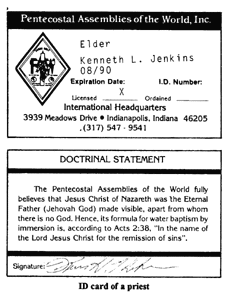
                  Abdullah al-Faruq - Formerly Kenneth L. Jenkins, minister and elder of the Pentecostal Church

                  Foreword

                  As a former minister and elder of the Christian church, it has become incumbent upon me to enlighten those that continue to walk in darkness. After embracing Islam I felt a dire need to help those who have not yet been blessed to experience the light of Islam.
                  I thank Almighty God, Allah, for having mercy upon me, causing me to come to know the beauty of Islam as taught by Prophet Muhammad and his rightly guided followers. It is only by the mercy of Allah that we receive true guidance and the ability to follow the straight path, which leads to success in this life and the Hereafter.
                  Praise be to Allah for the kindness shown to me by Shaykh 'Abdullah bin 'Abdul-'Azeez bin Baz upon my embracing Islam. I cherish and will pass on the knowledge gained from each meeting with him. There are many others who have helped me by means of encouragement and knowledge, but for fear of missing anyone, I will refrain from attempting to list them. Sufficient it is to say that I thank Almighty God, Allah, for each and every brother and sister that He has allowed to play a role in my growth and development as a Muslim.
                  I pray that this short work will be of benefit to all. I hope that Christians will find that there is yet i hope for the wayward conditions that prevail over the bulk of Christendom. The answers to Christian problems are not to be found with the Christians themselves, for they are, in most instances, the root of their own problems. Rather, Islam is the solution to the problems plaguing the world of Christianity, as well as the problems facing the so-called world of religion as a whole. May Allah guide us all and reward us according to the very best of our deeds and intentions.
                  Abdullah Muhammad al-Faruque at-Ta'if, Kingdom of Saudi Arabia
                  Beginnings
                  As a young boy I was raised with a deep fear of God. Having been partially raised by a grandmother who was a Pentecostal fundamentalist, the church became an integral part of my life at a very early age. By the time I had reached the age of six, I knew all too well the benefits awaiting me in Heaven for being a good little boy and the punishment awaiting in Hell for little boys who are naughty. I was taught by my grandmother that all liars were doomed to go to the Hellfire, where they would burn forever and ever.
                  My mother worked two full-time jobs and continued to remind me of the teachings given to me by her mother. My younger brother and older sister did not seem to take our grandmother's warnings of the Hereafter as seriously as I did. I recall seeing the full moon when it would take on a deep reddish hue, and I would begin to weep because I was taught that one of the signs of the end of the world would be that the moon would become red like blood. As an eight year old child I began to develop such a fear at what I thought were signs in the heavens and on earth of Doomsday that I actually had nightmares of what the Day of Judgement would be like. Our house was close to a set of railroad tracks, and trains passed by on a frequent basis. I can remember being awakened out of sleep by the horrendous sound of the locomotive's horn and thinking that I had died and was being resurrected after hearing the sound of the trumpet. These teachings were ingrained in my young mind through a combination of oral teachings and the reading of a set of children's books known as the Bible Story.
                  Every Sunday we would go to church dressed in all of our finery. My grandfather was our means of transportation. Church would last for what seemed to me like hours. We would arrive at around eleven in the morning and not leave until sometimes three in the afternoon. I remember falling asleep in my grandmother's lap on many occasions. For a time my brother and I were permitted to leave church in between the conclusion of Sunday school and morning worship service to sit with our grandfather at the railway yard and watch the trains pass. He was not a churchgoer, but he saw to it that my Family made it there every Sunday. Sometime later he suffered a stroke, which left him partially paralysed, and as a result, we were unable to attend church on a regular basis. This period of time would be one of the most crucial stages of my development.

                  Rededication

                  I was relieved, in a sense, at no longer being able to attend church, but I would feel the urge to go on my own every now and then. At age sixteen I began attending the church of a friend whose father was the pastor. It was a small storefront building with only my friend's family, myself, and another schoolmate as members. This went on for only several months before -the church closed down. After graduating from high school and entering the university I rediscovered my religious commitment and became fully immersed in Pentecostal teachings. I was baptised and "filled with the Holy Ghost," as the experience was then called. As a college student, I quickly became the pride of the church. Everyone had high hopes for me, and I was happy to once again be "on the road to salvation".
                  I attended church every time its doors would open. I studied the Bible for days and weeks at a time. I attended lectures given by the Christian scholars of my day, and I acknowledged my call to the ministry at the age of 20. I began preaching and became well known very quickly. I was extremely dogmatic and believed that no one could receive salvation unless they were of my church group. I categorically condemned everyone who had not come to know God the way I had come to know Him. I was taught that Jesus Christ (peace be upon him) and God Almighty were one and the same thing. I was taught that our church did not believe in the trinity but that Jesus (peace be upon him) was indeed the Father, Son and Holy Ghost. I tried to make myself understand it even though I had to admit that I really did not fully understand it. As far as I was concerned, it was the only doctrine that made sense to me. I admired the holy dress of the women and the pious behaviour of the men. I enjoyed practicing a doctrine where women were required to dress in garments covering themselves completely, not painting their faces with makeup, and carrying themselves as true ambassadors of Christ. I was convinced beyond a shadow of a doubt that I had finally found the true path to eternal bliss. I would debate with anyone from a different church with different beliefs and would totally silence them with my knowledge of the Bible. I memorized hundreds of Biblical passages, and this became a trademark of my preaching. Yet, even though I felt assured of being on the right path, a part of me was still searching. I felt that there was an even higher truth to be attained.
                  I would meditate while alone and pray to God to lead me to the correct religion and to forgive me if what I was doing was wrong. I had never had any contact with Muslims. The only people I knew that claimed Islam as their religion were the followers of Elijah Muhammad, who were referred to by many as the "Black Muslims" or the "Lost-Found Nation." It was during this period in the late seventies that Minister Louis Farrakhan was well into rebuilding what was called "The Nation of Islam." I went to hear Minister Farrakhan speak at the invitation of a co-worker and found it to be an experience that would change my life dramatically. I had never in my life heard another black man speak the way that he spoke. I immediately wanted to arrange a meeting with him to try to convert him to my religion. I enjoyed evangelising, hoping to find lost souls to save from the Hellfire - no matter who they were.

                  Comment


                  • #10
                    He further Adds:

                    "After graduating from college I began to work on a full-time basis. As I was reaching the pinnacle of my ministry, the followers of Elijah Muhammad became more visible, and I appreciated their efforts in attempting to rid the black community of the evils that were destroying it from within. I began to support them, in a sense, by buying their literature and even meeting with them for dialogue. I attended their study circles to find out exactly what they believed. As sincere as I knew many of them were, I could not buy the idea of God being a black man. I disagreed with their use of the Bible to support their position on certain issues. Here was a book that I knew very well, and I was deeply disturbed at what I deemed was their misinterpretation of it. I had attended locally supported Bible schools and had become quite knowledgeable in various fields of Bible study.
                    After about six years I moved to Texas and became affiliated with two churches. The first church was led by a young pastor who was inexperienced and not very learned. My knowledge of the Christian scriptures had by this time developed into something abnormal. I was obsessed with Biblical teachings. I began to look deeper into the scriptures and realized that I knew more than the present leader. As a show of respect, I left and joined another church in a different city where I felt that I could learn more. The pastor of this particular church was very scholarly. He was an excellent teacher but had some ideas that were not the norm in our church organization. He held somewhat liberal views, but I still enjoyed his indoctrination. I was soon to learn the most valuable lesson of my Christian life, which was "all that glitters is not gold." Despite its outward appearance, there were evils taking place that I never thought were possible in the Church. These evils caused me to reflect deeply, and I began questioning the teaching to which I was so dedicated.

                    Welcome to the Real Church World


                    I soon discovered that there was a great deal of jealousy prevalent in the ministerial hierarchy. Things had changed from that to which I was accustomed. Women wore clothing that I thought was shameful. People dressed in order to attract attention, usually from the opposite sex. I discovered just how great a part money and greed play in the operation of church activities. There were many small churches struggling, and they called upon us to hold meetings to help raise money for them. I was told that if a church did not have a certain number of members, then I was not to waste my time preaching there because I would not receive ample financial compensation. I then explained that I was not in it for the money and that I would preach even if there was only one member present... and I'd do it for free! This caused a disturbance. I started questioning those whom I thought had wisdom, only to find that they had been putting on a show. I learned that money, power and position were more important than teaching the truth about the Bible. As a Bible student, I knew full well that there were mistakes, contradictions and fabrications. I thought that people should be exposed to the truth about the Bible. The idea of exposing the people to such aspects of the Bible was a thought supposedly attributable to Satan. But I began to publicly ask my teachers questions during Bible classes, which none of them could answer. Not a single one could explain how Jesus was supposedly God, and how, at the same time, he was supposedly the Father, Son and Holy Ghost wrapped up into one and yet was not a part of the trinity. Several preachers finally had to concede that they did not understand it but that we were simply required to believe it.
                    Cases of adultery and fornication went unpunished. Some preachers were hooked on drugs and had destroyed their lives and the lives of their families. Leaders of some churches were found to be homosexuals. There were pastors even guilty of committing adultery with the young daughters of other church members. All of this coupled with a failure to receive answers to what I thought were valid questions was enough to make me seek a change. That change came when I accepted a job in the Kingdom of Saudi Arabia.

                    A New Beginning

                    It was not long after arriving in Saudi Arabia that I saw an immediate difference in the lifestyle of the Muslim people. They were different from the followers of Elijah Muhammad and Minister Louis Farrakhan in that they were of all nationalities, colours and languages. I immediately expressed a desire to learn more about this peculiar brand of religion. I was amazed with the life of Prophet Muhammad and wanted to know more. I requested books from one of the brothers who was active in calling people to Islam. I was supplied with all of the books that I could possibly want. I read each and every one. I was then given the Holy Qur'an and read it completely several times within four months. I asked question after question and received satisfactory answers. What appealed to me was that the brothers were not keen on impressing me with their knowledge. If a brother did not know how to answer a question, he would tell me that he simply did not know and would have to check with someone who did. The next day he would always bring the answer. I noticed how humility played such a great role in the lives of these mysterious people of the Middle East.
                    I was amazed to see the women covering themselves from face to foot. I did not see any religious hierarchy. No one was competing for any religious position. All of this was wonderful, but how could I entertain the thought of abandoning a teaching that had followed me since childhood? What about the Bible? I knew that there is some truth in it even though it had been changed and revised countless numbers of times. I was then given a video cassette of a debate between Shaykh Ahmed Deedat and Reverend Jimmy Swaggart. After seeing the debate I immediately became a Muslim. (To view this debate click here - requires RealPlayer)
                    I was taken to the office of Shaykh 'Abdullah bin 'Abdul-'Azeez bin Baz to officially declare my acceptance of Islam. It was there that I was given sound advice on how to prepare myself for the long journey ahead. It was truly a birth from darkness into light. I wondered what my peers from the Church would think when they heard that I had embraced Islam. It was not long before I found out. I went back to the United States for vacation and was severely criticized for my "lack of faith." I was stamped with many labels - from renegade to reprobate. People were told by so-called church leaders not to even remember me in prayer. As strange as it may seem, I was not bothered in the least. I was so happy that Almighty God, Allah, had chosen to guide me aright that nothing else mattered.
                    Now I only wanted to become as dedicated a Muslim as I was a Christian. This, of course, meant study. I realized that a person could grow as much as they wanted to in Islam. There is no monopoly of knowledge - it is free to all who wish to avail themselves of the opportunities to learn. I was given a set of Saheeh Muslim as a gift from my Qur'an teacher. It was then that I realized the need to learn about the life, sayings and practices of Prophet Muhammad . I read and studied as many of the hadith collections available in English as possible. I realized that my knowledge of the Bible was an asset that is now quite useful in dealing with those of Christian backgrounds. Life for me has taken on an entirely new meaning. One of the most profound attitude changes is a result of knowing that this life must actually be spent in preparation for life in the Hereafter. It was also a new experience to know that we are rewarded even for our intentions. If you intend to do good, then you are rewarded. It was quite different in the Church. The attitude was that "the path to Hell is paved with good intentions." There was no way to win. If you sinned,thenyou had to confess to the pastor, especially if the sin was a great sin, such as adultery. You were judged strictly by your actions"

                    Comment


                    • #11
                      He adds:

                      After an interview by the Al-Madinah newspaper I was asked about my present-day activities and plans for the future. At present, my goal is to learn Arabic and continue studying to gain greater knowledge about Islam. I am presently engaged in the field of da'wah and am called upon to lecture to non-Muslims who come from Christian backgrounds. If Allah, Almighty, spares my life, I hope to write more on the subject of comparative religion.
                      It is the duty of Muslims throughout the world to work to spread the knowledge of Islam. As one who has spent such a long time as a Bible teacher, I feel a special sense of duty in educating people about the errors, contradictions and fabricated tales of a book believed in by millions of people. One of the greatest joys is knowing that I do not have to engage in a great deal of dispute with Christians, because I was a teacher who taught most of the dispute techniques used by them. I also learned how to argue using the Bible to defend Christianity. And at the same time I know the counter arguments for each argument which we, as ministers, were forbidden by our leaders to discuss or divulge.
                      It is my prayer that Allah will forgive us all of our ignorance and guide us to the path leading to Paradise. All praise is due to Allah. May the peace and blessings of Allah be upon His last messenger, Prophet Muhammad, his family, companions, and those following true guidance.


                      Comment

                      Working...
                      X