Announcement

Collapse
No announcement yet.

Foundations of Islam - Shaykh Hamza Yusuf

Collapse
X
 
  • Filter
  • Time
  • Show
Clear All
new posts

  • Foundations of Islam - Shaykh Hamza Yusuf

    Articles of Faith - Shaykh Hamza Yusuf (24 Parts)


    How the Holy Quran was compiled


    These lectures are part of the Foundations of Islam series, a series of classes on the basics of Islam that Shaykh Hamza Yusuf taught to teachers at the Dar al Islam Teachers' Institute in New Mexico.

    The complete series includes the following titles:
    How the Qur'an Was Revealed and Compiled
    Pillars of Practice
    Articles of Faith
    The Concept of Ihsan
    Signs of the Last Day
    SeekersGuidance - Online Courses, IslamCast, Answers

    SunniPath - The Online Islamic Academy

    masud.co.uk - Resource for Traditional Islam


  • #2
    SubhanAllah - listening to these lectures gives one a sense of how vast Shaykh Hamza's knowledge is. He possesses an encyclopedic intellect.
    SeekersGuidance - Online Courses, IslamCast, Answers

    SunniPath - The Online Islamic Academy

    masud.co.uk - Resource for Traditional Islam

    Comment


    • #3
      hes alright....
      Frater aliquis in fide nec fratrem humanitatis


      Comment


      • #4
        Hamza yusuf is a misguided . first you look at his face .. shaven and shaving is haram .. the Prophet alehi salam turned his face away from two majos when they have shaven so what about this loser .so he is a fasiq commiting greater sin.Hamza Yusuf is amongst the `aqlaaniyyah (rationalists), mu`attilah (deniers of Allaah's Attributes), and mutasawwifah - and his collections of video lectures, audio lectures, and his own website (still operative and available online) is ample testimony to this.

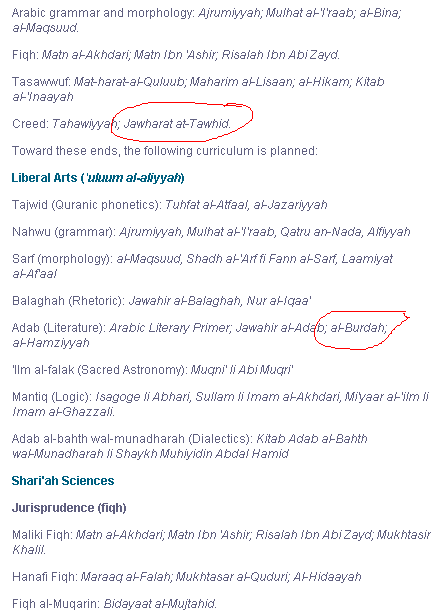
        The courses taught at his institute use the book "Jawharat ut-Tawheed" - the book that preaches and invites to the heresies of ta'teel and (false) ta'weel and tafweed, a book which is a base and pole for the Mu`attilah. His institute teaches al-Burdah of al-Busayree which is a poem that invites to Shirk with Allaah, invites to Istigaathah from other than Allaah, and which has been refuted by the Scholars of Tawheed and the Sunnah.

        See the screenshot (taken from his website today) attached for a mention of these books used for his curriculum.


        You can see some refutations of excerpts from al-Burdah here:
        http://www.sahab.net/sahab/showthrea...hreadid=294580

        And I have also heard this person on a video lecture making the following two remarks, "This concern with `aqeedah is a sickness in the minds of the Muslims", and "I can go to the desert in Mauritania and learn Tawheed in five minutes", which gives further insight into his ignorance and misguidance.

        HAMZA YUSUF EXPOSED

        Michael: Well we know now it was more plunder than religion.
        Hamza Yusuf: Well, that's true. And unfortunately a lot of religious wars tend to be for other than religion. But the word jihad is probably one of the highest concepts that the Arabs and the Muslims have. It represents really the best of humankind. In the Quran it is never once used to express a military meaning. Not once.

        Comment: This is not true. Open any Quran commentary book and find for yourself. (See for example: surah 4 verse 95, surah 9 verse 41, and surah 61 verses 10-13) Interestingly, even Hamza Yusuf himself knows that this statement is not entirely accurate. In his tape “The Life of The Prophet Muhammad,” tape number 9 Hamza Yusuf - talking about the prophet SAAWS and his companions in Madinah-said:
        “They are in a state of perpetual vigilance and war. This is jihad, his life is really a life of jihad, of struggle against the people who were bent on not seeing Islam spread which is important to us to take as a lesson if we really want to spread Islam”.


        Michael: It means -- does it not mean to go to war with yourself?

        Hamza Yusuf: Well, that's one of the meanings. It literally means – if you look at the word, the root word is "jihad" which means to struggle, and juhd in the Arabic language means a struggle literally. So jihad is the act of struggling. And the Prophet Muhammad peace be upon him, said that the greatest jihad is to struggle with your own soul's insidious suggestions.

        Comment: The root word of Jihad is actually “jahada.” It means 'fighting the enemies or doing ones utmost in fighting' (see lisaan Al-Arab by Ibn Mandhoor, Vol. 2 page 396. First edition, published by Dar Ihya at-Turath al-Arabi, Beirut 1988). The hadith mentioned at the end is a weak hadeeth (See the book of weak hadeeths by Imam al-Albani, and the book of weak and fabricated Hadeeths for Imam al-Shawkani). Sufis in general always quote this Hadith because it relieves them from waging the true Jihad.

        Hamza Yusuf (continues): And I think that really clarifies to the Muslims. Building a hospital in the Arab world – and I've lived in the Arab world, I speak Arabic very well – building a hospital, the Arabs will literally say what a great jihad that was when it was completed.

        Comment: This is not an accurate statement. Arabic is my native tongue and I have studied it – at least one session every day -- for 22 years. That phrase would never be used to describe such an effort. Instead, the Arab might say: what a great juhd which means “effort”. However the Shari’ (legal) meaning of the term ‘Jihad,’ is “ The war Muslims wage to make the word of Allah superior against kuffar (disbelievers) who do not have a covenant with Muslims after being invited to Islam and rejecting the invitation. Reference: The Fiqh encyclopedia by the Ministry
        of Islamic Affairs, Kuwait”


        Hamza Yusuf (continues): The idea of spending money for anything good -- those firefighters who were pulling people out of the World Trade Towers, they would be considered, that's an act of jihad. They would be considered mujahideen if they were described in Arabic. And I'm not exaggerating at all. That really is at the essence of this word.

        Comment: Again, this is not accurate. In Islamic literature, when the word “mujahideen” is used without any qualification, it means one and only one thing: those who fight in the battlefield for the sake of Allah. Please refer to the Quran (See for example the commentary on surah 4 verse 95) and search for the word Jihad and Mujahideen to gain a better understanding of how they are used.
        The following hadith in Sahih Bukhari, Vol. 4 Book 52, No. 44 shows how the prophet SAAWS understood the word “jihad” and “mujahid” (singular of mujahideen,” please compare this hadith to what Hamza Yusuf said: Narrated by Abu Hurayrah (RA): A man came to Allah's Apostle and said, "Instruct me as to such a deed that equals Jihad (in reward)." He replied, "I do not find such a deed." Then he added, "Can you, while the Muslim fighter is in the battlefield, enter your mosque to perform prayers without cease and fast and never break your fast?" The man said, "But who can do that?" Abu- Hurayrah added, "The Mujahid (i.e., Muslim fighter) is rewarded even for the footsteps of his horse while it wanders about (for grazing) tied by a long rope."
        However, if one does use the terms 'Jihad' or 'Mujahid' in a context other than their literal meaning, one must supplement these words with specific references that modify its literal meaning. These two words may be qualified to mean other types of jihad e.g. you may say jihad against the devil which means being vigilant towards the devil's tricks. Therefore, each time the word jihad is used without any qualification in the Islamic literature – aside from the Sufi books--it means primarily fighting in the battlefield for the sake of Allah (SWT.) Without doubts scholars have clearly mentioned Jihad-ul-nufs (struggle against one's insidious suggestions), however this has never been the primary understanding of the term Jihad.
        Also, refer to all the authentic Hadeeth in which “jihad” is mentioned, observing what the scholars have said about it. For example when
        Imam Bukhari & Muslim compiled their books of Sahih Hadith, they carefully gathered related Hadeeth reflecting a certain theme under definitive titles. In order to see the understanding of these Imams about Jihad, please go and read the chapters on Jihad in their respective books of Hadeeth. The same applies to Imam Nawawi in his book Riyad-us-Saliheen.


        Michael: When you read the coverage in some of the more fulminating columnists and commentators, it comes up time and time again, this business about the Quran promising the martyrs or the suicide bombers that if they die in the course of their mission they will go immediately to heaven where they will be greeted by ten or fifteen or sixty-eight or something or other, virgins. You must have seen that. What is that?

        Hamza Yusuf: You know, again this is the problem with religious language for the modern mind. The Quran, just to give you an example, says that there is nothing like God and immediately after that – it's in a chapter called Shura (The Council) – and immediately after that it says and He is the All-Seeing, the All-Hearing. So here's a verse that says there's nothing like Him and then it's immediately followed by saying He hears everything and He sees everything. Well, how do we know what seeing and hearing is if we don't have a likeness in this world of it

        Comment:: When it comes to the attributes of Allah the scholars of Islam discuss these attributes from 2 distinct, yet related, perspectives:
        1. ‘The how’: This means, how does Allah actually see? How does His hand –that He has mentioned in the Quran -- look? The stance of the Companions of the Prophet, the Tabi’een (those who came after the companions) and those who follow, the major scholars of Ahul-Sunnah
        including the 4 Imams stated that: We do NOT know anything about the ‘how’ of the attributes of Allah SWT because Allah SWT did not tell us anything about them.
        2. ‘The meaning’: What is the meaning of the attribute of hearing, seeing, etc.? The stance of the Companions of the Prophet SAAWS, the Tabi’een (those who came after the companions) and those who follow, the major scholars of Ahul-Sunnah including the 4 Imams is that: We KNOW the meaning of the attribute of Allah SWT. We know what mercy means when Allah says about Himself that He is merciful. We know what hearing means. We also believe that His attributes are perfect. For example, Allah has the attribute of knowledge and humans have that attribute too. The difference is that Allah’s knowledge is perfect in the sense that there is no beginning for His knowledge and there is no end, it is not limited by time nor space, it precedes everything, etc. Human knowledge, on the other hand, is far from being perfect. Human knowledge is preceded by ignorance, it is limited by time, space, ones mental capacity, and it is followed by a lack of it when one ages.
        There is no contradiction in the verse that Hamza Yusuf speaks about. When Allah SWT states that “there is nothing like Him and He is the All-Seeing, the All-Hearing” this actually means that there is nothing like him in: [1] manifestations of (How) and [2] perfection of attributes (meaning). Actually, the scholars consider this very verse as the corner stone of the Islamic creed (Aqeeda) when it comes to the attributes of Allah SWT since this verse negates any resemblance between Allah and his creation, however it also affirms that He has attributes.


        Hamza Yusuf(continues): So on the one hand there is pure transcendence and on the other hand there's the imminent aspect of God's manifestations, his attributes in the world.

        Comment: Please note how he has introduced a ‘supposed contradiction in the Quran.’ “Does Allah have a likeness to something in this world.” He will now use this, below, to convince the reader not to take the Quranic verses regarding Paradise literally.

        Hamza Yusuf (continues): If you look in the Quran about the pleasures of paradise, the definitive verse in the Quran is that the pleasures of paradise are those, which no eye has seen, no ear has heard of, and has never occurred to the heart of a human being. So that is the definitive verse about the pleasures of paradise. Now, there are some Hadeeths, it's not in the Quran, there is mention of beautiful youths as well as beautiful women, and that's more metonymy in rhetoric.

        Michael: It's an allegory.
        Hamza Yusuf: Exactly, it's an allegory, exactly.


        Comment:: There are many issues here:
        1. With all due respect to Hamza Yusuf, he is wrong: The statement “the pleasures of paradise are those which no eye has seen, no ear has heard of, and has never occurred to the heart of a human being” is not in the Quran. It is part of a Hadith. (Please see hadith 1760, page 857 in Sahih al-Bukhari, published by Dar-us-Salam Publications). If someone claims it is in the Quran, let him show us the Surah and the verse number.
        2. In addition, beautiful youth and women are mentioned in the Quran contrary to his statement. See for example the following verses:
        a. Surah 52 Verse 24
        b. Surah 55 Verse 56 &70
        c. Surah 56 Verse 22,36,37
        d. Surah 76 Verse 19
        e. Surah 78 Verse 33
        Please refer to what the scholars of the commentary on the Quran have said about the meaning of the aforementioned verses. You may read Imam at-Tabari, Imam Ibn Kathir, Imam al-Qurtubi, Imam al-Shawkani, etc.,
        3. The reward for a martyr is also mentioned in Ahadith. And it is not limited to what has been stated above. See Riyad-us-Saliheen [English], vol. 2, pages 967-992. Published by Darussalam, 1999)
        4. Hamza Yusuf claims that the pleasures of Paradise are “an allegory”. This statement is in contradiction with the consensus of Muslim scholars. There are clear Ahadeeth describing in detail the types of pleasures awaiting the believing men and women in Paradise. Unfortunately some early philosophers –who were not considered Muslims by Muslim scholars -- claimed that the pleasures of Paradise are not real, but rather are only allegorical. As a general rule though, all the statements of the Quran must be interpreted literally unless there is an evidence for them to be interpreted metaphorically. In fact, this is the case in all sorts of texts (e.g., American Constitution -- the US law).


        Michael: It's an allegory.
        Hamza Yusuf: Exactly, it's an allegory, exactly. And the thing about it is that our scholars say that the highest sensual experience in the world is orgasm and it's quite literal. I mean this is a traditional opinion; Imam al-Ghazali, one of the early theologians said that the orgasm that a human being experiences in sexual intercourse is the closest sensual experience that one can taste of what the delights of paradise are like. The Muslims traditionally saw it as almost – and the Hindus have this concept as well – that there's almost a mystical experience. Now, the vast majority of human beings do not have profound mystical experiences. The mystic has experiences that transcend sexuality and in fact, it's well known that a lot of mystics lose their appetite for those types of things because of their own internal experiences.


        Michael: They're celibate.
        Hamza Yusuf: Exactly.


        Comment:: There is a contradiction here. If ‘the pleasure of Paradise has never occurred to the heart of a human being’ (as said by Hamza Yusuf earlier), which is true, how would anyone know if “sexual intercourse” is the closest sensual experience that one can taste of what the delights of Paradise are alike. It does not behoove a Muslim to introduce such an irrelevant matter in this conversation.
        What is the point of mentioning what concepts the Hindus share with Muslims? Does it make our concepts more valid? Are we to use Hindu doctrines to legitimize Islamic beliefs? Who are these Muslims that considered orgasms to be a mystical experience? Can he quote any of the four Imams as having agreed with such as perverse notion.1 , 2
        Please read the book of Abdulwahab al-Sharani ( a sufi scholar and historian) which he titled: Tabakat al-sufiyyah , or a book for al-Nabhani (another Sufi) to find if the mystics really lost their appetite for such things due to their own internal experiences. The reality is that many of these mystics have indulged in illicit sexual acts including homosexuality. With all due respect to Hamza Yusuf, does he find it praiseworthy to lose one's “appetite” for these types of things?


        Expert says Islam prohibits violence against innocents
        Source of interview: http://www0.mercurycenter.com/local/center/isl0916.htm

        Hamza Yusuf said: Jihad means struggle. The Prophet said the greatest jihad is the struggle of a man against his own evil influences. It also refers to what Christians call a ``just war,'' which is fought against tyranny or oppression -- but under a legitimate state authority.
        Comment: -This Hadith is not authentic as mentioned before. Please note in the previous interview Hamza Yusuf alluded to Jihad as ‘Jihad-ul-Nufs’ (internal struggle). However now he is introducing another meaning to Jihad, and allowing Jihad to be –a “Just War” against tyranny and oppression! This kind of Jihad is to be a defensive form of warfare.-[Jihad –ul-dafa’]
        Please note in Islam there is indeed a legitimate offensive Jihad. [Jihad-at-Talab] The Prophet SAWS sent troops to different parts of the
        Arabian Peninsula to spread Islam. Also the three rightly guided Khalifas after Him sent armies to Persia, Roman territory, and North Africa to spread Islam. (However there are etiquettes to all types of Jihad, and the armies did not oppress or compel people to change their religion, but rather spread the virtues of Islam).


        Interviewer: What is the Arabic word for martyr?

        Hamzah Yusuf said: Shaheed. It means witness. The martyr is the one who witnesses the truth and gives his life for it. There are people in this
        country like Martin Luther King who would be considered a martyr for his cause. Also, if your home, your family, your property or your land or religion is threatened, then you may defend it with your life. That person is a martyr. But so is anybody who dies of terminal illness; it's a martyr's death. Because it's such a purification that whatever wrongs they once did, they're now in a state of purity.


        Comment: While it is agreed that one meaning of the term Shaheed is to be a witness. The prominent meaning of Shaheed in Islamic terms is, however, a person who is killed in Jihad. This is the highest degree of martyrdom. A lesser degree is for a Muslim who gets killed defending his/her family, his/her wealth, or his/her honor, a person with terminal illness, a woman who dies while delivering a child, and the one who dies drowning. But this applies only to Muslims according to the definitive Ayah in the Quran: “Verily, Allah forgives not (the sin of) setting partners (in worship) with Him” (Surah 4 Verse 116). Hence, Martin Luther King – although he stood for a just cause-- definitely does not fit in this second category of martyrdom unless he became a Muslim before he died.

        Hamzah Yusuf said: And the greatest martyr in the eyes of God is the one who stands in the presence of a tyrant and speaks the truth and is killed for it. He is martyred for his tongue.

        Comment: With all due respect this is not the complete truth. The statement above is extracted from a Hadith, which in full is “the master of the martyrs is Hamzah – the Prophet’s uncle who was killed in the battlefield- and a man who stood in the presence of a tyrant and spoke the truth and was killed for it” (see Sahih al-jami as-Sageer by Imam al-Ablani, Vol. 3 hadith no. 3569 page 219. Second Edition, Published by al-Maktab al-Islami, Amman 1979) .

        Hamzah Yusuf said: If there are any martyrs in this affair it would certainly be those brave firefighters and police that went in there to save human lives and in that process lost their own.

        Comment: This is inaccurate due to the fact that the hadith of the Prophet SAWS regarding this matter applies to Muslims only. If any of them was a Muslim, then we hope that he/she is a martyr.

        FOOTNOTES:
        (PLEASE REFER TO LAST PARAGRAPH OF FIRST LECTURE) The four Imams were chosen here because they have a prestigious status in the entire Ummah and their leadership and knowledge has been clearly accepted by an overwhelming majority of Muslims.
        Also please note that we were forced to address this perverse issue (understanding the delights of paradise through sexual experience) simply
        because it was brought up in these interviews in such a manner.
        This article can be found at:
        http://hamzayusuf.faithweb.com/interviews_hamza.htm


        "Allahuma arenal Haqqa Haqqan war zuqna ittiba`u, wa arenal batila batilaan war zuqna ijtinaba. Ameen."
        "O Allah, please give us the ability to observe truth as it truly is and make us follow it; and give us the ability to observe falsehood as it truly is and help us reject and steer clear from it."
        Ameen.


        Interview with Hamza Yusuf Hanson by Michael Enright
        Aired on September 23, 2001

        Comment


        • #5
          Jazakallah khair for posting this Ezatullah.
          [SIZE="4"][B][CENTER][URL="www.quranawsunnat.com"]www.quranawsunnat.com
          [/URL]
          [URL="www.youtube.com/Sangartube"]www.youtube.com/Sangartube
          [/URL][/SIZE]
          Mullah 4 Life! [/CENTER][/B]

          Comment


          • #6
            Imam abu hanifa was .. was Salafi ,Sunni .its shame that you don`t take his aqeeda? was he wrong in aqeeeda? none of the pukhtons are Ashari maturidi excpet those deobandi and blind followers ..Imam abu hasan al ashari repented from his aqeeda and wrote book to refute it .. and its strange you take his aqeeda? where is the brain .. show to me what was the aqeeeda of great imam Abu hanafi ... not ashari maturid..

            Comment


            • #7
              Timbatu .. your bit jahil from islam but never mind .. any amar of the Prophet is taken for fard.. so about beard he has orderd us to leave .. not like a fly under chin.
              Concerning Adherence to the Sunnah in the Holy Qur'an:
              "O ye who believe! Obey Allah, and obey the Messenger, and those charged with authority among you." (Quran 4:59)
              "O ye who believe! Obey Allah and His Messenger, and turn not away from him when ye hear (him speak)." (Quran 8:20)
              "O ye who believe! give your response to Allah and His Messenger, when He calleth you to that which will give you life; and know that Allah cometh in between a man and his heart, and that it is He to Whom ye shall (all) be gathered."(Quran 8:24)
              "Ye have indeed in the Messenger of Allah an excellent exempler for him who hopes in Allah and the Final Day, and who remembers Allah." (Quran 33:21)
              "What Allah has bestowed on His Messenger (and taken away) from the people of the townships,- belongs to Allah,- to His Messenger and to kindred and orphans, the needy and the wayfarer; in order that it may not (merely) make a circuit between the wealthy among you. So take what the Messenger gives you, and refrain from what he prohibits you. And fear Allah: for Allah is strict in Punishment." (Quran 59:7)

              Importance of the Beard in the words of Rasulullah (Sallallahu Alayhi Wasallam):
              1. (1) Rasulullah (Sallallahu Alayhi Wasallam) said "I have no connection iwth one who shaves, shouts and tears his clothing eg. in grief or affication."
                - Reported by Abu Darda (R.A.) in Muslim, Hadith no. 501

                (2) The teachings of Hadhrat Ammar Bin Yaasir, Abdullah Ibn Umar, Sayyidina Umar, Abu Hurairah and Jaabir (R.A.), indicate that ALL used to keep beards that were one fist length or more. Hadhrat Jaabir (R.A.) had said: "We used to grow long beards and only during Hajj and Umrah did we trim them to the required length (i.e. fist length)."
                (3) Hadhrat Abdullah Ibn Umar (R.A.) relates that: "He who imitates the kuffar (non-believers) and dies in that state, he will be raised up with them on the Day of Qiyamat (Judgement)."
                (4) Rasulullah (Sallallahu Alayhi Wasallam) says: "Trim closely the moustache, and let the beard flow (Grow)."
                - Narrated Ibn Umar (R.A.) in Muslim, Hadith no. 498

                (5) "Rasulullah (Sallallahu Alayhi Wasallam) ordered us to trim the moustache closely and spare the beard" says Ibn Umar.
                - Muslim, Hadith no. 449

                (6) Rasulullah (Sallallahu Alayhi Wasallam)said: "Act against contrary to the polythesists, trim closely the moustache and grow the beard."
                - Reported by Ibn Umar (R.A.) in Muslim, Hadith no. 500

                (7) Rasulullah (Sallallahu Alayhi Wasallam) said "Trim closely the moustache and grow the beard."
                - Reported by Abu Hurairah (R.A.) in Muslim, Hadith no. 501

                (8) Rasulullah (Sallallahu Alayhi Wasallam) said: "Anyone who shaves has no claim to the mercy of Allah"
                - Reported by Ibn Abbas (R.A.) in Tibrabi

                (9) Hadhrat Abdullah Ibn Umar (R.A.) used to cut that portion (which exceeds the grip of the hand) of the beard.
                - Tirmidhi
              The Beard according to the Great Imams of Jurisprudence
              Hanafi
              Imam Muhammed (R.A.) writes in his book "Kitabul Aathaar" where he relates from Imam Abu Hanifa (R.A.) who relates from Hadhrat Haytham (R.A.) who relates from Ibn Umar (R.A.) that he (Ibn Umar) used to hold his beard in his hand and cut off which was longer. Imam Muhammed (R.A.) says that this is what we follow and this was the decision of Imam Abu Hanifa. Therefore, according to Hanafies, to shorten the beard less than a FIST LENGTH is HARAAM and on this is IJMA (concensus of opinion).
              Shafi'i
              Imam Shafi (R.A.) in his Kitabul Umm states, "To shave the beard is HARAAM." (Shari Minhaj dar Shara Fasl Aqueeqa).
              Maaliki
              Shekh Ahmad Nafarawi Maliki in the commentary of Imam Abu Zayed's booklet states, "to shave the beard is without doubt haraam according to all Imams." It is also mention in "Tamheed" which is a commentary of "Muatta" (Sunnan Imam Malik (R.A.)) that to shave the beard is HARAAM and among males the only ones to resort to this practice (of shaving) are the HERMAPHRODITES (persons who possess both male and female features and characteristics).
              Hanbali
              The Hanbalies in the famous Al-Khanie'a Hanbali Fatawa Kitab state that "to grow the beard is essential and to shave it is HARAAM." Also in the Hanbali Mathab books "Sharahul Muntahaa" and "Sharr Manzoomatul Aadaab", it is stated "The most accepted view is that it is HARAAM (prohibited to shave the beard)."
              Also note, according to scholars of Islam: "To shave off the beard is unlawful (haraam) and one who shaves his beard is legally speaking an unrighteous fellow (FASIQ); hence, it is NOT PERMISSIBLE to appoint such a man as an Imam. To say Taraweeh behind such an Imam is MAKRUH-E-TAHRIMI (near prohibition)" (Shami Vol.1, p.523)
              The Durre-Mukhtar states: "No one has called it permissible to trim it (the beard) less than FIST-LENGTH as is being done by some westernized Muslims and hermaphrodites." (Vol. 2, p. 155). Also, "It is forbidden (haraam) for a man to cut off another's beard." (Vol. 5, p. 359).
              Conclusion
              Thus, a Muslim who shaves or shortens his beard is like a hermaphrodite, his Imamate near prohibition, his evidence is not valid, he will not have the right to vote or being voted for. Shaving and shortening the beard is the action of non-believers. Imam Ghazzali (RA) says: "Know that the key to total bliss (Saadah) lies in following the Sunnah and in emulating the life of Rasulullah (Sallallahu Alayhi Wasallam) in ALL that issues from him, and in ALL his doings even if it concerns the manner of his eating, rising, sleeping, and speaking. I do say thisin relation to rituals in worship ONLY because ther is no way neglecting the Sunnah reported of him in such matters - but what I say INCLUDES EVERY ASPECT of his daily life." (Kitab al Arbain Addin, Cairo 1344, p. 89). Furthermore, in the Holy Qur'an, Allah told Rasulullah (Sallallahu Alayhi Wasallam) to say:
              "Say: "If ye do love Allah, Follow me: Allah will love you and forgive you your sins: For Allah is Oft-Forgiving, Most Merciful." (Quran 3:31)
              The daily recitation of a band of angels of Allah is "Holy is the Being who adorned men with beards and women with braids" (Takmela e Bahr al Raiq, Vol. 3, p. 331)
              Lastly, Allah Ta'ala says in the Holy Qur'an: "And when the true believers are called to Allah and His Rasul (Sallallahu Alayhi Wasallam) [to accept and practice the law and commands of Allah and His Rasul (Sallallahu Alayhi Wasallam)] that he may pass judgement upon them, their ONLY reply is 'We hear and obey.' Such men shall surely prosper." (24:51)
              THE CALL IS TO GROW A FIST LENGTH BEARD, LET US HEAR AND OBEY TO PROSPER.

              Comment


              • #8
                all the hadit says grow grow grow .. u become sheikh ul islam in one day that just leave it like a ... fly on the face

                Comment


                • #9
                  Originally posted by Timbaktu
                  This is like asking show me jesus was a muslim because Islam came 600 years later. Maturidi/Ashari Aqeeda is the Aqeeda of Ahlul Sunnah wal jamah. Just like there was no madhabs in the time of the prophet (pbuh), the Ashari/Maturidi schools didn't exist in his time. But both these school are based ont he Aqeedas of Ahlul sunnah was jammah. your point is illogical.

                  Its like saying we should abondon madhabs because they didn't exist in the time of the prophet. (pbuh). Think about what your saying.
                  it is a valid argument against maturidism and ash'arism. You have no evidence to prove that Ash'arism and Maturitism existed among the companions of the prophet muhammad saww.

                  It's an evil innovation. And there is nothing sunni about Ash'arims or maturidism. Its misguidance.
                  [SIZE="4"][B][CENTER][URL="www.quranawsunnat.com"]www.quranawsunnat.com
                  [/URL]
                  [URL="www.youtube.com/Sangartube"]www.youtube.com/Sangartube
                  [/URL][/SIZE]
                  Mullah 4 Life! [/CENTER][/B]

                  Comment


                  • #10
                    Originally posted by Timbaktu
                    This is like asking show me jesus was a muslim because Islam came 600 years later. Maturidi/Ashari Aqeeda is the Aqeeda of Ahlul Sunnah wal jamah. Just like there was no madhabs in the time of the prophet (pbuh), the Ashari/Maturidi schools didn't exist in his time. But both these school are based ont he Aqeedas of Ahlul sunnah was jammah. your point is illogical.

                    Its like saying we should abondon madhabs because they didn't exist in the time of the prophet. (pbuh). Think about what your saying.
                    .......................... you make me laugh .. maturid and aashiri .. i told you bring a proof from your imam abu hanifa that he had this aqeeda which you have ... instead imam abu hanfia says in fiq ul akbar .. and same about Aqeeda tu tahaweya .. anyone who dont excpet the istiwa of Allah is a kafir so according to ur imam ur a kafir lol hanafi dont take the aqeeda of imam abu hanifa neither they take it from imam tahawi cuz thier aqeeda was a sunni aqeeda .. here some hanafis agreeing with sunnis ..
                    Abdul Aziz Al-Bukhari and Al-Bazdawi affirming a hand and face for Allah
                    In “Kashful Asrar” of Abdul Aziz Al-Bukhari Al-Hanafi, Sharh of Usul Bazdawi, in chapter of Haqiqah and Majaz, Al-Bazdawi and Al-Bukhari rejected Mu'tazilah's denial of Hand and Face for Allah.

                    Here are extracts:

                    "And the same as establishing Seeing Allah (Ar-Ruyah), establishing His Face (Wajh) and Hand of Allah are true for us. Because of His Saying we turn away from the saying of the one who says that we do not describe Allah with a face and hand, rather the meaning of face is satisfaction (rida) and essence (Zat) and similar to this, and meaning for Hand is power (Qudrah), Favour (Ni’mah) and similar to this. Then the Shaykh (Al-Bazdawi) said : rather He is described with the attribute (Sifat) of Face and Hand with purification of Him from the form present in the creation (Surah Al-Jariyah), because Face and Hand are attributes of perfection in the witnessed world, as one without Face or Hand is considered as defective, and He is described with attributes of perfection, so He is described by these two also, except that the form present in the creation is impossible for Him, as establishing of Kayfiyah (is impossible), so you make Tashbih (comparison) with His description. So It is obligatory to accept them (attributes) upon their reality (I’tiqad Haqqiyah) without turning from it with Taweel (extrapolation).

                    “And it is not permitted to reject the foundation (Asl)”: It is not permissible (for someone) to say that seeing Allah (Ar-Ruyah), Hand and Face are false (Batil) because of his inability to understand the face, the eye, their reality…while the possibility of Ruyah and His description with face and hand is established with decisive proofs (Dalail Qat’iyah)…

                    “They (Mu'tazilah) rejected foundations (Usul)”: It is possible that the meaning (of words of Al-Bazdawi) are “They rejected the reality of Ruyah, of Face and Hand because of their ignorance”…and it is possible that the meaning is “ they rejected Usul meaning attributes”.

                    They called themselves people of Monotheism (Ahlul Tawhid) and they made their Tawhid Batil with their (invented) Tawhid…They became Mu’atilah (deniars of attributes).

                    End of quotes from Kashful Asrar

                    Comment: we can see what these two great Hanafi scholars say that people who deny a hand and face for Allah have ruined their Tawhid and with their extrapolations have invented a new Tawhid.

                    Shabeer Ahmad 'Uthmani affirming a hand, foot and eye for Allah
                    Shabeer Ahmad Uthmani wrote in his Tafsir of the Quran, on verse 64 of Surah Al-Maidah about Allah's two Hands being outstretched and not tied as said by Jews:

                    "Where for Haqq Ta'ala hand, foot, eye and other attributes are mentioned, we should not even by forgetfulness have doubt that Ma'az Allah has a body (Jism) like creation or Jismani members. But just like God's essence (Zat), existence (Wujud), life, knowledge, and other attributes of perfection have no comparison or similarity and Kayfiyat (how they are) cannot be known except by Him...( after quoting a poem in Farsi, 'Uthmani gave it meaning in Urdu) His Sam' (listening), Basar (seeing), Yad ( Hand) and others descriptions, attributes and meanings are also according to His essence (Zat) and saint status and our Kayf (How) and Kam (how many) and Ta'bir and explanation are far away from comprehending this..." End of Shabeer Ahmad Uthmani's words

                    Comment: So this is a lesson for people who consider Shabeer Ahmad Uthmani as Shaykhul Islam. He compared the attributes of foot, eye and hand to seeing and hearing, and believed in all of them, and he said that Kayfiyah is not known.

                    “Fawatih Ar-Rahmut” and “Muthalam uth-Thubut”on attributes, Istiwa and Nuzul
                    It is written in “Fawatih Ar-Rahmut” that is an explanation of “Muthalam uth-Thubut” of 'Allamah Al-Bahari, a reference in Usul ul Fiqh for Ahnaf:
                    “This is among Mutashabih (unclear) like the letters at the beginning of Surah and hand” mentioned in His saying (Ta'ala): “The Hand of Allah is above their hands”. “And the Eye” mentioned in His saying (Ta'ala): “So that you grow under My eye”, “And the Nuzul (descent of Allah to the lower Heavens)” as it is narrated in the authentic Sunnah that our Lord descends every night in the heaven of this world, “and other than these” like “The most Merciful rose (istiwa) over His throne”.
                    Now that the Madhab of the Salaf about these verses and Ahadith is to believe in them and not to ask about their Kayfiyah (how they are), this is why Imam Malik said: “belief in it is obligatory, and asking about it is forbidden”.And their saying is not that the ruling intended of this is general, so it is among the necessities that the meaning of the hand of Allah being above their hands means Ghalbah (superiority) and likewise Nuzul and Istiwa mean mercy (Mercy of Allah rising or descending), rather this generality is only in establishing these attributes. The late scholars (mutaakhirun) did Tawil (extrapolations) of all of these texts, and some of the Sufis said about them that they are among those believe in some and disbelief in some of that.”
                    Comment: So for the author of “Fawatih Ar-Rahmut” the extrapolations of late scholars are disbelief in some of the Book and belief in some parts.
                    Anwar Shah Al-Kashmiri affirming a voice for Allah
                    Anwar Shah Al-Kashmiri said in his “Faydhul Bari” in first chapter related to how the revelation would descend to the Prophet (saw):
                    “This is why I say that this sound of the bell (Silsilah) is the voice of Allah, contrary to what other explainers (of Sahih Al-Bukhari) said. Know that there are two points here:
                    First: establishing a voice for Al-Bari (Ta'ala) and there is no doubt in its existence, but it is not like the voices of the creation, He is glorified and elevated, and Al-Bukhari also chose this at the end of his book.
                    Second: His this bell the voice of Al-Bari, may His name be honoured, or not? I decide about this that this is the voice of Al-Bari (Ta'ala), and Allah is more knowledgeable about the reality of it” End of Al-Kashmiri's words
                    Comment: Shaykh Abdul Mannan An-Nurpuri said in reply that without doubt Allah speaks with a voice, but there is no proof that the sound of this bell is the voice of Allah. Yet Al-Kashmiri clealry affirmed a voice for Allah and this is a clear refutation of the people of Kalam.
                    Some words of Shah Walliyullah on the attributes of Allah
                    Shah Walliyullah wrote in his “Hujjatullah Al-Balighah”:
                    “Without exception all of the heavenly religions agree that the Divine Attributes should be explained in this way, and that these expressions should be applied according to their proper meaning, and that nothing more should be discussed about them beyond this usage. In this way the upright generations (close to the time of the Prophet) passed away, then a group of Muslims became engrossed in discussing the Attributes, and in investigating their meanings without a revealed textual basis and without conclusive, demonstrative proof.
                    The Prophet, may the peace and blessings of God be upon him, said "Speculate about the creation, not about (the nature of) the Creator," and he interpreted God's, may He be Exalted, saying, "Your Lord, He is the utmost limit," (53 : 42) by "there should be no speculation about the Lord."'
                    The Divine Attributes are not created, temporally originated things, and speculating about them lies in asking "How is God qualified by them?" and therefore this is speculation about the Creator.
                    Al-Tirmidhi- said concerning the hadith "The hand of God is full,"' that the religious leaders had said concerning this hadith that they believed it as it was given without interpreting or making conjectures about it. Likewise, more than one Imam, among them Sufyan al-Thauri,' Malik ibn Anas, Ibn 'Uyayna,' and Ibn al-Mubarak," said that these things have been transmitted (in the hadith) and they believed them, and there was no scope for asking "how."
                    On another occasion he (Tirmidhi) said, "The application of these attributes, as they are, is not anthropomorphism. Rather it is anthropomorphism to say, 'Hearing is (literally) hearing (like our hearing) and seeing is (literally) seeing."...
                    I hold that there is no difference among hearing, seeing, having power, laughing, speaking, and sitting; for regular speakers of the language understand these in a fashion inappropriate to the Holy. Is there any inconsistency in laughing except that it requires a mouth, and likewise so does speech? Is there any incompatibility in falling and descending other than that they require a hand and a leg? And likewise seeing and hearing require eyes and ears, and God knows better.
                    These speculators behaved contemptuously toward the People of the Hadith calling them corporealists and anthropomorphists and saying that they sought refuge in the formula of "without asking how" (bi la kaif).It has become eminently clear to me that this contempt of theirs is unfounded and that they err in their sayings both from the viewpoint of tradition and of reason and that they err in slandering the leaders of the true religion.
                    ...
                    There is in the Holy Enclave an order which they desire to establish among mankind, so that if people are in conformity with it (the order) they will be joined to the Highest Council and are taken out of the darkness into the light of God and His bounty, and they are given joy in their souls and other humans and the angels are inspired to treat them well. If they oppose it (the order), they remain separate from the Highest Council and are struck by their (the Council's) hatred and punished in a way that has been mentioned above. Therefore it must necessarily be said that God is "pleased" and "gives a reward of thanks," or is "angered" and "bestows curses;" all (of this), derives from the running of the universe according to the requirement of the beneficial purpose (al-maslaha). Sometimes the creation of the thing which is prayed for turns out to be part of the order of the universe, and this is called "the answering of prayer." Since "vision," according to our usage, is the disclosure of what is seen in the most perfect way; and since people, when they are transported to certain states which they had been promised at the Resurrection, will attain the theophany" which stands in the center of the World of Images, so that all of them will see Him with their eyes;" it is necessary to say that, "you will see Him as you see the full moon," and God knows better.” End of Shah Waliyullah's words.
                    Comment: So Shah Waliyullah refuted the people of Kalam who attacked Ahlul Hadithd declaring them to be antropormorphists because they established the attributes without asking how (Kayfiyah). Also Shah Waliyullah also said that the believers will see Allah with their eyes.
                    Ashraf Ali Thanvi saying that late scholars followed the Jahmiyah
                    Ashraf Ali Thanvi wrote in his “Taqrir Tirmidhi” in the chapter of “Bab Ma Ja fi fadl Sadaqah” p 187 and after, Idarah Talifat Ashrafiyah:
                    “Maulana Sahib (Rahmatullah Aleyhi) said that many people of knowledge say that these Ahadith should be taken upon their apparent (Zahir) meaning, it will be said that Allah (Ta'ala) possesses a hand, a foot , an eye and an ear, He possesses all these things but we are not aware of their Kayfiyah (how they are). Like God has no similarity and like his essence (Zat) cannot be comprehended as it is, in the same manner it is impossible to comprehend His attributes, and this was the Madhab of the Salaf us Salihin and previous scholars (Mutaqaddimun) and the Jahmiyah, which is an Islamic sect, performs tawil (extrapolation) of all of these matters, for instance they say that in the verse “The hand of Allah is above their hands”, hand means power.
                    Late scholars (Mutaakhir) chose the Madhab of these innovators, and this because of a particular need, as it was resembling the Christians...
                    Ahlus Sunnat nowadays chose Tanzih (purification), meaning Haqq (Ta'ala) is free from space and time, and the Sufis nowadays say that neither Allah is purified in all ways neither resembling in all ways, but all of this is true.
                    Maulana said that is someone asked himself in his heart: where did these Sufis invent this Barzakh? Either Allah (Ta'ala)'s hand and food will be similar (to that of creation) or they won't exist, then one should reply in his heart that our hands and feet and others are Majazi (metaphorical) and those of Haqq (Ta'ala) are real (Haqiqi), like He is God, in the same way His hand and foot will be. End of His Taqrir
                    Comment: The people Ashraf Ali Thanvi tells to be Ahlus Sunnah are in fact Ash'aris and Maturidis and they are not from Ahlus Sunnah as they opposed the Madhab of the Salaf and choose the extrapolations of the Jahmiyah. Also Thanvi told us that Madhab of Sufis is different from the people of Kalam, as for them Allah can have a foot and hand different from creation.
                    http://pic70.picturetrail.com/VOL180.../372585896.jpg
                    http://pic70.picturetrail.com/VOL180.../372585898.jpg
                    http://pic70.picturetrail.com/VOL180.../372585897.jpg

                    Comment

                    Working...
                    X