
 Tweet
Tweet
 Pakistan's 'Pashtun Spring'
Pakistan’s ‘Pashtun Spring’: human rights vs War on Terror
The protests have come along just as Pakistan and Afghanistan’s relationship is deteriorating
By Admir Skodo February 25, 2018 10:56 AM (UTC+8)
Pakistan's 'Pashtun Spring': human rights vs War on Terror | Asia Times
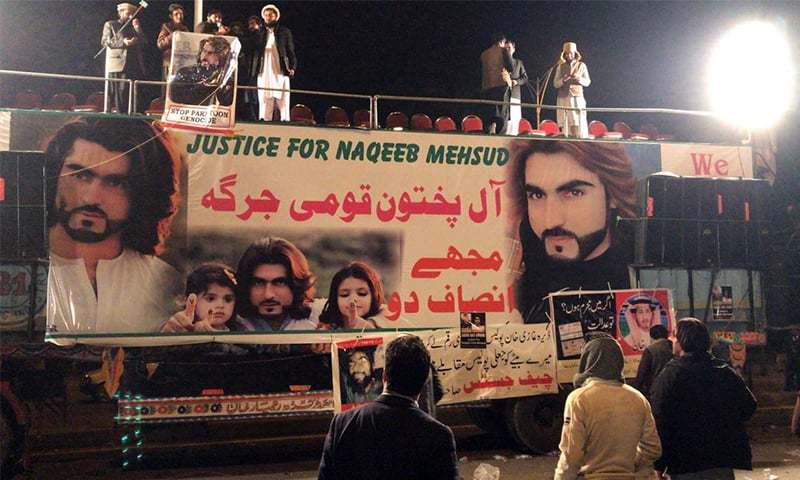
After years of tension and exclusion, it seems Pakistan’s Pashtuns – the country’s second-largest ethnic group – have had enough. In January, a large crowd began protesting after 27-year-old shopkeeper Naqibullah Mehsud was shot dead by a police officer in Karachi.
The protesters marched from Khyber Patunkhwa province to Islamabad, where they staged a sit-in protest in front of the National Press Club. Although the sit-in has ended, protests have erupted elsewhere in Pakistan, and the movement has variously become known as the Pashtun Long March and the Pashtun Spring.
The protesters are demanding the arrest and punishment of Rao Anwar, the police officer who killed Naqibullah. They are further demanding an end to what they call state-imposed terrorism and militarism justified by War on Terror rhetoric. Other demands include the clearing of landmines in the tribal areas, and the return of missing people who have been taken into custody by Pakistani security forces.
These demands are expressed in the language of human rights, and have received the support of leading Pakistani politicians, including opposition leader Bilawal Bhutto.
Pakistani authorities claimed that Naqibullah was a member of the Pakistani Taliban. The claim was later dropped. According to Human Rights Watch, extrajudicial killings by Pakistani police are widespread, especially among marginalized groups. These include Pashtuns, more than one million of whom are Afghan refugees.
Across the border
Pakistan’s Prime Minister, Shahid Khaqan Abbasi, has reportedly promised to use all available means to secure Rao Anwar’s arrest. He also vowed to build a college to be named after Naqibullah Mehsud, and clear South Waziristan of landmines.
The size and public visibility of the protests are unprecedented, but calls for Pashtun rights are not new. One protest leader, Manzoor Ahmad Pashteen from South Waziristan, is a co-founder of the Mehsud Tahafuz Movement (Mehsud Protection Movement). This movement has fought for the rights of the Pashtun Mehsud tribe in South Waziristan since 2013.
Around 25 million Pashtuns live in Pakistan and around 11 million in Afghanistan. In 1893, British India imposed the Durand Line, a 2,640km border between Afghanistan and today’s Pakistan. The line bolstered British territorial control on its side of the line, which divides historical Pashtun areas. Afghanistan has never officially acknowledged this border.
Whereas Pashtuns are the largest ethnic group in Afghanistan, they are economically and politically marginalized in Pakistan. The tribal area they inhabit there borders Afghanistan to the west, and it has become a major front in the War on Terror. Pakistan routinely associates Pashtuns and Afghan refugees with the Taliban and Islamist terrorism.
Us and them
The protests have come along just as Pakistan and Afghanistan’s relationship is deteriorating. In 2016, chafing at Afghanistan’s deepening relationship with India, Pakistan deported more than 500,000 Afghans. Conversely, when Afghan officials discuss the Pashtun protest, they often resort to nationalist language.
Ahmad Shah Katawazai, defense liaison at the Afghan embassy in the US, has called for Pakistani Pashtun areas to be incorporated wholesale into Afghanistan. As he writes in American newspaper The Hill: “The government and people of Afghanistan have consistently asked for the territory to be re-incorporated into Afghanistan. People who live along the Durand Line don’t consider it to be a border.”
Both Pakistan and Afghanistan have tried to frame their respective approaches to the protest as beneficial for the War on Terror. Afghanistan’s president, Ashraf Ghani, has supported the protest as a citizen struggle against terrorism and fundamentalism.
The protesters have a tough road ahead. They have to navigate between human rights demands, Afghanistan-Pakistan relations, and the politics of the War on Terror. Yet it is undeniable that the protests are in themselves a victory of sorts for this marginalized group. As the columnist Raza Rumi writes in Pakistan’s Daily Times:
The Pashtun long march and its ten-day long protest in Pakistan’s capital Islamabad testifies to how the marginalized are negotiating the contradictions of today’s Pakistan … The people of [Federally Administered Tribal Areas] continue to be treated as second-class citizens and all talk of ‘reform’ founders at expediency of the civil-military elites … Youngsters from tribal areas are less willing to engage with the state structures as their elders have done in the past. Ethnicity-based politics will remain a reality and it needs to be accepted by powers-that-be. Democratization, howsoever flawed it might be, enables reconciliation of multiple political and social identities.
It seems that for Pakistan’s Pashtuns, the odds of change for the better could finally be shifting in their favor.
Pashtuns rising up against years of military oppression
The murder of 27-year-old Naqeebullah Mehsud has triggered nationwide protests and calls for an end to persecution in tribal lands
By Kunwar Khuldune Shahid February 13, 2018 6:09 PM (UTC+8)
Pashtuns rising up against years of military oppression | Asia Times

Frustrated by decades of persecution by the state, Pakistan’s minority Pashtuns have taken to the streets in a protest movement sparked by the police shooting of Naqeebullah Mehsud in a staged gun battle.
The 27-year-old, who was from the northwest Federally Administered Tribal Areas (FATA), which are often targeted for unpopular security crackdowns, was shot dead on January 13. Rao Anwar, a Karachi police commander accused of killing Mehsud, is now a fugitive, with an Anti-Terrorism Court ordering that his arrest by this Friday.
Protests demanding justice for Mehsud first began in Karachi and since the start of the month have spread to Islamabad. The movement’s #PashtunLongMarch hashtag is attracting support on social media. More than 5,000 Pashtuns have joined the protests, which have been endorsed by members of all leading Pakistani political parties.
After Mehsud’s death the Mehsud Tahaffuz Movement (Mehsud Protection Movement) sprang up under the leadership of Rehmat Khan, who hails from the same tribe in FATA’s South Waziristan district. It drew in protestors from Kurram, Orakzai, Bajaur and other areas.
Mohsin Dawar, central chairman of the National Youth Organisation, who is one of the nationalists leading the protests in Islamabad, described the movement as a “Pashtun spring”, comparing it to the Arab Spring uprising that swept the Middle East from 2010.
“Yes, this is a Pashtun spring. This is a nationalist movement against oppression and age-old grievances that the state has long failed to address,” he told Asia Times.
“We feel we are being targeted owing to our Pashtun identity and whatever is happening in FATA is a prime example of that,” Dawar added, in reference to army operations in the Pashtun tribal areas that have razed many cities and left thousands internally displaced. Among those forced to relocate to Karachi were Naqeebullah Mehsud’s family.
Ethnic Pashtun, also known as Pathan, live in tribal areas that stretch into both Pakistan and Afghanistan. In Pakistan they originate from the Khyber Pakhtunkhwa region, which was supposed to be merged long ago with FATA; as that didn’t happen, Pashtun are still governed by the Frontier Crimes Regulations, an outdated British colonial code that is often used by the state and military to justify brutalities.
Khan Abdul Ghaffar Khan, one of Pakistan’s top leaders when it was granted independence in 1947, had advocated a separate homeland for the Pashtuns. Khan was often known as the “Frontier Gandhi” for his commitment to non-violent approach to protesting.
However, Pakistan’s leaders are not very happy with the push for a separate Pashtun identity. Last month a Pakistan Army spokesperson linked Afghan refugees with terrorism. Historically, Pashtuns have maintained a distinct identity from Pakistan’s majority Punjabs.
Dawar insists that the movement is nationwide and unstoppable: “Of course, the Pashtuns have faced problems for a long time, but this killing has resulted in a nationwide eruption. Islamabad is now the hub where all these protest movements are converging. It’s been 10 days now and our strength is increasing,” he said.
The protesters have a list of demands, including the arrest of Mehsud’s killers, a halt in judicial killings, the relocation of all missing persons the clearing of land mines in the FATA.
Pashtun journalist Ali Arqam told Asia Times that the movement’s instigators were “those in the crossfire between the Taliban and the Pakistan Army”, adding: “They chanted slogans against the security forces in the tribal areas to express their discontent against the treatment meted out to the locals.”
Taliban insurgents have been attacking security forces and tribal populations in the FATA since the 1980s.
While displacements and disruption to lives are common complaints, blogger Hurmat Ali Shah said the Pashtun living under military operations also encounter torture and the disappearance of family members.
“There is an information blockade from FATA and from Pashtun regions in general, which is why this spontaneous eruption of protests has taken everyone by surprise,” he said.
“It is a manifestation of a new form of Pashtun nationalism, which defies all the administrative divisions of the tribe in Pakistan. It is appealing to the political consciousness of Pashtuns from Balochistan to Karachi to FATA to Khyber Pakhtunkhwa.
“It is the start of a new phase in the development of Pashtun nationalism, which is defining itself through unified indicators such as language and culture and is defining what it means to be a Pakistani Pashtun,” Shah said.
While the local media has suppressed coverage of the movement, leading politicians, especially those with ambitions in Khyber Pakhtunkhwa province, have tried to jump aboard the bandwagon. However, the protestors maintain that the movement is “too big” to be hijacked by anyone.
“This movement is one of a kind, because it is beyond the ambitions of separate political parties. It is actually influencing the narratives of the parties, instead of succumbing to the parties’ goals,” said Ali Arqam.
Its leadership includes members of Pashtun nationalist factions Qaumi Watan Party, Awani National Party and Pashtunkhwa Milli Awami Party. However, Arqam maintains that party leaders have failed to put their own stamp on the protest movement.
“When (Pakistan Tehrik-e-Insaf chairman) Imran Khan came to address the protestors and called out the Mehsuds, the crowds said ‘no, we’re Pashtun’. When (Jamaat-e-Islami chief) Siraj-ul-Haq chanted that ‘we will liberate Kashmir’, they shouted ‘no, we won’t’. When (Qaumi Watan Party chairman) Aftab Sherpao said that ‘we’ve sacrificed in the past and will continue to do so’, the masses said ‘no, we won’t’,” Arqam noted.
Tribal activist Mona Aurangzeb is optimistic the movement will be a “tipping point” for a “Pashtun awakening”.
“It’s the Pashtun youth and particularly the tribal youth who have been kept depoliticized and isolated that now want to negotiate their role with the state,” she told Asia Times. “They are rejecting the old order. They are tired of war that was imposed on them in the shape of Taliban and military operations.”
Aurangzeb says that while the protest may have been triggered by the death of Mehsud, it had been building through 15 years of war.
“As a tribeswoman [the movement] gives me hope. We now have the capacity and the awareness to demand our rights from the state and negotiate our identity,” she said.

Comment