Announcement

Collapse
No announcement yet.

The case for the partition of Iraq

Collapse
X
 
  • Filter
  • Time
  • Show
Clear All
new posts

  • The case for the partition of Iraq


    The case for patriotism – and for the partition of Iraq


    By Daniel Hannan Politics Last updated: June 19th, 2014
    467 Comments Comment on this article

    If partition coming anyway, better to get there by referendum than by war

    Euro-integrationists will often tell you that they dream of a “post-national” future. Patriotism, they maintain, is chauvinistic, irrational and dangerous. Nation-states, in the words of our old friend Guy Verhofstadt, are “a relic of the past”. We should transcend our arbitrary loyalties to linguistic or historical units.
    Well, you don’t have to look too hard to find places without patriotism – places where, in the absence of a nation-state, tribal or confessional loyalties crowd out national ones.
    Western commentators, observing the collapse of Iraq, naturally overstate their own countries’ role. Those who supported the war blame the withdrawal of U.S. troops; those who opposed it blame the original invasion. But it’s not always about us. Alright, there’s a smidgen of truth on both sides: plainly the overthrow of Saddam led indirectly to the present circumstances; and, equally plainly, ISIS could not have made its military advances had allied troops still garrisoned the Sunni triangle (I write as someone who opposed the war). But the underlying problem is not to do with the presence or absence of Western soldiers. It’s to do with the synthetic nature of the Iraqi state. If you absolutely must make it about us, make it about the Sykes-Picot agreement that arbitrarily grouped the Ottoman provinces of Mosul, Basra and Baghdad together for no better reason than that two oil-rich regions needed to be connected by an oil-poor third.
    Lacking ethnic or religious homogeneity, the new state almost immediately descended into authoritarianism. I’m sick of being told that at least Saddam kept the place peaceful. He did nothing of the kind. The Ba’athists maintained their dictatorship by the use of constant violence against Kurds, Shi’a, monarchists, Communists and any other group that got in their way. Lacking a shared sense of identity, and with no loyalty to common institutions, Iraqis grouped themselves by tribe and sect, seeing their opponents, not as co-citizens, but as enemies. The same charge can be laid against almost every faction there: that it sees power as a winner-takes-all game, in which compromise is a sign of weakness.
    Precisely the same analysis applies to Syria, which was also governed, in practice, through the military dominance of a minority group. Sunni Arabs were helots in Syria, masters in Iraq, but the dynamics were otherwise identical.
    Euro-federalists should travel in such places before they dismiss the virtues of patriotism. Patriotism, as I argued at yesterday’s CPS Liberty Conference, is what makes us behave unselfishly. It’s what makes us recognise an obligation to the people around us. It’s why we accept election results when we voted for the loser, why we pay taxes to support strangers, why we obey laws with which we disagree. Take that away and you get… well, you don’t necessarily get the sectarian violence of Syria or Iraq, but you do get a breakdown of responsible government.
    How much disorder, horror, fear and mutiny might have been avoided had Iraq been divided along ethnographic lines in 2003 – or, better yet, in 1920. (If you don’t like the word “ethnographic”, substitute “democratic”: it amounts to the same thing.)
    Any mention of partition sends some pundits scurrying to their keyboards. What about Yugoslavia, they say, or Ireland, or India, eh, eh? I wonder whether, in Yugoslavia, an agreed separation beforehand might have left us with something very like today’s borders without the intervening war. We’ll never know, obviously, but it’s worth noting that several partitions happened amicably enough, from Czechoslovakia to the West Indies Federation.
    More to the point, look at the consequences of non-partition. The civil wars have driven 2.1 million Iraqis and 1.4 million Syrians into exile. How much worse do things have to get before we consider an alternative?

    This British patriot Daniel Hannan, a historian by education, understands the human condition very well indeed. Notice how so eerily reminiscent his description of Iraq is of Afghanistan (a similarly artificial and failed state, carved out of the great game of imperial powers).

  • #2


    Iraq: A divided future

    By Borzou Daragahi

    As sectarian violence spreads, more ordinary people are beginning to feel that break-up is the only solution
    ©AFPDangerous trek: a family fleeing fighting heads towards a temporary camp in Nineveh

    One is Sunni, one Shia and one Christian. They have been crammed together for years in a small agricultural supplies store and showroom in central Baghdad’s vast Senek Market.
    <!--.--> Outside the sprawling maze of 1,000 businesses, Iraq is alive with talk that the country might be split into Sunni, Shia and Kurdish states to staunch the bloodshed of sectarian violence. Inside the bazaar, despite an anti-government insurgency in the Sunni heartland and a renewed drive for independence by Kurds, many cannot countenance the notion.
    “If you come to the question from the perspective of this market, Iraq will work,” says Majid Mikhail, 55, a Christian. Ahmed Shaker, 35, a Shia, agrees. “Iraq is one beating heart,” he says. But Ahmed Saleh, 44, the Sunni, is not so sure. “In these circumstances, maybe it would be better to have a Sunni homeland,” says Mr Saleh. “The problem is the majority of people are ignorant, and that’s where you find sectarian violence.”


    More


    On this story


    On this topic


    IN Analysis


    Senek, a name derived from the Ottoman word for the flies that once infested the area, is Iraq’s central wholesale market for industrial goods. Merchants from across the country haggle with importers before trucking purchases back to their shops scattered across Iraq’s 18 provinces.
    “There is no place here for sectarianism,” says Yahaa Mandalawi, a 60-year-old Nissan parts distributor. A native of the diverse province of Diyala, he lives now in a religiously mixed neighbourhood in the capital. Both his daughters have married into a different sect. “Our people have coexisted for a long time.”
    Only Iraqis grasp how intimately the lives of the country’s communities have been woven together, how intricately relations within clans and families have been entangled – and how tortured would be a sectarian divorce. Many tribes include both Sunni and Shia branches, and intermarriage continues to be common.
    Sheikh Abdullah Hamad al-Anbari, the leader of a largely Shia tribe, illustrates how intimately the different groups are intertwined. “My tribe is named after them,” he says of the Sunni Anbar province, which today is largely under the control of Sunni militant groups. Among them is the Islamic State of Iraq and the Levant, known as Isis, which has made redrawing Iraq’s borders – created by the Sykes-Picot agreement of 1916 – a core mission.

    Iraqis are also bound together in a union of shared suffering that includes the trauma of the Iran-Iraq war, the punishing western sanctions that drove many into poverty during the 1990s, the terror of the US-led invasion and subsequent bloody spasms of the country’s civil war.
    A separation of any kind, whether a formal redrawing of the map as demanded by Kurds or the creation of a separate Sunni homeland as proposed by some Sunni, would be so painful that some spurn it outright. “My mother is Sunni, my father is Shia and my brother married a Christian,” says Sabine Awad, a 26-year-old who works in Baghdad’s Mansour district. “We are all brothers and sisters. We cannot separate.”
    But, underscoring the depths of the crisis, many imagine a partition of Iraq, a land of constant war, ubiquitous weapons, rampant corruption and broken public services.
    “The problem is not just security or politics at this point – half of the country is already out of the control of the government,” says Thamer Tamimi, an adviser to Nouri al-Maliki, the prime minister “It’s too late for Iraq,” he says with a sigh.
    More video

    Slow collapse

    Despite paeans to national unity, Iraq has been disintegrating for decades. The Kurds spent much of the past century in armed revolt against successive Arab governments in Baghdad before securing autonomy in 1991. Outside the relatively cosmopolitan capital, large segments of the country’s Shia population were locked in armed confrontation with the government since Saddam Hussein consolidated his power in 1979 until he was toppled by the US in 2003.
    Within weeks of the US invasion, a Sunni insurgency flared up against the Americans and then the Shia majority now dominating the country. “The sectarianism has been here for a long time; it’s not new,” says Ziad Ajeel, a political analyst. “The Kurds refused to be ruled by the Arabs. The Shia refused to be ruled by the Sunni. Now the Sunni don’t want to be ruled by the Shia. Iraq’s history confirms that you cannot achieve your rights without the use of weapons. And that is the problem with Iraq.”
    Neighbouring Syria, with its ethnic mix of Kurds, Sunni and Shia that mirrors that of Iraq, is also falling apart. There is a sense that Iraq’s demography is incompatible with the zero-sum politics that have long dominated the country and region. All three of Iraq’s main communities view themselves as aggrieved victims of history as they absolve themselves of their own sins.
    “Saddam Hussein did the same thing to the Shia that Maliki is now doing to the Sunni,” says a 23-year-old Sunni man in Adhemiya district.
    At the time of independence from Great Britain, East and West Pakistan split from India, sparking mass migration, massacres and a war that led to Bangladesh’s creation in the east in 1971

    Outraged by their treatment at the hands of the Shia government, many Sunni began agitating for a federal region months ago, led by Osama Nujaifi, the outgoing speaker of parliament who heads one of the main Sunni political blocs.
    In cafés, on television and in newspapers, many speak of a future Iraq with Sunni inhabiting their own region, much like the Kurds. Iraq’s Kurds fly their own flag, assemble their own armed forces and run their own schools with little interference from the Baghdad government.
    “The missing component in all of this is loyalty to Iraq,” says Qubad Talabani, deputy prime minister of the Kurdistan Regional Government. “That’s what makes me less optimistic about the country’s future. We’re not seeing loyalty to Iraq. We’re seeing loyalty to different sects, to ethnic identity, to religious ideologies.”
    A messy divorce

    Nothing in Iraq is so simple as drawing lines on a map. Many of its provinces are mixed Sunni and Shia. Diyala, northeast of Baghdad and abutting both Kurdistan and the Iranian border, includes Shia and Kurds as well as the majority Sunni.
    While the mostly Kurdish eastern end of the province around Khaneqin could be incorporated into the Kurdistan region, the western half of the province is a patchwork of Sunni and Shia towns, which makes cutting a line through it impossible.
    Within at least two Shia provinces – Babel, just to the south of Baghdad, and in Basra in the deep south – there are several significant Sunni districts. There are also Shia districts in other provinces, including several Shia Arab and Turkoman enclaves.
    Just as Arabs live amicably within the autonomous Kurdistan Regional Government, Sunni could in theory live amicably in Shia areas. But for now mistrust runs too high.
    “If a Shia guy goes to a Sunni area, he will be slaughtered,” says Seitar Jalil, 42, a carpenter in the Shia city of Najaf. “But if a Sunni comes to our areas, we welcome him.”
    Baghdad itself may be the most complicated piece of the puzzle. Although once fairly equally divided between Sunni and Shia, the city has lost up to 60 per cent of its Sunni over the past decade. Many neighbourhoods are mixed. Few believe that the Shia will let go of any part of the capital, which is also coveted by the Sunni.
    Iraqis have long considered the Rasafa area of Baghdad east of the Tigris river a Shia bastion. The western half, called Karkh, was dominated by the Sunni. But the shrine of Imam Kadhem, one of the most important in Shia Islam, lies in Karkh, while the most important Sunni mosque in the country, Adhemiya, lies on Shia side of the river.
    After prolonged conflict, a referendum separating the country from Sudan paved the way for the creation of the world’s newest state. Civil war broke out last year after a power struggle

    “As a very last resort, one may be able to move the sarcophagus of Imam Kadhem from west to east, and solve the problem,” says Mazen Mohamed, an actor who has spent entire evenings struggling to map a future Iraq with other intellectuals. “But this is a very sad conversation.”
    Any Sunni entity in Iraq could quickly descend into infighting, especially between the large Dulaymi clan of Anbar and the Shammari tribe of Nineveh. “Those of Anbar will want Ramadi as a capital and those of Nineveh will want Mosul,” says Adnan Hussein, editor of al-Mada newspaper. “There is a lot of bad blood between the tribes.”
    Fighting has already broken out between Sunni rebel factions. Few believe a compromise is possible between radical Islamists seeking to establish a utopian version of the caliphate and whiskey-swilling members of Saddam Hussein’s former Ba’ath party keen to throw off the yoke of Shia rule.
    Outright partition of Iraq’s three main Sunni provinces simply may not be feasible economically. Much of Anbar, Salahadin and Nineveh provinces are sparsely populated, landlocked and devoid of natural resources. “Sunnistan is the poorest portion of Iraq,” says Wayne White, an Iraq specialist formerly at the US state department and now at the Middle East Institute in Washington. “Its agriculture is nil. It has no oil. It could be a new poverty-stricken Middle East state. Backing themselves into a dry, landlocked, barren and oil-poor corner of the country wouldn’t be exactly desirable.”
    Even if oil is discovered, a landlocked Sunni statelet lacking a strong strategic partnership with its neighbours may never thrive. As South Sudan has shown, having an oil-rich country with little else is hardly a recipe for success. “If you’re going to be economically viable you have to have some kind of agreement with your neighbours for stability,” says Sijbren de Jong at The Hague Centre for Strategic Studies in the Netherlands. “Exporting anything depends on getting access to ports, networks of pipelines, infrastructure.”
    The Shia would also be likely to resist a Sunni entity that controlled the upper Euphrates and Tigris rivers, the main sources for agriculture in the south.
    An orderly separation

    Partitioning Iraq now, whether into federal regions or separate statelets, could be disastrous. Tempers must first be cooled and Isis must at least be isolated if not defeated outright.
    It may require a new government without the divisive Mr Maliki. Politicians and opinion makers float several ideas for rebooting Iraq. Article 140 of the constitution permits provinces to coalesce into single regions, capable of governing their own affairs. That has been discussed for Nineveh, which encompasses Mosul, Salahaddin and Anbar provinces.
    National security, foreign policy, oil revenues and border control would all fall under the purview of the central government.
    After the collapse of communism, resurgent nationalism led to the break-up of Yugoslavia, starting with Croatia and Slovenia in 1991. Kosovo declared independence in 2008
    “Though it’s not yet time to start redrawing borders, there is an option available, which is true federalism or confederalism,” says Mr Hussein. “We expect difficult times ahead and a lot of bloodshed, but we might be able to avoid the worst if there is some kind of regional federalism. The Kurds might even accept confederalism or even federalism.”
    Nabeal Younes, a political scientist an adviser to Mr Nujaifi, suggests dividing Arab Iraq into three regions: one for the Sunni, one for the Shia and one mixed central province that includes Diyala, Baghdad and all the heavily mixed districts around it.
    Kurds aside, opinion polls show that Iraqis do not want their country broken up. A 2009 petition to hold a referendum on turning parts of the south into a separate region failed to attract enough signatures. The ideal of Iraq as a mosaic of different religions, tribes and languages epitomised by the Senek market still carries much weight.
    But in recent weeks, momentum has built for a drastic reconfiguration as the least bad solution. Despite their best intentions, it may no longer be possible for Sunni and Shia to live together. “If the government can’t protect Sunni as citizens or doesn’t protect us as citizens, we are going to go out on or own,” says Mr Younis.
    Memories of the sectarian civil war, which in 2006 and 2007 left 100 corpses a day in the capital’s morgues, linger just beneath the surface. “The militias started killing people,” says Munther Abdul Ghani, 75, a retired schoolteacher in the religiously mixed Baghdad district of Sadiya. “And they killed my son.”
    In the mostly Sunni Ghazaliya neighbourhood, Shia militias and members of Mr Maliki’s “antiterrorism” forces cruise the streets nightly, menacing locals with chants commemorating the seventh-century martyrdom of Hussein, grandson of the prophet Mohamed, at the hands of the Sunni caliph.
    “We don’t refuse to live under the Shia; they are our brothers. I have family ties to Nasiriya,” says Raed Kamel, a lawyer and member of the mostly Sunni Dulaymi tribe in Ghazaliya. “Here, we don’t speak of Isis. We only speak of the many injustices that caused the Sunni to rise up. Before we refused to consider a Sunni region as a solution, but after the injustices that have befallen us, maybe it’s for the best.”
    Additional reporting by Erika Solomon in Erbil

    Comment


    • #3
      Analysts say formation of independent Kurdistan could threaten nation-state system of entire region

      Is the Partition of Iraq Inevitable?


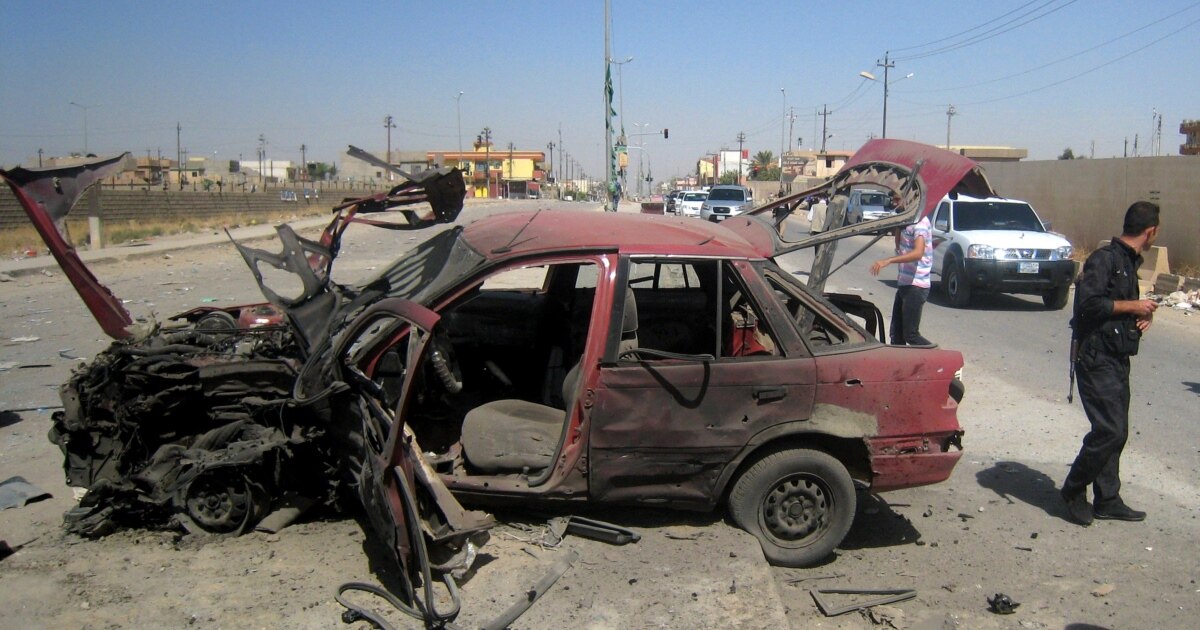
      People inspect the site of a car bomb attack on cars lined up at a gas station in the oil rich city of Kirkuk, in northern Iraq, July 10, 2014.


      Related Articles


      Mohamed Elshinnawi
      July 12, 2014 9:00 AM

      As Sunni jihadists continue to make gains in Iraq, Kurds have taken control of two oil fields in northern Iraq and have pulled out of the Shi'ite government of Prime Minister Nouri Al-Maliki. Experts say that that the country’s future may have already unfolded.
      Edmund Ghareeb, professor of Middle East history at the American University in Washington, D.C., agrees. He believes that the current situation could easily deteriorate into long-term civil war that could entail ethnic cleansing and the devastation of the country’s infrastructure.He warns that the Shi'ite-led government would be acquiescent to Iran and argues that any amount of U.S. involvement now is not likely to make much of a difference.
      At the same time, the crisis provides opportunity for at least one segment of Iraq’s population.
      “Perhaps, more than any time in modern history, the Kurds have an opportunity to establish an independent state of their own,” he said. “Not only taking over Kirkuk, but also discovering oil in their region, which makes it economically viable.”
      But the formation of an independent Kurdistan by Iraq’s five million Kurds won’t just change the face of Iraq. Nine million Kurds in Iran and 22 million Kurds in Turkey could be tempted to emulate their Iraqi counterparts, and that dynamic could threaten the nation-state system of the entire region.
      Staving off partition
      The better scenario for Iraq, says Ghareeb, would be reconciliation and the formation of national unity government to give a political voice to all of Iraq’s factions. He said the U.S. is actively pressuring Iraqi leaders come to such an understanding.
      “The U.S. realizes that the disintegration of Iraq carries with it dangers and consequences that not only threaten the Iraqi state but are also likely to upset regional stability and the interests of many parties including the U.S.,” Ghareeb said.
      He also advocates a system of federalism that would distribute a fair share of Iraq’s national wealth to localities based on their percentage of the total population.
      But Richard Brennan, a senior political scientist and Iraq expert at the Rand Corporation, says that keeping Iraq intact would depend on there being a single Iraqi figure who could appeal to Sunnis, Shiites and Kurds – and even if such a personality were to exist, it may be too late to bring factions together.
      “Fear and mistrust govern the Iraqi politics,” Brennan said. “Sunnis fear not having a stake in the future of Iraq, and the Shi'ites fear being dominated by Sunnis and repressed as they have for hundreds of years.”


      Insightful comment from user Not Again from Canada:
      We can continue to be nostalgic, and continue to go along by historical wrongs for the sake of retaining a name which means very little to the people, and IRAQ is not the only state with these issues.
      We continue to see great conflict, great suffering, the creation of millions of refugees, because as ostriches do, we want to stick our heads in the quicksands of the past; those quicksands of the dastardly imperial legacies, that have created millions of victims around the World. Colonial tribal dividing borders, the cause of conflicts, are wrong and are one of the main causes of the conflicts we observe. Millions of innocent people are paying a huge price for the negative colonial legacy= bad borders; be it in Ukraine, be it in Syria, "Iraq", CAR, Libya, Yemen, Sri Lanka, Afghanistan..... an endless list of countries in turmoil.
      At this stage Iraq is a nightmare, with the potential of far greater bloodshed than even Syria. Advocating to forcefully keep people in a totally undesired union, is morally and concretely wrong. People that can't live together need to be separated, in time, as the Europeans have done, the countries may decide to form unions, for advancement, not for the current common denominator, of extremists, of all sides, killing innocent civilians and destroying all structures/infrastructure, and even enslaving their opponents.
      Maliki has clearly shown no desire to resign, so that this mirrage called Iraq can survive for a few more years. The Kurds have oil in their region, the Shia have oil in their region(South), and the Sunni have oil in their region (North West). So oil should not be what keeps them from separating. All of them face the super threat, which is IS (ISIS/ISIL). A four way conflict will only strengthen IS, and not just destroy Iraq's tribes, but far beyond.
      Bottom line, forcing people to stay in a murderous union, will just postpone the separation, with far more victimes to be created, while forcing them to stay in the union.

      Comment


      • #4
        Interesting... the theme of politics and political power in sectarian societies as a zero-sum game between sectarian groups that Ive noticed in many of these articles: this is exactly how the dynamics of group conflict is framed in realistic group conflict theory in social psychology. In Sherifs notorious Robbers cave study, in-group formation (and these were artificial groups of children's teams in a camp) by itself did not entail between group conflict -its semblance did, however, emerge spontaneously, with all the trappings of human tribalism including out-group hatred/hostility, after the groups came to compete in zero sum games over resources (prizes). Equally interesting was that the group tension was successfully diffused by getting them to play (positive sum) non-zero sum games where cooperation was mutually beneficial.
        http://psychclassics.yorku.ca/Sherif/

        Ethnic groups are the dominant naturally occurring human in-group (the in-group hierarchy in the real world tends to be based on genetic relatedness thus ethnic interests triumph over sectarian interests, which explains why the Kurds are more inclined toward separatism than the sectarian Arabs). The ingenuity of the ethnic nation state -the best form of social organization in human history- is in fact contained in this simplicity: ethnic zero-sum games over economic and political resources are minimized since groups are circumscribed within an agreed territory, confined to an agreed economic and political resource pool. On the other hand, international trade, for example, the main form of interaction between nation states, as the great economist David Ricardo famously first demonstrated (with the comparative vs absolute advantage distinction), is a non-zero sum game that relatively benefits all states involved. Sherifs Robbers cave experiment is in a way a microcosm of international relations: group conflict typically emerges as a consequence of ethnic or sectarian, that is group, zero sum games (e.g. Malikis exploitation of the Sunnis) and group and national alliances are formed within structures of positive sum non-zero sum games (e.g. economic unions).

        This is exactly what the fuss is all about in Afghan politics currently: both sides expect that political power in a centralized, sectarian and ethnically divisive state like Afghanistan is a zero- sum situation with the consequence that the losing ethnic populations will ultimately be marginalized; power-sharing and/or federalism will diffuse this to some extent but the best solution will always remain to completely remove the means of competition in the first place: the best way to minimize group conflict in the real world is to remove the means of zero-sum interactions between human groups, within the context of politics, this means the formation of ethnically and/or religious homogeneous nation states.

        Analysts who are touting the idea that Iraq can be kept intact are essentially asking to reassemble humpty dumpty. Their modus operandi seems to be either to ascribe virtually all the woes of that intrinsically failed state to either Maliki or western imperialism / American intervention (this is not to say that these things did not exacerbate the situation) as if Iraq was the multicultural utopia that seems to exist in the wet dreams of western leftists, prior to the American war. Reality check: ethnic and sectarian group conflict, with genocide (the Al-Anfal campaign) and all that other lovely stuff, has pervaded "Iraq" since the creation of its artificial borders by Britain and France in the first place (Skyes-Picot agreement). I think that in the light of Iraqs sectarian history, the burden of proof is on the idealists to furnish a case that sectarian and divided Iraq can work, and a few emotionally loaded anecdotes about inter-mixing and whatnot is not sufficient. As Carl Sagan would say "extraordinary claims require extraordinary evidence".

        Comment


        • #5
          funny how good for nothing herat jan , is cheering for pakistan a truly artificial state while want to break up afghanistan a grown country ,in every regard . culture ,religion and even language .

          dirty ass iranian haiwan eat **** .

          Comment


          • #6
            Iraq will remain as it is except the potential of Kurdistan getting independance is high.

            The Common People of Iraq irrespective of being Shia/Sunni want the united Iraq.

            Evil ISIS doesn't has the capacity to do so.And i am sure neither does West as Russia/China Won't allow this to happen
            "[B][SIZE="3"]Seer Speen Wazeer[/SIZE][/B]"

            Comment


            • #7
              Originally posted by abassinafghan View Post
              funny how good for nothing herat jan , is cheering for pakistan a truly artificial state while want to break up afghanistan a grown country ,in every regard . culture ,religion and even language .

              dirty ass iranian haiwan eat **** .
              On the contrary my mountain savage Awghan friend, not only have I never done anything of the sort, if you read my past posts, you will notice that I have clearly endorsed the partition of both Afghanistan (currently the most quintessential failed artificial state, created by imperial Britain and Russia, in all of Eurasia) and Pakistan (another failed, synthetic state) along lines. But let me make it clear if it wasn't already, I support the partition, along ethnic and sectarian lines, of every single failed state in the third world -which includes Iran (e.g. I support the Kurds in their right to secede from Iran if they so wish) and even our future non-Pashtun state (if the Hazara want their own state then so be it, I support them as I will the Uzbeks). I am not a hypocrite, I wish for others what I wish for myself: I support the right to self determination of all the peoples in the world but not at the expense of other people. I am not like you who will do anything for his ethnic interests at our expense (e.g. anything for your ethnic kin across the border but will not even support our right to self-determination), I hope Ive made that clear, Awghan.

              Comment


              • #8
                A biannual digital magazine that probes key issues at the intersections of religion, culture, and politics. Click to read Muftah Magazine, a Substack publication with thousands of subscribers.


                The Case for Breaking up Iraq and Syria


                Christopher J. Ferrero


                Balance of power politics is ready for a makeover—and a comeback. The Middle East is shattering along ideological and kinship lines, and Western visions of pluralism are shattering with it. The politicians in Baghdad have postponed efforts to form a government until possibly mid-August—national unity or otherwise—as Nuri al-Maliki continues to resist calls for resignation or a sectarian reconciliation program as a prerequisite to American assistance in fighting the Islamic State. Meanwhile, the Kurds of northern Iraq plan to forge ahead with a referendum on independence. Back in Damascus, the Alawite dictator Bashar al-Assad remains locked in a zero-sum conflict with majority Sunni rebels of every political persuasion.
                Attempting to hold Iraq and Syria together while cajoling the constituent parties to find common ground is noble but very likely futile. It may even be counter-productive. The region’s political and kinship communities are undergoing what Joshua Landis has called a “Great Sorting Out”, or political and geographic reconfiguration, much like European nations experienced during the conflict-ridden 20th century. As this process unfolds, the United States and other major powers should strive to maintain a balance of power in the Middle East, not just among states, but among sects. As part of this approach, the US and other international power brokers must accept—or even promote—the redrawing of Middle Eastern borders. Ultimately, this may be the wisest and most fruitful path to the development of stable political cultures and legitimate, sustainable institutions in the region.


                The Security Dilemma and Failed States in Iraq and the Levant

                Between and among states, the balance of power approach often gets a bad rap. It is associated with superficial alliances and the treatment of people and polities as pawns in a game of chess. In the modern Middle East, it is associated with the carving of Great Power spheres of influence and support for brutal strongmen. When mismanaged, the balance of power can lead to war. Yet the fundamental purpose of a balance of power is to preserve peace, and in the absence of shared political norms among nation-states or reliably-enforced international laws, it is the best that we can do.
                Ironically, a balance of power is functionally what America and the West prescribe within many Middle Eastern countries under the guise of pluralism, and it is failing miserably within certain existing borders. In Iraq, Americans want Maliki to more equitably share resources and power with the Sunnis. His failure to do so has contributed to an existential crisis for Iraq and the rise of a newly-declared Islamic State. In Syria, Sunni protesters sought to rectify an imbalance of power that favored the Alawite minority; Assad’s resistance has wrought a nightmarish civil war. Even a Lebanese state structured to balance power among Sunnis, Shiites, and Christians faces gridlock and may teeter on the brink of renewed violence a generation after its own civil war.
                The failure of the balance of power within these states is due not to primordial hatreds, but largely to the shallowness or absence of shared notions of civic identity and interests. All states, but especially those made up of diverse populations, require their leaders and citizens to agree upon rights, obligations, and sources of political legitimacy. They require a social contract and a civic national identity that exceed in value and importance such traits as creed or ethnic origin. This civic identity must be substantive. It is not enough to wave an Iraqi flag and claim patriotism—one must be able to explain the political values behind that flag. If the state is merely an arena into which different kinship groups are thrown and told to distribute power and resources among themselves, then competition and conflict along kinship lines is virtually assured.
                That is the story of much of the Middle East, and it is why states like Iraq and Syria are not worth preserving from either a strategic or a moral standpoint. The state apparatus in both Iraq and Syria has been used not to unite and to build stable civic value systems, but to repress and deter competing kinship groups within political arenas drawn up by European powers nearly one hundred years ago. A Hobbesian approach to the security dilemma has long dominated the internal politics of both states. Barring the remarkable appearance of politically- and military-strong cross-sectarian coalitions in Iraq and Syria, these two states’ dissolution is a superior alternative to sectarian war under the dubious pretense of preserving the nation.
                The balance of power should no longer be viewed as a cynical method of Great Powers or be relegated to the arena of Middle East intra-state politics. Instead, it should be re-conceptualized as a way to prevent a wider, catastrophic, and more enduring regional war waged along confessional lines, as well as a means for providing room to kinship groups to delineate substantive political value systems. It is desirable that Sunnis and Shiites join forces to successfully fight the bad guys (Assad and ISIS) and govern cooperatively and effectively in Syria and Iraq, but it is not foreseeable. ISIS, or the Islamic State, is very strong both financially and militarily, and its fighters are highly motivated. Meanwhile, the Iraqi army is in shambles. Without extensive American involvement, an Iraqi government operation to roll back the Islamic State is likely to rely heavily on Shiite militiamen and thus take on the trappings of a sectarian war, even if the operation has token Sunni political backing.


                A Return to Wilsonian Self-Determination

                A non-cynical, constructive balance of power begins with the basic premise that self-defined political groups, whether they are ethnicities, sects, or even tribal associations, should not have to fear constant and imminent threats from neighboring states or co-nationals. This is a core norm in international society, but the current configuration of state borders is working against it in Iraq and Syria, and international institutions are impotent to enforce it. Thus, all parties should relent to the establishment of smaller, more homogenous states, including a division of Iraq and Syria along largely sectarian lines (and an independent Kurdistan). The strategic objective of the United States—the world’s sole superpower and the Middle East’s offshore balancer—should be to preserve a balance of power among the region’s sectarian actors so that each may develop politically of its own accord. Rather than the Sykes-Picot agreement, Woodrow Wilson’s self-determination of peoples serves as a point of reference. Accepting the reality of the Islamic State, either de facto or de jure, is indeed problematic. ISIS is a threat to virtually every state in the region, as well as to Europe and the United States. It is also a gross violator of human rights. But the point is not to legitimize a caliphate as much as to recognize the value of delineating territory where Sunnis can self-govern and hash out what exactly Sunnism means to the life of a polity in the 21st century. In a sign of just how much Iraq’s Shiite leadership has alienated people along sectarian lines, multiple reports suggest that secular Sunnis have so far welcomed and cooperated with their ISIS conquerors. But beyond a shared sectarian enemy, their political views are fundamentally at odds, and it is only a matter of time before the Islamic State’s heavy-handedness stokes a second Anbar Awakening. The Islamic State must indeed be defeated, but it should be defeated by Sunnis. The cancer of austere, violent Sunni Islamism cannot be decisively defeated by the West or by the Shi’a; it can only be permanently discredited by members of ISIS’s own sectarian kinship group.
                Breaking Iraq and Syria into smaller, more homogenous states would allow their respective citizens and politicians to cease thinking of politics as a competition between kinship groups and answer important questions about other, ideational sources of political legitimacy, particularly religious sources. For the Sunnis, is Islamism the answer? If so, in what form? Does ISIS or the Taliban provide the model, or perhaps the Muslim Brotherhood or another movement? How does the Shi’a belief system actually inform political norms, behavior, and legitimacy? To what extent is Shi’a Islam compatible with pluralistic democracy? Such a debate is alive in well in Iran as regards the system of veliyat-e faqih. There is a genuine, politically-significant difference in Sunni and Shiite belief systems about hierarchy and legitimacy. New borders and a sectarian balance of power would better enable the region’s sects and other kinship groups to focus on these important questions and debates, and to devise civic value systems and institutions that draw upon their belief systems. There is likely to be variation in institutions and civic value systems across countries of similar kinship. France, Germany, Canada, and the United States all base their political life and institutions on the European liberal tradition, but they are hardly identical in how they do so. Ultimately, the new, smaller, and more homogenous states of the region may decide that it really is in their interest to pool sovereignty and resources and to closely coordinate policies. This, too, would match the historical trajectory of Europe from World War to the European Union.


                Fostering a Stable Balance of Power

                There are, admittedly, problems with this plan. Egyptian society is currently fracturing along a secular-Islamist fault line. The Muslim Brotherhood made strides in implementing an Islamist vision before getting muscled out by the military, and Egypt’s fate is uncertain. In Palestine, Hamas—which is an offshoot of the Muslim Brotherhood—has long competed with Fatah for the hearts and minds of the Palestinian people. The parties are currently committed to a unity government, but they have very different visions of a future State of Palestine, and as with past attempts, cooperation could soon break down. These two cases make clear that national or sectarian homogeneity is no panacea. But the strong sense of national kinship felt by the people of both Egypt and Palestine does appear to reduce the risk of devastating, viral conflict within their borders and across the region. A second difficulty of this plan is the fact that, should a new group of states be established in the Levant and Mesopotamia, minorities would remain in each. Their fair treatment should be a condition of aid from the international community. Finally, there is the risk of terrorism emanating from the Islamic State, particular against Western targets, and expansionist war against countries and actors on the Islamic State’s periphery. Thus, the international community should maintain counterterrorism vigilance and draw red lines for the Islamic State well outside of Baghdad and at the borders of Jordan, Turkey, and Iraqi Kurdistan. The United States should communicate with Iran and the Shiites of southern Iraq in order to contain the Islamic State without sparking all-out sectarian war, and provide support to all groups in the region whose political platforms promote stability and human decency in a difficult world—whether that decency draws on Liberal, Islamic, or other traditions.
                We of the West, and especially of the United States, wish that the region’s actors would adopt liberal democracy. We also prefer battle lines to be morally distinct. But distrust and cross-cutting interests render perfect moral clarity impossible. For example, the two countries with arguably the greatest ability to affect the outcomes in Iraq and Syria are the United States and Iran. But due to the complexity of their own relationship, incentives to work together tend to be offset by incentives to maintain leverage against one another. Meanwhile, Hezbollah, officially designated a terrorist organization by the United States, serves as a potentially helpful buffer on the new Islamic State’s western flank. And despite the vile Assad, the Shiites of Syria surely deserve protection from a new Sunni tyranny that could descend upon the ruins of that country. The difficulties are compounded because no major external power wants to take the side of one sect while incurring the wrath and losing the trust of representatives of the other.
                Under such conditions, we cannot afford to obsess with moral clarity about friends and enemies. The best bet is to separate the fighters and foster a stable balance among them through aid, diplomacy, small troop presences, and limited strikes so that they can look inward as kinship communities and so that, at long last, the region’s polities can develop freely, organically, and substantively.

                Comment


                • #9
                  I think Iraq might eventually split due to the rising ethnic and religious tensions. I believe the kurds will get their own land and minorities like the Assyrians and turkmens will have no choice but to be lumped in with them. Sunni and Shia will be forced to live together regardless of religous sect since they are both Arab.

                  As for Afghanistan splititing up, not a chance.
                  "Revenge is a dish best served cold".

                  -Old Pashtun proverb


                  "My Pashtun Pride i will not hide!"

                  Comment


                  • #10
                    Originally posted by Kushan Prince View Post
                    I think Iraq might eventually split due to the rising ethnic and religious tensions. I believe the kurds will get their own land and minorities like the Assyrians and turkmens will have no choice but to be lumped in with them. Sunni and Shia will be forced to live together regardless of religous sect since they are both Arab.

                    As for Afghanistan splititing up, not a chance.
                    You really are a brain-farter aren't you? Why the hell would the Sunni and Shiite Arabs live together after this debacle unless one conquers and militarily dominates the other (ensuring yet more long-run instability in the region) and more importantly, why the hell do you think that would be desirable in any way? Can't you bloody see that these ethnic and religious heterogeneous states have been nothing but military sectarian rule and domination?

                    Adding one more point to Christopher Ferrero's excellent realist political analysis: Partition of both Syria and Iraq along sectarian and ethnic lines will also contribute to the stabilization of the region in another way: neutering Iran's Shiite mullahcratic interventionism in the region with the establishment of yet another hostile Sunni Arab state that will hopefully block Irans way to the rest of the ME. And I say this as an ethnic Persian: **** Iranian Shiism.

                    Comment


                    • #11
                      Originally posted by Herat View Post
                      You really are a brain-farter aren't you? Why the hell would the Sunni and Shiite Arabs live together after this debacle unless one conquers and militarily dominates the other (ensuring yet more long-run instability in the region) and more importantly, why the hell do you think that would be desirable in any way? Can't you bloody see that these ethnic and religious heterogeneous states have been nothing but military sectarian rule and domination?

                      Adding one more point to Christopher Ferrero's excellent realist political analysis: Partition of both Syria and Iraq along sectarian and ethnic lines will also contribute to the stabilization of the region in another way: neutering Iran's Shiite mullahcratic interventionism in the region with the establishment of yet another hostile Sunni Arab state that will hopefully block Irans way to the rest of the ME. And I say this as an ethnic Persian: **** Iranian Shiism.
                      Stop quoting me you half Arab filth.
                      "Revenge is a dish best served cold".

                      -Old Pashtun proverb


                      "My Pashtun Pride i will not hide!"

                      Comment


                      • #12
                        In retrospect, it seems very odd that Israel supports both Kurdish independence and has even come out against Assad -presumably against the Alawites in general since they contend the relationship with Iran as the main factor. Do they not realize that a giant Sunni Arab state, which will certainly materialize as a consequence of Iraq and Syrias partition, especially of a religious variety, is probably going to replace the role of Iran in the region? In any case, this will be good for the Palestinians too, I think a Sunni Arab state will do a better job as the Palestinian benefactor compared to Iran.

                        Comment


                        • #13
                          http://www.huffingtonpost.com/delova...b_5509430.html

                          Partition: The Only Viable Solution for the Turmoil in Iraq and Syria


                          The rapid rise of violence in Iraq and the sudden victory of the Islamic State of Iraq and the Levant (ISIL), the world's most brutal Jihadist terror group, against the Iraqi Army in Mosul and the other Sunni-dominated areas and the Sunni support for the ISIL (driven by their distrust of Baghdad) illuminates the deeply-rooted and historic political issues in Iraq. Accordingly, to reach a long-term political settlement, the United States and the other international players must promote a solution that addresses the aspiration of its indigenous people.
                          The borders of Iraq, along with Syria and much of the Middle East, are the outcome of the Sykes-Picot Agreement, a secret agreement between United Kingdom and France (with the approval of Russia) following the demise of the Ottoman Empire after World War I. The agreement paved the way for the United Kingdom and France to control and divide the Ottoman provinces and later design the borders of new states without taking into account the demands of the ethnic and religious groups living in their own ancestral lands.
                          As a result, Iraq was created by forcefully merging three semi-autonomous Ottoman provinces of the predominately Kurdish Mosul in the North, the Sunni-Arab Baghdad in the center, and the Shiite-Arab Basra in the South, to be ruled under the Sunnis. It led to decades of tyranny, as the latter ruled with an iron fist -- oppressing the Kurds and the Shiites. Thus, the history of Iraq has been filled with endless uprisings and wars since its creation.
                          In the aftermath of the second gulf war in 2003, the Shiites, who make-up the majority of the population, became the new masters of the so-called Democratic Federal Iraq. Further, a federal Kurdish region made-up of three Kurdish provinces, known as the Kurdistan Regional Government (KRG), was officially recognized. Yet, after 11 years, Iraq continues to experience serious political crisis and violence has reached its peak in the areas south of the KRG borders.
                          The current turmoil is the outcome of the divisive and marginalizing policies of the Shiite led central government in Baghdad, which has enabled the ISIL to gain a strong foothold in the Sunni dominated areas and to receive the support of its population, including some of the tribes and the ruminants of the former Ba'ath party.
                          ISIL's seizure of Iraq's second largest city, Mosul, and vast Sunni territories in Iraq and Syria, along with territories captured by the Syrian Kurds, Syrian National Coalition, and other Jihadist groups, have eroded the borders of Iraq and Syria and have nullified the Sykes-Picot agreement.
                          Over the years, the United States' policy has been in favor of preserving the territorial integrity of Iraq, mainly to pacify its strongest regional alley, Turkey. Further, in the post-Saddam era, the Obama administration has blindly supported and armed the Shiite-led Iraqi government with sophisticated U.S. military arsenals (some of which have now fallen into than the hands of the ISIL), despite Maliki's disenfranchising and marginalizing policies against the Kurds and Sunnis.
                          Consequently, the United States and the other international powers should look beyond short-term strategies for reducing violence and combating terrorism, as the failure in their quest stems from disregarding the underlying issues.
                          The geopolitical situation in the region has changed drastically. Iraqi Kurdistan is the only proven success story in Iraq. The Kurds, along with the ethnic and religious minorities, are experiencing a thriving economy in a peaceful and evolving democracy. Further, due to its strong economic ties with the KRG, Turkey has recently voiced its support for the Iraqi Kurds' right to self-determination.
                          Obama ought to take into account the wisdom in President Woodrow Wilson's Fourteen Points speech given to the U.S. Congress on January 8th, 1918: "National aspirations must be respected; people may now be dominated and governed only by their own consent. Self determination is not a mere phrase; it is an imperative principle of action."
                          Unquestionably, to win the turbulent war against terrorism and to reach a long-term settlement for the century long territorial disputes, the voices and demands of the moderate ethnic and religious group must be heard and respected. With that said, the solution lies in one of the key cardinal principles of the Universal Declaration of Human Rights, the right to self-determination. Hence, as the historic national borders of Kurdistan and the Sunni and Shiite regions in both Iraq and Syria are now a reality, the only viable solution is to demarcate the Iraq and Syria borders accordingly.

                          Comment


                          • #14
                            [MENTION=17960]Herat[/MENTION]

                            Sect and ethnicity are two different things. I understand that ethnicity or nationalism are real factors in Realpolitik but why sect is this much important as sect means religion. Why then Kurds and Arabs in Iraq both Sunnis are not against the Shia Arabs or why Shia and Sunni Arabs are not united against another ethnicity Kurds?

                            Comment


                            • #15
                              Originally posted by Herat View Post
                              On the contrary my mountain savage Awghan friend, not only have I never done anything of the sort, if you read my past posts, you will notice that I have clearly endorsed the partition of both Afghanistan (currently the most quintessential failed artificial state, created by imperial Britain and Russia, in all of Eurasia) and Pakistan (another failed, synthetic state) along lines. But let me make it clear if it wasn't already, I support the partition, along ethnic and sectarian lines, of every single failed state in the third world -which includes Iran (e.g. I support the Kurds in their right to secede from Iran if they so wish) and even our future non-Pashtun state (if the Hazara want their own state then so be it, I support them as I will the Uzbeks). I am not a hypocrite, I wish for others what I wish for myself: I support the right to self determination of all the peoples in the world but not at the expense of other people. I am not like you who will do anything for his ethnic interests at our expense (e.g. anything for your ethnic kin across the border but will not even support our right to self-determination), I hope Ive made that clear, Awghan.
                              now now, lets play nice.

                              Comment

                              Working...
                              X