Announcement

Collapse
No announcement yet.

Arbaki/Arbakai

Collapse
X
 
  • Filter
  • Time
  • Show
Clear All
new posts

  • Arbaki/Arbakai

    Arbaki in Kunduz province

    By Bill RoggioJanuary 29, 2010 2:09 PM
    Local tribal militias, called arbaki, have been raised in Kunduz province as Afghan and German security forces have failed to fill the security vacuum. Some locals complain the arbaki have committed crimes, including a rape, and are not accountable to the law.


    Read more: http://www.longwarjournal.org/videos...#ixzz37BPEFjlj

    Afghan villages form local militias - YouTube
    faye's chauffeur

    Pashton's girlfriend

    I'm a Pashtun Princes


  • #2
    Fears surface over US-trained local Afghan police "Arbakai" in Marjah Helmand - YouTube
    Afghan Civilians Join Arbakai - YouTube
    faye's chauffeur

    Pashton's girlfriend

    I'm a Pashtun Princes


    Comment


    • #3


      Wife kills Arbaki husband in Paktia

      Details Created on Thursday, 10 July 2014 04:34 Written by Zabihullah Mujahid Category: New news Hits: 125
      PAKTIA, July 10 – A woman married to an Arbaki militia has killed her Arbaki husband in Zazi Aryub district of Paktia province.
      The brave woman was shot and martyred by the nephew the Arbakis after she had taken down the Arbaki.


      http://shahamat-english.com/index.ph...band-in-paktia
      faye's chauffeur

      Pashton's girlfriend

      I'm a Pashtun Princes


      Comment


      • #4
        The ‘Arbaki’ Problem

        June 01, 2013 | Mohammad Rasool Shah

        At times we fear that a suicide bomber would come and blow himself in public and we would also be one of the victims, or we fear that there would start a gunfire between terrorists and security forces and we would also get stuck in between them and keep hiding in a building until the gunshots become silent and area is cleared by the security forces, but such fears are very rare especially due to the decreasing number of terror attacks in the country. But many years before, I felt the same fear by Iraqi people.
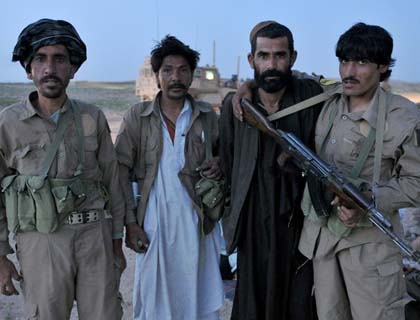
        Those days were the most disturbed days in the history of Iraq and more than hundreds of civilians and government personnel were killed every day in a number of suicide attacks. The condition had made Iraqi security forces and allied forces totally helpless and all their efforts went in vain as stopping a suicide bomber was almost impossible. Innocent civilians were dying every day and there was immense public pressure on the government and security forces of Iraq to stop these terrorists.
        Then a strategy was adopted which was dangerous but it seemed as the final option in tackling this situation. Every town or village was given funds to make their own army and safeguard their own towns and villages. With this, an alternate private army came into existence and every town and village of Iraq presented the picture of a mini military camp. The area was cordoned off and there were checkpoints on every entry to a town or village.
        This solution temporarily solved the problem but then it was feared that what would happen if this private army got out of control and acted like a terrorist group because fighting such a big establishment would also be very difficult for the security forces of the country. People who feared terrorists now got into another fear when they moved from town to town or village to village and it was the fear of this private army. Experts said that this arrangement had divided the people into innumerable groups who were suspicious about each other and had jeopardized the general unity and solidarity among the public.
        There are also present some places in Afghanistan where the typical establishment of army and security forces was not much successful. Terrorists were from the common public who used to work in their farms in day while in the darkness of night; they would carry up their guns and turned into terrorists. This problem was confusing and then we heard about a new term ‘arbaki’ that came into existence as a result of necessity. In every village and town of such disturbed areas, people were taken from the same village or town and a private army was formed and named, ‘arbaki’. They were provided with all the facilities like guns, vehicles and some monthly salary and given the responsibility to safeguard their own area. In order to win the public support for them, a large-scale media campaign was launched in which they were shown to be helping the people and controlling the order in the area in a perfect manner.
        This is a very good picture in which everything seems to be working perfectly but now time has come to assess the performance of this private militia and see how much they have attained the objectives that they were made for. But before doing so, it would be appropriate to discuss some of the issues related to them.
        This private militia or ‘arbaki’ includes of those who want to take extreme risk on a very nominal pay and of course, it would be very comical if we claim that they are doing so for the sake of country or humanity or with a desire to protect their fellow citizens because expecting such high thoughts from such people would be very unfair. Unfortunately, numerous factors have come together to make a society in which we can find a lot of criminals, thieves and other people who would like to earn their livelihood, either from legal or illegal sources. After the collapse of Mujahidin, there were so many people who had fought for almost two decades and their only skill was to fight and thus they were not able and ready to do any other work to earn their livelihood.
        They were ready to fight for anyone who would give them some money. Secondly, due to absence of any job opportunities, a lot of people turned into criminals who were ready to take any kind of risk if it helped them in earning their livelihood, so almost all the members of this private army or ‘arbaki’ included such people and we can also include some other categories in this like thieves, drug addicts and others and it would be irrational if we expect much from them.
        Second factor in this regard is the role of chief of the area. This private army or ‘arbaki’ has been formed in remote areas where every town or village is under the strong influence of a very powerful person or tribal chief. The responsibility of recruitment of such people was given to these elders and they got a golden opportunity to oil their bellies. The more one agreed to give the share of his salary to the chief, the more he got the chances of getting better position in this army and thus entire building was based on corruption and malpractices.
        Then, they were not given due training and in fact, they never needed any training because they were already expert in using guns and looting the houses. They faced only one problem and it was to control themselves when they noticed a good opportunity to loot someone and they were stopped by their elders as now they were no more bandits and part of a ‘pious’ army.
        Till now, they have not shown much impressive performance and the condition of security remains almost the same. However, it is a different reality that they have earned wide public criticism for their inappropriate conduct and behavior. People are of the view that they have not succeeded in getting rid of their old habits and behaviors and thus they are still as dangerous to the general public and order as they were before joining the army.
        Some experts raise another grave concern about the future of this private militia because if they slipped out of the hands of authorities and came under a single umbrella, it would be very challenging for our national security forces to combat them. Another serious issue also puts a question mark that which kind resistance would be shown by them if government decided to dissolve this army and how would government tackle the situation then.
        With all these bad points, it is also necessary to mention some good points about them and most important one is the providence of job for such a large number of people. We all know that our country has no factories or other means of job for illiterate and increasing joblessness poses many serious threats on our existence but with this establishment, at least some people have got jobs and have lifted up some pressure from this side.
        Time will decide about the positive and negative outcomes of this army but till then, it would also be better if we make preparations to avert any serious problem in this regard.


        Opinion: At times we fear that a suicide bomber would come and blow himself in public and we would also be one of the victims, or we fear that there would start a gunfire between terrorists and ...

        faye's chauffeur

        Pashton's girlfriend

        I'm a Pashtun Princes


        Comment


        • #5
          Afghanistan Dispatch: Why the Plan to Arm Local Militias Is Bound to Backfire


          Khoda Qul bought a new gun for $1,000 on the black market after his old one broke. Image by Anna Badkhen. Afghanistan, 2011.


          Bookmark
          Print


          See also


          Published August 17, 2011
          Anna Badkhen, Mazar-e-Sharif, Afghanistan


          It’s all so familiar. The chafing of seven pounds of steel and wood of a Kalashnikov against Khoda Qul’s bony right hip. The blanched desert that unfurls through the gunsight. And the enemy: Taliban forces advancing across a country so parched its desiccated alluvium has sun-baked into pottery.
          Fourteen years ago, Khoda Qul picked up a gun and joined a band of sandaled irregulars that, eventually, in 2001, helped drive the Taliban out of Shahraq, his village of oblique mud-slapped homes in northern Afghanistan’s Balkh province. This spring, the resurgent Taliban returned, and Khoda Qul once again strapped a Kalashnikov over his shoulder to defend his droughty tomato and melon fields and almond orchards. A score of other Shahraqans did the same. So did a dozen men in Shingilabad. And two dozen in Karaghuzhlah. And still more in Darabad and Khairabad. As the Taliban claim sovereignty over one Bactrian village after the next, hundreds of villagers across these millennial battlefields are arming themselves to repel the insurgency.
          The United States and NATO, desperate to stop the Taliban’s advance at any cost, have given their official blessing to the mobilization of these untrained minutemen, known among Afghans as arbaki and customary to southeastern Afghanistan. But in the volatile north, where land feuds, ethnic strife, invasions, and insurrections snarl into mega-conflicts that bleed one into the next for centuries, untold hundreds of men newly armed—even in self-defense—inevitably advance the familiar cycle of fratricidal warfare.
          No one knows where the arbaki’s allegiances lie. Most vigilantes are former foot soldiers of the Northern Alliance—a motley coalition of rival warlords and their militias that fought against the Taliban from 1996 until 2001. Their fidelity tends to mimic the ethnic fissures that, over centuries, have bespattered the Khorasan’s explosive demographics with fratricidal blood. Some men, like Khoda Qul and the leader of the Shahraqi arbaki, Aziz, belong to Junbish-e-Milli-e-Islami; others count themselves among Jamiat-e-Islami—two powerful militias-turned-political parties that fought viciously for control over northern and central Afghanistan in the 1990s, pillaging their way through each other’s territories, leveling parts of Kabul, and essentially paving the way for the Taliban takeover of Afghanistan. The arbaki commander in Karaghuzhlah, a former mujaheddin who had once fought against the Taliban, told me last winter that he would join the Taliban in protest over a nighttime raid on his village by American troops. And in Kunduz province, Balkh’s neighbor to the east, some 4,000 arbaki have been reported to be robbing villagers, raping women and girls, and clashing over territory.
          No one in Balkh province, including the top police officials, can tell how many men here have joined the vigilantes. Nor does anyone know how many weapons they have. Scores of Afghans have told me, in private, that they had defied the 2006 order to surrender their weapons and had secretly kept their rifles stashed within easy reach: in shallow pits in their backyards; beneath some boards in the earthen floors of their houses; behind knotty rafters holding up clay roofs. Afghanistan is a country at war, they say. It is foolish to face war unarmed. “When there’s fighting,” one village elder in Balkh told me, “there’s no law. The law is your Kalashnikov. Wherever you shoot, there you rule.”
          Given the vigilantes’ past, that is a self-fulfilling prophecy. “When you see who is playing the role of arbaki, you see no light in the future of this country,” said Farid Mutaqi, a human rights worker in Mazar-e-Sharif. “They are former mujaheddin, warlords, militiamen. They don’t feel safe if one of them has weapons and the other one doesn’t. We will have another civil war because of the arbaki, I am afraid.”
          Of course, the villagers have little choice, argues Aziz, the leader of Shahraq’s militia. Aziz and I met beneath a corrugated metal awning of a relative’s compound in Mazar-e-Sharif. Twice, at night, the Taliban had launched rockets at his house in Shahraq, and even during the day, he said, his village of 800 or so families was too dangerous to receive visitors. No police or Afghan soldiers guard the village, nor do NATO troops patrol the narrow dun streets that meander past compounds in which the villagers, mostly ethnic Turkmen, now live in dread of the next Taliban raid. For the past two months, Taliban riders on motorcycles have been making rounds of Shahraq’s two dozen tiny factories that bake uneven pale bricks in funnel-shaped ovens, demanding monthly donations of about $2,000 per factory to fund the insurgency. “Do they pay?” I asked Aziz. “They have to,” he replied. “People are afraid that, if they refuse to pay, they will be killed.”
          Even the vigilante teams have not prevented Taliban collectors from returning to the brick factories, day in and day out. “The weapons we have compared to their PK [machine guns] and rocket-propelled grenade launchers are weak,” Aziz explained. “I want you to convey my words to NATO and the foreign governments. In order to stop the war in our village, we need more weapons.”
          As Aziz spoke, Khoda Qul stood by, fingering his Kalashnikov. He had bought it on the black market for $1,000 a few weeks ago, he explained, to replace his old gun, which had broken. This Kalashnikov, too, was not new. Its wooden stock was worn silken like the herders’ footpaths that sickle the plains of Balkh. The chroming on the barrel was blemished, chipped. The dark-brown magazine of ABS thermoplastic dated the weapon to the 1980s.
          Who has fired this gun, and at whom? In which of the invasions and fratricides that have scarred this land? And how will this gun, and hundreds of still more weapons, yet unfired, alter the course of Afghanistan’s never-ending war?


          faye's chauffeur

          Pashton's girlfriend

          I'm a Pashtun Princes


          Comment


          • #6
            Dictatorship of Arbaki in Konduz province Imposed fear and horror by Afghan Local Police (ALP) Arbaki don’t allow people to speak about their problems in Northern Province of Konduz.
            Most of the province’s residents who want to talk about their problems to medias prefer not be named and they speak in condition of anonymity.
            Residents in Konduz province are worried about existence of Local tribal Militias, called Arbaki and ask the afghan government to disarm such militias as soon as possible.
            A dweller in Arabha Village of Chardara district in condition of anoynitmity said:” Arbaki have doubled our problems”
            “Afghan Local Police or Arbaki sometimes force people of the province to pay them, their harvests’ Zakat/tenth and Arbaki get involved in people’s transaction including selling and buying of houses, Land, commodities and animals” he added.

            In addition, a woman who declined to be named said:” we will not tolerate oppressions anymore, Arbaki damage our secure life, everyday they enter our houses asking money and food and they threaten us if we refuse to provide them with food and money.

            “These people” Arbaki” are not here to help us, instead they loot us. Why the president doesn’t give an ear to the people of Chardara” said the women nervously.

            Nearly 5000 students including girls and boys go to 40 schools located in Chardara district, but the students’ families are deeply worried about being of Local Police (Arbaki) in the district saying existence and operating of armed individuals apart from afghan national police and afghan national army were worrying them.

            However, Habibullah a local police commander in northern Konduz rejected all assertions as baseless.
            “All these assertions are made as propaganda by those who have private enmity with commanders of Local police” he told Suboot News Agency.

            “People who make these kinds of claims want to defame Arbaki” he added
            “Every day armed clashes take place in the valley, usually the armed clashes occur among the Arbaki so that people suffer damages from such clashes” said one of Aqtaash valley.
            Most of the valley’s dwellers who neither want their sounds nor their pictures to be provided by Suboot News Agency’s correspondent said that the areas where afghan national police and afghan national army forces are stationed can be more secure in comparison to the areas where Arbaki are operating.

            Suboot News Agency’s correspondent conducted a Survey saying Arbaki have presence in Aliabad, Qala-e Zaal, Imamsahib, Dasht-e Archi, Chardara and Khanabad districts of Northern Province of Konduz. According to the Agency’s survey, people in these districts are dissatisfied with activities of Arbaki; however residents of Khanabad and Chardara districts were wronged more than other residents in the districts where Arbaki exist.

            Chardara district Chief Hajji Abdul Momin Omar Khil confirmed that Arbaki have been involved in disorders in the district saying:” we knew about the issue and that is why we have sent a report indicating that no Arbaki are needed in Chardara district. in addition people complain about them”.

            Meantime, Chardara police Chief Col.Gholam Moheeudin stated:” based on people’s complains, we have launched operations to disarm illegal armed individuals”
            “During the operations we have arrested a commander along with his associates who were in charge of Arabha village of Chardara district”.

            Prior to this, in a press conference, Konduz provincial police chief called Arbaki as effect associates who played a good role in ensuring security along with afghan security forces in the province.
            Also Head of provincial council, Mahboobullah Mahboob appreciated activities of Arbaki in the province calling them as


            Unawareness about Arbaki

            Nearly three months ago, afghan president Hamid Karzai expressed his unawareness about activities of armed individuals under title of Arbaki, he added that they did know Arbaki and they are not formed in the framework of afghan government.
            Interior minister, Bismillah Mohammadi also rejected an existence of Arbaki, adding they would create Local Police in framework of interior ministry and as many as 3000 Local police forces would be considered for northern Konduz province.
            “ to implement a new security program, we will have Local Police force” interior minister Mr. Mohammadi emphasized, in a gathering with tribal elders, provincial officials and commanders of international troops in northern province of Konduz, he said:” according to the accepted structure, we will have only 1300 Local police force in Konduz province”
            According to him the rest of armed individuals are illegal in the province.

            While attending a condolence ceremony of late Gen. Mohammad Daud Daud, 1st vice president Marshal Mohammad Qaseem Faheem warned of all illegal armed individuals to quite people’s torment and persecution otherwise they would be treated based on law even faced with a military treatment.
            1st vice president met the governors and tribal elders of northern Konduz, north eastern provinces. He would take firm actions for betterment of security in north of the country, he promised.


            faye's chauffeur

            Pashton's girlfriend

            I'm a Pashtun Princes


            Comment


            • #7
              Arbaki


              by babatim on July 17th, 2010
              It looks like the new boss has convinced President Karzai to reverse his position on using tribal militias. The new name for these soon to be created Arbaki is Local Police Forces (LPF.) This is a plan which has been tried before with minimal success. In Kandahar the Local Defense Initiative (LDI) forces (the name for Arbaki from the past program) became active and were quickly targeted and decimated by the Taliban. In Kunduz and Takar they partnered with other armed opposition groups (AOG) to exploit the population and government supplies and in Parwan Province they flat out became the AOG. I’m not sure what is being modified to make this cunning plan more effective than the last time around but I do know this much – the plan is going to fail.
              Alex Strick van Linschoten has coined the term “hope tactics” to describe the thinking behind arming various local cats and dogs and that sounds like a pretty good description to me. There is only one way to do this sort of thing and that is to supervise the security forces you are creating. Without supervision and training all you can do is hope the units you create end up becoming effective and hope isn’t a plan. Hope is where Bill Clinton said he was from, gabbing meaningless platitudes about “hope” is how we ended up with a President who is completely clueless. I’m sick of hope and also sick of seeing the same narrow list of options being tried over and over again adding yet another chapter to our legacy of failure in Afghanistan.
              Living a true low carbon footprint lifestyle in Bamiyan Province

              Last night Captain America (regional manager for Team Canada – 2 years on the ground with the US Army as a CA officer and four more as a contractor) rucked up to the Taj for our Thursday happy hour and we talked for a long time with the Skipper about why we are always fighting to maintain program funding, keep our safe-houses, keep our mobility and freedom to maneuver despite consistently exceeding program goals. No reason to hash over the details of our incredibly interesting conversation but there was a portion worthy of mention. CPT A asked if we could do vertical structures, I said we could, to which he said, “you know if we could just knock out 250 schools we’re done”. CPT A is taking his cash for work money and refurbishing district irrigation systems. He does about three districts at a time, employs around 5,000 laborers and is building proper intakes and installing concrete in main canals and karez systems so that they last. The roads into the Nangarhar districts are done, once we finish all the irrigation systems if we knock out 250 schools we can say “dudes we did what we said we were going to do and we’re taking off….good luck.”
              This is what I mean about wasting money. We have spent millions and millions of dollars building new regional ANP training centers and running new ANP officers through them yet still we get an IED planted right outside a Provincial Governors compound.

              CPT A was understating what needs to be done but not by much. He wrote the Provincial reconstruction plan back when he was in Jalalabad with the Army and knows more about it than anyone else on planet earth. But the chances that we would recognize a successful template and slim down our efforts to switch up on the hold and build game are zero. The reason it is zero is that doing reconstruction is irrelevant for the thousands of military staff, civilian governmental agency personnel, and their contractors who have deployed to Afghanistan. All of them have high level security clearances, they spend their days in inter-agency working groups designed to trim the bureaucratic red tape for efficiency and speed while reducing “stove pipes.” These people are all highly paid professional decision makers but they spend their time flying between FOB’s to brief each other and to participate in “fusion cells” designed to provide the battle commanders with useful information. The goal of our efforts has turned inward so that participating in the closed loop is now the job for most of the mid to senior ranked civilians and military personnel.
              An incident like the attack on the DAI office in Kunduz last month gives this Classified Class weeks of work. Guys like the Skipper or CPT America, guys who get the job done day after day without any problems or hiccups – the Classified Class doesn’t even know they exist. There is no reason to track people doing their jobs as promised and without fanfare because they are not going to pop up on the classified nets. A gigantic Poppy Palace full of western aid workers getting attacked – that generates all kinds of classified message traffic and will require lots of flying around to other FOB’s to brief and participate in more emergency inter agency meetings and catch up with good friends. Want the truth? The Classified Class is spending millions of OPM to accomplish not one damn thing other than to feel good about how they spent their year in Afghanistan.
              This is an AP photo form the attack on the US AID implementing partner, DAI, in Kunduz last month

              We also have no resilience in our reconstruction fight if we continue doing it the same old way. Kunduz is a perfect example; the contractor was in a large, well fortified compound with a professional international security company providing armed expat and local security experts. They faced a serious ground attack but the fortifications and armed guard force did its job killing the attackers before they could injure any of the clients. But now the contractor is gone, the programs they were working on abandoned which means the security plan was designed to survive one attack and one attack only. How can one expect to get the build portion of the current clear hold and build program completed if the people doing the build leave after one attack?
              As our Thursday evening happy hour drew to a close the one thing we all agreed on was that our ability to operate in the manner we do is based on the years we have spent in N2KL because most people in most places know who we are, what we do, and know that we get the job done (reconstruction for Cpt A and I, EOD removal for The Skipper.) Reconstruction is not hard, establishing credibility is and that takes time in countries like Afghanistan. It also takes people who can operate on their own on the economy and not just survive but continue to function if attacked. That kind of thinking is not found inside the closed loop of the classified crowd. They do not know what they do not know. They can’t leave the FOB’s so they don’t have an accurate read on anything except what comes through the classified loop. Anyone who has dealt with that sort of information understands how limited it is.
              Which bring us back to the Local Security Forces. This “inspired” idea of using locals to provide security will fail because nobody responsible for it will get off the FOB to provide daily detailed supervision. I can’t stress enough the importance of daily, full time, supervision. The Skipper’s EOD program works because he provides daily, detailed supervision, while EOD programs elsewhere in the country languish. CPT America is re-building the entire Provincial irrigation system because he provides daily, detailed supervision, while the same projects elsewhere in the country barely break ground. If we can’t get the various government agencies to operate off of the FOB then there is only one viable option. Armed, outside the wire, experienced, contractors.
              Be Sociable, Share!
              President Karzai to reverse his position on using tribal militias. The new name for these soon to be created Arbaki is Local Police Forces (LPF.) This is a plan which has been tried before without success. In Kandahar the Local Defense Initiative (LDI) forces (the original Arbaki program from a few years back) were quickly
              faye's chauffeur

              Pashton's girlfriend

              I'm a Pashtun Princes


              Comment


              • #8
                Afghanistan: The challenge of 'good' vs 'bad' militias

                Gunmen in northern Afghanistan want the Karzai government to make their local unit an official part of the security force that will take over after US withdraws.


                By Scott Peterson, Staff writer January 11, 2013


                Kunduz, Afghanistan — As two Afghan farmers tell it, they are part of the "good" militia in their northern province: unofficial armed men who protect schools, families, and farms, and have chased Taliban insurgents away.
                They are not part of the "bad" militia, they say, that since 2010 has especially traumatized parts of Kunduz Province by forcibly extracting "taxes" from villagers, and engaging in killings and rape – all in the name of fighting insurgents themselves.
                Now these traditional gunmen want the Karzai government to make their local unit an official part of the 350,000-strong Afghan security forces that will take over after US combat forces withdraw by the end of 2014.
                Recommended: How well do you know Afghanistan? Take our quiz.
                But as President Obama and Afghan President Hamid Karzai meet today in Washington, such militias – both good and bad, and neither of them under government control – present a challenge to the future stability in Afghanistan.

                Test your knowledge How well do you know Afghanistan? Take our quiz.


                Photos of the Day Photos of July 4th weekend


                Kunduz represents a blend of unofficial and official security forces in Afghanistan, where well-connected militia chiefs have been reluctant to disarm or cede influence. Here, the legacy of the decade-long fight against the Soviets in the 1980s has persisted, thwarting government efforts to extend its reach throughout the country.
                Recommended: Key world markets to see big changes. Get in-depth reports FREE.


                Fighting back against the Taliban is second nature, says Abdul Wasi, a black-bearded, gray-turbaned farmer, though his militia would prefer it if the government trained them, paid them, and officially made them members of the Afghan Local Police (ALP), a program launched by Gen. David Petraeus and modeled after the Sons of Iraq to mobilize Sunnis in Iraq against Al Qaeda.
                "Going 30 years back, we were involved with these guns," says Mr. Wasi. "Our families fought the Soviet Union, so that is our legacy. We can't sleep without guns."
                They call themselves arbaki, after the proud and revered local militias that formed more than a century ago to fight the British in Afghanistan. But that is a term that has been used by nominally pro-government militias with both good and bad reputations.
                "Yes, we are winning the war, meaning we pushed the insurgents out of our area," says Mohammed Yasir, a young man with a budding beard and a light-brown wool cap from a district near Khanabad.
                'Good' v 'bad' militia

                "If there was no arbaki, [the Taliban] would kill many people in one night," says Wasi. He joined the militia two years ago, when the Taliban shot at a vehicle he was riding in with a rocket-propelled grenade.
                "They kill people with any connection to the government,” says Wasi, who, with half a dozen family members with government connections, has been a target. But, he claims: “The provincial capital is secure because of the arbaki."
                These farmers' local militia "might be considered pure" because they operate apart from the much larger territory encompassed by a key commander who fought the Russians, says Gran Hewad, a political researcher at the Afghanistan Analysts Network in Kabul who closely follows Kunduz affairs. The commander, Amir Mir Alam, controls a militia with a notorious reputation for violence and abuse of civilians.
                Mr. Mir Alam has kept good relations with key people in Kabul and Kunduz, and in the past "disarmed only in name," says Mr. Hewad, interviewed in Kabul. Mir Alam was instrumental in recruiting a militia from 2009 in concert with Afghanistan's National Directorate for Security, to make up for manpower shortages in the province.
                "Already there was insecurity; this was a new wave of insecurity in Kunduz," says Hewad about Mir Alam’s militia. "These are the proxy forces undermining the rule of law and national government.... They have fought people, looted, burned houses, abducted, and raped women – whatever crimes are known in Afghanistan are committed by them."
                Mir Alam’s militia is "getting bigger, with the normal argument that the Americans are leaving and the Taliban are recruiting," says Hewad. "The government argues that the ANSF [Afghan National Security Forces] would be better after 2014. If they are not lying, they should disarm these people. If there is a political will, it is possible."
                Hewad noted in a November blog post that militia numbers have been increasing in Kunduz and "provincial security forces seem incapable of controlling them."
                Mir Alam, who after the Soviet withdrawal eventually became a commander in the Northern Alliance which fought the Taliban, "has been known as the major obstacle for implementation of the disarmament agenda," Hewad wrote.
                "These militias have already become a big source of trouble for the local people," concluded Hewad. "If a real disarmament effort does not take place soon, before 2014, they can be considered a major threat to the security of the province after NATO's troop drawdown."
                Plagued with problems

                Alarm bells have sounded before. A spring 2012 report called "From Arbaki to Local Police," by the Afghanistan Independent Human Rights Commission and based on extensive field research, lamented that even the government's local police program – meant to absorb some militias – was plagued with problems.
                Among them, on top of an illiteracy rate of more than 90 percent, were that a number of ALP had been in "illegal armed groups, arbakis, and the Taliban." According to the report, some local police recruits were "notorious for criminal acts," had "bad war records" and were "even serial killers. This makes people lose their confidence in the ALP and even in the government."
                Militias in Kunduz are a step further down the accountability chain, and abuses have been widespread. The result has colored the view of locally-raised militias like that of farmers Mr. Yasir and Wasi. Before they took up guns as volunteers, they say, the principal at their local school was forced by Taliban threats to flee and the primary school – which doubled as a polling station during elections – was burned.
                "We gathered up our guns and took them on, so now our presence has lowered insurgent activity," says Yasir. "Many times they were hurting people, so people got angry, many times they burned the school.... Now girls and boys go to school,"
                Both men want the "illegal" militias to be disarmed, and "good" ones like theirs to be recognized for their work. They reckon there are 2,000 guns in their area, and 1,200 of those they consider to be arbaki. Officials have stated a figure of armed militiamen in Kunduz anywhere from several to ten thousand."Every family has one gun," says Yasir.
                "If the government trained the [good] militia, they could play a bigger role," says a veteran police trainer in Kunduz who asked not to be named for his safety.
                "If they can get trained well, they can be very effective, because they are in all these areas," says the police trainer. He notes that two years ago, some districts were off-limits to government workers, though police and "good" militia deployments have since made them safer.
                And yet this police trainer himself was forced to flee his home.
                "I knew that one day a person would come and cause me trouble," he recalls. He brought all his family to Kunduz, the largest city in the province. "Sometimes I go back and walk on the land; other farmers are using it. This is common."
                "The Mir Alam militia is much more problematic than a mafia – they are smuggling, kidnapping, and killing for more than business issues, but for tribes also," says Hewad of the Afghanistan Analysts Network.
                Yasir and Wasi say those incidents should not be confused with the informal efforts of their arbaki militia.
                "Most of us are farmers and live on our farms, nobody pays us," says Wasi. "Commanders with big groups take taxes from farmers; we don't do that. This is the reason they have a bad image, and made a bad reputation for all arbaki."


                Gunmen in northern Afghanistan want the Karzai government to make their local unit an official part of the security force that will take over after US wit…
                faye's chauffeur

                Pashton's girlfriend

                I'm a Pashtun Princes


                Comment


                • #9
                  Mir Alam and Atta are doing a good job in north Afghanistan. Its just propaganda.

                  Comment


                  • #10
                    faye's chauffeur

                    Pashton's girlfriend

                    I'm a Pashtun Princes


                    Comment


                    • #11
                      faye's chauffeur

                      Pashton's girlfriend

                      I'm a Pashtun Princes


                      Comment

                      Working...
                      X