

 Tweet
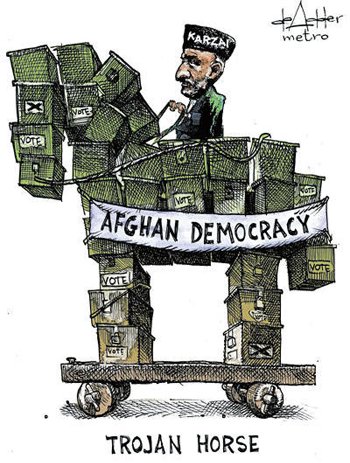
A senior campaign official for Mr. Abdullah, who won the most votes in the election’s first round, said the candidate believes President Hamid Karzai and a coterie of advisers around him orchestrated the fraud. The aim, in the estimation of the Abdullah campaign, was either to install Ashraf Ghani, the other candidate for president, or to see Mr. Karzai use a postelection crisis as an excuse to extend his own term in office.
“Karzai is quite happy everything is tied up,” said the official, who spoke anonymously because the campaign was still collecting evidence of fraud. “They have engineered it in a way that goes far beyond the normal. It’s industrial-scale fraud.”
The official, who is familiar with Mr. Abdullah’s thinking, questioned the neutrality of electoral officials and the courts, saying the candidate had no expectation that complaints would be addressed. Campaign officials also accused Mr. Ghani of being complicit in fraud.
In his public statements, Mr. Abdullah has also suggested there was widespread fraud, though he has not leveled direct accusations at Mr. Karzai or other officials. Speaking to reporters on Sunday, Mr. Abdullah questioned initial reports that more than seven million Afghans had voted. (His campaign figures five million would have been more realistic.) He also said that his campaign staff had witnessed ballot stuffing in Kabul and elsewhere in favor of Mr. Ghani, and that some of the fraud was conducted by a senior elections officials.
The campaign of Mr. Ghani, a former finance minister, said it would accept the official final result. But his campaign officials complained of fraud and violence on the part of Mr. Abdullah’s supporters, and accused Mr. Abdullah himself of violating campaign laws and stoking a crisis.
“If Dr. Abdullah is not announced as unconditional winner, then the country might be led toward a crisis — that is what they have been saying,” said Faizullah Zaki, a spokesman for Mr. Ghani, at a news conference on Monday. “We believe such statements are a serious violation of the Constitution, electoral laws and the fundamental rule of election.”
The hard line from the Abdullah campaign, before all the ballots were even counted or any evidence of fraud publicly disclosed, propelled concerns that Afghanistan was headed for a political showdown at a crucial and delicate moment in a country with a history of civil strife.
For many in Afghanistan, the accusations of fraud directed at President Karzai’s circle echoes the fraught 2009 election and political crisis, when Mr. Karzai defeated Mr. Abdullah. In that vote, about 1.2 million ballots were thrown out as fraudulent, most of them biased toward Mr. Karzai.
The election was headed for a second round before Mr. Abdullah stepped aside under pressure from some of his own Afghan political allies and American officials eager to see the crisis defused.
This time, the Abdullah campaign official said, Mr. Abdullah believed that nothing good would come of his stepping aside to avoid a crisis. Allowing fraud to prevail would harm the country, the official said.
Asked if Mr. Abdullah’s supporters, including powerful former warlords and militia commanders, would mobilize to support their candidate, the official said the campaign would “always ask them to show restraint.”
Another drama that has consumed Kabul in the aftermath of the vote is an allegation that a top election official was caught with a truckload of blank ballots, driving them to an insecure area on the outskirts of Kabul without the mandatory police escort.
Mr. Abdullah has publicly called for the removal of the official, Zia ul-Haq Amerkhel. The election commission has denied the allegations.

Comment