Announcement

Collapse
No announcement yet.

advantages and disadvantages of COLONIALISM

Collapse
X
 
  • Filter
  • Time
  • Show
Clear All
new posts

  • advantages and disadvantages of COLONIALISM

    salam,

    can you guys highlight in academic terms, the benefits and harms of colonialism?

    benefits:
    • stronger economy (wealth creation, job creation)
    • modern infrastructure
    • good healthcare (eradication of deadly diseases)
    • better technology (electricity, machinery )
    • .........


    harms:
    • loss of sovereignty
    • loss of religion/culture/identity/language
    • resources looted
    • colonizers above local laws
    • slavery
    • .........

    Last edited by Zazai; 11-26-2013, 09:55 AM.

  • #2
    any good essays, youtube lectures or books anyone can recommend on this subject ?

    Comment


    • #3
      This is a very important topic. I really appreciate your interest and creativity to touch such issues.

      If you look at the advantages you listed above are all tangible things while the disadvantages are mostly intangible or symbolic or abstract. Now it depends you are a realist, pragmatic or an idealist. For realists colonialism in the past has many benefits as compared to the harms.

      In our context compare Pakistan, India and Afghanistan. Pakistan and India are nuclear powers, with all infrastructure, roads, railway lines, irrigation canals, dams, educational system,public health system, ministries, codes of law, proper legislature, executive and judiciary, world's 5th and 6th largest armies, functional democracies, no Taliban(except Pashtuns and few Seraikis) etc. While Afghanistan is at a very rudimentary stage in almost all these spheres.

      Where from all these tangible achievements came for India and Pakistan and not for Afghanistan as such? From colonialism. Afghansitan is proud to be graveyard of empires, never effectively ruled by others but the result is that today's Afghanistan is itself a graveyard with medieval thinking and life style.

      Colonialism in past and secularism are two misnomers. If you ponder over these two objectively then you will find a lot of justification. For colonialism in the past and secularism in the present.

      Now the world has progressed much and there can be no compromise on sovereignty. The colonial powers also know that now they cannot annex other countries and make it part of their empires as was done by Persians,, Greeks,Arabs, Turks, Pashtuns,Spanish, French, Dutch , English, Communists etc.

      Now a days there can be international cooperation or foreign armies can enter in different countries on the invitation or consent of the people or government of the countries as we see in Iraq, Afghanistan etc.

      Neocolonialism in shape of economic joint ventures, investment or foreign trade are also positive. However exporting Salafism, Wahabism etc is something negative.

      Comment


      • #4
        Originally posted by Zazai View Post
        salam,

        can you guys highlight in academic terms, the benefits and harms of colonialism?

        benefits:
        • stronger economy (wealth creation, job creation)
        • modern infrastructure
        • good healthcare (eradication of deadly diseases)
        • better technology (electricity, machinery )
        • .........


        harms:
        • loss of sovereignty
        • loss of religion/culture/identity/language
        • resources looted
        • colonizers above local laws
        • slavery
        • .........

        Zazai Wrorre,

        Once again issues center around historical precedence in total. Militant secular ideology general utilizes the carrot and stick logic and tends to be rather uneducated, ignoring confounding in their analysis of the subject. Militant secularists also draw arbitrary lines that represent the time points of their choosing without considering the full historical picture of a land and its people.

        Consider that in the very court of Ahmad Shah Abdali, Al Munshi was writing his Tarikh and Ahmad Shah's war strategems and artillery were not by any means rudimentary (e.g. he utilized smoothbore cannons). It was not a caveman court by any means.

        In the same vein, the Mughals accomplishments as well as that of the Persians pre colonization was also evidence in their literary works, society structure, economy, etc.

        So the very reason for the term neocolonialization is that a second phase, or some view it as an extension of the early phase is manifesting itself as if colonial rule never really ended. The very map lines drawn and the leaders left in place were a part of a new "off shore" weighted approach to peripheral rule that cost a lot less and allowed for continued rule/extraction of resources.

        To restress, once again the loss of autonomy of indigenous peoples has been consistently detrimental - that is a time tested and proven truth.

        Pakistan is actually a perfect example of the colonial design destined to fail. In these various states, there is immense wealth concentration, some remnant of feudalism and a ruling class associated with the former colonial power, massive corruption and state dependency on outside sources of funding, limited land resources etc.

        Regarding Afghanistan, perpetual war and invasion took the autonomous kingdom of Ahmad Shah and the direction it was going (alongside some contribution from inept rulers) and produced the results we see today.

        The divide and conquer motif also made sure that migration patterns and the ability to utilize a larger land mass was unable to be done.

        So the best similitude would be that Pakistan et al. are states on life support or at least ill states being artificially kept alive and dependent on the 5 anglo powers in the form of having the lower hand and serving the security apparatus of those powers.

        This is in contrast to their prior status as controlling some of their own destiny and resources and having the ability, due to the totality of land and goods, to withstand global embargoes and the like.

        A great example would be how Turkey was forced to trade for Iran with Gold bullion and then the powers imposed further sanctions on even that, with Turkey understanding the reality of the situation but being helpless in having to abide by the will of the imperial powers.

        Usually secular militants present the majority of the problems in these indigenous regions - they are a foreign innoculation that serves a vocal minority interest mirroring outside interests. Their frame of mind is to shift the time honored cross cultural definitions of autonomy and independence for secondary gain.
        "2 crackheads don't become any better or stronger by sharing the same crack pipe." - Greatest PF quote

        Comment


        • #5
          Originally posted by BarakzaiAbdali View Post
          Zazai Wrorre,

          Once again issues center around historical precedence in total. Militant secular ideology general utilizes the carrot and stick logic and tends to be rather uneducated, ignoring confounding in their analysis of the subject. Militant secularists also draw arbitrary lines that represent the time points of their choosing without considering the full historical picture of a land and its people.

          Consider that in the very court of Ahmad Shah Abdali, Al Munshi was writing his Tarikh and Ahmad Shah's war strategems and artillery were not by any means rudimentary (e.g. he utilized smoothbore cannons). It was not a caveman court by any means.

          In the same vein, the Mughals accomplishments as well as that of the Persians pre colonization was also evidence in their literary works, society structure, economy, etc.

          So the very reason for the term neocolonialization is that a second phase, or some view it as an extension of the early phase is manifesting itself as if colonial rule never really ended. The very map lines drawn and the leaders left in place were a part of a new "off shore" weighted approach to peripheral rule that cost a lot less and allowed for continued rule/extraction of resources.

          To restress, once again the loss of autonomy of indigenous peoples has been consistently detrimental - that is a time tested and proven truth.

          Pakistan is actually a perfect example of the colonial design destined to fail. In these various states, there is immense wealth concentration, some remnant of feudalism and a ruling class associated with the former colonial power, massive corruption and state dependency on outside sources of funding, limited land resources etc.

          Regarding Afghanistan, perpetual war and invasion took the autonomous kingdom of Ahmad Shah and the direction it was going (alongside some contribution from inept rulers) and produced the results we see today.

          The divide and conquer motif also made sure that migration patterns and the ability to utilize a larger land mass was unable to be done.

          So the best similitude would be that Pakistan et al. are states on life support or at least ill states being artificially kept alive and dependent on the 5 anglo powers in the form of having the lower hand and serving the security apparatus of those powers.

          This is in contrast to their prior status as controlling some of their own destiny and resources and having the ability, due to the totality of land and goods, to withstand global embargoes and the like.

          A great example would be how Turkey was forced to trade for Iran with Gold bullion and then the powers imposed further sanctions on even that, with Turkey understanding the reality of the situation but being helpless in having to abide by the will of the imperial powers.

          Usually secular militants present the majority of the problems in these indigenous regions - they are a foreign innoculation that serves a vocal minority interest mirroring outside interests. Their frame of mind is to shift the time honored cross cultural definitions of autonomy and independence for secondary gain.
          Ahmad Shah Abdali,the Mughals ,Persians , Arabs cannot be called a period of pre colonization. They were also colonists who invaded, killed, occupied , annexed and ruled foreign lands. Colonists are not only British or Spanish or other Europeans.

          Neo-colonialization is a negative word but if we take it in form of FDI and International Cooperation then China will be the most Neo colonized country of the world with presence of such a huge foreign investments and Multi nationals.

          If you are not impressed by the progress of Pakistan owing to its colonial past then what about India? Is it also a failure?

          The only problems I see in Pakistan is Pashtun Taliban, army rule and insufficient representation of minorities. Feudalism is withering away as Industrial class is getting stronger with passage of time. Now Faisalabad, Sialkot, Karachi, Lahore rule the country not feudal lords with agricultural land holdings.


          The autonomous kingdom of Ahmad Shah was destroyed by his own sons not by others. Why Afghans are so week that they are under perpetual war? Why they do not become masters of their own destiny? Why they let others to conquer them and divide them?

          Comment


          • #6
            In most circles, colonialism is considered to be a sad episode in history—where dominant economic powers with sophisticated military might subjugated less developed, more vulnerable societies, turned them into colonies, imposed foreign languages and organizations upon them, and exploited local natural resources and labor. Indeed, Karl Marx argued that mature capitalist economies required such colonies in order to forestall their inevitable stagnation and decline. And there was a heavy price paid by the colonies themselves, with long-term negative consequences that are often pointed to as the reason why many of those societies remain poor today.

            But this dark story has now been revised. A recent series of papers co-authored by Hoover Property Rights Task Force members Daron Acemoglu and James Robinson found that there were advantages from colonization as well, especially for those colonies within the British Empire. English institutions, such as the common law, property rights security, contract enforcement, and banking and trading practices provided a positive basis for economic growth in the colonies that has persisted.
            The Bright Side of British Colonialism | Hoover Institution

            Advantages of Colonialism

            • Transformed ecological systems

            Ecological systems of the colonized territory are definitely transformed intentionally or unintentionally by colonial rule. The colonists introduced new plant foods and create new agriculture to the colonized territory. “American savannahs were converted into corn fields” (Parcelle, 2009). England’s native crops like corn and tobacco were also cultivated in America (Scott, 2001).
            Last edited by Badlun; 11-28-2013, 01:14 PM.

            Comment


            • #7
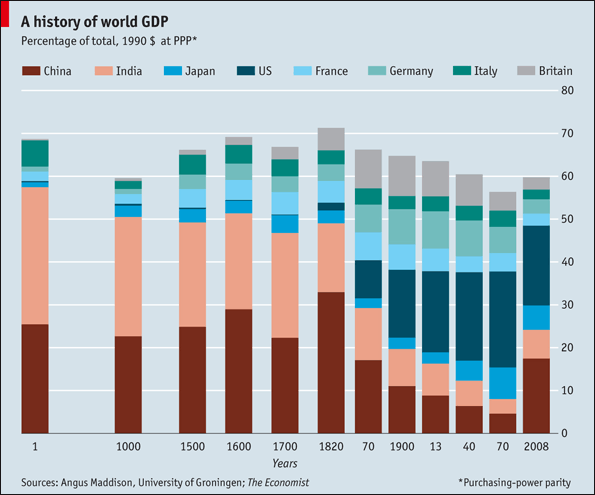
              Actually India was much richer before the brits took it and left it plundered.

              Comment


              • #8
                Imagine the India at the time of the last Mughal King bahadar Shah zafar in 1857 and the India in 1947 with railways, roads, dams, governmental structure, assemblies, municipalities, educational system, English Language, army, irrigation system, big cities with planning, legal codes, Indian civil service, constitution, courts, democracy , land reforms, land demarcation system, some factories,and so on............

                Comment


                • #9
                  Originally posted by Badlun View Post
                  Ahmad Shah Abdali,the Mughals ,Persians , Arabs cannot be called a period of pre colonization. They were also colonists who invaded, killed, occupied , annexed and ruled foreign lands. Colonists are not only British or Spanish or other Europeans.

                  Neo-colonialization is a negative word but if we take it in form of FDI and International Cooperation then China will be the most Neo colonized country of the world with presence of such a huge foreign investments and Multi nationals.

                  If you are not impressed by the progress of Pakistan owing to its colonial past then what about India? Is it also a failure?

                  The only problems I see in Pakistan is Pashtun Taliban, army rule and insufficient representation of minorities. Feudalism is withering away as Industrial class is getting stronger with passage of time. Now Faisalabad, Sialkot, Karachi, Lahore rule the country not feudal lords with agricultural land holdings.


                  The autonomous kingdom of Ahmad Shah was destroyed by his own sons not by others. Why Afghans are so week that they are under perpetual war? Why they do not become masters of their own destiny? Why they let others to conquer them and divide them?
                  thats what the usa is right now is in afghanistan or pakistan in balochistan and in the north west frontier province khyber pukhtunkhwa hope the pakis giving the autonomi to fata back.
                  pashtun taliban in pakistan? they came 2004 or 2005 rised in waziristan to a local milliz brought pakistan alot of money the paki army did nothing and even supported the ttp to rise .but the true taliban the first taliban the afghan taliban that was born in kandahar in 1994 they came as puffer for the anarchi and civilwar that was going on in afghanistan between the warlords that was armed in the 80's by the usa and the international community.the warlords in afghanistan for exampl ahmad shah massoud,dostum, mazari, rabbani, sayaf, hekmatyar etc captured large provinces divived afghanistan in local warlord kingdoms, where a afghan from paktia province in afghanistan had to make a visa for the kunduz province in afghanistan etc.the taliban stoppt this nonsense made a good job in uniting the afghan provinces defeating the civilwar of the warlords and anarchi and brought their kind of system to afghanistan wich was not 100% compatibl ethnical and religous groups there.at last 95% of afghanistan was under the taliban rule their plan was actually to give this united provinces to a islamic goverment, choosen by the afghan people, this is what one of the first taliban said mullah zaeef. of course the taliban had no money to pay at this time local police schools etc so the woman had to stay at home because kidnapping of woman and children was actually under the civilwar-anarchi of the warlords normal.mullah zaeef is one of the first taliban his view of the taliban are very interesting. Pashtun Taliban sounds funny because the taliban are a group of diffrent ethnical and religous groups.pakistans taliban ttp you could call it punjabi taliban created in waziristan joint by uzbeks punjabis pashtuns.
                  sry for the gatwat englisi
                  Last edited by Khilji; 11-29-2013, 07:57 PM.

                  Comment

                  Working...
                  X