
 Tweet
Originally posted by Talal
View Post
-
First time Punjabis will directly rule Peshawar after Ranjit Singh."If a nation expects to be ignorant and free, in a state of civilization, it expects what never was and never will be".
"Knowledge will forever govern ignorance; and a people who mean to be their own governors must arm themselves with the power which knowledge gives". -
yao warokay ghwandi baagh ao pa khwa ye seen rawan!
Comment
-
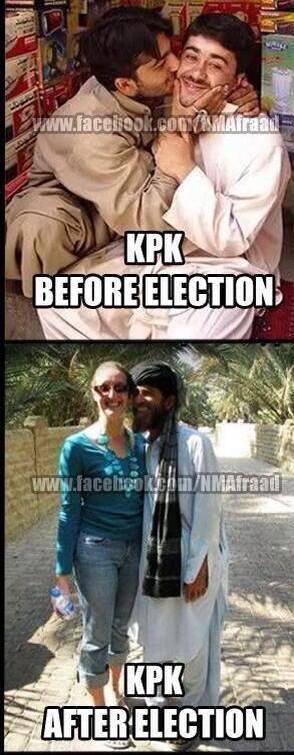 Originally posted by Elite Pakhtun
Comment
-
Pervez Khattak is pashtun, look at his last name dude.Originally posted by Levanaye Zalmaye View PostLast edited by Kushan Prince; 05-15-2013, 10:34 PM."Revenge is a dish best served cold".
-Old Pashtun proverb

"My Pashtun Pride i will not hide!"Comment
-
PESHAWAR: Pakistan Tehrik-i-Insaf (PTI) , Jamaat-i-Islami (JI) and Qaumi Watan Party (QWP) finalised on Wednesday a formula over the formation of government in Khyber Pakhtunkhwa province, according to which JI and QWP would get three ministries each whereas, the PTI would hold the chief minister and speaker positions in the province.
The Jamiat Ulema-i-Islam-Fazl (JUI-F) also announced that it would sit in the opposition benches of Khyber Pakhtunkhwa’s provincial assembly.The General Secretary of PTI Khyber Pakhtunkhwa, Shaukat Youzafzai when contacted said : “Yes QWP, JI and PTI have agreed on a power sharing formula and the government formation formula would be announced today.”The sources in PTI confirmed that the Qaumi Wattan Party would get the slot of Deputy Speaker, one senior minister and minister while the Jamaat-i-Islami would be getting two ministers and a senior minister’s slot.
The PTI would also be announcing the names of the leader of the house shortly while the speaker’s slot would also be retained by it.“No we have not yet finalised the names of the Chief Minister and the Deputy Speaker but yes we would be retaining both the slots,” Shaukat said.
The PTI leaders Pervaiz Khattak and the Asad Qaiser are both engaged in power struggle for the coveted slot of the KPK chief minister and a decision with regards to who would head PTI’s rather inexperienced government is still awaited.
Some sources also say that one of the coalition partners of the PTI has shown reservations on the name of Pervaiz Khattak so the PTI was mulling over the name of some other candidate, probably Asad Qaiser, which would be finalised after PTI chief Imran Khan approves the name later today.
Shaukat Yousafzai also confirmed that they have a strength of 67 members now and the modalities for the government would be announced soon.It's enough that I know, Our time had a home, In your heart..Was a place..But the glass always breaks..Comment
-
And this bloody hypocrite moron Imran Khan was saying he will not enter into alliance with any party whose leaders have corruption charges lodged against them and both Sherpao and Pervez Khattak have corruption cases against them still in court. Besides, Pervez Khattak is a turncoat having changed four parties so far. Sherpao also have admitted to Swiss account worth 5 million pounds in 2000-2001.Last edited by Toramana; 05-15-2013, 11:02 PM.Comment
-
Mullah Barakzai, my heart is not broken. ANP and its predecessor parties like NAP and KKs have been in politics for almost a century having already seen many ups and downs in their fortune. On the other hand, you Talib looser after the defeat in 2001 and the virtual extermination with no hope of a comeback are jealous of other Afghan elite in Kabul.Originally posted by BarakzaiAbdali View PostComment
-
Imran Khan reminds me of Obama.Originally posted by Toramana View PostEven Adobe Photoshop can't change me.
A line[Durrand line] of hatred that raised a wall between the two brothers -Hamid Karzai
For generations, the Hindus of India prayed for deliverance from "the venom of the cobra, the teeth of the tiger and the vengeance of the Afghan."
The men of Kábul and Khilj also went home; and whenever they were questioned about the Musulmáns of the Kohistán (the mountains), and how matters stood there, they said, "Don't call it Kohistán, but Afghánistán; for there is nothing there but Afgháns and disturbances." Thus it is clear that for this reason the people of the country call their home in their own language Afghánistán, and themselves Afgháns. The people of India call them Patán; but the reason for this is not known. But it occurs to me, that when, under the rule of Muhammadan sovereigns, Musulmáns first came to the city of Patná, and dwelt there, the people of India (for that reason) called them Patáns—but God knows!
-Ferishta, 1560–1620Comment
-
He is not even Obama. He is worst than Obama. Obama has some principle. This guy has got no principle no ideology.Originally posted by Admin Khan View PostComment
-
Originally posted by Toramana View Post
Dang a century and still so little to show for it? All I hear is the language of intellectual flatulence... Translatable into Pashto as "terr terr terr terrarray." LOL. It's ok Toramana we here at Pf love you still even if KP unanimously rejected you. We still need relics of the past movements around for the pf Pashto history section. Pffffft man elites and Taliban are your buddies not mine... Mr Peshawar Youth leader"2 crackheads don't become any better or stronger by sharing the same crack pipe." - Greatest PF quoteComment
-
Talal, what gauge do you use to make governance comparison between Punjab and other provinces? One yardstick can be economic growth which Punjab has lower than other provinces. Another can be crime in which Punjab tops even in terms of average and capita. Check below.
28,823 crimes reported in 72 districts of Pakistan during January 2011 | Maverick Pakistanis
On Economy see below.
Punjab’s lost growth momentum
PUNJAB’S regional economy has increased at a much slower pace than ‘the rest of Pakistan’ over last four financial years to 2011, a trend that must be reversed to create jobs and reduce poverty.
The province’s annual average growth rate of 2.5 per cent between 2007 and 2011 lags far behind 3.4 per cent for the rest of Pakistan,according to a report of the Lahore-based Institute of Public Policy (IPP).
The report – The State of the Economy: The Punjab Story – estimates the provincial gross regional product (GRP) to have expanded by 5.6 per cent, or slightly faster than the national average of 5.5 per cent and the rest of Pakistan average of 5.4 per cent between the financial years 2000 and 2007 before falling sharply in the following years.
The average provincial growth rate of 4.5 per cent during 2000 and 2011, nevertheless, falls behind the national average of 4.6 per cent and the rest of Pakistan average of 4.7 per cent. Between 2000 and 2011 the average growth rate of Punjab has been 0.2 percentage points less than that of the rest of Pakistan. However, much of the growth shortfall experienced in Punjab has been in the last four years, the report says.
The IPP growth estimates for Punjab should be instructive for the Shahbaz Sharif government as it prepares the provincial budget for 2012/13, promising to provide relief to people in the run up to the new election early next year. By implication, the report has been quite critical of the government’s development priorities that have done little to address structural weaknesses and infrastructure gaps responsible for dragging down the provincial economy. It also advises the government to reset its development priorities to push growth rate to combat rising unemployment.
It also accuses the previous government of Chaudhry Pervaiz Elahi (2002/07) of overstating growth rate for its tenure, saying Punjab grew at 6.6 per cent during financial years between 2003 and 2007 compared to the national average of 6.8 per cent and the rest of Pakistan average of seven per cent. Official estimates for the said period claimed that the province had grown at an average pace of 7.5 per cent, faster than the national average of 7.3 per cent and the rest of Pakistan average of 7.1 per cent.
The report says unemployment has increased significantly since 2007/08 because of the falling growth. “The economy of Punjab will have to grow at a rate of above six per cent on a long-term basis if increasing unemployment is to be avoided,” it argues.
It estimates the per capita GRP of Punjab at Rs97,492 or $1140 per annum in 2011, or two per cent lower than the rest of Pakistan.
The slowing regional growth has led to contraction in Punjab’s share in the national economy to 54.9 per cent in 2011 from 55.5 per cent in 2000 and 55.7 per cent in 2007.
Punjab’s economy, according to the IPP, is composed of 24 per cent agriculture (17 per cent for the rest of Pakistan and 20.9 per cent for Pakistan), 21.2 per cent industry (31 per cent for the rest of Pakistan and 25.8 per cent for Pakistan) and 54.8 per cent services (52 per cent for the rest of Pakistan and 53.3 per cent for Pakistan). The provincial economy’s sectoral composition signifies relative importance of agriculture in its economy and underdevelopment of industry as compared to the rest of Pakistan, says the IPP.
The report identifies three major factors that have dragged down economic growth in Punjab in recent years: decreasing water availability for agriculture, growing energy crunch for industry and declining public sector investment in economic infrastructure.
The IPP points out that performance of agriculture plays a major part in the economic growth of the province. During the last few years, it contends, the performance of agriculture sector has been disappointing, especially of major crops that have shown little growth since 2007 due to growing water shortages and rising fertiliser prices. Wheat production was virtually stagnant and output of sugarcane and cotton dropped by 10 per cent and 17 per cent respectively. The only crop with significant growth of 26 per cent was rice. In addition, there was hardly any growth in minor crops. Given the relatively large share of agriculture in the regional (Punjab) economy, the growth rate is likely to be lower because even in good years agriculture is unlikely to average a growth rate above four to five per cent,” it underlines.
The annual average agriculture growth rate in Punjab declined to just one per cent between 2007 and 2011 from 3.3 per cent between 2000 and 2007. In contrast, the average agriculture growth rate rose to three per cent for the rest of Pakistan from 2.5 per cent.
Growing energy shortages have affected industrial output in Punjab disproportionately, according to the report. There has been cumulative drop in gas consumption in the province of 13 per cent in the last few years compared to an increase of 16 per cent in the rest of Pakistan, especially in Sindh.
Similarly, increase in electricity consumption since 2007 has been restricted to only two per cent compared to six per cent in the rest of Pakistan. Punjab’s share in the national production of cotton yarn, for example, dropped from 33 per cent in 2007 to 29 per cent in 2011 and in cotton cloth from 43 per cent to 37 per cent.
Additionally, the report underlines the weaker presence in Punjab of industry producing consumer durable and construction inputs compared to Sindh as another factor for slower growth. “In the peak of business cycle, industries producing consumer durables like automobiles and industries providing construction inputs like cement show very high growth rates. During 2003 and 2007, for example, production of automobiles showed extraordinarily high growth rate of 31 per cent. The growth rate of cement industry was also high at 18 per cent.
These industries, which are sensitive to business cycle, have larger presence in the rest of Pakistan, particularly in Sindh, and further push the growth rate of this region during periods of high growth.”
In spite of these factors, the decline in industrial growth in Punjab to 3.3 per cent between 2007 and 2011 from 6.9 per cent between 2000 and 2007 has been far less marked than in the rest of Pakistan where it dropped to just 1.6 per cent from 7.8 per cent. The national average has come down to 2.3 per cent from 7.4 per cent.
The report further argues that the export boom has been more advantageous for the industries closer to the port in Karachi than the ones in Punjab. “The good performance of manufactured exports between 2003 and 2007, with an annual growth rate in excess of 14 per cent clearly meant that units located closer to the port were in an advantageous position to exploit these opportunities than the ones in Punjab.
Consequently,the textile sector of Sindh benefited more from the export boom.”
Punjab’s services sector too has performed poorly compared to the rest of Pakistan in the years between 2007 and 2011. While the sector grew by 3.6 per cent in Punjab, it expanded by 5.3 per cent in the rest of Pakistan. The growth rate in the province’s services sector has come down from 6.3 per cent between 2000 and 2007 when the rest of Pakistan increased its services sector by 5.2 per cent.
Punjab’s share in taxes also appears to have declined during the years of falling growth. The province’s share in direct tax collection, for example, is estimated to have dropped to 33.7 per cent in 2009/10 from 34.2 per cent in 2006/07. Its share in excise duty too has plunged to 42.9 per cent from 53.2 per cent. But the domestic sales tax collection from Punjab grew to 44 per cent from 29.9 per cent.
“The decline in Punjab’s share (of direct tax collection) tends to indicate that the non-agricultural GRP of the province may have grown at a
somewhat lower rate than the rest of the country’s. The relatively low share of Punjab in revenues compared to its population may also be noted. The highest incidence of taxes is on the large-scale manufacturing sector and Punjab has a relatively low share in the national value added in this sector,” the report says.
The IPP is of the view that Punjab’s development priorities must focus primarily on removing constraints – large infrastructure gaps of water availability for agriculture and energy for industry – to growth.
“Currently, the Punjab government devotes less than one-third of its annual development programme (ADP) to infrastructure development. This share will have to be raised substantially and the inter-sectoral allocation will have to shift from highways to irrigation schemes and power projects.”
The development strategy must also focus on sectors and sub-sectors in which it has a comparative advantage. This will include policies and programmes to develop the yields in major crops, minor crops (especially fruits and vegetables), milk production and marketing, poultry, agro-based industry, small and medium enterprises and services sector. It advises the provincial government to draw up a plan to maximise gains that liberalisation of trade with India offers.
And last but not the least, it urges the government to follow a more expansionary fiscal policy with the objective of achieving a quantum jump in the size of its ADP to remove infrastructure gaps dragging growth in the province. “This will require a more aggressive policy of resource mobilisation involving the development of provincial taxes on services, agricultural income and real estate.”
But the Shahbaz Sharif government, which has so far dithered on theissue of increasing provincial own tax resource, is unlikely to heed to the IPP suggestions, its critics say. “I don’t see the provincial government effectively taxing the under-taxed or untaxed sectors in the next year’s budget. Nor do I think it will shift whatever financial resources it can muster for development to such irrigation and energy projects that will take some time to complete. I believe that it will continue to spend money on schemes that can bring it immediate political dividend in the election year rather than those whose benefits will accrue after a few years,” comments an economist.
PunjabLast edited by Toramana; 05-16-2013, 12:17 AM.Comment
-
I know your heartburn-Looking Karzais and Wardags building Afg whereas you watching as a non-entity reduced to nothingness.Originally posted by BarakzaiAbdali View PostComment
-
Wroraka bus kherdeh- swazeezhay au kareezhay- sthaseh hizbe surkh kholay qabil na sho. Pa der hafgan ke ye. Weh meh bakhalaay. Piryaano stha zargaay da pasa ksheynaastha.Originally posted by Toramana View Post "2 crackheads don't become any better or stronger by sharing the same crack pipe." - Greatest PF quote
Comment
-
Not exactly. The very first CM of NWFP khan abdul qayyum khan aka double barrel khan of muslim league was kashmiri (not to be confused with sahibzada abdul qayyum khan of swabi). He was the one responsible for babra massacre, he repressed pashto and heavily promoted urdu...i think he was the one who said that pashto is langauge of hell , in response to which ghani khan said he would go to jannat with this langauge of hell.Originally posted by Levanaye Zalmaye View Post
Punjab is ruling peshawer since 1947, they are neo-angraiz or kalay angraiz.
Comment
-
Comment