
 Tweet
http://www.rawa.org/temp/runews/2012...ing-spree.html
In both cases, local residents complained that the groups received support and protection from American Special Operations forces, which the United States military has denied
By Abdul Matin Sarfraz and Rod Nordland
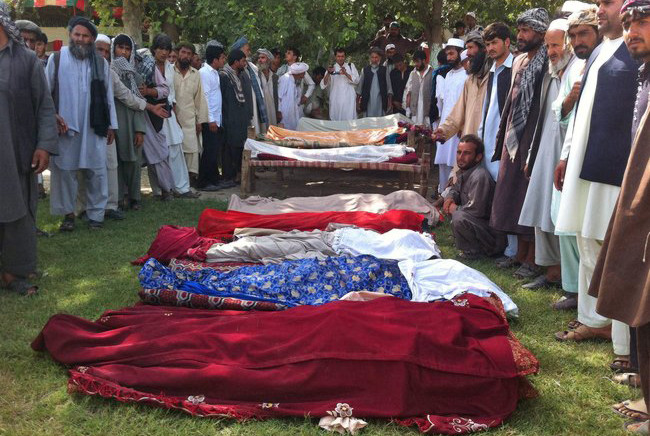
September 1, 2012: Residents of Kanam staged a protest over the killing of 11 of their fellow villagers by a pro-government militia group on Sunday. (Photo: European Pressphoto Agency)
Read more: http://www.rawa.org/temp/runews/2012...#ixzz25MDpRPtZ
On the bed of this village’s only pickup truck, three bullet-riddled bodies were laid out on Sunday, hastily wrapped in sheets. Behind the truck, several cars, their hatchbacks propped open as they bounced down the dirt roads, carried one or two bodies each. All 15 of the village’s vehicles, most of them shabby and old, joined the grim convoy, stuffed with 200 distraught relatives and 11 of their dead.
The villagers headed south to the provincial capital, Kunduz, about six miles away, to stage a protest over the killings, which Afghan officials and surviving villagers say were carried out by pro-government militiamen in reprisal for a Taliban assassination of a member of their militia. The bodies of the 11 victims, all young or middle-age men, were carried along as grisly proof.
It was the second time in a month that one of the controversial militia groups, known as arbakai, had carried out reprisal killings of people believed to be Taliban sympathizers.
In both cases, local residents complained that the groups received support and protection from American Special Operations forces, which the United States military has denied. The Special Operations units train arbakai militiamen only when they are enrolled in official programs for recruits of the Afghan Local Police, American officials insist.
That training program has recently been suspended, however, in the wake of a series of so-called insider killings of American and other international coalition soldiers by members of the Afghan security forces and recruits. In the past month, 15 coalition servicemen have been killed that way, including five members of Special Operations units, according to the American military.
In much of Kunduz Province, in northern Afghanistan, the arbakai militias support the government against what had been a growing presence of Taliban insurgents, especially in Pashtun areas. Many local residents complain that the groups often operate outside the law, extort unofficial taxes from local residents and are prone to act on the basis of ethnic loyalties.
Gov. Anwar Jegdalak of Kunduz called the attackers in Kanam members of “irresponsible armed militias” who had accused the villagers here of cooperating with the Taliban and sheltering them. Officials said “a large group” of gunmen carried out the attack; villagers said they counted 20 to 30.
Kanam is one of many small pockets of ethnic Pashtun people in Kunduz, where the police and militias are dominated by ethnic Tajiks, who make up the majority of residents. Many of those groups are led by former warlords and aligned with their former militia commanders, who now hold high government positions.
According to villagers, the Taliban abducted an arbakai figther named Abdul Jalil, killed him and on Saturday dumped his body outside Kanam. Mr. Jalil belonged to a group led by a pair of commanders known by their nicknames, Qaderak and Faizak.
Early Sunday morning, Mirjan, 50, a farmer who like many Afghans goes by one name, heard a knock on his door. “My son got up to answer the door and as soon as he opened it we heard a burst of gunshots,” he said. “I found him lying in a pool of blood.” Mr. Mirjan said he peeked outside and saw heavily armed men prowling through the village, shooting any man they saw.
The status of arbakai militiamen is a delicate issue. The term refers to unpaid militiamen who have organized themselves, sometimes as former insurgents, sometimes as armed robbers, but in other cases as a self-defense force and vigilantes. Many of them in Kunduz and other areas have begun to receive arms and other support from government officials, even before they have been officially trained.
Many of the arbakai say they hope to be trained as Afghan Local Police recruits by American Special Operations teams, who also are supposed to vet the Afghans to make sure they have really committed to the government side and are not involved in criminal activity. They then are issued equipment and paid. But the training program has recently been suspended to allow the American trainers to re-examine existing recruits and root out any who pose a risk.
Another resident of Kanam, Mirza Ali, said the village had been attacked three times by Qaderak and his militiamen because the residents had refused to pay an illegal tax to the arbakai. On one occasion, the arbakai shut down a girls’ school and beat up the headmaster, Mr. Ali said.
“They are still roaming around in the area with no prosecution and no punishment,” he said.
The attack on Sunday prompted a prominent arbakai commander in Kunduz, Mir Alam, to publicly repudiate the militia commanders Qaderak and Faizak in telephone calls to reporters. “These are not my men anymore,” he said. “They are trying to defame me. The government can arrest and punish them anyway they want.”
A similar attack occurred last month after two ethnic Hazara militiamen were killed by the Taliban in eastern Oruzgan Province. The commander of an ethnic Hazara arbakai group attacked nearby Pashtun villages and killed at least nine civilians, according to Afghan police officials.
Afghan officials claimed that the commander was well known to them for previous atrocities but had been protected by American Special Operations forces. An American military spokesman denied those claims.
“These criminal groups were created and trained by the occupying American forces in an attempt to lower the number of American casualties and to improve security,” said a Taliban spokesman, Zabiullah Mujahid, in an e-mail on Sunday. Mr. Mujahid claimed that the arbakai commander in last month’s attack was not only still at large but also still working for the government.
Human rights groups have raised concerns that the arming of Afghan militia groups increases the danger that Afghanistan will return to the multisided civil war, which pitted many Afghan ethnic groups against one another and destroyed the country in the 1990s, setting the stage for a Taliban takeover.
When the Kanam villagers’ convoy reached Kunduz on Sunday, the province’s deputy police chief, Ghulam Mohammad Farhad, met with them and promised to bring the attackers to justice.
Some of the protesters were skeptical. “We are suffering like this while foreigners are still in the country,” said one man, who declined to give his name. “What will happen to us when they pull out?”
An employee of The New York Times contributed reporting from Kunduz Province, Afghanistan.
Read more: http://www.rawa.org/temp/runews/2012...#ixzz25MDEkvoF
In both cases, local residents complained that the groups received support and protection from American Special Operations forces, which the United States military has denied
By Abdul Matin Sarfraz and Rod Nordland
September 1, 2012: Residents of Kanam staged a protest over the killing of 11 of their fellow villagers by a pro-government militia group on Sunday. (Photo: European Pressphoto Agency)
Read more: http://www.rawa.org/temp/runews/2012...#ixzz25MDpRPtZ
On the bed of this village’s only pickup truck, three bullet-riddled bodies were laid out on Sunday, hastily wrapped in sheets. Behind the truck, several cars, their hatchbacks propped open as they bounced down the dirt roads, carried one or two bodies each. All 15 of the village’s vehicles, most of them shabby and old, joined the grim convoy, stuffed with 200 distraught relatives and 11 of their dead.
The villagers headed south to the provincial capital, Kunduz, about six miles away, to stage a protest over the killings, which Afghan officials and surviving villagers say were carried out by pro-government militiamen in reprisal for a Taliban assassination of a member of their militia. The bodies of the 11 victims, all young or middle-age men, were carried along as grisly proof.
It was the second time in a month that one of the controversial militia groups, known as arbakai, had carried out reprisal killings of people believed to be Taliban sympathizers.
In both cases, local residents complained that the groups received support and protection from American Special Operations forces, which the United States military has denied. The Special Operations units train arbakai militiamen only when they are enrolled in official programs for recruits of the Afghan Local Police, American officials insist.
That training program has recently been suspended, however, in the wake of a series of so-called insider killings of American and other international coalition soldiers by members of the Afghan security forces and recruits. In the past month, 15 coalition servicemen have been killed that way, including five members of Special Operations units, according to the American military.
In much of Kunduz Province, in northern Afghanistan, the arbakai militias support the government against what had been a growing presence of Taliban insurgents, especially in Pashtun areas. Many local residents complain that the groups often operate outside the law, extort unofficial taxes from local residents and are prone to act on the basis of ethnic loyalties.
Gov. Anwar Jegdalak of Kunduz called the attackers in Kanam members of “irresponsible armed militias” who had accused the villagers here of cooperating with the Taliban and sheltering them. Officials said “a large group” of gunmen carried out the attack; villagers said they counted 20 to 30.
Kanam is one of many small pockets of ethnic Pashtun people in Kunduz, where the police and militias are dominated by ethnic Tajiks, who make up the majority of residents. Many of those groups are led by former warlords and aligned with their former militia commanders, who now hold high government positions.
According to villagers, the Taliban abducted an arbakai figther named Abdul Jalil, killed him and on Saturday dumped his body outside Kanam. Mr. Jalil belonged to a group led by a pair of commanders known by their nicknames, Qaderak and Faizak.
Early Sunday morning, Mirjan, 50, a farmer who like many Afghans goes by one name, heard a knock on his door. “My son got up to answer the door and as soon as he opened it we heard a burst of gunshots,” he said. “I found him lying in a pool of blood.” Mr. Mirjan said he peeked outside and saw heavily armed men prowling through the village, shooting any man they saw.
The status of arbakai militiamen is a delicate issue. The term refers to unpaid militiamen who have organized themselves, sometimes as former insurgents, sometimes as armed robbers, but in other cases as a self-defense force and vigilantes. Many of them in Kunduz and other areas have begun to receive arms and other support from government officials, even before they have been officially trained.
Many of the arbakai say they hope to be trained as Afghan Local Police recruits by American Special Operations teams, who also are supposed to vet the Afghans to make sure they have really committed to the government side and are not involved in criminal activity. They then are issued equipment and paid. But the training program has recently been suspended to allow the American trainers to re-examine existing recruits and root out any who pose a risk.
Another resident of Kanam, Mirza Ali, said the village had been attacked three times by Qaderak and his militiamen because the residents had refused to pay an illegal tax to the arbakai. On one occasion, the arbakai shut down a girls’ school and beat up the headmaster, Mr. Ali said.
“They are still roaming around in the area with no prosecution and no punishment,” he said.
The attack on Sunday prompted a prominent arbakai commander in Kunduz, Mir Alam, to publicly repudiate the militia commanders Qaderak and Faizak in telephone calls to reporters. “These are not my men anymore,” he said. “They are trying to defame me. The government can arrest and punish them anyway they want.”
A similar attack occurred last month after two ethnic Hazara militiamen were killed by the Taliban in eastern Oruzgan Province. The commander of an ethnic Hazara arbakai group attacked nearby Pashtun villages and killed at least nine civilians, according to Afghan police officials.
Afghan officials claimed that the commander was well known to them for previous atrocities but had been protected by American Special Operations forces. An American military spokesman denied those claims.
“These criminal groups were created and trained by the occupying American forces in an attempt to lower the number of American casualties and to improve security,” said a Taliban spokesman, Zabiullah Mujahid, in an e-mail on Sunday. Mr. Mujahid claimed that the arbakai commander in last month’s attack was not only still at large but also still working for the government.
Human rights groups have raised concerns that the arming of Afghan militia groups increases the danger that Afghanistan will return to the multisided civil war, which pitted many Afghan ethnic groups against one another and destroyed the country in the 1990s, setting the stage for a Taliban takeover.
When the Kanam villagers’ convoy reached Kunduz on Sunday, the province’s deputy police chief, Ghulam Mohammad Farhad, met with them and promised to bring the attackers to justice.
Some of the protesters were skeptical. “We are suffering like this while foreigners are still in the country,” said one man, who declined to give his name. “What will happen to us when they pull out?”
An employee of The New York Times contributed reporting from Kunduz Province, Afghanistan.
Read more: http://www.rawa.org/temp/runews/2012...#ixzz25MDEkvoF


Comment