Announcement

Collapse
No announcement yet.

Tehran Builds on Outreach to Taliban

Collapse
X
 
  • Filter
  • Time
  • Show
Clear All
new posts

  • Tehran Builds on Outreach to Taliban

    • MIDDLE EAST NEWS
    • July 31, 2012, 7:30 p.m. ET

    Tehran Builds on Outreach to Taliban


    By MARIA ABI-HABIB

    KABUL—Iran has allowed the Taliban to open an office in eastern Iran and discussed providing them with surface-to-air missiles, ramping up the potential for cooperation with the insurgents, according to senior Afghan and Western officials.
    Iran's shift came after the U.S. and Afghanistan sealed a long-term partnership agreement in May, and in an effort to expand its options for retaliation should its nuclear facilities be attacked, the officials said.


    Iran, a Shiite theocracy, wasn't friendly with the Sunni Taliban government ousted by the U.S. in 2001 and hasn't permitted an official Taliban presence in the country until now. But these days both sides "see America as the bigger enemy" a Western official in Kabul said.
    "Iran is willing to put aside ideology and put aside deeply held religious values…for their ultimate goal: accelerating the departure of U.S. forces from Afghanistan," the official said.
    The Iranian Embassy in Kabul and consulate in Herat, in western Afghanistan near the border with Iran, didn't respond to requests for comment.
    A member of the Taliban's leadership council, the Quetta Shura, set up an office in the eastern Iranian city of Zahedan in late May, according to a senior Western diplomat in Kabul and a senior Afghan official. Zahedan sits near the borders with Pakistan and Afghanistan and on an easy transit route from the Pakistani city of Quetta, where the Taliban leadership is based.
    The office is intended to allow Iran to coordinate with the Taliban against the U.S., the officials said.
    In intercepted communications in early July, members of the Quds Force, a special unit of Iran's Revolutionary Guard, discussed plans to send surface-to-air missiles to insurgents in Afghanistan, according to the Western official. There is no information that Iran has delivered such missiles to the insurgents, Western officials said.
    A U.S. decision to supply such missiles to the mujahedeen in the 1980s proved a game changer during the Soviet occupation, precipitating a Soviet withdrawal.


    The U.S. has committed to withdraw most of its troops from Afghanistan by the end of 2014, but will maintain bases, mostly for special forces, after that.
    The possible introduction of surface-to-air missiles should be seen as Iran's contingency planning if its nuclear facilities are attacked by Israel or America, coalition officials say. The Obama administration has described such a strike as an option if Iran proceeds with nuclear weapons production; Iran says its nuclear program is for peaceful purposes.
    The dozens of U.S. bases in Afghanistan are on Iran's doorstep, and would be the most effective way for Iran to strike back if it is attacked first, officials say.
    "Something significant would have to change…a strike against the home nation," for Iran to introduce surface-to-air missiles, a senior coalition military official in Kabul said. "Then, red lines will be crossed and things will probably change."
    The official said the Iranians continue to provide "low-level lethal support" and training in Iran to the insurgency, but hold back from supplying "signature weapons" such as the explosively-formed penetrator, or EFP, mines that were widely used by pro-Iranian insurgents against U.S. troops in Iraq. The U.S. Embassy in Kabul declined to comment.
    The increase in Iranian support for the Taliban comes after Tehran failed in its campaign to scuttle the U.S.-Afghan agreement in May, which establishes long-term U.S. military presence here post-2014.
    Iran's ambassador to Kabul at the time urged Afghan lawmakers to vote against the agreement, and threatened economic reprisals such as the expulsion of millions of Afghans working in Iran if they didn't. The warning caused a public uproar in Afghanistan. Both houses of parliament proceeded to ratify the pact, and the Iranian ambassador was recalled in a low point in relations between the two countries under Afghan President Hamid Karzai.
    In June, Iranian President Mahmoud Ahmadinejad escalated the issue, warning Mr. Karzai during a meeting at a regional conference in Beijing that Afghan civilians living around U.S. bases should be removed "for their own safety," according to senior Afghan officials familiar with the conversation.
    Afghanistan's intelligence service in July said Iran was sending infiltrators into the country among the hundreds of Afghan refugees it deports every month, according to a Western military official who read the classified report. That coincides with what Western and Afghan officials say is increased Iranian surveillance of coalition military bases and U.S. government infrastructure in Afghanistan.
    "Iran is the only neighboring country opposed to the Strategic Partnership Agreement," said a senior Afghan official close to Mr. Karzai. "Afghanistan is determined to have friendly and deep brotherly relations with Iran and this is our policy."
    —Yaroslav Trofimov and Ziaulhaq Sultani contributed to this article.

  • #2
    Taliban opens office in Iran

    http://www.telegraph.co.uk/news/worl...e-in-Iran.html


    Iran has increased its support for the Taliban by allowing the militants to open an office in the country while considering the supply of surface-to-air missiles, according to Afghan and Western officials.


    Intercepted communications showed members of the Quds Force of Iran's Revolutionary Guard Corps discussing plans to send surface-to-air missiles to Afghanistan


    By Ben Farmer, Kabul

    3:53PM BST 01 Aug 2012


    By helping the Taliban, Iran aims to derail a decade-long "strategic partnership" signed between Afghanistan and America in April. Tehran would also have the option of stirring violence in Afghanistan in retaliation for any US strike on its nuclear facilities.

    A member of the Taliban's "Shura", or ruling council, was allowed to set up an office in May in the eastern Iranian city of Zahedan. Two months later, intercepted communications showed members of the Quds Force of Iran's Revolutionary Guard Corps discussing plans to send surface-to-air missiles to Afghanistan, although there was no evidence of the weapons actually being dispatched.

    If they were given to the Taliban, this would mark a significant escalation of Iranian support. Iran's Shia regime was an enemy of the Sunni Taliban when the latter ruled most of Afghanistan between 1996 and 2001. When Taliban forces captured the city of Mazar-i-Sharif in 1998, they murdered nine Iranian diplomats.

    However the US was now seen as "the bigger enemy" a Western official in Kabul told the Wall Street Journal. "Iran is willing to put aside ideology and put aside deeply held religious values for their ultimate goal: accelerating the departure of US forces from Afghanistan," he said.

    Nato commanders say Iran has long provided small arms and training to the Taliban. William Hague, the Foreign Secretary, last year complained to Tehran after British SAS soldiers seized a convoy carrying Iranian-manufactured 122mm rockets destined for the Taliban.


    But the Taliban has received far greater quantities of aid and support from Pakistan.
    Iran has also refrained from supplying more advanced weapons, notably the armour-piercing explosive charges that were widely used against American and British forces in Iraq.
    Afghanistan's decision to defy Iran and sign a strategic pact with America, paving the way for some US troops to stay in the country beyond 2014, may have led Tehran to give more help to the insurgents.
    Jamie Ingram, Middle East analyst at IHS Jane's, a defence consultancy, said he did not expect Iran to give the Taliban "game-changing" weapons like surface-to-air missiles because of the risk of confrontation with America. Accepting Iranian support could also damage the Taliban's standing, he added. "It is worth noting that reports of links to Iran could hurt the Taliban as a lot of their financing comes from people in the Gulf who don't like Iran or Shia Muslims," said Mr Ingram.
    "The Pakistani military may not like the Iranians trying to get a toehold of influence in the Taliban either, although the extent to which they view the Iranians as a threat is questionable."
    Iran tried its utmost to dissuade Afghanistan from signing the pact with America. Abu Fazel Zohrawand, the hawkish Iranian ambassador to Kabul, told members of Afghanistan's parliament that hundreds of thousands of Afghan refugees would be expelled from his country if the agreement was ratified. But his threats backfired when they were reported in the local media: the deal was passed in defiance of perceived Iranian meddling. Tehran briefly recalled Mr Zohrawand from Kabul in protest.
    An Afghan official said that some factions in Iran's regime wanted a less confrontational policy. "Tehran is divided on its policy about Afghanistan," he said. He added that diplomats in Kabul expected Mr Zohrawand to be replaced, perhaps by a more "seasoned and reasonable" diplomat like Gholamreza Ansari, a former Iranian ambassador to London.

    Comment


    • #3
      Iran allows Taliban to open office to 'tackle' US


      Last Updated: Thursday, August 02, 2012, 00:09


      Kabul: Iran has allowed the Taliban to open an office in eastern Iran, and has discussed providing them with surface-to-air missiles, raising the potential for cooperation with the insurgents, senior Afghan and Western officials have said.

      According to the officials, Iran’s shift came after the US and Afghanistan sealed a long-term partnership agreement in May, and in an effort to expand its options for retaliation should its nuclear facilities be attacked, reports the Wall Street Journal.

      "Iran is willing to put aside ideology and put aside deeply held religious values...for their ultimate goal: accelerating the departure of US forces from Afghanistan," the official said, referring to the fact that Iran has permitted an official Taliban presence in the country as both sides "see America as the bigger enemy". According to senior officials, the office set up in the eastern Iranian city of Zahedan in late May, is intended to allow Iran to coordinate with the Taliban against the US.


      Zahedan is situated near the Pak-Afghan border and on an easy transit route from the Pakistani city of Quetta, where the Taliban leadership is based.

      The possible introduction of surface-to-air missiles should be seen as Iran’s contingency planning if its nuclear facilities are attacked by Israel or America, coalition officials said.

      The Obama administration has described such a strike as an option if Iran proceeds with nuclear weapons production. Iran, however, says its nuclear program is for peaceful purposes.

      A senior coalition military official in Kabul said the Iranians continue to provide "low-level lethal support" and training in Iran to the insurgency, but hold back from supplying "signature weapons" such as the explosively-formed penetrator, or EFP, mines that were widely used by pro-Iranian insurgents against US troops in Iraq.

      ANI

      Comment


      • #4
        any word about this from the taliban or the iranians?

        Comment


        • #5
          Iran thought that their influence in the government could derail the afghans from signing the strategic pact. They forget that only the US can protect the government from its people. Iran can not.

          Comment


          • #6
            hahahaha

            and do you really think you mullah is so naive to fall fo an iranian shia koss kesh ? and forget about his saudi and emirati babas ???

            and who are the babas of the saudis and emiratis ???

            right the americans .

            Comment


            • #7
              Glad that lynx posted these articles.

              It's about time the 2 coordinated BETTER - I am sure
              they were working behind the scenes to some degree before.

              But the hype about SAMs is ridiculous. Sounds like
              fake information planted to terrify Western readers into
              yet higher levels of fear of Teheran.

              I hope that the 2 can cooperate QUIETLY as it is
              best for each party as well the future stability of the entire
              region after nato leaves.

              Comment


              • #8
                When this stupid Yanks bomb the crap of Irooon ,can't wait to see that day .
                ~~~~~~~~~~~~~~~~~~~~~~~~~~~~~~~~~~~

                Comment


                • #9
                  Well well well.. Look who gr struck by the lightening of kindness...now that it's weeks away from being invaded, it realizes that Afghanistan and afghans need help. A donkey could realize being used but not a Talib.

                  I am no bird, and no nest ensnares me.

                  non commercial would cost less if he was in charge himself which he plans on doing. right now it's n herat but soon it will be in qanadahar.

                  Comment


                  • #10
                    Originally posted by Niazi View Post
                    When this stupid Yanks bomb the crap of Irooon ,can't wait to see that day .
                    Aren't you pro-talib? They are helping your buddys you schould apriciate there help.

                    Comment


                    • #11
                      Iran and the Taliban, allies against America

                      The testimony of a Guantanamo detainee confirms that cooperation between Iran and the Taliban began prior to the September 11 attacks. The one-time enemies came together to fight their common foe: America.


                      By Thomas JoscelynJuly 28, 2009


                      Over the past several years, US military officials have repeatedly pointed out that the Iranian regime provides assistance to the Taliban in Afghanistan. In particular, US officials have noted that the Iranians have shipped arms, including anti-aircraft missiles, to the Taliban on numerous occasions.
                      For some, this cooperation is surprising. After all, the Shiite Iranians and the Sunni Taliban were not allies in the pre-September 11 world. In fact, they were bitter rivals, even enemies.
                      The US-led invasion of Afghanistan clearly changed the Iranians' priorities, however. But did the Iranians begin their rapprochement with the Taliban only after September 11? Or, had the groundwork for the type of cooperation we see in Afghanistan today already been laid?

                      The answer to these questions can be found, in part, in the unclassified documents prepared by the US government for Gitmo detainee Khirullah Said Wali Khairkhwa (ISN #579). Khairkhwa is one of more than 200 detainees remaining at Gitmo. His fate will ultimately be decided by the Obama administration's inter-agency review boards.
                      During Khairkhwa's time at Gitmo, US officials produced several memos for his combatant status review tribunal (CSRT) and administrative review board hearings (ARB). In addition, Khairkhwa testified at his CSRT and one of his ARB hearings. The Defense Department's transcripts of Khairkhwa's testimony, as well as the memos produced by the government, can all be readily found online. (See, for example, The New York Times' web site here.)
                      Links began well before September 11 attack
                      The story laid out in the government's memos and in Khairkhwa's own testimony reveals new details about the collusion between Iran and the Taliban. Interestingly, this cooperation began even before the September 11 attacks.
                      The story begins in 1998 when the Taliban and Iran were on the verge of war. In August of that year, the Taliban slaughtered hundreds of Shiites, including nine Iranian diplomats, in Mazar-e-Sharif, Afghanistan. The Iranians responded by positioning thousands of uniformed Revolutionary Guardsmen and other forces on Iran's easternmost border with Afghanistan. Mullah Omar and Ayatollah Khameini traded verbal barbs in the press. The world openly fretted over the prospect of war.
                      Enter Khairkhwa. For years, Khairkhwa had been the public voice of the Taliban, acting as its Pashto spokesman and doing interviews with the BBC and Voice of America. Khairkhwa was trusted by the Taliban's most senior leaders to spin news for their regime. This was no small task given the Taliban's continual human rights abuses. Khairkhwa was, according to the US government's unclassified files, also the Taliban commander who helped take Mazar-e-Sharif in 1996. At the time, Mazar-e-Sharif was hotly contested territory.
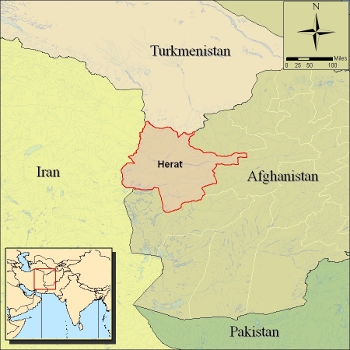
                      In 1999, the Taliban would trust Khairkhwa with another mission. He was installed as the governor of Afghanistan's westernmost province of Herat. Khairkhwa served in that capacity until the Taliban's fall in late 2001.
                      The US government alleges that during that time Khairkhwa became a major drug trafficker with ties to senior al Qaeda leaders, including Osama bin Laden. Khairkhwa reportedly built three walled compounds that he used to manage his opium trade. And he allegedly oversaw one of Osama bin Laden's training facilities in Herat as well. One US government memo notes that only Khairkhwa or bin Laden himself "could authorize entrance" to the facility, which was one of bin Laden's "most important bases" and "conducted terrorist training two times per week."
                      Khairkhwa denied that he was a drug dealer and that he had significant ties to senior al Qaeda leaders during his hearings at Gitmo. But it is clear that US intelligence officials did not believe Khairkhwa's denials. The allegations were repeatedly included in the memos prepared for Khairkhwa's case.
                      Khairkhwa assigned a Taliban liaison to Iran
                      Khairkhwa played another, more provocative role as well.
                      According to the US government's unclassified files, Khairkhwa was installed as the governor of Herat "to improve relations between Iran and the Taliban government."
                      By his own admission, Khairkhwa began meeting with the Iranians in early 2000. The US government's unclassified documents cite at least two instances when Khairkhwa took part in meetings between senior Taliban and Iranian officials: one on Jan. 7, 2000, and a second time in late 2001.
                      The government's Oct. 7, 2005, ARB summary of evidence memo for Khairkhwa (see here) includes this allegation:
                      "On 7 January 2000, the detainee and three other Taliban officials attended a meeting with Iranian and Hizbi Islami-Gulbuddin Hikmatyar faction officials. Present at the meeting were Afghan Hizbi Islami-Gulbuddin leader, Gulbuddin Hikmatyar and Ayman Al-Zawahiri [emphasis added]. Topics of discussion included United States intervention in the region, restoration of peace in Afghanistan and strengthening the Taliban's ties with [the] Iran[ian] government."
                      The government's second and more recent ARB summary of evidence memo (dated June 16, 2006) modified this allegation. US intelligence officials did not allege that Hekmatyar or Zawahiri personally attended the meeting. (See here.) Instead, the government's allegation reads:
                      "On 7 January 2000, the detainee and three other Taliban officials attended a meeting with Iranian and Hizbi Islami-Gulbuddin Hekmatyar faction officials [emphasis added]. Topics of discussion included United States intervention in the region, restoration of peace in Afghanistan, and strengthening the Taliban's nascent ties with Iran."
                      It is not clear why the US government removed the part about Gulbuddin Hekmatyar, a long-time ally of Osama bin Laden, and top al Qaeda terrorist Ayman al Zawahiri personally attending the meeting. At the time, Hekmatyar was sheltering in Iran under the care of the Revolutionary Guards Corps.
                      Regardless, the rest of the details about the meeting between the Taliban and the Iranians were substantively unchanged. And a memo prepared for Khairkhwa's third ARB hearing (see here) notes that Khairkhwa did meet with Ayman al Zawahiri to discuss US "intervention" in the region.
                      During his hearings at Gitmo, Khairkhwa did not deny that he attended the meeting with the Iranians in January of 2000. Khairkhwa also did not deny a second meeting with the Iranians in late 2001. The US government's Sept. 2, 2004, CSRT summary of evidence memo for Khairkhwa states (see here):
                      "Detainee was present at a clandestine meeting in October of 2001 between Taliban and Iranian officials in which Iran pledged to assist the Taliban in their war with the United States."
                      The government's unclassified summary of evidence memos for Khairkhwa's first and second ARB hearings (see here and here) allege that the meeting between the Taliban and the Iranians took place in November of 2001, not October.
                      "In November 2001, the detainee met with an Iranian diplomatic delegation. The Iranian Government was prepared to offer anti-aircraft weapons to the Taliban for use against the United States and Coalition Forces operating in Afghanistan."
                      In all likelihood, therefore, this post-September 11 meeting between the Taliban and Iranian officials took place in November, and the US government simply refined its allegation in the latter memos. Khairkhwa discussed this post-September 11 meeting with the Iranians during his CSRT hearing. Khairkhwa did not deny attending the meeting or that the Iranians "pledged to assist the Taliban in their war with the United States," but claimed that he had only set up security for the meeting and was not the only Taliban official present.
                      Khairkhwa explained:
                      "Yes, I participated in that meeting with the Iranians. There was a committee that came from Kandahar and I joined them and was just sitting there. They were conducting the meeting. My job was for the security of this committee. I was not the sole representative of this committee to talk with the Iranians. They were responsible; my job was to provide security and safety for the committee."
                      Later in his testimony, Khairkhwa made it clear that the Taliban sent a delegation from its central government to attend the meeting. Khairkhwa undoubtedly wanted to downplay his own role in the secret meetings.
                      "The meeting with the Iranians, it was designed and conducted by the committee that came from Kandahar, which was the central government at the time. I was just a security member," Khairkhwa said.
                      During his second round ARB hearing, Khairkhwa denied that the Iranians offered anti-aircraft weapons at the November 2001 meeting. He claimed that the Iranians made this offer only at the Jan. 7, 2000, meeting, which took place on Iranian soil. Khairkhwa also denied that any representatives of Hekmatyar's group attended.
                      "Yes. There was a meeting with the Taliban delegation on Iran's soil," Khairkhwa said. "There were no Gulbuddin representatives."
                      Khairkhwa told his Gitmo board that the Taliban had difficulty procuring arms because of international sanctions that had been levied against the regime. "The Iranians offered to buy weapons for us because we were on restriction and could not buy them," Khairkhwa explained. "That is the truth."
                      Khairkhwa also claimed that the arms deal was never consummated. However, history does not bear out Khairkhwa's denial.
                      In fact, multiple press outlets have reported that the Iranians have been supplying anti-aircraft missiles, mines, and other arms to the Taliban.
                      There is another important aspect to the meetings between the Iranians and the Taliban that Khairkhwa attended as well. A US government memo produced for Khairkhwa's third ARB hearing notes that in addition to anti-aircraft missiles, the Taliban and Iran negotiated "an open border to Iran for any Arab or Taliban to smuggle money or goods out of Afghanistan."
                      This, too, came to fruition. For example, Time Magazine reported in early 2002 that Taliban and al Qaeda terrorists slipped across the border into Iran in order to avoid American forces.
                      Khairkhwa's testimony and the US government's evidence against Khairkhwa confirm a central point in this Long War against terrorism. Even one-time enemies like the Taliban and Iran can conspire when it comes to countering their mutual enemy: America. And, somewhat surprisingly, they had begun to plan their countermeasures even before the September 11 attacks prompted America's response in the region. According to the US government's files, that planning may have even involved senior terrorists, including al Qaeda's second in command, Ayman al Zawahiri.

                      Comment


                      • #12
                        Iran’s hosting of Taliban reflects desire for greater role

                        http://www.washingtonpost.com/world/...O7K_story.html

                        By Ernesto Londoño,

                        KABUL — Iran quietly hosted a delegation of Taliban members in Tehran this month in a powerful and unusual signal of its ambition to shape the trajectory of the Afghanistan conflict as U.S. troops begin to withdraw.
                        Iranian officials had apparently hoped to facilitate a meeting between the delegation and Burhanuddin Rabbani, a former Afghan president and leader of the country’s reconciliation efforts, who was attending the same conference in Tehran, his associates said. Although that did not happen, the presence of the Taliban members suggests Iran has cultivated deeper ties with the insurgent group than was previously known and is stepping up efforts to influence its eastern neighbor as the U.S. role recedes.
                        The relationship between Iran and the Taliban’s central leadership has long been deeply fraught; when the Taliban was running Afghanistan in the 1990s, the two countries came to the brink of war.
                        U.S. officials have for years accused Iran of fueling the Afghanistan war by providing training and sophisticated weapons to its favored insurgent commanders, although they have described Tehran’s role as minimal compared with other regional players. There have been few signs of senior-level contact between the Taliban and Iran.
                        Hosting Taliban members at the Tehran conference might have been an attempt by Iran to mend ties as it becomes clear that the group will be a major power broker in Afghanistan after the United States withdraws its last combat troops as scheduled in 2014, analysts said. U.S. officials have launched their own initiatives to talk to the Taliban, to little avail.
                        “Iran considers itself a regional player with a legitimate stake in Afghanistan, and it doesn’t want to see progress that runs contrary to its political interests,” said Michael Semple, who has decades of experience in Afghanistan as a diplomat and a scholar. “If the price of Iran having a role in the next step is dealing with the Taliban, then they are prepared to do it.”
                        Reports of the Tehran meeting came as U.S. efforts to promote a dialogue between Afghanistan and its eastern neighbor, Pakistan, appeared to falter Thursday. The Afghan government canceled a meeting with its Pakistani counterpart that was scheduled for next week, part of a U.S.-promoted effort begun early this year to assuage long-standing distrust between the two countries, U.S. officials said.
                        The Obama administration has asked Pakistan to assist the reconciliation process by eliminating Taliban havens in its territory and pressing the insurgents toward negotiations. But recent high-profile attacks in Afghanistan by the Pakistan-based Haqqani group — for which the United States has publicly held Pakistan at least indirectly responsible — have stirred Afghan antagonism. U.S. officials confirmed the cancellation, first reported by the Wall Street Journal, but said they anticipated that the break in dialogue would be only temporary.
                        An unusual opening
                        The Islamic Awakening conference in Tehran was organized by Iran’s supreme leader, Ayatollah Ali Khamenei, who has the final say in the nation’s policies. The conference, held in mid-September, drew more than 700 scholars and Islamist political figures from around the world.
                        The Afghan government was represented by Rabbani, who a year ago was tasked with leading Afghanistan’s High Peace Council. Days after attending the conference, Rabbani was slain by a man posing as a Taliban negotiator. The two events do not appear to have been linked.
                        Council members say they have made virtually no headway in starting peace talks because the Taliban has shown little interest in a negotiated settlement to end the war. But the Tehran conference marked an unusual opening. Arsala Rahmani, a member of the council who traveled to Tehran with Rabbani, said he was startled when he saw Nik Mohammad, a former colleague from their years together as Taliban government officials.
                        “They seldom come to public events, and when they do, they use aliases,” said Rahmani, who served as deputy education minister when the Taliban controlled Kabul in the late 1990s.
                        Rahmani said he and Mohammad shook hands but exchanged nothing beyond pleasantries.
                        “It was not in the typical way Afghans use to greet each other,” he said. “It was done in a very cool manner.”
                        Rahmani said Mohammad, who was heading the small Taliban delegation, is an influential insurgent leader who is in contact with the top members of the group’s ruling Quetta Shura.
                        Semple said that although Mohammad is on a U.N. terrorist sanctions list, there has been little public evidence suggesting he is actively involved in running the Afghan insurgency. Mohammad served as deputy commerce minister during the Taliban regime.
                        Waheed Mozhdah, a political analyst who was with Rabbani’s delegation, said he first learned about the Taliban representatives as he leafed through the conference program and found two names he recognized. The men were listed as representing what was described as the American Opposition Front in Afghanistan: Nik Mohammad and Tayeb Agha.
                        The latter is an aide to Taliban leader Mohammad Omar and reportedly held talks with U.S. officials this year in Qatar and Germany. Agha apparently stopped talking to Western officials after his role in the talks was disclosed. None of the members of Rabbani’s delegation said they saw Agha, but two noted that some members of the Taliban contingent hid their faces with scarves.
                        At one point, Mozhdah said, the Iranian hosts asked Rabbani’s team whether it would object to giving the Taliban representatives an opportunity to make public remarks.
                        “There were various opinions,” said Mozhdah, who worked in the Afghan Foreign Ministry during the Taliban’s reign. “One side said, ‘Let them come and express what they have to say.’ ”
                        Mozhdah said he objected, arguing to Rabbani that such a move would “damage the relation between Kabul and Tehran.”
                        The Iranian hosts suggested instead that Rabbani make time to speak privately to the Taliban representatives on the sidelines of the conference, Mozhdah said. In the end, no such discussions took place, said members of Rabbani’s team.
                        “We feared that if we were to do so, it would show our weakness,” said peace council member Qazi Amin Weqad, who also attended. “We were also scared of getting a negative response, such as, ‘You need to talk to the Quetta Shura.’ ”
                        A State Department spokesman declined to comment on the Tehran conference. Administration officials have said that Iran has a legitimate interest in Afghanistan and a role to play in promoting regional stability. As part of its own efforts to promote Taliban reconciliation, the Obama administration has sent senior emissaries to all of the countries bordering Afghanistan, except Iran.
                        Strategic mediation
                        Iran, a predominantly Shiite nation, supported the Northern Alliance as it fought the Taliban during the 1990s. The Taliban, a hard-line Sunni organization that was in power between 1996 and 2001, came close to war with Iran in 1998 when a number of Iranian diplomats were killed in Afghanistan.
                        When U.S.-backed Northern Alliance forces toppled the Taliban in late 2001, Iran began to broaden commercial and diplomatic ties with Afghanistan. Iranian leaders have become concerned in recent years that Afghanistan’s insurgency and illicit drugs could spread beyond its western border into Iran.
                        The presence of Taliban members at the public conference in Tehran appears to have received little notice in Iran, or beyond. But even the limited coverage it got in Iran provides insight into why Iranian leaders decided to invite a Taliban delegation.
                        An article that appeared Saturday on the influential Iranian news Web site Khabar, which is supportive of the supreme leader, described the presence of Taliban and Afghan government representatives at the conference as a watershed moment.
                        “Officials who had never gathered in one place were now discussing current issues of the area together,” the article said.
                        Referring to the U.S. talks with Taliban representatives this year, the piece said: “It should be noted that the radical forces in Afghanistan have not accepted mediations from [the] West.”

                        Correspondent Thomas Erdbrink in Tehran, staff writer Karen DeYoung in Washington and special correspondent Sayed Salahuddin in Kabul contributed to this report.

                        Comment


                        • #13
                          Originally posted by khushal View Post
                          Iran thought that their influence in the government could derail the afghans from signing the strategic pact. They forget that only the US can protect the government from its people. Iran can not.


                          "Iran is willing to put aside ideology and put aside deeply held religious values...for their ultimate goal: accelerating the departure of US forces from Afghanistan," the official said, referring to the fact that Iran has permitted an official Taliban presence in the country as both sides "see America as the bigger enemy". According to senior officials, the office set up in the eastern Iranian city of Zahedan in late May, is intended to allow Iran to coordinate with the Taliban against the US.
                          Last edited by Shah-i-Kot; 08-02-2012, 09:04 PM.

                          Comment


                          • #14
                            One has to sift through all the disinformation and twists to suit
                            the usual suspects to get finally to one
                            piece of helpful information:

                            Opened office of Taliban in Zahedan.

                            Though not explained, this is of course the capital of Iranian
                            Baluchistan, and a colorful area.

                            Perhaps Zahedan was chosen because it's so remote and
                            a little wild, so there will be less monitoring by all the foreign countries.

                            Hopefully the contacts can be conducted in a peaceful atmosphere
                            away from nosy eyes.

                            After all, this forms the beginning of formal cooperation which would
                            last for quite some time to come.

                            As far as the Guatanamo witness, those testimonies were so skewed
                            and so unfairly extracted, that almost no value can be placed on what
                            these prisoners were SAID to have SAID>

                            There is that book and interview on Press Tv of the man who
                            interrogated a guy named Pacha Wazir [as I recall] who turned
                            to be no one at all of any interest to anyone. But this man was
                            subjected to awful things, only to be released finally, with no apology
                            from the U.S. for the years of brutal treatment he had endured

                            For NO reason.

                            So when reading about any of these detainees, and looking at the source,
                            the LongWar Journal, a typcial neo con outfit, with everything twisted in
                            favor of the war, then we as readers can't take their material seriously.

                            Still, it's good that progress is being made which will benefit
                            all sides.

                            Comment


                            • #15
                              Probably Taliban forgot Iranian support for USA ,and also Talab jee so conveniently forgot Iranian Mullah's hand in massacring of 1000 of 1000 Taliban foot soldiers in north by Uzbek Dostom ( now enjoying Turksh government unconditional protection ).
                              ~~~~~~~~~~~~~~~~~~~~~~~~~~~~~~~~~~~

                              Comment

                              Working...
                              X