Announcement

Collapse
No announcement yet.

Karzai dimisses his interior minister and director of intelligence

Collapse
X
 
  • Filter
  • Time
  • Show
Clear All
new posts

  • Karzai dimisses his interior minister and director of intelligence


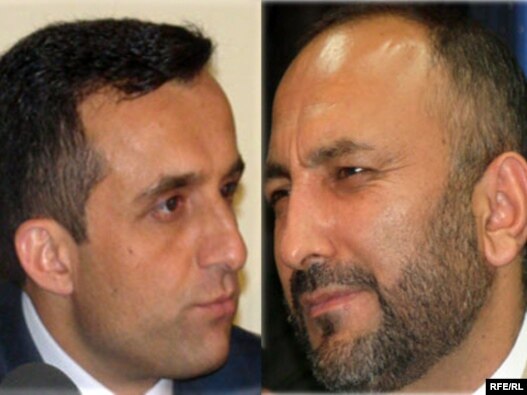
    KABUL -- Afghanistan's interior minister and national security chief have resigned, reportedly over last week's rocket attacks on a high-level peace conference in the capital, RFE/RL's Radio Free Afghanistan reports.

    Amrullah Salih, the general director of the National Security Directorate of Afghanistan, explained to reporters today in Kabul why he and Interior Minister Mohammad Hanif Atmar had submitted their resignations.

    "[The] president of Afghanistan has lost trust in our capability to protect national events," Salih said. "Our briefing and explanation in regards to the preparations that we have done for the peace jirga, and our later success in killing the two terrorists and capturing the facilitators who brought those two suicide bombers to Afghanistan, were not convincing to him.

    "Therefore, morally, that does not leave any space for me to continue as the national director of the National Directorate of Security."

    President Hamid Karzai's office said the explanation given by the two officials for the June 2 attacks in Kabul was "not satisfactory."

    No delegates to the jirga were injured in the attack.

  • #2
    Afghan interior, intel chiefs replaced over attack
    By MATTHEW PENNINGTON (AP) – 20 minutes ago

    KABUL, Afghanistan — Afghan President Hamid Karzai removed two of the country's top security officials — each with longtime ties to American forces — over an attack on a national conference exploring peace with the Taliban.

    The removals Sunday of the interior minister and intelligence chief surprised U.S. officials and may cause major disruption within Afghanistan's intelligence and security establishment at a critical juncture — as the U.S. and NATO escalate the war and the Afghan government commits to offering peace to the insurgents.

    The move is likely to fuel speculation over differences within the Karzai administration over its efforts to reconcile with the Taliban — including the possible release of hundreds of detained militant suspects.

    The head of the National Directorate of Security, Amrullah Saleh, was a senior figure in the Northern Alliance that helped the U.S. oust the Taliban regime in 2001. As a young man, Interior Minister Hanif Atmar served in Afghanistan's Communist-era intelligence agency and fought mujahedeen opposed to the Soviet occupation.

    "It's a very significant event. There will be a massive fallout from these resignations both in the Interior Ministry and the NDS as alliances are shuffled," said Candace Rondeaux, senior analyst on Afghanistan for the International Crisis Group think tank.

    "They appear to be forced resignations, and reflect significant worries of Karzai's administration over the loyalty of those leading key security agencies in the country," she said.

    Sunday's resignations were a surprise — not least as the attack on the jirga last week was thwarted. Security officials have rarely faced punishment or resigned over previous major attacks in the capital.
    Replacing the security chiefs comes after Karzai's May visit to Washington that eased strains in the bilateral relationship.

    "Both the ministers of interior and intelligence are people we admire and whose service we appreciate," Pentagon press secretary Geoff Morrell said. He also noted the U.S. had favored Atmar for the interior ministry job.

    But Gen. Stanley McChrystal, commander of U.S. and NATO forces in Afghanistan, said in a statement he respected the Afghan president's authority to make this "difficult decision."

    He said he remained confident in Karzai's "ability to appoint credible replacements to lead these critical organizations."

    Saleh, an ethnic Tajik, had served as intelligence chief since 2004 and had a long-standing relationship with the CIA in the fight against the Taliban and al-Qaida.

    British-educated Atmar, a former education minister, was first appointed interior minister in a 2008 Cabinet reshuffle aimed at rooting out high-level corruption in Karzai's government. He was reappointed after Karzai's re-election.

    Two Taliban militants fired rockets where some 1,500 delegates — including lawmakers, tribal and religious chiefs — had gathered in a grand tent. One of the missiles landed about 200 yards (meters) away, but no delegates were hurt. The militants were later killed in a gunbattle with security forces in a house about a mile (1.5 kilometers) away.

    Saleh said evidence showed the Haqqani network, a Pakistan-based Afghan Taliban faction with close ties to al-Qaida, was behind the attack.
    Interior Ministry spokesman Zemeri Bashary said the two attackers were able to breach security by dressing as a couple — one in a man's street clothes and the other in a woman's burqa, and clutching a Kalashnikov rifle and a grenade launcher wrapped up in cloth like a swaddled baby.

    Karzai's office said in a statement he accepted the resignations because Atmar and Saleh had given unsatisfactory explanations. He appointed their deputies Munir Mangal at the interior ministry and Ibrahim Spinzada at intelligence as acting chiefs.

    U.S. officials contend the Taliban leadership — which is demanding the complete withdrawal of foreign troops from Afghanistan — feels little reason to negotiate because it believes it is winning the war, which is only growing ever more bloody nearly nine years after it began.

    On Sunday, five NATO troops — including four Americans — were killed in three separate incidents, the coalition said.

    Associated Press writers Rahim Faiez, Heidi Vogt, Rohan Sullivan and Amir Shah in Kabul, Anne Gearan traveling with Defense Secretary Robert Gates and Mirwais Khan in Kandahar contributed to this report.

    Comment


    • #3
      KABUL, Afghanistan — President Hamid Karzai forced two of his top three security officials to resign Sunday over their failure to prevent attacks on last week’s peace council in the capital, Afghan and American officials said, creating shock and concern among Western officials about such serious changes in crucial ministries even as the American war effort here reaches a critical phase.

      After a two-and-a-half-hour conversation with Mr. Karzai on Sunday afternoon, Amrullah Saleh, the head of Afghanistan’s intelligence agency, known as the National Directorate of Security, and Hanif Atmar, the interior minister, submitted their resignations.

      The announcement took the NATO leadership and diplomats by surprise. “We had a very good working relationship with both, a relationship developed over a long time,” said a NATO official close to Gen. Stanley A. McChrystal, the senior military commander in Afghanistan.
      “It’s really not helpful to what we’re trying to do right now,” added the official, who spoke on the condition of anonymity.

      In a statement, General McChrystal emphasized that Mr. Karzai had his full backing. “This is clearly a matter between President Karzai and his leadership,” he said in a statement. “I respect the president’s authority to make this difficult political decision.”

      Both men had served Mr. Karzai since he became president in 2002. Mr. Atmar has held three cabinet posts, and Mr. Saleh has been intelligence chief since 2004. Both were trusted by senior NATO officials; the United States ambassador, Karl W. Eikenberry, included Mr. Atmar on a list of Afghan cabinet members he described as “world class” in Congressional hearings.

      Mr. Karzai’s office announced the resignations in a brief statement that listed the security lapses at the peace council, known as a jirga, as the cause.

      But even in the months before the peace jirga, Mr. Karzai had been wrangling with both men, according to several people close to Mr. Karzai. Mr. Atmar and Mr. Karzai had argued about the appointment of police chiefs as well as other positions, according to security officials close to Mr. Karzai.

      The officials also said that Mr. Saleh was uncomfortable with Mr. Karzai’s insistence that some Taliban members should be released from detention as a signal of the government’s intent to negotiate and reach out to the insurgents. Mr. Karzai issued a decree to release those for whom there was not enough evidence for trials, as one of the first steps toward carrying out the agreements reached at the peace jirga.

      “I’m sure the disagreement between the two men and the president have been going on for awhile,” said Daoud Sultanzoi, a member of Parliament from Ghazni who is a businessman and is viewed as independent. “The president issued a decree to start looking at the release of some Taliban, and I’m sure Amrullah Saleh would not see eye to eye on this and he indicated that it would not be good for security.”

      Mr. Saleh is also an outspoken critic of Pakistan and has publicly blamed the government for its support of the Taliban and other extremists. As Mr. Karzai positions himself to reach out to the Taliban, he is likely to have to turn to Pakistan for help, and that could have been more difficult if Mr. Saleh remained in a central role.

      The president’s spokesman, Waheed Omar, insisted that disagreements over policy were not a factor. “The resignation is only due to the failure to prevent the attack; nothing of the past was in consideration,” he said, referring to the rocket and mortar attack on the first day of the peace jirga in Kabul, when about 1,600 people were in attendance.

      “We have to consider how major the event in question was. In the tent, all prominent leaders from around the country, members of the Parliament, the entire cabinet, as well as international diplomats were present,” Mr. Omar said. “But despite the repeated assurance that our security officials had provided the president, such an attack still took place.”
      One of the president’s bodyguards was seriously wounded when a rocket exploded near the tent, Mr. Omar said.

      Caretakers were appointed to lead the Interior Ministry and the intelligence service. Although described as interim choices, they are likely to remain at the head of both agencies for some months since Mr. Karzai is unlikely to be able to persuade the cabinet to approve nominees for two such important positions in the three months remaining before parliamentary elections.

      The Interior Ministry will be led by the deputy minister, Gen. Munir Mangal, who is viewed by Westerners as steady, but unlikely to be as innovative as Mr. Atmar. The powerful intelligence job will be filled by Ibrahim Speenzada, a confidant of Mr. Karzai, who has been serving as a first deputy in the intelligence agency.

      In a news conference earlier in the day, the Interior Ministry’s spokesman, Zemary Bashary, acknowledged that the police and intelligence operatives had made mistakes. But NATO officials have repeatedly said that they felt both services had performed well in a difficult situation. They said that in a city of several million people and in a country rife with insurgents it was hard to stop every attack.

      “There were two mistakes by security forces,” Mr. Bashary said. He said that intelligence operatives had not detected the group that took up residence in a safe house near the jirga tent and launched rockets at it, and that the police had not searched one of the attackers wearing a burqa.

      “First, there was no information, no intelligence about this group,” he said. “And secondly, when the two terrorists walked almost one kilometer to reach the area close to the jirga, our police did not search women.”
      In a hastily called news conference, Mr. Saleh, who speaks fluent English, read his resignation letter in an even and resolved tone and answered questions without criticizing the president.

      “The president of Afghanistan has lost trust in our ability to protect national events,” he said. “Our briefing and explanation in regards to the preparation that we have done for the peace jirga and later success in killing the two terrorists and capturing the facilitators were not convincing to him. Therefore, morally, that does not leave any space for me to continue as the director general of the National Directorate of Security.”

      Reporting was contributed by Carlotta Gall, Sangar Rahimi, Mujib Mashal and Abdul Waheed Wafa.


      Comment


      • #4
        Will Karzai's Afghan Cabinet Shakeup Make Taliban Reintegration Easier?

        Karzai Replaces Two Top Security Officials Unpopular with the Taliban

        By ALEEM AGHA, NICK SCHIFRIN and MIKE GUDGELL

        KABUL , Afghanistan, June 6, 2010


        Afghan President Hamid Karzai fired two senior members of his government today, replacing officials particularly unpopular with the Taliban less than a week after insurgents launched a failed attack against a national peace assembly.

        Interior Minister Hanif Atmar and Afghanistan's chief spy, Amrullah Saleh, both lost Karzai's confidence after those attacks, according to Karzai's spokesman, Waheed Omer.
        "The president asked for an explanation about the attacks," Omer told ABC News. "Explanations were given and the president did not find the explanations satisfactory. He decided they had not done enough."

        Insurgents attacked the assembly, or jirga, with three suicide bombers and rockets, one of which landed within 200 feet of the jirga tent as Karzai spoke. Atmar's spokesman said today an additional 15 insurgents had been arrested and 700 rockets confiscated, preventing even larger attacks.


        But Saleh and Atmar, who were popular among American officials, were not necessarily on the same page as Karzai when it came to reintegrating Taliban into Afghan society, analysts pointed out.

        Today, Karzai began to enact plans endorsed by the assembly's 1,600 delegates on measures designed to earn the Taliban's trust and, therefore, reconcile with insurgents. Both of their replacements, named today as caretaker leaders, will likely be more palatable to the Taliban, who call Karzai untrustworthy and weak.

        Saleh, who was from the only province the Taliban never conquered, will be replaced by longtime Karzai aide Engineer Ibrahim Speenzada, whose ethnicity is the same as the vast majority of the Taliban. Speenzada is Karzai's brother-in-law and has been close to the Taliban leadership in the past, meeting with them in Kandahar, their spiritual home, where he once lived. Speenzada was trusted enough by senior leaders to meet with one of them in Guantanamo Bay, hand-delivering a letter from Mullah Mohammad Fazel back to his family in Afghanistan, according to former commanders.

        Atmar's replacement is his deputy, Gen. Muneer Mangal. In the 1980s, both Atmar and Mangal fought against mujahedeen fighters, many of whom would later become Taliban leaders. But after the mujahedeen took control of Kandahar, Mangal handed over government weapons to their commander, earning at least a small level of trust with future Taliban leaders, according to former senior officials in Kandahar.

        Karzai officials declined to comment on whether Saleh and Atmar were replaced in order to better appeal to the insurgency or because their feelings about reintegration diverged from the president's. Publicly, they insist that the rocket and suicide attacks on the jirga -- even though they killed nobody but the attackers -- embarrassed the president and caused him to doubt their ability to do their jobs.

        Saleh and Atmar have been widely trusted by the international community. American officials have described them as key figures in the attempt to raise the efficiency of the Karzai government and reduce corruption. It's unclear whether American officials believed that their removal would help facilitate reintegration.

        Karzai, clearly mindful of the reaction among the international community, called an emergency meeting with Western ambassadors and military leaders, including Gen. Stanley McChrystal, the head of coalition forces in Afghanistan.

        "I remain confident in President Karzai's leadership and his ability to appoint credible replacements to lead these critical organizations charged with protecting the Afghan people and ensuring their sovereignty," McChrystal said in a press release after the meeting.

        Earlier in the day, in a hastily arranged news conference, Saleh said there were "tens" of reasons why he was leaving his position, but would only admit that he had failed the president during the jirga.

        "I want to thank colleagues who, for the last six-and-a-half years, always made sure the three color flag of Afghanistan flew high, safe from the threats of its enemies: al Qaeda and Pakistan," Saleh told journalists.

        Pakistan, where many senior Taliban officials live, has long mistrusted Saleh. Senior Pakistani military officials have complained to ABC News about the Afghan FBI, known as the National Directorate of Security, or NDS, saying senior officials were giving Pakistan a bad name.

        Just two weeks ago, Saleh accused Pakistan's premiere spy agency, the Inter-Services Directorate, or ISI, of training a suicide bomber who killed four Western colonels in Kabul in May.

        Comment


        • #5
          Originally posted by hindupashtun
          Glad to hear that. Now lets see if we have 2 good Pashtun candidates to take their spots.
          The interim/caretaker acting as the minister of interior is Muneer Mangal who has been serving the ministry for almost 2-3 decades and is extremely capable individual.

          No had heard of this Irbahim Speenzada, allegedly Karzai's brother in-law, aprently he has webs of intel and connections that goes right in to the Taliban leadership.
          Last edited by Guest; 06-06-2010, 10:47 PM.

          Comment


          • #6
            Originally posted by Afghan_Soldier View Post
            The interim/caretaker who are acting as the minister of interior is Muneer Mangal who has been serving the ministry for almost 2-3 decades and is extremely capable individual.

            No had heard of this Irbahim Speenzada, allegedly Karzai's brother in-law, aprently he has webs of intel and connections that goes right in to the Taliban leadership.
            Munir Mangal is a former Khalqi. He use to call my dad and beg him to send him money because he was very poor living somwhere in Quetta.

            And now he is filhty rich working for the Americans.
            [SIZE="4"][B][CENTER][URL="www.quranawsunnat.com"]www.quranawsunnat.com
            [/URL]
            [URL="www.youtube.com/Sangartube"]www.youtube.com/Sangartube
            [/URL][/SIZE]
            Mullah 4 Life! [/CENTER][/B]

            Comment


            • #7
              What ever Sangara. Enjoy your life in the red-light district in Holland and be part of that society, Mullah Sahib the epitome of greatness. He is a Khalqi and what ever he is - is serving his country and is there while you are where you are. Stop making allegations without any evidence.

              Comment


              • #8
                Sangara, you remind me of this funny liar Mullah my dad used to tell us about when we were young and used to beg him to tell us stories of his young days and how they lived. Da darwaghoo gooday ye, Sangara.. hahaha

                Comment

                Working...
                X