
 Tweet
this is a chapter from an interesting book called "fault lines in the afghan jihad"
an interesting read.
The Radicals
Following the failure of the Faizani coup d’état and the subsequent arrests of numerous Muslim militants, leaders of the Muslim Youth Organization and other well-known Muslim figures fled to Peshawar. Among the refugees were Qazi Amin’s old friend and mentor Maulavi Habib-ur Rahman, Hekmatyar (Fig. 13), and one of their former professors at Kabul University, Ustad Burhanuddin Rabbani (Fig. 14). A Persian-speaking Tajik from northern Badakhshan Province, Rabbani had studied at madrasas in Afghanistan, graduated from the Faculty of Islamic Law in 1963, and then was employed to teach at the university. In 1966, he traveled to Egypt to study at al-Azhar, from which he received a master’s degree in Islamic philosophy. While in Cairo, he became familiar with the activities of the Muslim Brotherhood and, on his return to Kabul, devoted himself to translating into Persian various works by Sayyid Qutb, the chief theoretician of that organization. He also resumed his position at the university and became closely associated with his fellow professor, Ghulam Muhammad Niazi, whom he served as secretary in 1969 and 1970. After Professor Niazi’s imprisonment in 1974, the government reportedly sent police to arrest Rabbani at his campus office, but he was warned ahead of time and managed to flee to Peshawar, arriving there a few months after Hekmatyar, Maulavi Habib-ur Rahman, and other Muslim Youth leaders.
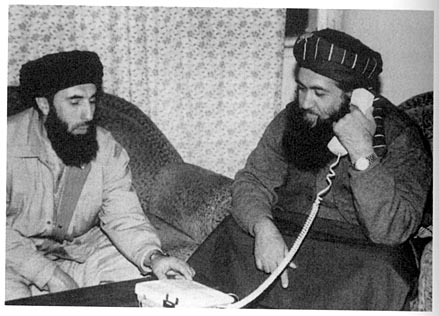
13. Qazi Amin (right) with engineer Gulbuddin Hekmatyar, Charasiab, post-1989 (courtesy of Qazi Amin).
[Full Size]
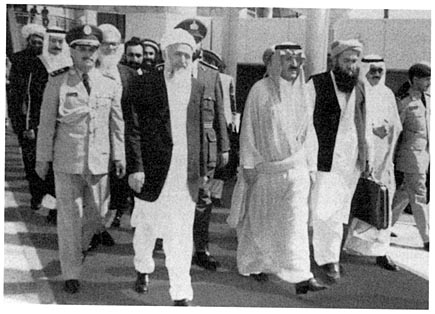
14. Qazi Amin (with briefcase) with Professor Burhanuddin Rabbani (in dark suit coat), Saudi Arabia, n.d. (courtesy of Qazi Amin).
[Full Size]
The most pressing issue for the refugees was deciding how to press their political agenda, and a split immediately developed between the younger group, which wanted to commence armed operations against the government, and Rabbani, who was more cautious in his approach and did not think the refugees were ready to begin an armed struggle. The dispute continued for some time, but while Rabbani was away in Saudi Arabia in the summer of 1975, the student group went ahead and initiated the abortive attacks that led to the arrest of many of the top student leaders. The failure of this plot decimated the Muslim Youth, as a number of the chief figures in the movement were arrested and later executed by the government. [14] Of equal importance, the uprisings cemented a lasting rupture between what was to become the Tajik-dominated wing of the party (which became known as Jamiat-i Islami Afghanistan) and the Pakhtun-majority wing (which was to become Hizb-i Islami Afghanistan). At the center of this dispute were Hekmatyar, who had been a strong advocate of the attacks, and Rabbani.
A Kharoti Pakhtun from northern Kunduz Province, Hekmatyar was a student in the School of Engineering at Kabul University when he became one of the founding members of the Muslim Youth Organization. [15] Considered one of the most militant of all the Muslim activists, Hekmatyar was actively involved in many of the violent demonstrations that flared up on the campus of Kabul University in the early 1970s, including one in the spring of 1972 in which a member of the Maoist Eternal Flame party (Shula-yi Jawed) was killed. Whether he was responsible for this killing has been disputed, but there is little doubt as to his advocacy of violence in pursuit of political objectives. In the case of the uprisings carried out in 1975, criticism of Hekmatyar centers on the naiveté of the plan, its devastating impact on the party’s leadership, and the fact that, while strongly supporting the attacks, Hekmatyar—almost alone among the party’s student leaders—stayed in Peshawar rather than participate. Enemies of Hekmatyar have seen his noninvolvement as evidence that he wanted the uprisings to fail and its leaders to be captured so that he could consolidate his own power.
Another source of controversy and criticism of Hekmatyar concerns the purported existence of a military coup d’état that was supposed to happen concurrently with the attacks on rural government offices. According to one informant in Rabbani’s party, those who were involved in the provincial attacks were told that once they had succeeded in securing their objectives, they were to listen on the radio for word of the progress of the Kabul coup attempt. If the coup succeeded, they were to stay in place. If it failed, they were to leave their positions and make their way back to Pakistan. Those who participated in the uprisings were assured that as soon as the troops in Kabul heard that the provincial operations had begun, they would immediately mobilize their own assaults. But in fact there is little evidence that a military coup d’état was under consideration or even conceivable following the arrest of Faizani’s group. Engineer Habib-ur Rahman had been the Muslim Youth’s chief contact with the military, along with Hekmatyar himself, and since Rahman’s execution and Hekmatyar’s flight to Pakistan, it appears that military recruitment and mobilization had effectively ceased. In the view of many of Hekmatyar’s critics, the assumption that Muslim officers would mount an attack against the government when they heard word of the rural insurrections was no more than a wish, and on this feeble premise idealistic Muslim militants were sent off on their mission.
In their criticism of Rabbani, Hekmatyar loyalists contend that he was all along a moderate who had never had a significant role in the Islamic movement prior to his flight and therefore had no right to a leadership role in Peshawar. Rabbani, it was charged, was an apologist for the government who supplied articles to government journals and associated with government officials. Some have even declared, without apparent evidence, that Rabbani informed friends in the government ahead of time of the planned uprisings and thereby contributed to their failure. Rabbani’s involvement in the Islamic movement in Afghanistan prior to 1975 was a controversial issue, for precedence in the movement was one of the principal bases on which authority was premised. Hekmatyar’s assertion of preeminence in the jihad was grounded in the early militancy of the Muslim Youth, originally against Zahir Shah and then against President Daud. Muslim Youth activists were the first to recognize the threat of Soviet communism in Afghanistan, and they had called for a jihad against the government before anyone else. On this basis and despite their youth and lack of Islamic credentials, they claimed the right to lead the resistance.
For Rabbani, what counted more than anything else was his close relationship with Professor Niazi, as well as his own early involvement in the Islamic movement inside Afghanistan. Because of Niazi’s generally accepted status as the first Afghan to import the ideas of the Muslim Brotherhood in Egypt into Afghanistan, the question of who worked most closely with him prior to his arrest was a matter of great importance within the ranks of the Afghan Islamic leadership in Peshawar. [16] Members of Rabbani’s Jamiat party claimed that Rabbani was Niazi’s chief assistant, and while acknowledging that Rabbani’s activities were necessarily carried out discreetly because of his position as a government employee, they asserted that he was actively involved with Niazi long before the founding of the Muslim Youth Organization. Further, they noted that Rabbani’s role in translating works of Sayyid Qutb proved both his knowledge of and his commitment to Islamic reform, and they contended that he was selected as the leader of the original Jamiat-i Islami party in 1972 by a fifteen-member council that comprised “all active youths with leading members of Jamiat including Ghulam M. Niazi.” [17] Hekmatyar and other members of the Muslim Youth discount this history, maintaining that the Jamiat party was founded in Peshawar only after the split between Hekmatyar and Rabbani and that the person closest to Professor Niazi was his student Abdur Rahim Niazi. The elder Niazi, they argued, was an enlightened man, but because of his position he would not take an active role in political activities. This role was assigned to the younger Niazi, through whose leadership the Muslim Youth Organization was founded and the Islamic movement was begun in Afghanistan. Rabbani, in this accounting, was a minor figure, a colleague of Professor Niazi’s in the Faculty of Islamic Law, but not himself a significant actor in the drama then beginning to unfold.
These claims and counterclaims will never be resolved conclusively since most of the principals are dead and those still alive are entangled in political arrangements that compromise their neutrality. However, the relative merits of the different positions aside, the dispute demonstrates the importance given to history and lineal succession as different parties jockeyed for position in Peshawar. In a politically turbulent and uncertain environment, Hekmatyar and Rabbani each made claims of precedence, rooting these assertions in their connection to venerated ancestors who were dead and could not contest claims made in their names. For Hekmatyar in particular, the issue of precedence was vitally important because he had little else to offer by way of justification for his leading the jihad. Still in his twenties, from an insignificant family and tribe, and without any substantial religious education or even a college degree, the only basis he could offer for leadership in the jihad was his connection to an obscure student group, most of whose members were now dead. Rabbani had better credentials. He was older, a respected scholar familiar with both the traditional madrasa and the university, a man of experience who had studied abroad and spoke numerous foreign languages.
The fact that Rabbani’s partisans were forced to assert their leader’s historical link to Niazi can be seen, at least in part, as an indication of Hekmatyar’s success in dictating the terms of the debate over the right to leadership. It is also, however, a demonstration of the importance that lineality plays in Afghan culture. Lineality is the primary basis of tribal relations, just as it is in Sufi orders and madrasas, where claims to rights and privileges are premised on connections to respected mentors. In this light, the fact that both Hekmatyar and Rabbani wanted to prove their relationship not to a Sufi saint or a traditional religious scholar but to a little-known university professor speaks to the marginalization of the clerical establishment and the decline of the great saintly families. Regardless, this was one of the principal grounds on which Hekmatyar and Rabbani contested their claims to authority, and their inability to resolve their differences led to the first major rupture in the Peshawar-based community of Muslim refugees, as Hekmatyar and Rabbani became the heads of separate parties. [18]
This split occurred in the winter of 1976, at a time when Peshawar was beginning to fill up with Afghan religious leaders, among them Maulavi Jalaluddin Haqqani from Paktia, Maulavi Hussain from Pech, and Qazi Amin. The Afghan ulama in Peshawar were upset over the Hekmatyar-Rabbani rupture and as Qazi Amin indicates, joined together to try to heal this rift in their ranks:
Qazi Amin’s role as amir of the party is of particular interest here. Clearly a compromise candidate, Qazi Amin was not exclusively associated with any one group, and his lack of ties was his greatest advantage. In Kabul, he had been an important, but second-tier member of the Muslim Youth, more closely aligned with Maulavi Habib-ur Rahman than with Hekmatyar. Even though he was associated with the student wing of the movement, he was madrasa-educated and a graduate of the Faculty of Islamic Law, which undoubtedly made him more acceptable to Rabbani as well as to the clerics on the council. Finally, the fact that he was still living in Afghanistan during the uprisings of 1975 meant that he was not directly implicated in the still-bitter dispute over who was responsible for that disaster. What Qazi Amin was not, however, was a strong leader who brought strategic assets of his own to the party. Qazi Amin’s role in the coalition was a traditional one for a cleric—that of the stana, or holy man, whose principal function was to mollify and mediate between the heavyweight factional leaders who otherwise would be at each other’s throats. Qazi Amin was a fundamentally decent person who was not likely to play any tricks or push his own agenda on the council. Throughout the years of jihad, when treachery became standard operating procedure for many leaders, Qazi Amin maintained a reputation for trustworthiness, and this quality more than any other apparently gained for him the honor of being the first amir of Hizb-i Islami Afghanistan and the leader who issued the first formal declaration (fitwa) of jihad against the Afghan government. This declaration was distributed widely within Afghanistan in the last year of Daud’s regime and spread the name of Hizb-i Islami throughout the country, so that when the Marxists succeeded in taking power in 1978, many ulama looked to this party and to Qazi Amin for leadership after they had fled to Pakistan.
During the time the party was united under Qazi Amin, the primary concerns were solidifying its organizational structure (a shura was established, articles of association and a manifesto were drafted, a party emblem was designed, and a newspaper was published), expanding its activities inside Afghanistan in order to establish more and more cells and branches, and attempting to generate financial support in the Arab Middle East—an activity in which Rabbani, with his command of Arabic, took the lead. The party also reportedly continued to pursue its political objective of overthrowing the government. The avenue of the military coup d’état was assayed unsuccessfully, but according to both Qazi Amin and Hekmatyar, the party did manage to dispatch hit squads to assassinate Afghan communist leaders. [21]Although most of the major leftist leaders were targeted, the only attack that ultimately proved successful was against the Parchami ideologue Mir Akbar Khyber. Ironically, this assassination precipitated the street demonstrations that led President Daud to arrest Taraki and Hafizullah Amin, who then launched the Saur Revolution in April 1978. [22] By this time, however, the united Hizb-i Islami under Qazi Amin’s leadership had broken apart, with Rabbani establishing (in the fall of 1977) Jamiat-i Islami as a separate party and Qazi Amin and Hekmatyar staying in Hizb-i Islami.
A major point of contention between Rabbani and Hekmatyar was Rabbani’s willingness to negotiate with the Afghan government. At the end of his tenure in power, President Daud was moving increasingly away from his Soviet allies and seeking new alliances with Saudi Arabia and the Shah of Iran. Rabbani spent much of the year prior to the Taraki coup in Saudi Arabia and reputedly was in contact with Daud’s minister of justice, Wafiullah Sami’e, an old friend and former colleague of Rabbani’s in the Faculty of Islamic Law. Rabbani’s discussion with Sami’e supposedly concerned the release of imprisoned activists in Kabul as a sign of the regime’s good faith. Despite this purported goal, however, which might have led to the release of many jailed members of the Muslim Youth, Hekmatyar opposed Rabbani’s initiative on the grounds that it would diffuse the jihad and lead to Daud’s remaining in power. Hekmatyar’s opponents counter that Hekmatyar didn’t want his own leadership undermined by the release of prisoners who had a better claim to leadership than his own. In any event, the effort—if it took place at all—proved futile, and the united Islamic front was already history well before the Marxists took power.
Another underlying factor in the feud between Rabbani and Hekmatyar was ethnicity. While it would be an overstatement to say that it was a cause of the feud, ethnic division within the resistance became one of the legacies of the dispute. In its first campus incarnation, the Muslim Youth Organization included Pakhtuns, Tajiks, and members of other ethnic groups, and the group around Professor Niazi was equally diverse. However, over time, Hizb and Jamiat, the two parties that claimed the mantle of the early organizing activity at Kabul University, became increasingly polarized along ethnic lines. During the Taraki and Amin period, Hizb and Jamiat had commanders on their rosters representing the range of ethnic groups found in Afghanistan. Thus, in Pakhtun areas like Kunar, Hizb and Jamiat mujahidin groups existed side by side in nearly every locality, and the same was true in Tajik-majority Kohistan, north of Kabul, and many other regions as well. However, that situation gradually changed during the course of the war, as Jamiat became increasingly associated with Tajiks and Hizb with Pakhtuns.
In certain respects, the division between Hizb and Jamiat can be compared with that between the Marxist Khalq and Parcham parties. In its early years, the PDPA had also included in its inner circle individuals from different ethnic and linguistic groups. Over time, this inclusiveness had broken down, and an atmosphere of distrust had taken hold. Like Hizb, Khalq recruited mostly among Pakhtuns and was the more militant of the two parties. Parcham’s support came mainly from Tajiks, and it had a more experienced and moderate leadership, which was willing to compromise with the government in power to achieve its ends. As with Hizb and Jamiat, distrust within Marxist circles ultimately gave way to outright hostility and organizational schism, which helped obscure the common purpose the parties were striving for and ensured that neither would be able to get a solid hold on power for long.
One factor in the increasing ethnic polarization of the Islamic movement was the role of Ahmad Shah Massoud, the famous Jamiat commander in Panjshir Valley, who was minister of defense after the collapse of the Najibullah regime in 1992. Massoud was an early member of the Muslim Youth Organization, though not one of the inner circle. Like other members of the organization, he emigrated to Pakistan after Daud’s coup and was one of those who went inside Afghanistan in 1975 to lead attacks against the government. His assault on the government offices in Panjshir failed, and a number of his compatriots were captured in the operation. Massoud, it appears, never fully forgave Hekmatyar for his role in these uprisings or trusted him again, and, after that time, Massoud generally stayed inside Afghanistan, rarely setting foot in Pakistan, in part because of his distrust of Hekmatyar. On his side, Hekmatyar showed a marked disdain for Massoud, as I discovered in an interview in 1983, when he derided the man the Western press was lauding as “the Lion of Panjshir.”
an interesting read.
The Radicals
Following the failure of the Faizani coup d’état and the subsequent arrests of numerous Muslim militants, leaders of the Muslim Youth Organization and other well-known Muslim figures fled to Peshawar. Among the refugees were Qazi Amin’s old friend and mentor Maulavi Habib-ur Rahman, Hekmatyar (Fig. 13), and one of their former professors at Kabul University, Ustad Burhanuddin Rabbani (Fig. 14). A Persian-speaking Tajik from northern Badakhshan Province, Rabbani had studied at madrasas in Afghanistan, graduated from the Faculty of Islamic Law in 1963, and then was employed to teach at the university. In 1966, he traveled to Egypt to study at al-Azhar, from which he received a master’s degree in Islamic philosophy. While in Cairo, he became familiar with the activities of the Muslim Brotherhood and, on his return to Kabul, devoted himself to translating into Persian various works by Sayyid Qutb, the chief theoretician of that organization. He also resumed his position at the university and became closely associated with his fellow professor, Ghulam Muhammad Niazi, whom he served as secretary in 1969 and 1970. After Professor Niazi’s imprisonment in 1974, the government reportedly sent police to arrest Rabbani at his campus office, but he was warned ahead of time and managed to flee to Peshawar, arriving there a few months after Hekmatyar, Maulavi Habib-ur Rahman, and other Muslim Youth leaders.
13. Qazi Amin (right) with engineer Gulbuddin Hekmatyar, Charasiab, post-1989 (courtesy of Qazi Amin).
[Full Size]
14. Qazi Amin (with briefcase) with Professor Burhanuddin Rabbani (in dark suit coat), Saudi Arabia, n.d. (courtesy of Qazi Amin).
[Full Size]
The most pressing issue for the refugees was deciding how to press their political agenda, and a split immediately developed between the younger group, which wanted to commence armed operations against the government, and Rabbani, who was more cautious in his approach and did not think the refugees were ready to begin an armed struggle. The dispute continued for some time, but while Rabbani was away in Saudi Arabia in the summer of 1975, the student group went ahead and initiated the abortive attacks that led to the arrest of many of the top student leaders. The failure of this plot decimated the Muslim Youth, as a number of the chief figures in the movement were arrested and later executed by the government. [14] Of equal importance, the uprisings cemented a lasting rupture between what was to become the Tajik-dominated wing of the party (which became known as Jamiat-i Islami Afghanistan) and the Pakhtun-majority wing (which was to become Hizb-i Islami Afghanistan). At the center of this dispute were Hekmatyar, who had been a strong advocate of the attacks, and Rabbani.
A Kharoti Pakhtun from northern Kunduz Province, Hekmatyar was a student in the School of Engineering at Kabul University when he became one of the founding members of the Muslim Youth Organization. [15] Considered one of the most militant of all the Muslim activists, Hekmatyar was actively involved in many of the violent demonstrations that flared up on the campus of Kabul University in the early 1970s, including one in the spring of 1972 in which a member of the Maoist Eternal Flame party (Shula-yi Jawed) was killed. Whether he was responsible for this killing has been disputed, but there is little doubt as to his advocacy of violence in pursuit of political objectives. In the case of the uprisings carried out in 1975, criticism of Hekmatyar centers on the naiveté of the plan, its devastating impact on the party’s leadership, and the fact that, while strongly supporting the attacks, Hekmatyar—almost alone among the party’s student leaders—stayed in Peshawar rather than participate. Enemies of Hekmatyar have seen his noninvolvement as evidence that he wanted the uprisings to fail and its leaders to be captured so that he could consolidate his own power.
Another source of controversy and criticism of Hekmatyar concerns the purported existence of a military coup d’état that was supposed to happen concurrently with the attacks on rural government offices. According to one informant in Rabbani’s party, those who were involved in the provincial attacks were told that once they had succeeded in securing their objectives, they were to listen on the radio for word of the progress of the Kabul coup attempt. If the coup succeeded, they were to stay in place. If it failed, they were to leave their positions and make their way back to Pakistan. Those who participated in the uprisings were assured that as soon as the troops in Kabul heard that the provincial operations had begun, they would immediately mobilize their own assaults. But in fact there is little evidence that a military coup d’état was under consideration or even conceivable following the arrest of Faizani’s group. Engineer Habib-ur Rahman had been the Muslim Youth’s chief contact with the military, along with Hekmatyar himself, and since Rahman’s execution and Hekmatyar’s flight to Pakistan, it appears that military recruitment and mobilization had effectively ceased. In the view of many of Hekmatyar’s critics, the assumption that Muslim officers would mount an attack against the government when they heard word of the rural insurrections was no more than a wish, and on this feeble premise idealistic Muslim militants were sent off on their mission.
In their criticism of Rabbani, Hekmatyar loyalists contend that he was all along a moderate who had never had a significant role in the Islamic movement prior to his flight and therefore had no right to a leadership role in Peshawar. Rabbani, it was charged, was an apologist for the government who supplied articles to government journals and associated with government officials. Some have even declared, without apparent evidence, that Rabbani informed friends in the government ahead of time of the planned uprisings and thereby contributed to their failure. Rabbani’s involvement in the Islamic movement in Afghanistan prior to 1975 was a controversial issue, for precedence in the movement was one of the principal bases on which authority was premised. Hekmatyar’s assertion of preeminence in the jihad was grounded in the early militancy of the Muslim Youth, originally against Zahir Shah and then against President Daud. Muslim Youth activists were the first to recognize the threat of Soviet communism in Afghanistan, and they had called for a jihad against the government before anyone else. On this basis and despite their youth and lack of Islamic credentials, they claimed the right to lead the resistance.
For Rabbani, what counted more than anything else was his close relationship with Professor Niazi, as well as his own early involvement in the Islamic movement inside Afghanistan. Because of Niazi’s generally accepted status as the first Afghan to import the ideas of the Muslim Brotherhood in Egypt into Afghanistan, the question of who worked most closely with him prior to his arrest was a matter of great importance within the ranks of the Afghan Islamic leadership in Peshawar. [16] Members of Rabbani’s Jamiat party claimed that Rabbani was Niazi’s chief assistant, and while acknowledging that Rabbani’s activities were necessarily carried out discreetly because of his position as a government employee, they asserted that he was actively involved with Niazi long before the founding of the Muslim Youth Organization. Further, they noted that Rabbani’s role in translating works of Sayyid Qutb proved both his knowledge of and his commitment to Islamic reform, and they contended that he was selected as the leader of the original Jamiat-i Islami party in 1972 by a fifteen-member council that comprised “all active youths with leading members of Jamiat including Ghulam M. Niazi.” [17] Hekmatyar and other members of the Muslim Youth discount this history, maintaining that the Jamiat party was founded in Peshawar only after the split between Hekmatyar and Rabbani and that the person closest to Professor Niazi was his student Abdur Rahim Niazi. The elder Niazi, they argued, was an enlightened man, but because of his position he would not take an active role in political activities. This role was assigned to the younger Niazi, through whose leadership the Muslim Youth Organization was founded and the Islamic movement was begun in Afghanistan. Rabbani, in this accounting, was a minor figure, a colleague of Professor Niazi’s in the Faculty of Islamic Law, but not himself a significant actor in the drama then beginning to unfold.
These claims and counterclaims will never be resolved conclusively since most of the principals are dead and those still alive are entangled in political arrangements that compromise their neutrality. However, the relative merits of the different positions aside, the dispute demonstrates the importance given to history and lineal succession as different parties jockeyed for position in Peshawar. In a politically turbulent and uncertain environment, Hekmatyar and Rabbani each made claims of precedence, rooting these assertions in their connection to venerated ancestors who were dead and could not contest claims made in their names. For Hekmatyar in particular, the issue of precedence was vitally important because he had little else to offer by way of justification for his leading the jihad. Still in his twenties, from an insignificant family and tribe, and without any substantial religious education or even a college degree, the only basis he could offer for leadership in the jihad was his connection to an obscure student group, most of whose members were now dead. Rabbani had better credentials. He was older, a respected scholar familiar with both the traditional madrasa and the university, a man of experience who had studied abroad and spoke numerous foreign languages.
The fact that Rabbani’s partisans were forced to assert their leader’s historical link to Niazi can be seen, at least in part, as an indication of Hekmatyar’s success in dictating the terms of the debate over the right to leadership. It is also, however, a demonstration of the importance that lineality plays in Afghan culture. Lineality is the primary basis of tribal relations, just as it is in Sufi orders and madrasas, where claims to rights and privileges are premised on connections to respected mentors. In this light, the fact that both Hekmatyar and Rabbani wanted to prove their relationship not to a Sufi saint or a traditional religious scholar but to a little-known university professor speaks to the marginalization of the clerical establishment and the decline of the great saintly families. Regardless, this was one of the principal grounds on which Hekmatyar and Rabbani contested their claims to authority, and their inability to resolve their differences led to the first major rupture in the Peshawar-based community of Muslim refugees, as Hekmatyar and Rabbani became the heads of separate parties. [18]
This split occurred in the winter of 1976, at a time when Peshawar was beginning to fill up with Afghan religious leaders, among them Maulavi Jalaluddin Haqqani from Paktia, Maulavi Hussain from Pech, and Qazi Amin. The Afghan ulama in Peshawar were upset over the Hekmatyar-Rabbani rupture and as Qazi Amin indicates, joined together to try to heal this rift in their ranks:
We appointed a council of six people to try to find a compromise between Hekmatyar and Rabbani that would unite them. The council worked for about two months. The members of the council talked separately with each of them and asked them which one should be the leader. According to their own declarations, neither of them was ready to accept the other’s leadership, so the neutral members of the delegation, who had more authority, proposed that there should be a third choice for amir. . . . The delegation said that they didn’t want to choose the third person themselves. They had to confer with both sides to find a person that both of them would agree on. First, they asked Engineer Hekmatyar, and he mentioned two or three names. My name was among the names he mentioned. When they asked Rabbani to choose a possible third man, my name was again among the suggestions. Since my name was on the list of both of the opposed leaders, I was selected, and the dispute was solved. [19]
In this way on May 11, 1976, Qazi Amin was selected as the amir of the unified Islamic movement, which was given the name Hizb-i Islami Afghanistan. Both Hekmatyar and Rabbani agreed in the presence of the council to accept his leadership and merge their own factions within the unified party. Both were also included as members of the executive committee of this newly constituted party. [20] Though still small at this point, the Islamist movement that first developed at Kabul University seemed to have resolved its difficulties and put itself in a position to spearhead efforts against the Daud regime. Between them, Rabbani and Hekmatyar represented the faculty and student wings of the Islamist movement. That Rabbani was a Persian-speaking Tajik and Hekmatyar a Pakhtun was also significant for building a national front. So too was the fact that the executive council of the party included Maulavi Haqqani and Maulavi Nasrullah Mansur, who were more traditional clerics from Paktia Province, where earlier antigovernment movements had successfully developed, and Maulavi Hussein of Pech, the most important and visible representative of the reformist Panj Piri movement, which was influential in Kunar Province.Qazi Amin’s role as amir of the party is of particular interest here. Clearly a compromise candidate, Qazi Amin was not exclusively associated with any one group, and his lack of ties was his greatest advantage. In Kabul, he had been an important, but second-tier member of the Muslim Youth, more closely aligned with Maulavi Habib-ur Rahman than with Hekmatyar. Even though he was associated with the student wing of the movement, he was madrasa-educated and a graduate of the Faculty of Islamic Law, which undoubtedly made him more acceptable to Rabbani as well as to the clerics on the council. Finally, the fact that he was still living in Afghanistan during the uprisings of 1975 meant that he was not directly implicated in the still-bitter dispute over who was responsible for that disaster. What Qazi Amin was not, however, was a strong leader who brought strategic assets of his own to the party. Qazi Amin’s role in the coalition was a traditional one for a cleric—that of the stana, or holy man, whose principal function was to mollify and mediate between the heavyweight factional leaders who otherwise would be at each other’s throats. Qazi Amin was a fundamentally decent person who was not likely to play any tricks or push his own agenda on the council. Throughout the years of jihad, when treachery became standard operating procedure for many leaders, Qazi Amin maintained a reputation for trustworthiness, and this quality more than any other apparently gained for him the honor of being the first amir of Hizb-i Islami Afghanistan and the leader who issued the first formal declaration (fitwa) of jihad against the Afghan government. This declaration was distributed widely within Afghanistan in the last year of Daud’s regime and spread the name of Hizb-i Islami throughout the country, so that when the Marxists succeeded in taking power in 1978, many ulama looked to this party and to Qazi Amin for leadership after they had fled to Pakistan.
During the time the party was united under Qazi Amin, the primary concerns were solidifying its organizational structure (a shura was established, articles of association and a manifesto were drafted, a party emblem was designed, and a newspaper was published), expanding its activities inside Afghanistan in order to establish more and more cells and branches, and attempting to generate financial support in the Arab Middle East—an activity in which Rabbani, with his command of Arabic, took the lead. The party also reportedly continued to pursue its political objective of overthrowing the government. The avenue of the military coup d’état was assayed unsuccessfully, but according to both Qazi Amin and Hekmatyar, the party did manage to dispatch hit squads to assassinate Afghan communist leaders. [21]Although most of the major leftist leaders were targeted, the only attack that ultimately proved successful was against the Parchami ideologue Mir Akbar Khyber. Ironically, this assassination precipitated the street demonstrations that led President Daud to arrest Taraki and Hafizullah Amin, who then launched the Saur Revolution in April 1978. [22] By this time, however, the united Hizb-i Islami under Qazi Amin’s leadership had broken apart, with Rabbani establishing (in the fall of 1977) Jamiat-i Islami as a separate party and Qazi Amin and Hekmatyar staying in Hizb-i Islami.
A major point of contention between Rabbani and Hekmatyar was Rabbani’s willingness to negotiate with the Afghan government. At the end of his tenure in power, President Daud was moving increasingly away from his Soviet allies and seeking new alliances with Saudi Arabia and the Shah of Iran. Rabbani spent much of the year prior to the Taraki coup in Saudi Arabia and reputedly was in contact with Daud’s minister of justice, Wafiullah Sami’e, an old friend and former colleague of Rabbani’s in the Faculty of Islamic Law. Rabbani’s discussion with Sami’e supposedly concerned the release of imprisoned activists in Kabul as a sign of the regime’s good faith. Despite this purported goal, however, which might have led to the release of many jailed members of the Muslim Youth, Hekmatyar opposed Rabbani’s initiative on the grounds that it would diffuse the jihad and lead to Daud’s remaining in power. Hekmatyar’s opponents counter that Hekmatyar didn’t want his own leadership undermined by the release of prisoners who had a better claim to leadership than his own. In any event, the effort—if it took place at all—proved futile, and the united Islamic front was already history well before the Marxists took power.
•••
The feud between Hekmatyar and Rabbani that began before the revolution proved to be one of the defining fault lines of the Afghan jihad and the subsequent civil war. Underlying this feud were the personal ambitions and animosities of the chief protagonists, but there were other factors as well—notably the generational divide that lay between them. Hekmatyar represented a younger generation, which came of age in the political confrontations that tore apart the Kabul University campus during the late 1960s and early 1970s. Hekmatyar’s reality was shaped by his experiences as a member of the inner circle of the Muslim Youth, and, for him, all issues, relationships, and options were judged in relation to the party, its ideological tenets, and its organizational interests. Rabbani, however, grew up in a less polarized climate. Politics were subordinate to studies for most of his youth, and they took on importance only gradually as he was exposed to the Muslim Brotherhood in Egypt and then came back to Kabul to join colleagues in discussions about Afghanistan’s future. These discussions were less tense and urgent for Rabbani, who found time to translate documents, teach, travel to foreign countries, and learn other languages. Rabbani ultimately was more open to compromise than Hekmatyar, in part at least because he had wider experience in and awareness of a world larger than Afghanistan. Like many university students, Hekmatyar lived in a world defined by personal experiences and peer relations. As his experiences became increasingly antagonistic and his peer relations narrowed to the confines of the party, Hekmatyar came to see all compromise as potentially threatening to the welfare of the party and his own leadership, and therefore he believed that it had to be opposed.Another underlying factor in the feud between Rabbani and Hekmatyar was ethnicity. While it would be an overstatement to say that it was a cause of the feud, ethnic division within the resistance became one of the legacies of the dispute. In its first campus incarnation, the Muslim Youth Organization included Pakhtuns, Tajiks, and members of other ethnic groups, and the group around Professor Niazi was equally diverse. However, over time, Hizb and Jamiat, the two parties that claimed the mantle of the early organizing activity at Kabul University, became increasingly polarized along ethnic lines. During the Taraki and Amin period, Hizb and Jamiat had commanders on their rosters representing the range of ethnic groups found in Afghanistan. Thus, in Pakhtun areas like Kunar, Hizb and Jamiat mujahidin groups existed side by side in nearly every locality, and the same was true in Tajik-majority Kohistan, north of Kabul, and many other regions as well. However, that situation gradually changed during the course of the war, as Jamiat became increasingly associated with Tajiks and Hizb with Pakhtuns.
In certain respects, the division between Hizb and Jamiat can be compared with that between the Marxist Khalq and Parcham parties. In its early years, the PDPA had also included in its inner circle individuals from different ethnic and linguistic groups. Over time, this inclusiveness had broken down, and an atmosphere of distrust had taken hold. Like Hizb, Khalq recruited mostly among Pakhtuns and was the more militant of the two parties. Parcham’s support came mainly from Tajiks, and it had a more experienced and moderate leadership, which was willing to compromise with the government in power to achieve its ends. As with Hizb and Jamiat, distrust within Marxist circles ultimately gave way to outright hostility and organizational schism, which helped obscure the common purpose the parties were striving for and ensured that neither would be able to get a solid hold on power for long.
One factor in the increasing ethnic polarization of the Islamic movement was the role of Ahmad Shah Massoud, the famous Jamiat commander in Panjshir Valley, who was minister of defense after the collapse of the Najibullah regime in 1992. Massoud was an early member of the Muslim Youth Organization, though not one of the inner circle. Like other members of the organization, he emigrated to Pakistan after Daud’s coup and was one of those who went inside Afghanistan in 1975 to lead attacks against the government. His assault on the government offices in Panjshir failed, and a number of his compatriots were captured in the operation. Massoud, it appears, never fully forgave Hekmatyar for his role in these uprisings or trusted him again, and, after that time, Massoud generally stayed inside Afghanistan, rarely setting foot in Pakistan, in part because of his distrust of Hekmatyar. On his side, Hekmatyar showed a marked disdain for Massoud, as I discovered in an interview in 1983, when he derided the man the Western press was lauding as “the Lion of Panjshir.”

Comment