
 Tweet
You can watch it live here: UN General Assembly: live — RT On air
At the moment David Cameron is giving a speech.
US leads mass walkout of
Ahmadinejad speech at UN
UNITED NATIONS — The United States led a mass walkout of the UN
General Assembly on Thursday when Iran's President Mahmoud
Ahmadinejad launched an outspoken attack on Western nations.
A US diplomat who was in the assembly hall to monitor the speech left
halfway through, while the 27 European Union nations then followed in a
coordinated protest move.
Without naming any country, the Iranian leader strongly attacked the role
of the United States and its allies in wars and the financial crisis and called
on major powers to pay reparations for slavery.
"They officially support racism," Ahmadinejad said. "They weaken countries
through military intervention and destroy their infrastructures, in order to
plunder their resources by making them all the more dependent."
"Mr Ahmadinejad had a chance to address his own people's aspirations for
freedom and dignity, but instead he again turned to abhorrent anti-Semitic
slurs and despicable conspiracy theories," said US mission spokesman Mark
Kornblau.
"It was a coordinated position by the EU if the Iranian president called into
question European nations for their 'support of Zionism' and made reference
to the Holocaust," a French source told AFP.
AFP: US leads mass walkout of Ahmadinejad speech at UN
------
Mahmoud Ahmadinejad's
UN speech will be playing
to his home crowd
As his domestic problems mount up, the Iranian president
will seek to use a global platform to bolster his ailing
regime at home
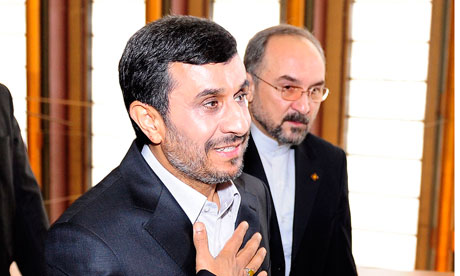
Iranian President Mahmoud Ahmadinejad arrives at the UN headquarters in New York.
His speech to the general assembly is key to his prospects at home.
All eyes are once again on the Iranian president, Mahmoud Ahmadinejad.
He is expected, again, to exploit the high-profile iglobal platform given to
him during his speech to the UN general assembly.
Unlike last year, however, when he sought to grab international headlines,
Ahmadinejad is likely to play to a domestic audience in an attempt to
bolster his leadership and quash suggestions that he has become a
lame-duck president two years before his term ends in 2013. Last week, in
the latest confrontation with conservatives close to the country's spiritual
leader and highest authority, Ayatollah Ali Khamenei, he failed to fulfil a
pledge to release the US hikers held in Iran accused of spying.
Ahmadinejad had been hoping the release would take place before his visit
to New York, so he would win any credit following the release.
Instead, he was embarrassed by the judiciary, which contradicted his
remarks and insisted they would make the final decision on the fate of the
Americans, Shane Bauer and Josh Fattal.
But Ahmadinejad's dilemma back in Iran is more complex than the
controversy around the release of two westerners. After publicly
challenging Khamenei over a cabinet appointment in April, Ahmadinejad
abruptly lost his position as the protege of the Ayatollah.
Since then he has become increasingly isolated, with only a handful of
reliable supporters. He has also lost the support of the elite Revolutionary
Guards and the majority of his backers in parliament and the wider
establishment.
Aside from these continuing feuds, Ahmadinejad and his team – in
particular his chief of staff and close confidant, Esfandiar Rahim Mashaei,
and deputy, Hamid Baghaei – who have accompanied him on his visit to
New York - are facing some of the most serious accusations at home.
Supporters of Khamenei are worried about the influence of Ahmadinejad's
regime on Iranian politics, accusing it of everything from revolutionary
deviancy to financial corruption and even sorcery. Mashaei, who is often
referred to as the head of a "deviant current" within the president's inner
circle and viewed as Iran's "real" president, is the focus of criticism due to
his relatively liberal views. He is accused of trying to undermine clerical
power and seeking to appeal to younger Iranians by advocating a freer
society.
Mashaei has also been accused of involvement in a $2.6bn (£1.7bn)
banking scam , described as Iran's biggest ever financial fraud.
Ahmadinejad and Mashaei, whose many allies have been arrested in recent
months, face a serious challenge in Iran. It seems that Khamenei has
chosen to tolerate them until the end of Ahmadinejad's term to avoid major
public confrontation before parliamentary elections in 2012 and presidential
elections in 2013.
Ahmadinejad's troubles were further highlighted when it emerged that
speculation is rife among Iranian MPs that there will be a move to bring
back the position of prime minister, thus replacing the current system of
presidency. If this turns out to be the case, it would constitute an attempt
by MPs to take power, as any prime minister would be appointed by them,
unlike a president, who is elected by the people.
Speaking at the UN will give Ahmadinejad a good opportunity to fight back
against his opponents. During his stay in New York he has been bombarded
by interview requests from US media and may be viewing this as a chance
to distract attention from his poor record in Iran, especially the appalling
violations of human rights.
Ironically, Ahmadinejad is not receiving the attention he needs at home,
with even semi-official media giving scant coverage to his visit to the UN.
To ensure domestic publicity, Ahmadinejad is likely to discuss one of the
biggest global controversies of them all – Palestinian statehood and Barack
Obama's apparent support for the Israelis. He may also wish to bring up the
US and Britain's apparent lack of interest in uprisings in Bahrain and Yemen.
Mahmoud Ahmadinejad's UN speech will be playing to his home crowd | World news | guardian.co.uk
-----
You can see live text updates of the General Assembly here: Ahmadinejad addresses the UN General Assembly - live | World news | guardian.co.uk
At the moment David Cameron is giving a speech.
US leads mass walkout of
Ahmadinejad speech at UN
UNITED NATIONS — The United States led a mass walkout of the UN
General Assembly on Thursday when Iran's President Mahmoud
Ahmadinejad launched an outspoken attack on Western nations.
A US diplomat who was in the assembly hall to monitor the speech left
halfway through, while the 27 European Union nations then followed in a
coordinated protest move.
Without naming any country, the Iranian leader strongly attacked the role
of the United States and its allies in wars and the financial crisis and called
on major powers to pay reparations for slavery.
"They officially support racism," Ahmadinejad said. "They weaken countries
through military intervention and destroy their infrastructures, in order to
plunder their resources by making them all the more dependent."
"Mr Ahmadinejad had a chance to address his own people's aspirations for
freedom and dignity, but instead he again turned to abhorrent anti-Semitic
slurs and despicable conspiracy theories," said US mission spokesman Mark
Kornblau.
"It was a coordinated position by the EU if the Iranian president called into
question European nations for their 'support of Zionism' and made reference
to the Holocaust," a French source told AFP.
AFP: US leads mass walkout of Ahmadinejad speech at UN
------
Mahmoud Ahmadinejad's
UN speech will be playing
to his home crowd
As his domestic problems mount up, the Iranian president
will seek to use a global platform to bolster his ailing
regime at home
Iranian President Mahmoud Ahmadinejad arrives at the UN headquarters in New York.
His speech to the general assembly is key to his prospects at home.
All eyes are once again on the Iranian president, Mahmoud Ahmadinejad.
He is expected, again, to exploit the high-profile iglobal platform given to
him during his speech to the UN general assembly.
Unlike last year, however, when he sought to grab international headlines,
Ahmadinejad is likely to play to a domestic audience in an attempt to
bolster his leadership and quash suggestions that he has become a
lame-duck president two years before his term ends in 2013. Last week, in
the latest confrontation with conservatives close to the country's spiritual
leader and highest authority, Ayatollah Ali Khamenei, he failed to fulfil a
pledge to release the US hikers held in Iran accused of spying.
Ahmadinejad had been hoping the release would take place before his visit
to New York, so he would win any credit following the release.
Instead, he was embarrassed by the judiciary, which contradicted his
remarks and insisted they would make the final decision on the fate of the
Americans, Shane Bauer and Josh Fattal.
But Ahmadinejad's dilemma back in Iran is more complex than the
controversy around the release of two westerners. After publicly
challenging Khamenei over a cabinet appointment in April, Ahmadinejad
abruptly lost his position as the protege of the Ayatollah.
Since then he has become increasingly isolated, with only a handful of
reliable supporters. He has also lost the support of the elite Revolutionary
Guards and the majority of his backers in parliament and the wider
establishment.
Aside from these continuing feuds, Ahmadinejad and his team – in
particular his chief of staff and close confidant, Esfandiar Rahim Mashaei,
and deputy, Hamid Baghaei – who have accompanied him on his visit to
New York - are facing some of the most serious accusations at home.
Supporters of Khamenei are worried about the influence of Ahmadinejad's
regime on Iranian politics, accusing it of everything from revolutionary
deviancy to financial corruption and even sorcery. Mashaei, who is often
referred to as the head of a "deviant current" within the president's inner
circle and viewed as Iran's "real" president, is the focus of criticism due to
his relatively liberal views. He is accused of trying to undermine clerical
power and seeking to appeal to younger Iranians by advocating a freer
society.
Mashaei has also been accused of involvement in a $2.6bn (£1.7bn)
banking scam , described as Iran's biggest ever financial fraud.
Ahmadinejad and Mashaei, whose many allies have been arrested in recent
months, face a serious challenge in Iran. It seems that Khamenei has
chosen to tolerate them until the end of Ahmadinejad's term to avoid major
public confrontation before parliamentary elections in 2012 and presidential
elections in 2013.
Ahmadinejad's troubles were further highlighted when it emerged that
speculation is rife among Iranian MPs that there will be a move to bring
back the position of prime minister, thus replacing the current system of
presidency. If this turns out to be the case, it would constitute an attempt
by MPs to take power, as any prime minister would be appointed by them,
unlike a president, who is elected by the people.
Speaking at the UN will give Ahmadinejad a good opportunity to fight back
against his opponents. During his stay in New York he has been bombarded
by interview requests from US media and may be viewing this as a chance
to distract attention from his poor record in Iran, especially the appalling
violations of human rights.
Ironically, Ahmadinejad is not receiving the attention he needs at home,
with even semi-official media giving scant coverage to his visit to the UN.
To ensure domestic publicity, Ahmadinejad is likely to discuss one of the
biggest global controversies of them all – Palestinian statehood and Barack
Obama's apparent support for the Israelis. He may also wish to bring up the
US and Britain's apparent lack of interest in uprisings in Bahrain and Yemen.
Mahmoud Ahmadinejad's UN speech will be playing to his home crowd | World news | guardian.co.uk
-----
You can see live text updates of the General Assembly here: Ahmadinejad addresses the UN General Assembly - live | World news | guardian.co.uk


Comment