Announcement

Collapse
No announcement yet.

Pakistan's Pashtuns React To Bin Laden's Death
Collapse
X
 
  • Filter
  • Time
  • Show
Clear All
new posts

  • Pakistan's Pashtuns React To Bin Laden's Death

    Pakistan's Pashtuns React To Bin Laden's Death

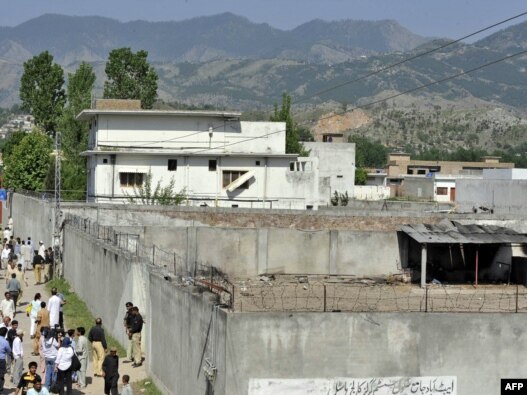
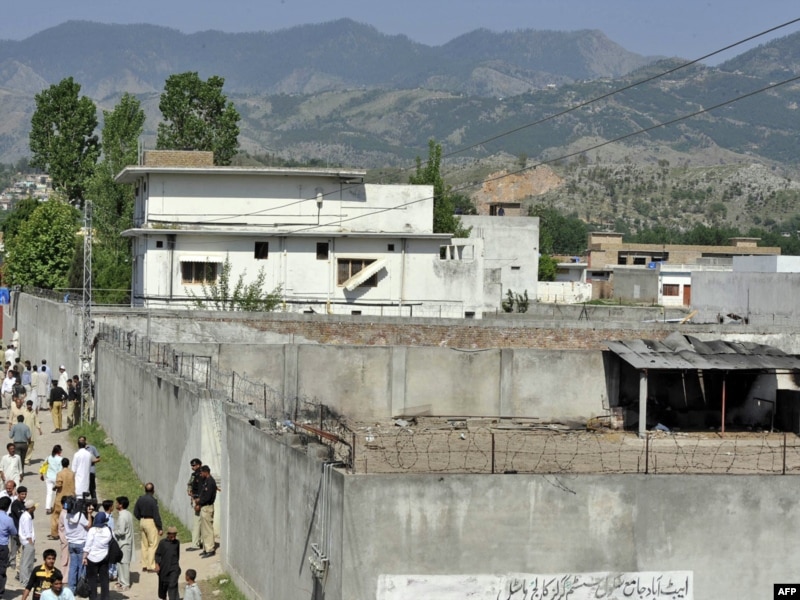
    Police, reporters, and local residents gather outside Osama bin Laden's compound in Abbottabad following his death.

    May 04, 2011
    Pashtun nationalist leaders in Pakistan's Khyber Pakhtunkhwa and Baluchistan regions are reacting positively to the news that Al-Qaeda founder Osama bin Laden has been killed. Many social and political leaders in the region near the border with Afghanistan are hoping that it will force Pakistan’s military establishment to change its policy of "strategic depth" in the Pashtun-dominated tribal belt.

    Mian Iftikhar Hussain, Khyber Pakhtunkhwa provincial minister for information, told RFE/RL's Radio Mashaal that bin Laden's elimination was "a really a positive development" because "the symbol of global terrorism had been eliminated."

    “Terrorism is a mindset, and we have to work hard to defeat this mindset," Hussain said. "Osama was the main figure behind the network that funded terrorism; therefore it will make a lot of difference."

    Hussain, who lost his only son in July 2010 in a Taliban attack in northwestern Pakistan, represents the Pashtun nationalist Awami National Party (ANP) that came under attacks from pro-Al-Qaeda Taliban militants. According to the Bacha Khan Research Center, the Taliban has killed more than 400 ANP workers since 2006.

    Raza Muhammad Raza, a former senator and spokesman of the Pakhtunkhwa Milli Awami Party (PkMAP), noted that in the decade since the September 11, 2001, attacks, Pakistani officials had stuck to the claim that bin Laden was either in Afghanistan or in the rugged mountains in the tribal regions on the border
    .

    "But he was found and killed in Abbottabad, close to the training academy of Pakistan’s Army," Raza told RFE/RL. "If Pakistan can assure the world and its neighbors that it will not support and protect terrorist forces anymore, it can avoid serious challenges to peace and prosperity in the region.

    "The intelligence service and the army never follow the policies of the elected governments," he continued. "Instead, they pursued their own so-called strategic interests. It is high time that these policies are altogether reviewed and completely changed. Pakistan has reached a dangerous turn."

    The decade-long war in the Pashtun areas along the Pakistan-Afghanistan border has left hundreds killed and wounded and thousands more displaced. Since 2001, religious parties like Jamiat Ulam-e-Islam (JUI) and Jamat-e-Islami (JI) have fanned anti-Americanism and regularly held large-scale protests against the United States in the tribal areas and all major cities of Khyber Pakhtunkhwa Province.

    The religious leadership has kept largely silent on the bin Laden operation, avoiding public expressions on the events of May 2. An interesting debate has emerged, however, after Mufti Kifayatullah, a leader of Jamiat Ulema-e-Islam-Fazi (JUI-F), called bin Laden "a martyr and a hero" at a gathering of the local assembly. He received a very strong reaction from other assembly members.

    In response, Bashir Bilour, senior minister of Khyber Pakhtunkhwa Province, counted the number of civilians, police, and security personnel killed in terrorist attacks in the province adding, "Pashtuns did not know about suicide attacks. It was Arabs under the leadership of Osama who gave suicide jackets to the Pashtun children."

    Bilour said bin Laden and his supporters had "killed the mothers, sisters, and children of the Pashtuns" and that he felt a sense of relief at the news of bin Laden's death.

    -- Shaheen Buneri
    Last edited by єѕαρχαι; 05-17-2011, 07:52 AM.
    Intezar che pa salgo sho no ta raghley
    Che me jwand pa dobedo sho no ta raghley.....

  • #2
    A great example of Truth:-

    "Bashir Bilour, senior minister of Khyber Pakhtunkhwa Province, counted the number of civilians, police, and security personnel killed in terrorist attacks in the province adding, "Pashtuns did not know about suicide attacks. It was Arabs under the leadership of Osama who gave suicide jackets to the Pashtun children."

    Osama gave suicide jackets to Pashtun children, while he was relaxing with his 4 wives, a cow, chickens and a few rabbits, drinking American Coca Cola, and trying for another baby, while our mothers and sisters were slaughtered in suicide bombings in honor of Arabian honour.

    The only regret I have, is that it wasnt me to pulled the trigger on this coward hypocrite. and what makes things even worse, we have a member on here who wants to associate the drun and ghairatmand pashtuns with this Yemani Terrorist hiding in luxury under the protection of JUI and ISI while Pashtuns died.

    Comment


    • #3
      Originally posted by Pashtun_Ultranationalist View Post
      A great example of Truth:-

      "Bashir Bilour, senior minister of Khyber Pakhtunkhwa Province, counted the number of civilians, police, and security personnel killed in terrorist attacks in the province adding, "Pashtuns did not know about suicide attacks. It was Arabs under the leadership of Osama who gave suicide jackets to the Pashtun children."

      Osama gave suicide jackets to Pashtun children, while he was relaxing with his 4 wives, a cow, chickens and a few rabbits, drinking American Coca Cola, and trying for another baby, while our mothers and sisters were slaughtered in suicide bombings in honor of Arabian honour.

      The only regret I have, is that it wasnt me to pulled the trigger on this coward hypocrite. and what makes things even worse, we have a member on here who wants to associate the drun and ghairatmand pashtuns with this Yemani Terrorist hiding in luxury under the protection of JUI and ISI while Pashtuns died.
      Here is an interesting article that, when you read it on the surface, intially appears to support your view, since it does not give the ethnic break down of who thought what... but then, when you do break it down it appears that your conclusions still find no support in this data that cannot be extrapolated to all of southern Afghanistan. Yet, this snippet of information at least makes it clear that you make little if no sense, and have little, if no data backing you regarding the views of the rural masses:

      http://news.yahoo.com/s/afp/20110516...unrestbinladen

      Here is the key quote which is the only section delineating Pashtun opinions:

      "However, the survey revealed some stark contrasts, with 71 per cent of interviewees in Marjah, a hotbed of Taliban fighters and drug-traders in the southern province of Helmand, describing bin Laden's killing as bad news."

      This is the only commentary that deviates away from the northern alliance/farsibaan view. Contrast this with the farsibaan view:

      ""I am happy that Osama is dead as he killed Ahmad Shah Massoud," a 19-year-old man from Panjshir told ICOS, referring to the Taliban's main rival, who was killed in a suicide attack two days before 9/11."

      This, coupled to the Al Jazeera article we desired you to comment on earlier paints a different picture regarding the rural Pashtoon's view on Mr. Bin Ladin.

      http://english.aljazeera.net/video/a...315358960.html

      Your unfortunate attempt to subvert the view of the masses is what leads to more war and killing because you are merely trying to hoist your view onto them without evidence based practice.
      "2 crackheads don't become any better or stronger by sharing the same crack pipe." - Greatest PF quote

      Comment


      • #4
        What's strange is that these same Deceivers who work as Agents of Imperialists and are mentally colonized and slaved to serve their agenda

        try and exploit Pashtun identity and culture to manipulate and pretend to be representatives of but Cheered and Celebrated when Americans are raping women in Afghanistan and try so hard to make excuses for them. And they have the nerve to blame American air attacks on our Muslim brothers and sister while they themselves are the ones who cheer and encourage American military conquest like slaves of Imperialists usually do.

        Comment


        • #5
          so is it pakistan's pashtuns or pakistani pashtuns?

          Comment


          • #6
            Some people cannot raise above rabbies-bitten Arabism and Islamo-fascism/Ikhwanism to see this as a plight of a people whose lives have been devastated by almost three decades of war and instability. There is no denying the fact that suicide bombing tactic is the invention of an under-evolved, frustrated, and defeated Arab mind-set lacking the ability to respond rationally, creatively, and effectively to the the strategy of Israeli state.

            It is very fortunate that KPK Pashtuns at least have reaslised as what is the real agenda of the Arab fugitives/terrorists like Osama and Zawahiri on Pashtun land. The Arab-centered agenda of Arab terrorism on Pashtun land is amply evident from the fact that whenever Osama etc. released a tape, it was focussed on the middle east.

            In order to see the Punjabist agenda behind the so-called Taleban movement, just watch the following tv debate. In part 4, the god-father of Afghan Ikhwanis-General Hamid Gul- makes it clear that they would not fight US and would use only Pashtuns to bargain with US and extract concession from it. He clealy says that Pakistan must not fight US.

            YouTube - Hoodbhoy & Saleem: US-Pak Relations -1/4
            YouTube - Hoodbhoy & Saleem: US-Pak Relations -2/4
            YouTube - Hoodbhoy & Saleem: US-Pak Relations -3/4
            This part 4 is important.
            YouTube - Hoodbhoy & Saleem: US-Pak Relations -4/4
            Last edited by Toramana; 05-17-2011, 08:04 PM.

            Comment


            • #7
              Originally posted by graveyardofempires View Post
              so is it pakistan's pashtuns or pakistani pashtuns?
              I think its Pakistan's Pashtuns Since PkMAP/ANP as Pakistani Pashtun own by ISI always trys to speak pro-Pashtun but act as anti-Pashtun, and if its coming from Pashtun they pretend to side what is better for Pakistan. I have to agree every pashtun knew how to kill enemy but not themselves and this was brought into minds of Pashtuns by Arabs.
              Happy Ramadan everyone. [url=http://www.youtube.com/watch?v=Dym5AVwvc7c&feature=related]‫نشيد (زين الشهور) كااااملة || Zain Ramadan Nasheed-Full Version‬‎ - YouTube[/url]

              Comment


              • #8
                Originally posted by Nick View Post
                I think its Pakistan's Pashtuns Since PkMAP/ANP as Pakistani Pashtun own by ISI always trys to speak pro-Pashtun but act as anti-Pashtun, and if its coming from Pashtun they pretend to side what is better for Pakistan. I have to agree every pashtun knew how to kill enemy but not themselves and this was brought into minds of Pashtuns by Arabs.
                true that

                Comment


                • #9
                  Originally posted by Toramana View Post
                  Some people cannot raise above rabbies-bitten Arabism and Islamo-fascism/Ikhwanism to see this as a plight of a people whose lives have been devastated by almost three decades of war and instability. There is no denying the fact that suicide bombing tactic is the invention of an under-evolved, frustrated, and defeated Arab mind-set lacking the ability to respond rationally, creatively, and effectively to the the strategy of Israeli state.

                  It is very fortunate that KPK Pashtuns at least have reaslised as what is the real agenda of the Arab fugitives/terrorists like Osama and Zawahiri on Pashtun land using their land for Arab cause. The Arabist agenda of Arab terrorism on Pashtun land is amply evident from the fact that whenever Osama etc. released a tape, it was focussed on the middle east.

                  In order to see the Punjabist agenda behind the so-called Taleban movement, just watch the following tv debate. In part 4, the god-father of Afghan Ikhwanis-General Hamid Gul- makes it clear that they would not fight US and would use only Pashtuns to bargain with US and extract concession from it. He clealy says that Pakistan must not fight US.

                  YouTube - Hoodbhoy & Saleem: US-Pak Relations -1/4
                  YouTube - Hoodbhoy & Saleem: US-Pak Relations -2/4
                  YouTube - Hoodbhoy & Saleem: US-Pak Relations -3/4
                  This part 4 is important.
                  YouTube - Hoodbhoy & Saleem: US-Pak Relations -4/4
                  Well, you make a key point. If it is the response of the Arabs to the Israeli state... and you view it as an underdeveloped less evolved response, what do you suggest as a possible alternative recourse?

                  Your commentary on this matter is generally is subjective and lacks the insight of etiology. It is the equivalent of you seeing a man dying of an infectious disease and instead of offering an alternative, or understanding how he contracted the illness... you simply comment on his current status.

                  Once again, the professor here, out of Cambridge, does it for you. He defines where the illness comes from and pretty much discusses what you refuse to... which is the generally predictable response that populations demonstrate in the face of asymmetric power.

                  Basically, you blame the man for the pneumonia... and he bypasses you by correctly identifying the bacteria that caused the pneumonia infection in the first place.

                  Treat the bug Toramana with the proper antibiotics. Dont insult the patient's intelligence.
                  ----------------------------------------------------------------


                  http://english.aljazeera.net/indepth...424785830.html


                  Breaking bread with terrorists

                  Asymmetric warfare is the result of conflict between the powerful and the powerless, reinforcing a cycle of violence.


                  In an earlier moment of resistance against the Western world order, the Hong Kong Chinese opened a front in the bakeries. They nearly wiped out the entire European community on the island by kneading arsenic into their bread. But the bakers were too generous with the arsenic, which caused the Europeans to vomit before the poison could take effect.


                  The British were trying to open up Chinese markets for the sale of Indian opium. It took them two wars to do so in the mid-nineteenth century and the "terrorist bakers" provided part of the excuse to get the second war started. The prime minister, Lord Palmerston, railed against those who would kill British subjects by "murder, assassination, and poison".

                  The irony that he was practising narco-colonialism on a grand scale by force of arms, addicting Chinese in order to balance payments, perhaps never occurred to him.
                  When those who are weak in conventional military terms seek to fight the strong, they often do so through unconventional tactics and ruses. To do otherwise is to be stupid and risk being mown down by superior firepower. Yet tactics like poisoning families as they break bread expose the weak to charges of barbarity.

                  These tactics fuel the desire for righteous revenge in the West, for "justice" as those US citizens celebrating bin Laden's death called it. Palmerston made his remarks at an election rally, where he also spoke of insolent barbarians. Such desires have a way of licensing their own forms of savagery and reprisal.

                  A blinkered vision of warfare

                  This cycle in the war of the weak against the strong is an old one. The strong can afford traditions of warfare which prize decisive combat between military forces. They are genuinely shocked and horrified when their opponents find ways to shoot them in the back or massacre their loved ones. Yet the strong somehow do not see the great suffering they inflict, whether through violence or the kinds of mass slow death that capitalism specialises in for those enmeshed in its lower rungs.

                  As Victor Davis Hanson comments, "we in the West call the few casualties we suffer from terrorism and surprise 'cowardly', the frightful losses we inflict through open and direct assault 'fair'."

                  The great problem for those leading revolts in the era of European empire was that their local resources, no matter how cleverly deployed, rarely could match the global power of the West. A troop convoy on the way to fight Palmerston's war of choice in China was diverted to crush the 1857 rebellion in India.

                  Guerrilla warfare could beguile and tie down Western armies, but ordinarily it could not achieve decisive results. One of bin Laden's predecessors in resistance, Omar Mukhtar of what is now Eastern Libya, repeatedly flummoxed Italian forces with his lightning raids and local support in a fight that lasted twenty years from 1911.

                  The Italians responded with one of the great tools of counterinsurgency: concentration camps. They transferred and locked up around 100,000 people from Mukhtar's home region, draining the sea around the guerrilla fish in the Maoist idiom.
                  Invented by the British to deprive Boer guerrillas of their civilian support, the concentration camp would morph into the strategic hamlet in Malaya and Vietnam and the concrete barrier in Iraq, all designed to separate insurgents from those who succour them.

                  Mukhtar had but the resources of one mountainous area with which to oppose the modern state of Italy. How could a local people counter the weight of the strong and their world order?

                  End of empire
                  It was the Second World War which finished off the European empires, draining their resources while Japanese victories punctured forever the myth of white superiority. For those who tried to hang on to colonies, Mao, Fanon, Ho Chi Minh and others had evolved answers.

                  In various ways, they developed political strategies that could be served by guerrilla tactics. Military operations became armed propaganda exercises, aimed at local and faraway populations. They turned to the idea of the nation to mobilise the masses, requiring the West to devote large numbers of troops to obscure, hot places.
                  Back in the West, a combination of media and democratic politics made those wars politically unsustainable over time, leading to the axiom that guerrillas only had to avoid defeat to win. Western armies were very rarely defeated in the field, but eventually were forced to withdraw by their own politicians and publics.

                  But victories in taking over countries only reproduced the problem of the local and the global in new form. Another of bin Laden's predecessors, Muhammad Ahmad, the Mahdi of the Sudan, had managed to wrest control of the Sudan from Britain's Egyptian clients in 1885. No matter, the country could be left isolated for fifteen years before it was convenient to organise an expeditionary force to retake it.

                  The struggle for liberation
                  The nation-state can serve as a kind of large concentration camp, walling off from one another peoples with shared interests in resisting the West. Revolutionary leaders in places like Egypt, Cuba and Vietnam took state power amid a hostile world. They could be subject to sanctions, embargoes, and covert attack while they struggled with their own internecine conflicts, inflicted disastrous economic policies on their populations, and became corrupt.

                  Eventually they faced a choice between withering on the vine or re-entering the capitalist world order on unfavourable terms.

                  This was the stalemate between the local and the global that bin Laden sought to bust open with his spectacular attacks on the US. With the greatest armed propaganda operation in world history he sought to generate a revolt that did not respect sovereign borders.

                  Westerners mocked his idea of the Caliphate as a seventh-century throwback. They did not appreciate what a creative response it was to the division of the world into nation-states, which could so easily be turned into clients of the West and partitioned off from one another. As an al-Qaeda website once noted with contempt, "A 'Karzai' regime exists officially in all the Muslim countries."

                  But bin Laden lacked a politics with which to capitalise on his armed success. His brand of Islam divided rather than unified even those who shared the faith, and had no appeal for those outside it no matter how much they suffered from Western power. After all, who wants to fight a revolution only to live in something like the Taliban's Afghanistan?

                  In the late 1980s, El Salvadoran guerrillas struggling against a US-supported client regime considered using their immigrant population in Washington DC for terrorist attacks on the city's subway. Despite their desire for revenge, they cool-headedly rejected the idea out of fears that it would simply call forth a more direct and violent reprisal from the Americans.

                  In essence, 9/11 was like a brilliant guerrilla raid that exhilarates young fighters and gives them the taste of a victory they can never achieve. Its immediate effect is to call forth legions of imperial storm troopers on missions of reprisal, missions that wreck the rebellion and inflict suffering on those it sought to liberate.


                  Like bad schoolboys, bin Laden's followers never quite learned the lesson. They repeated smaller scale terrorist attacks that sowed division and generated reprisal. About the only people receptive to their propaganda were other groups of would-be young terrorists. They were enough to keep the conflict going
                  –
                  and the reprisals coming
                  –

                  but never sufficient or minded to build anything serious politically.
                  In the long arc of the decline of empires and great powers, the main consequence of 9/11 and the wars that followed is to hasten the decline of the US. Precious resources needed to regenerate the US have been spent on wars of reprisal as well as the fantastically corrupt arrangements for economic reconstruction in Iraq and Afghanistan. Having allowed business to feed so well at the public trough for a decade, US politicians now deny their own people desperately needed funds for healthcare, education, and modernisation.

                  Guerrilla raids and imperial reprisals both achieve little but further human suffering. Nonetheless there may come a day not too far off, in the violent world of competing powers to come, that we may long for the world order built by the Anglo-Americans and for the grand ideals of many of those who resisted them.

                  Tarak Barkawi is Senior Lecturer, Centre of International Studies, University of Cambridge. He specialises in the study of war, armed forces and society with a focus on conflict between the West and the global South in historical and contemporary perspective. He is author of Globalisation and War, as well as many scholarly articles.
                  "2 crackheads don't become any better or stronger by sharing the same crack pipe." - Greatest PF quote

                  Comment


                  • #10
                    Originally posted by Nick View Post
                    I think its Pakistan's Pashtuns Since PkMAP/ANP as Pakistani Pashtun own by ISI always trys to speak pro-Pashtun but act as anti-Pashtun, and if its coming from Pashtun they pretend to side what is better for Pakistan. I have to agree every pashtun knew how to kill enemy but not themselves and this was brought into minds of Pashtuns by Arabs.

                    Possibly. Younis Khalis used to joke that the Afghan fighters preferred to die in their beds and kill as many enemy as they could.
                    "2 crackheads don't become any better or stronger by sharing the same crack pipe." - Greatest PF quote

                    Comment


                    • #11
                      These Beghairat traitiors of Muslim pashtuns who gave hugs to and kisses to Najibullah who was taking orders from the Kremlin and to Zedari; always use Arabs and other Muslims as a scapegoat for their benamous and bewafa tactics. The Arab scapegoat is a manufactured diversion by Imperialists to shift focus away from their agenda and to manipulate others to be subervient to them.

                      Comment

                      Working...
                      X