Announcement

Collapse
No announcement yet.

Afghanistan: vegetation and other resources

Collapse
X
 
  • Filter
  • Time
  • Show
Clear All
new posts

  • Afghanistan: vegetation and other resources


    Between a rock and a hard place

    24 May 2007

    Armed with a few rudimentary fume cupboards, a small spectrophotometer and a handful of simple chemicals, scientists from the British Geological Survey have started the long process of rebuilding the analytical geochemistry capability of a country that for decades has been riven by war.


    Income from natural resources could help fund Afghan reconstruction
    For most of us Afghanistan is a distant, rugged country defined by a turbulent and often violent recent history. But despite its past and current difficulties, Afghanistan is gradually being rebuilt. An important part of this reconstruction is to enable the Afghan population to make the most of the country's mineral wealth.
    Afghanistan's natural resources include significant deposits of metals such as gold, silver, copper and zinc; precious and semi-precious stones including lapis, emerald and azure; and coal, natural gas and oil.

    Accurate geological surveys of the country's mineral resources are key to locating deposits and advising potential investors, and for this reason the Afghanistan Geological Survey (AGS) is being revitalised after decades of decay and neglect. Geological surveys from the UK, US, Japan and the Czech Republic are helping to rebuild the AGS. The UK's contribution is a three-year project, which finishes this September, funded by the Department for International Development, for the British Geological Survey (BGS) to provide training and equipment to get the AGS back on its feet.

    The challenge has been significant. The AGS headquarters in Kabul, for example, has had to be reconstructed almost from scratch, as Jack Medlin of the US Geological Survey explains: 'The AGS building is very large, but when we arrived in 2004 it was essentially a shell. There were no windows, no doors, no furniture, no wiring, no plumbing and the building had been bombed and looted of everything.' It took six million dollars and two years work to make the building habitable.

    Michael Watts, an analytical chemist with the BGS, is deputy leader of the BGS project whose aim is to get the AGS laboratories up and running. Five laboratories have so far been established: a sample preparation lab which is largely devoted to crushing and grinding rock material; an industrial mineral lab for testing the physical properties of minerals; a thin-section lab for producing samples for examination under the microscope; a petrographic lab for classifying and characterising rock samples; and a gem analysis lab. The chemistry lab will be shipped out this summer.

    This laboratory will be, at least initially, rudimentary. 'We have to take a very pragmatic, low-tech approach,' Watts says. 'We are establishing a very basic infrastructure with a water and power supply, some simple fume cupboards and we will set up some simple assays to assess the staff's practical skills and chemical knowledge to recommend future training programmes.'

    The main piece of equipment for the laboratory will be a portable Palintest spectrophotometer. Watts explains, 'The idea is initially to teach the staff how to use the equipment to test water for the presence of zinc, nickel and copper. A water sample is filtered and placed in the machine, which reads the absorbance wavelength and subsequent concentration of the particular metal. This information can provide an indication of the presence of minerals upstream from where the sample was collected, for example. We've also developed a way of analysing soils and rock materials for copper, where hydrochloric acid is added to the sample, it is heated, and a buffer and organic complexing agent is added. This can also be measured in the photometer.'

    Around 85 people work in the AGS laboratories, with 10 or 15 in the chemical analysis lab. Levels of expertise among the staff are highly variable. 'Some of the personnel have graduated from universities in the old Soviet Union, others from the university in Kabul and the range of education varies a lot,' Watts says. 'Some of the younger graduates from Kabul do not have a high basic level of knowledge, although they are very keen. We were expecting a higher level of knowledge across the board, but we found we are having to go right back to basics, particularly with fundamental IT and language skills.'

    If the AGS can start to function efficiently once again, the future is potentially bright. Significant donors such as the World Bank are waiting in the wings with substantial investment. 'It is important that we do not try to do too much too quickly,' Watts points out. 'There would be little point in kitting out the laboratory with, say, atomic absorption spectrometry, as in the current climate such a machine would be difficult to run and maintain. Companies that supply equipment will not go out to Afghanistan to repair or maintain instruments. In the future the AGS will need to develop contacts with neighbouring countries such as India and Pakistan to obtain support and to get access to chemicals as these are difficult to ship from Europe. We can't be too ambitious at this stage - it would not be fair on the Afghan staff.'

    Between a rock and a hard place


  • #2
    The New War for Afghanistan's Untapped Oil

    ISAF troops conducting live ordinance test unaware they are on a natural gas field and that a Taliban attack had just occurred. On road from Khoja Gogardak, Sheberghan city, Jowzan Province, Afghanistan. (Antonia Juhasz)
    I am looking out the window as men in grey turbans run from my building out onto the highway, their AK 47s at the ready. "There's been an accident," my Afghan guide, Danish calmly tells me. "Someone was just killed in the plaza here."

    I am in Faryab province in northwest Afghanistan, which had been considered among the more peaceful areas. "Was someone hit by a car?" I ask. Danish pauses. The "Oh yes, she's American" look passes quickly over his face before he replies, "Somebody was shot."

    Within a few minutes we get a report from the secretary of Abdullah Masoumi, the governor of Khoja Sabz Posh District, in whose office we've been waiting for some time. It was the Taliban, he tells us, and the victim was Commander Czhulam, a leading member of the governor's security team and a former commander under General Abdul Rashid Dostum, one of the country's most powerful warlords.

    With the close of 2012, the Pentagon has revealed a disturbing trend in Afghanistan: Taliban attacks remained steady, or in some cases increased, over 2011 levels. I experienced the Taliban surge firsthand this past November, and can offer a cause not cited in the Pentagon's report: oil and gas.

    I was there as part of a three week investigation into the growing efforts of both the US and Afghan governments to develop Afghanistan's oil and gas sector. I prepared my itinerary to include what are supposed to be among the safest regions, and was traveling alone with just a local guide and driver, my only "safety-gear" the local clothing and black head covering I wore. As long as I kept my mouth shut, with my dark hair and Middle-European heritage, I regularly passed for a local. I was tracking an oil and gas trail across Western and Northern Afghanistan. But so too, it became increasingly apparent, are the Taliban.

    Abandoned Russian oil derrick in village in Ahmad-a-Bad District, Herat Province, Afghanistan. (Antonia Juhasz)
    I was to interview Governor Masoumi because his district sits atop fields of natural gas in one of the most energy-rich provinces. As in virtually all of Afghanistan, none of the fields are marked because almost no natural gas or oil operations are taking place. I know the fields are there because I am following a map of Afghanistan's oil and natural gas riches produced by the United States' Government's US Geological Survey (USGS).

    My journey has uncovered a largely hidden battle being waged for control of Afghanistan's fossil fuel resources. The Afghan and US governments hope these resources will attract international oil companies and raise badly needed income. The Taliban appear increasingly bent on denying the fruits of the sector to their rivals, be they local, national, or international.

    As we leave Faryab, Danish warns, "If the Taliban catch us, throw your camera out the window and pretend to be my deaf mute mother."

    Two days later I'm in Jowzan province to the north of Faryab, waiting at the gates of the Khoja Gogardak natural gas treatment plant, a few miles from Sheberghan city. A lone guard sits nearby. Old, thin, and short with a small grey turban and stark white beard, his AK-47 is casually slung across his shoulder while two small "guard puppy" dogs relax at his feet, enjoying the calm afternoon sun in the heart of General Dostum's territory. His lackadaisical attitude is both quaint and oddly reassuring.

    Suddenly, Mir Hasan, head engineer of the facility, appears and ushers us quickly inside. "There is a recent security situation which is not good and the military will be here in a few minutes," Danish translates.

    Hasan had received word a few minutes earlier that his employees working at a natural gas field behind the facility and just in the distance (he points, we look) were attacked by the Taliban. "Right here?!" I ask. "Yes," Danish confirms. Hasan politely reassures me that he is happy to give me the tour of the facility, 90 percent of which is outdoors and in full view of the just-attacked field, but we'll have to be quick about it as the Afghan military is on its way. "This just happened?!" I ask. "Yes, exactly," Hasan responds. "Has this happened before?" I ask. "Mostly their attacks take place during the night," he explains. "This is the first time that they have attacked during the day."

    I quickly recall that on the road out of Mazar-i-Sharif, the city General Dostum calls home, Danish had been shocked to see a man on a motorbike brazenly wearing the telltale-black turban of a Taliban and brandishing his weapon in the middle of the day. It was the first time either Danish or our driver had seen such a display in over ten years.

    "I think we better go," Danish tells me. I try to stall, hoping to be there when the Afghan military arrive, but the men are anxious. Engineer Hasan cannot yet report any details other than that when the Taliban began shooting, his men got into their vehicles and fled the area without apparent injury. "You are not very lucky," Hasan tells me, as we say goodbye to him at the gate.

    How right he was. I am standing in the middle of the street in Sheberghan City waiting for Mohammad Chaari, commander of security for the Amu Darya oil contract area awarded in 2011 to the China National Petroleum Corporation (CNPC) in partnership with Afghanistan's Watan Group. With two facilities operating in Sari Pul Province south of Jowzan and east of Faryab, theirs is the only oil production in Afghanistan -- although they currently ship their entire product to Turkmenistan. Almost a week earlier, I had been given a secret tour. (The Chinese no longer allow press onto the facility, so I was snuck in.)


    Faiz Mohammad (former Sheberghan gas worker) and Danish (guide) speak with Mir Hasan, head engineer, Khoja Gogardak natural gas treatment plant, Sheberghan city, Jowzan Province, Afghanistan. (Antonia Juhasz)
    While we wait for Chaari, we overhear a conversation between him and two CNPC engineers from Sari Pul. There has been a Taliban attack near the facility, "large enough to call in air support." No one would say more when asked, but Commander Chaari does tell me that his security detail are about to be significantly increased.

    We begin crossing oil and gas fields off my itinerary, deeming them too "insecure" to visit, including oil fields very near to the city of Mazar-i-Sharif and the entire province of Kunduz. "Insecure," I have quickly learned, is code for "Taliban." As the director general of the Afghan Oil and Gas Survey tells me, "There is nothing else causing insecurity."

    The US Pentagon is the de-facto lead US agency pushing the development of Afghanistan's oil and gas sector. Jim Bowen, a Houston oilman hired by the Pentagon to guide a November 15 international oil and gas contract tender process, confirmed for me that these attacks are in fact on the rise. "Certainly, as the [oil and gas] sector develops, the sector is creating targets, there is no doubt about that," Bowen tells me. "But exactly how one defines 'Taliban' is open to interpretation."

    Sitting in Kabul shortly before my departure, I speak with Javed Noorani, extractive industries monitor for the Afghan NGO Integrity Watch. He confirms Bowen's analysis: As the oil and gas sector draws increasing public attention, so too have Taliban attacks grown. But identifying who is supporting those Taliban, "be they Pakistani, Iranian, or homegrown, is not so simple."

    The result is clear, and far from unique to Afghanistan: As development of the oil and gas sector has risen, so too has violence and insecurity.

    The New War for Afghanistan's Untapped Oil - Antonia Juhasz - The Atlantic

    Comment


    • #3
      Mining in Afghanistan - Wikipedia, the free encyclopedia

      Comment


      • #4
        WASHINGTON, July 18 (UPI) -- Roughly 70 percent of Afghanistan was mapped for natural resources, particularly minerals, using remote sensing, the U.S. Geological Survey announced.

        The U.S. Defense Department and the USGS said for the first time, about 70 percent of Afghanistan was surveyed using a technique called hyperspectral imaging.

        Jim Bullion, director of a Defense Department task force, said the mapping would help the Afghan government asses its mineral deposits.

        "These maps clearly show the enormous size and variety of Afghanistan's mineral wealth and position the country to become a world leader in the minerals sector," he said in a statement.

        USGS said light reflected from the surface can be used to determine the difference between vegetation, snow or minerals.

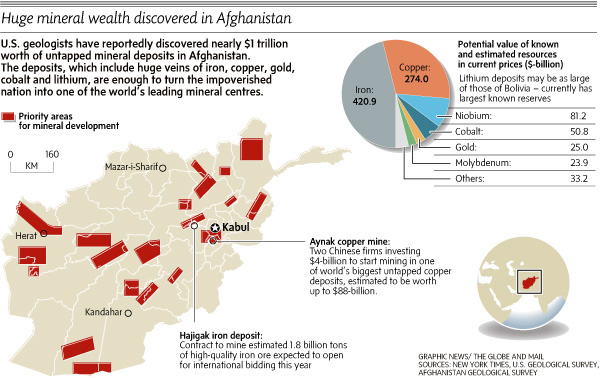
        U.S. defense officials estimated in 2010 that there could be as much as $1 trillion worth of iron, copper, cobalt, gold and lithium in Afghanistan.

        A 2007 survey found an estimated 1.5 million metric tons of potential rare earth resources in southern Afghanistan. The international community gets more than 95 percent of its rare earth minerals from China.

        Afghan officials said production of iron ore deposits in Bamyan province could begin in 2015.


        Read more: USGS surveys Afghan natural resources - UPI.com

        Comment


        • #5


          The Pentagon’s Map of Afghanistan: An Eldorado of Mineral Wealth and Natural Resources


          Curious information surfaced in the media last month – based on space reconnaissance, the US Department of Defense put together a map of Afghanistan showing in detail the country’s mineral riches which, as it transpired, may be quite impressive.

          The fact that Afghanistan sits on lucrative natural resources was recognized indirectly back in 2010 when the Afghan ministry of mines rolled out a $1b (!) estimate of what the country might have, and The New York Times quoted a source in the US Administration as saying that Afghanistan’s list of reserves included copper, gold, cobalt, and even lithium on which the present-day industry is heavily dependent. A Pentagon memo actually described Afghanistan’s potential lithium holdings as big enough to make it the “Saudi Arabia of lithium”. Somehow, the news flew below the radars of most w

          Comment


          • #6
            Afghanistan's natural resources could mean independence or corruption
            POSTED: 09/09/2012 12:01:00 AM MDT
            UPDATED: 09/09/2012 12:47:25 AM MDTBy Graham Bowley


            Read more: Afghanistan's natural resources could mean independence or corruption - The Denver Post Afghanistan's natural resources could mean independence or corruption - The Denver Post
            Read The Denver Post's Terms of Use of its content: Terms of Use - The Denver Post

            Comment

            Working...
            X