

 Tweet
Tweet
Akbar is probably the only Mughal king loved by non muslims, he tried to unite all religions of India. He was a very forward thinker for his times, the mullahs hated that
-
-
Abu'l-Fath Jalal ud-din Muhammad Akbar, known popularly as Akbar also known as Akbar the Great or Akbar I,[5][6] was Mughal Emperor from 1556 until his death. He was the third and one of the greatest rulers of the Mughal Dynasty in India. Akbar succeeded his father, Humayun, under a regent, Bairam Khan, who helped the young emperor expand and consolidate Mughal domains in India. A strong personality and a successful general, Akbar gradually enlarged the Mughal Empire to include nearly all of the Indian Subcontinent north of the Godavari river. His power and influence, however, extended over the entire country because of Mughal military, political, cultural, and economic dominance. To unify the vast Mughal state, Akbar established a centralised system of administration throughout his empire and adopted a policy of conciliating conquered rulers through marriage and diplomacy. In order to preserve peace and order in a religiously and culturally diverse empire, he adopted policies that won him the support of his non-Muslim subjects. Eschewing tribal bonds and Islamic state identity, Akbar strived to unite far-flung lands of his realm through loyalty, expressed through a Persianised culture, to himself as an emperor who had near-divine status.
Mughal India developed a strong and stable economy, leading to commercial expansion and greater patronage of culture. Akbar himself was a patron of art and culture. He was fond of literature, and created a library of over 24,000 volumes written in Sanskrit, Hindustani, Persian, Greek, Latin, Arabic and Kashmiri, staffed by many scholars, translators, artists, calligraphers, scribes, bookbinders and readers. Holy men of many faiths, poets, architects and artisans adorned his court from all over the world for study and discussion. Akbar's courts at Delhi, Agra, and Fatehpur Sikri became centers of the arts, letters, and learning. Perso-Islamic culture began to merge and blend with indigenous Indian elements, and a distinct Indo-Persian culture emerged characterised by Mughal style arts, painting, and architecture. Disillusioned with orthodox Islam and perhaps hoping to bring about religious unity within his empire, Akbar promulgated Din-i-Ilahi, a syncretic creed derived from Islam, Hinduism, Zoroastrianism, and Christianity. A simple, monotheistic cult, tolerant in outlook, it centered on Akbar as a prophet, for which he drew the ire of the ulema and orthodox Muslims.Last edited by Karachi; 03-31-2015, 12:26 AM. -
Relation with Hindus
Akbar decreed that Hindus who had been forced to convert to Islam could reconvert to Hinduism without facing the death penalty.[141]
Akbar in his days of tolerance was so well liked by Hindus that there are numerous references to him and his eulogies are sung in songs and religious hymns as well.[142]
Akbar practiced several Hindu customs. He celebrated Diwali. He allowed Brahman priests to tie jeweled strings round his wrists by way of blessing and, following his lead, many of the nobles took to wearing rakhi (protection charms).[143] He had renounced beef, and forbade the sale of all meats on certain days.[143] Also his royal queen-consort was a Hindu princess, Harkha Bai.
Even his son Jahangir and grandson Shahjahan maintained many of Akbar's concessions, such as the ban on cow slaughter, having only vegetarian dishes on certain days of the week, and drink only Ganges water.[144] Even as he was in the Punjab, 200 miles away from the Ganges, the water was sealed in large jars and transported to him. He referred to the Ganges water as the "water of immortality."[144]
It was rumored that each night a Brahman priest, suspended on a string cot pulled up to the window of Akbar's bedchamber, would captivate the emperor with tales of Hindu gods.[143]
Din-i-Ilahi
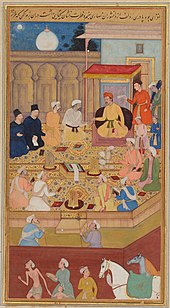
Akbar was deeply interested in religious and philosophical matters. An orthodox Muslim at the outset, he later came to be influenced by Sufi mysticism that was being preached in the country at that time, and moved away from orthodoxy, appointing to his court several talented people with liberal ideas, including Abul Fazl, Faizi and Birbal. In 1575, he built a hall called the Ibadat Khana ("House of Worship") at Fatehpur Sikri, to which he invited theologians, mystics and selected courtiers renowned for their intellectual achievements and discussed matters of spirituality with them.[116] These discussions, initially restricted to Muslims, were acrimonious and resulted in the participants shouting at and abusing each other. Upset by this, Akbar opened the Ibadat Khana to people of all religions as well as atheists, resulting in the scope of the discussions broadening and extending even into areas such as the validity of the Quran and the nature of God. This shocked the orthodox theologians, who sought to discredit Akbar by circulating rumours of his desire to forsake Islam.[123]Comment
-
-
Mullah loved him too for he take most of them on board and did not try to alienate themOriginally posted by Karachi View PostComment
-
Well meaning but misguided.Comment
-
Mr. Savage, what type of comment that is? These are the rants you want to bring revolution through.Originally posted by Brown Skinned Savage View PostComment
-
Akbar eclecticism was outstanding. His period was golden age of Mughal empire. He was a realist not a stupid like Aurangzeb who wanted to implement Sharia in the whole of India and because of that Mughals last power.Comment
-
The Mughals were actually at their most powerful during Aurangzeb, but they lost power because of their cooperation with the British East India company which allowed them to sift greater rivalries.
There's actually numerous historians that corroborate this fact. Under Aurangzeb Mughal authority was strongest, economy was also most productive. He was an excellent manager.Akbar mismanaged the treasury; gave land/preferred positions to unqualified people just to appease unrest. The only drawback to Aurangzeb was he was a bigot.
But in all secular standards Aurangzeb was superior.Comment

Comment