If this is your first visit, be sure to
check out the FAQ by clicking the
link above. You may have to register
before you can post: click the register link above to proceed. To start viewing messages,
select the forum that you want to visit from the selection below.
There are many Afghan Sikhs in Dubai. I once met a family at my job and they spoke perfect Pashto, English and Arabic. They said they have a great community in Dubai.
Even Adobe Photoshop can't change me.
A line[Durrand line] of hatred that raised a wall between the two brothers -Hamid Karzai
For generations, the Hindus of India prayed for deliverance from "the venom of the cobra, the teeth of the tiger and the vengeance of the Afghan."
The men of Kábul and Khilj also went home; and whenever they were questioned about the Musulmáns of the Kohistán (the mountains), and how matters stood there, they said, "Don't call it Kohistán, but Afghánistán; for there is nothing there but Afgháns and disturbances." Thus it is clear that for this reason the people of the country call their home in their own language Afghánistán, and themselves Afgháns. The people of India call them Patán; but the reason for this is not known. But it occurs to me, that when, under the rule of Muhammadan sovereigns, Musulmáns first came to the city of Patná, and dwelt there, the people of India (for that reason) called them Patáns—but God knows!
په تيرا کښ هم دي هندوان او سکهان يو متل دے وايي دا خو هلکه سم د تيرا هندو دا هاهاهاها په پيښاور کښ په باړه کښ ډر زيات دي هندوان او سکهان په ټوپئ کښ هم ډير دي ولے په ټوپئ کښ د کپړو دوکانونه يي دي مونږ سره په سکول کښهم وو
There are many Afghan Sikhs in Dubai. I once met a family at my job and they spoke perfect Pashto, English and Arabic. They said they have a great community in Dubai.
ya admin khana
they have good textile business in Bur dubai...
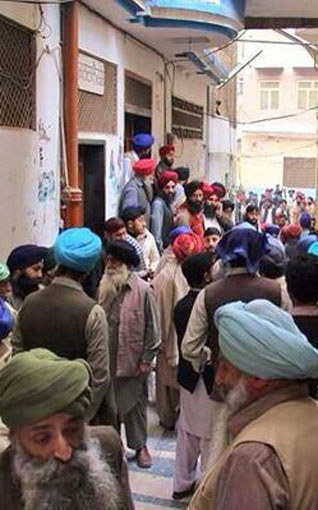
Khurshid Khan, an eminent 60-year-old lawyer and deputy attorney general of Pakistan, wants to "heal the wounds" of the terror-stricken minority Sikh community in that country.
So he does an extraordinary thing at a gurdwara in the northwestern city of Peshawar.
Every day when he completes his work as a legal expert, Khan visits a Sikh gurdwara in the center of the city, wraps a piece of cloth around his head to cover it and thus show his respect, and sits in the doorway to shine the shoes of Sikhs, whose community has come under frequent attack by Taliban militants over the last few years.
[The act of cleaning the shoes of others is, in the culture of the subcontinent, the ultimate act of humilty and repentance.]
Two months back, militants in the Khyber Agency region abducted three Sikhs and demanded a huge ransom for their release. Two were eventually freed. But one, Sardar Jaspal Singh, was killed in a brutal fashion and his corpse left on the roadside in the tribal area.
"I went to offer my condolences to the family of Jaspal Singh and that was a turning point in my life," says Khan. "I realized that as a Pashtun I should work to 'heal their wounds' by becoming their sevaadar (servant). I want to give them a message of love and brotherhood, and that's why every day I am here to shine their shoes."
Khan says he is himself a landlord and doesn't even shine his own shoes at his home. But his cause inspires him to sit on the ground on a daily basis and shine 70 to 80 pairs of shoes.
"I can see the light of love in their eyes for me and my people," he maintains.
He adds that Sikhs have lived in the area with the dominant Pashtun communities for centuries, pay taxes, and play an important role in the economic progress of the region. But still, he laments, we fail to protect their lives and property.
They are being killed and kidnapped by the Taliban in Orakzai, Kurrum, and Khyber tribal regions, Khan says, adding that other Pakistanis must stand by them in these critical hours and give them a sense of oneness and brotherhood.
An estimated 28,000 Sikhs live in Pakistan, including about 10,000 who live in the tribal region and Khyber Pakhtunkhwa province of the conflict-ridden country. In May 2009, Taliban militants destroyed 11 Sikh homes in the Orakzai tribal district after accusing them of failing to pay "taxes." The ongoing conflict in the Buner and Swat districts of Khyber Pakhtunkhwa has displaced more than 200 families.

 Tweet


 ..



Comment