If this is your first visit, be sure to
check out the FAQ by clicking the
link above. You may have to register
before you can post: click the register link above to proceed. To start viewing messages,
select the forum that you want to visit from the selection below.
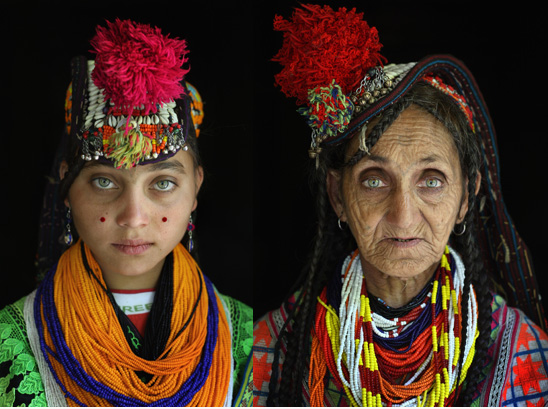
Also known as the Kalash (not all incidently, are non-Muslims; I believe that many living Kalash are known as "sheikhs" and are Muslims). Do they have cultural/linguistics ties with the Nuristanis?
Nuristanis were once called as red kafirs while kalash ones were/are called as Black kafirs. After forcble conversion to islam , nuristanis have no longer any cultural and other ties with kalash people
Also known as the Kalash (not all incidently, are non-Muslims; I believe that many living Kalash are known as "sheikhs" and are Muslims). Do they have cultural/linguistics ties with the Nuristanis?
its wikipedia, so iam not sure how reliable the material is
History
The Kalash are known as indigenous people of Chitral, and their ancestors migrated to Chitral from Afghanistan in the 2nd century BC.[1] It is thought the Kalash descendants migrated to Afghanistan from a distant place in South Asia, which the Kalash call “Tsiyam” in their folk songs and epics.[1]
The Kalash were ruled by the Mehtar of Chitral from the 1700s onward. They have enjoyed a cordial relationship with the major ethnic group of Chitral, the Kho who are Sunni and Ismaili Muslims. The multi-ethnic and multi-religious State of Chitral ensured that the Kalash were able to live in peace and harmony and practice their culture and religion. The Nuristani, their neighbours in the region of former Kafiristan west of the border, were converted to Islam by Amir Abdur-Rahman of Afghanistan in the 1890s and their land was renamed Nuristan.
Prior to that event, the people of Kafiristan had paid tribute to the Mehtar of Chitral and accepted his suzerainty. This came to an end with the Durand Agreement when Kafiristan fell under the Afghan sphere of Influence. Recently, the Kalash have been able to stop their demographic and cultural spiral towards extinction and have, for the past 30 years, been on the rebound. Increased international awareness, a more tolerant government, and monetary assistance has allowed them to continue their way of life. Their numbers remain stable at around 3,000. Although many convert to Islam, the high birth rate replaces them, and with medical facilities (previously there were none) they live longer.
Allegations of "immorality" connected with their practices have led to the forcible conversion to Islam of several villages in the 1950s, which has led to heightened antagonism between the Kalash and the surrounding Muslims. Since the 1970s, schools and roads were built in some valleys.[21]
Rehman and Ali (2001) report that pressure of radical Muslim organizations is on the increase:
they have huge noses though
ps they also have striking resemblance to the wakhis of Afghanistan
A line[Durrand line] of hatred that raised a wall between the two brothers -Hamid Karzai
For generations, the Hindus of India prayed for deliverance from "the venom of the cobra, the teeth of the tiger and the vengeance of the Afghan."
The men of Kábul and Khilj also went home; and whenever they were questioned about the Musulmáns of the Kohistán (the mountains), and how matters stood there, they said, "Don't call it Kohistán, but Afghánistán; for there is nothing there but Afgháns and disturbances." Thus it is clear that for this reason the people of the country call their home in their own language Afghánistán, and themselves Afgháns. The people of India call them Patán; but the reason for this is not known. But it occurs to me, that when, under the rule of Muhammadan sovereigns, Musulmáns first came to the city of Patná, and dwelt there, the people of India (for that reason) called them Patáns—but God knows!
 Tweet




 .

Comment