Announcement

Collapse
No announcement yet.

Astronomy Images

Collapse
X
 
  • Filter
  • Time
  • Show
Clear All
new posts

  • #16
    Chromoscope - View the Universe in different wavelengths

    A great website.
    Let's you see our galaxy thorugh the whole electromagnetic spectrum (visible, x-ray, infrared, microwave, UV, gamma, etc)
    ---
    To advise others is an easy matter, the difficulty is accepting advice -- since it is bitter for those who follow their
    own inclinations and desires
    .


    -Imam al Ghazali

    Comment


    • #17
      This image was taken recently by the hubble telesecope.


      The Necklace Nebula is located 15,000 light-years away in the constellation
      Sagitta (the Arrow). In this composite image, taken on July 2, 2011, Hubble's
      Wide Field Camera 3 captured the glow of hydrogen (blue), oxygen (green),
      and nitrogen (red).


      A giant cosmic necklace glows brightly in this NASA Hubble Space Telescope image.

      The object, aptly named the Necklace Nebula, is a recently discovered planetary
      nebula, the glowing remains of an ordinary, Sun-like star. The nebula consists of a
      bright ring, measuring 12 trillion miles wide, dotted with dense, bright knots of gas
      that resemble diamonds in a necklace.

      A pair of stars orbiting close together produced the nebula, also called PN
      G054.2-03.4. About 10,000 years ago one of the aging stars ballooned to the point
      where it engulfed its companion star. The smaller star continued orbiting inside its
      larger companion, increasing the giant’s rotation rate.

      The bloated companion star spun so fast that a large part of its gaseous envelope
      expanded into space. Due to centrifugal force, most of the gas escaped along the
      star’s equator, producing a ring. The embedded bright knots are dense gas clumps in
      the ring.

      The pair is so close, only a few million miles apart, they appear as one bright dot in
      the center. The stars are furiously whirling around each other, completing an orbit in
      a little more than a day.

      The Necklace Nebula is located 15,000 light-years away in the constellation Sagitta.
      In this composite image, taken on July 2, Hubble’s Wide Field Camera 3 captured the
      glow of hydrogen (blue), oxygen (green), and nitrogen (red).
      ---
      To advise others is an easy matter, the difficulty is accepting advice -- since it is bitter for those who follow their
      own inclinations and desires
      .


      -Imam al Ghazali

      Comment


      • #18


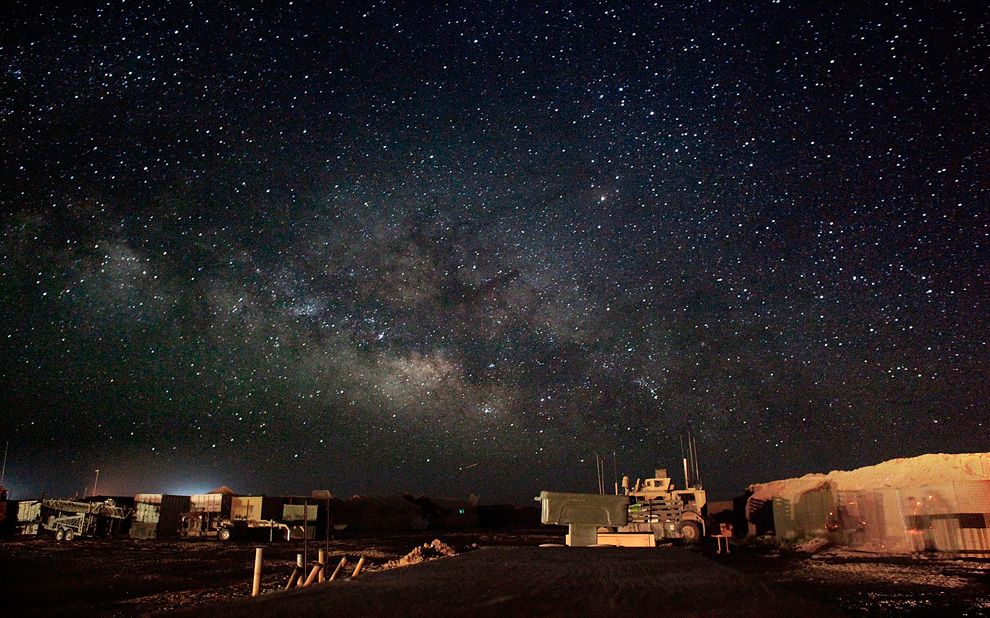
        That's in Helmand.

        I remember in Wardak where there is no electricity, you just look up at the sky and see all the stars so clearly.
        In London you'll be lucky to see any, especially if like me, your window is inbetween two bright lamposts that are lit throughout the night.
        Last edited by Haris; 08-23-2011, 09:16 PM. Reason: two instead of to
        ---
        To advise others is an easy matter, the difficulty is accepting advice -- since it is bitter for those who follow their
        own inclinations and desires
        .


        -Imam al Ghazali

        Comment


        • #19
          Orion Nebula

          It's enough that I know, Our time had a home, In your heart..Was a place..But the glass always breaks..

          Comment


          • #20
            woooooooooaaaaaaow

            I am no bird, and no nest ensnares me.

            non commercial would cost less if he was in charge himself which he plans on doing. right now it's n herat but soon it will be in qanadahar.

            Comment


            • #21
              talal, WOW!!!!!
              haris, i have seen the most awesome amount of stars in the sky, when camping in the desert, in the centre of australia. at first i thought i was imagining things, i did a doubletake.

              Comment


              • #22
                Changed title from Space Images to Astronomy Images so that we can post a wider variety of photos.

                A Pileus Iridescent Cloud Over Ethiopia


                Yes, but how many dark clouds have a multicolored lining? Pictured, behind this darker cloud, is a pileus iridescent cloud, a group of water droplets that have a uniformly similar size and so together diffract different colors of sunlight by different amounts. The above image was taken just after the picturesque sight was noticed by chance by a photographer in Ethiopia. A more detailed picture of the same cloud shows not only many colors, but unusual dark and wavy bands whose origins are thought related to wave disturbances in the cloud.


                Amazing, eh?
                ---
                To advise others is an easy matter, the difficulty is accepting advice -- since it is bitter for those who follow their
                own inclinations and desires
                .


                -Imam al Ghazali

                Comment


                • #23
                  Seeing the beauty, order and vastness of the universe always tugs on my heart strings. SubhanAllah

                  Comment


                  • #24
                    The Jellyfish Nebula


                    The Andromeda Galaxy


                    You can see it with a pair of binoculars but if you want to see it like how it is above then you'll need a £200,000,000 telescope.
                    Last edited by Haris; 09-07-2011, 09:27 PM. Reason: resized
                    ---
                    To advise others is an easy matter, the difficulty is accepting advice -- since it is bitter for those who follow their
                    own inclinations and desires
                    .


                    -Imam al Ghazali

                    Comment


                    • #25


                      A panoramic view of the milky way taken on the Canary Islands.
                      Great photo.
                      ---
                      To advise others is an easy matter, the difficulty is accepting advice -- since it is bitter for those who follow their
                      own inclinations and desires
                      .


                      -Imam al Ghazali

                      Comment


                      • #26
                        Wooooooooooowwwwww!!!!!!!!

                        Comment


                        • #27


                          We're all familiar with the full moon, half moon and far side of the moon, but here's
                          one view of our natural satellite that you won't have seen before - its north pole. This
                          image was stitched together from 983 photos taken by the Lunar Reconnaissance
                          Orbiter Camera (LROC) over the course of one month.

                          One of the LROC's objectives is to discover moon regions of permanent shadow that
                          never see sunlight at all. Dark areas in this image are possible candidates.


                          Short Sharp Science: Seeking eternal shadow on moon's north pole
                          ---
                          To advise others is an easy matter, the difficulty is accepting advice -- since it is bitter for those who follow their
                          own inclinations and desires
                          .


                          -Imam al Ghazali

                          Comment


                          • #28
                            2nd august i did the iftaar in the plane last ramazaan. i didn't used to understand people who were fascinated by the sunset and sunrise but what i saw that evening was really beautiful. at first the horizon looked like a thick shade of orange and the clouds dark gray against the light gray sky. then the sky turned bluish and the orange line changed to bright red, light orange and darkish blue...it's hard to explain but i had never seen anything like that before..

                            I am no bird, and no nest ensnares me.

                            non commercial would cost less if he was in charge himself which he plans on doing. right now it's n herat but soon it will be in qanadahar.

                            Comment


                            • #29
                              ---
                              To advise others is an easy matter, the difficulty is accepting advice -- since it is bitter for those who follow their
                              own inclinations and desires
                              .


                              -Imam al Ghazali

                              Comment


                              • #30


                                OUR SOLAR SYSTEM Winner and Overall Winner Jupiter with Io and
                                Ganymede - September 2010
                                by Damian Peach (UK). Jupiter depicted
                                along with two of its 64 known moons, Io and Ganymede, showing the
                                surface of the gas giant streaked with colourful bands and dotted with
                                huge oval storms; detail is also visible on the two moons. The photos
                                which make up this composite image were taken from Barbados where the
                                excellent atmospheric clarity allows for exceptionally clear astronomical
                                pictures.
                                ---
                                To advise others is an easy matter, the difficulty is accepting advice -- since it is bitter for those who follow their
                                own inclinations and desires
                                .


                                -Imam al Ghazali

                                Comment

                                Working...
                                X