
 Tweet
Interesting article.
China becomes an urban
nation at breakneck speed
With the government seeking to increase domestic demand,
places like Guiyang are at the heart of its urbanisation strategy
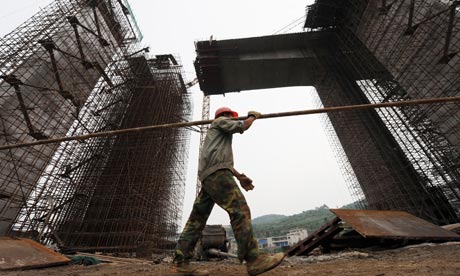
A construction site in Guiyang, part of development programme that has been
described by one expert as 'the most managed process of urbanisation in human
history.' Photograph: Wu Dongjun/Getty Images
Every few minutes another car brakes sharply as it reaches Tangbaguan on
Guiyang's new ring road. Another driver does a double-take. The dual
carriageway ends abruptly in a narrow dirt track twisting downwards
through heaps of rubble.
The city is eating hungrily into the hillsides, swallowing up maize fields and
rice terraces in loops of tarmac and towers of concrete and glass. But the
pace of change is so rapid, the transition so sharp, that its citizens are
increasingly bewildered by their surroundings. Some, like the migrant
workers building the roads, are new to city life. Others no longer recognise
their hometown as it sprawls across the land.
This is the year China finally became an urban nation. In April the census
revealed that 49.7% of its 1.34bn population was living in cities, compared
with around a fifth as economic reforms got off the ground in 1982. By
now, China's urbanites outnumber their country cousins. "The process they
have been going through over three decades took four or five decades in
Japan and [South] Korea and 100 years in the west," says Edward Leman,
whose Chreod consultancy has advised numerous Chinese cities on
development.
It is not only the extraordinary speed that is "unprecedented and
unparalleled", says Prof Paul James of the Global Cities Institute at RMIT
University in Melbourne. "It represents the most managed process of
urbanisation in human history. The state is involved in every way. It
manages the building of new cities. It regulates the housing of internally
displaced people. It responds actively and sometimes oppressively to new
waves of squatters."
The new five-year plan pushes urbanisation even further, as the
government seeks to raise living standards and promote development in the
poorer central and western regions. A hard landing for the economy could
slow this process – local government debt is a particular worry – but will
not stop it.
By 2025, one study suggests, 350 million more people will have moved to
cities; more than the population of the US. Five years later the urban
population will top 1 billion. There will be 221 cities with more than 1 million
inhabitants; Europe currently has 35. The number of new skyscrapers could
equate to 10 New York cities. The impact will be felt worldwide: in prices
for commodities such as steel and copper, and in greenhouse gas
emissions.
Li Keqiang – the vice-premier expected to become prime minister in 2012 –
has argued that urbanisation should be the "strategic focus" of expanding
domestic demand. China needs to restructure its economy, moving away
from exports and investment towards domestic consumption. In the
short-term urbanisation creates demand for infrastructure and property; in
the longer run, urbanites consume vastly more than rural dwellers.
Han Jun, deputy director with the state council's development research
centre – a top government thinktank – has predicted that the process will
boost domestic demand by 30trn yuan (£3trn) by 2030.
Cities such as Guiyang are at the heart of the government's strategy. It is
the capital of south-western Guizhou, China's poorest province, where just
34% of the population is urban. It already has 3 million inhabitants and is
challenging terrain for expansion: "This is Guizhou – you open the door, you
have to climb a mountain," says one resident. But its boundaries are
expanding north, south, east and west. There are cranes everywhere and
scores of developments thrusting into the skyline, their names –
Dreamland, Sky Acropolis – as lofty as their dimensions.
Further out, at Xinzaipo, a water buffalo is snuffling along a path and a
cockerel crows in the distance. But a new road curves through the little
valley and a vast printing plant is rising above the rice fields. Two medicine
factories will claim an adjacent patch. When they drive three railway lines
through another, the farmers will move to new homes down the road,
returning to tend what land remains.
Li Chengqiang has watched the city crawl closer and closer to his farm.
Now it has begun to absorb it. "The land is the most fundamental basis of
our family. Even though the country advocates industrial development,
people still have to eat. [Besides], the crops planted by ourselves taste
better," he says.
"It's noisier now. When we were little, we didn't have to close our door at
night to sleep. There are different kinds of people around all the time these
days."
Yet he welcomes the transition. "The housing has changed, the roads have
changed, we can eat well," Li says. Despite his emotional attachment to
the land, his main income now comes from selling cement.
Xinzaipo is unusual. None of the farmers have lost all their land, and Li and
his friends seem – so far, at least – sanguine about the changes. But land
seizures by local authorities are one of the main causes of the tens of
thousands of protests that break out in China each year; earlier this month
hundreds of villagers in southern Guangdong besieged government buildings
and attacked police over confiscated farmland. Standard Chartered
analysts have suggested 2.5 million to 3 million farmers a year lose land to
development, rarely with sufficient compensation.
"Of course urbanisation is good for China – but not this kind of
urbanisation," warns Prof Tao Ran, a land issues expert at Renmin
University.
Corrupt officials are often blamed for taking bribes from developers. But
Tao says the problem was more basic. Land is collectively owned and
farmers have no right to sell the patches they lease.
Land sales have become one of the main sources of income for local
governments, generating as much as a third to a half of revenues in some
areas. But the tax system is skewed so that local revenues benefit from
industrial development far more than residential.
Tao says that there is already overcapacity in manufacturing, yet around
50% of new urban areas become industrial parks, while only 20% or 30%
are residential, compared with 50% to 70% residential in other countries.
In many cases the industry moving westwards is also energy intensive and
heavily polluting, adding to the heavy environmental toll of urbanisation.
The solution, Tao argues, is to allow farmers' collectives to sell the land or
build houses upon it themselves, introducing a land sales tax and a
property tax to make up the shortfall in government revenues. But he
predicts: "You will see this model continue until it collapses … there is no
real reform to make these grand objectives happen."
Tao is also sceptical about the government's promotion of distributed
urbanisation, with smaller cities spread throughout the country, arguing
that in reality migrants will continue to be attracted to megacities.
Many others support Beijing's strategy, but question its implementation.
"Some of the plans look good on paper, but in reality the rush to build is
creating cities that will have to be completely rethought in 20 years' time
as expectations, aspirations and sustainability imperatives change," warns
James of the Global Cities Institute. China risks wiping out older cultures
and building dreary cities, he says; it is covering landscapes in one
generation, but with consequences for the foreseeable future. Others
worry about the safety standards of so much rushed construction. Last
Tuesday 270 people were injured in a crash on a Shanghai subway line built
barely a year ago. The same day Chinese media reported that a 8bn yuan
(£800m) highway in Gansu had closed for repairs less than 80 days after
opening.
Beijing may drive urbanisation, but it does not control it. The results are
often messy, chaotic and unanticipated.
"A lot of things are being built because they are flavour of the month. It's
good for the party secretary or mayor to be able to say: 'I built this ring
road and in the process GDP went up,' because it cost a lot," says Leman.
"It's the nature of urban management in China that you go into a city and
there are eight-lane roads that end in a field."
China becomes an urban nation at breakneck speed | World news | The Guardian
China becomes an urban
nation at breakneck speed
With the government seeking to increase domestic demand,
places like Guiyang are at the heart of its urbanisation strategy
A construction site in Guiyang, part of development programme that has been
described by one expert as 'the most managed process of urbanisation in human
history.' Photograph: Wu Dongjun/Getty Images
Every few minutes another car brakes sharply as it reaches Tangbaguan on
Guiyang's new ring road. Another driver does a double-take. The dual
carriageway ends abruptly in a narrow dirt track twisting downwards
through heaps of rubble.
The city is eating hungrily into the hillsides, swallowing up maize fields and
rice terraces in loops of tarmac and towers of concrete and glass. But the
pace of change is so rapid, the transition so sharp, that its citizens are
increasingly bewildered by their surroundings. Some, like the migrant
workers building the roads, are new to city life. Others no longer recognise
their hometown as it sprawls across the land.
This is the year China finally became an urban nation. In April the census
revealed that 49.7% of its 1.34bn population was living in cities, compared
with around a fifth as economic reforms got off the ground in 1982. By
now, China's urbanites outnumber their country cousins. "The process they
have been going through over three decades took four or five decades in
Japan and [South] Korea and 100 years in the west," says Edward Leman,
whose Chreod consultancy has advised numerous Chinese cities on
development.
It is not only the extraordinary speed that is "unprecedented and
unparalleled", says Prof Paul James of the Global Cities Institute at RMIT
University in Melbourne. "It represents the most managed process of
urbanisation in human history. The state is involved in every way. It
manages the building of new cities. It regulates the housing of internally
displaced people. It responds actively and sometimes oppressively to new
waves of squatters."
The new five-year plan pushes urbanisation even further, as the
government seeks to raise living standards and promote development in the
poorer central and western regions. A hard landing for the economy could
slow this process – local government debt is a particular worry – but will
not stop it.
By 2025, one study suggests, 350 million more people will have moved to
cities; more than the population of the US. Five years later the urban
population will top 1 billion. There will be 221 cities with more than 1 million
inhabitants; Europe currently has 35. The number of new skyscrapers could
equate to 10 New York cities. The impact will be felt worldwide: in prices
for commodities such as steel and copper, and in greenhouse gas
emissions.
Li Keqiang – the vice-premier expected to become prime minister in 2012 –
has argued that urbanisation should be the "strategic focus" of expanding
domestic demand. China needs to restructure its economy, moving away
from exports and investment towards domestic consumption. In the
short-term urbanisation creates demand for infrastructure and property; in
the longer run, urbanites consume vastly more than rural dwellers.
Han Jun, deputy director with the state council's development research
centre – a top government thinktank – has predicted that the process will
boost domestic demand by 30trn yuan (£3trn) by 2030.
Cities such as Guiyang are at the heart of the government's strategy. It is
the capital of south-western Guizhou, China's poorest province, where just
34% of the population is urban. It already has 3 million inhabitants and is
challenging terrain for expansion: "This is Guizhou – you open the door, you
have to climb a mountain," says one resident. But its boundaries are
expanding north, south, east and west. There are cranes everywhere and
scores of developments thrusting into the skyline, their names –
Dreamland, Sky Acropolis – as lofty as their dimensions.
Further out, at Xinzaipo, a water buffalo is snuffling along a path and a
cockerel crows in the distance. But a new road curves through the little
valley and a vast printing plant is rising above the rice fields. Two medicine
factories will claim an adjacent patch. When they drive three railway lines
through another, the farmers will move to new homes down the road,
returning to tend what land remains.
Li Chengqiang has watched the city crawl closer and closer to his farm.
Now it has begun to absorb it. "The land is the most fundamental basis of
our family. Even though the country advocates industrial development,
people still have to eat. [Besides], the crops planted by ourselves taste
better," he says.
"It's noisier now. When we were little, we didn't have to close our door at
night to sleep. There are different kinds of people around all the time these
days."
Yet he welcomes the transition. "The housing has changed, the roads have
changed, we can eat well," Li says. Despite his emotional attachment to
the land, his main income now comes from selling cement.
Xinzaipo is unusual. None of the farmers have lost all their land, and Li and
his friends seem – so far, at least – sanguine about the changes. But land
seizures by local authorities are one of the main causes of the tens of
thousands of protests that break out in China each year; earlier this month
hundreds of villagers in southern Guangdong besieged government buildings
and attacked police over confiscated farmland. Standard Chartered
analysts have suggested 2.5 million to 3 million farmers a year lose land to
development, rarely with sufficient compensation.
"Of course urbanisation is good for China – but not this kind of
urbanisation," warns Prof Tao Ran, a land issues expert at Renmin
University.
Corrupt officials are often blamed for taking bribes from developers. But
Tao says the problem was more basic. Land is collectively owned and
farmers have no right to sell the patches they lease.
Land sales have become one of the main sources of income for local
governments, generating as much as a third to a half of revenues in some
areas. But the tax system is skewed so that local revenues benefit from
industrial development far more than residential.
Tao says that there is already overcapacity in manufacturing, yet around
50% of new urban areas become industrial parks, while only 20% or 30%
are residential, compared with 50% to 70% residential in other countries.
In many cases the industry moving westwards is also energy intensive and
heavily polluting, adding to the heavy environmental toll of urbanisation.
The solution, Tao argues, is to allow farmers' collectives to sell the land or
build houses upon it themselves, introducing a land sales tax and a
property tax to make up the shortfall in government revenues. But he
predicts: "You will see this model continue until it collapses … there is no
real reform to make these grand objectives happen."
Tao is also sceptical about the government's promotion of distributed
urbanisation, with smaller cities spread throughout the country, arguing
that in reality migrants will continue to be attracted to megacities.
Many others support Beijing's strategy, but question its implementation.
"Some of the plans look good on paper, but in reality the rush to build is
creating cities that will have to be completely rethought in 20 years' time
as expectations, aspirations and sustainability imperatives change," warns
James of the Global Cities Institute. China risks wiping out older cultures
and building dreary cities, he says; it is covering landscapes in one
generation, but with consequences for the foreseeable future. Others
worry about the safety standards of so much rushed construction. Last
Tuesday 270 people were injured in a crash on a Shanghai subway line built
barely a year ago. The same day Chinese media reported that a 8bn yuan
(£800m) highway in Gansu had closed for repairs less than 80 days after
opening.
Beijing may drive urbanisation, but it does not control it. The results are
often messy, chaotic and unanticipated.
"A lot of things are being built because they are flavour of the month. It's
good for the party secretary or mayor to be able to say: 'I built this ring
road and in the process GDP went up,' because it cost a lot," says Leman.
"It's the nature of urban management in China that you go into a city and
there are eight-lane roads that end in a field."
China becomes an urban nation at breakneck speed | World news | The Guardian