
 Tweet
Africa could host the
world's most powerful
telescope
South Africa battles Australia and New Zealand for vast
£1.3bn stargazer Square Kilometre Array project
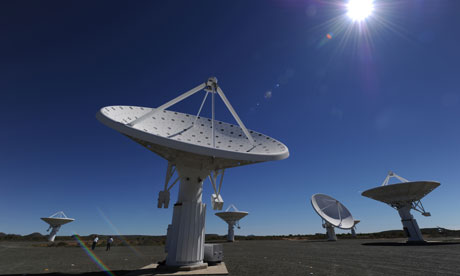
South Africa is ready to host the world's most powerful radio telescope, the Square
Kilometre Array (SKA). Photograph: Alexander Joe/AFP/Getty Images
Sitting in a white prefab hut, Lindsay Magnus punches a code into a
computer beneath bands of red, green and blue representing the Centaurus
A galaxy. Beyond the window, seven giant dishes turn in unison, throwing
shadows across the gravel. Their target lies millions of light years away in
the cosmos.
Magnus and his colleagues are aiming to build the world's biggest
telescope. It will cost £1.3bn and consist of thousands of dishes with a
total surface area of one square kilometre. It will generate enough raw
data to fill 15m 64 GB iPods every day, requiring a supercomputer 1,000
times faster than currently exists. It will peer back to a time before the
first stars and galaxies formed and offer our best chance yet of detecting
alien intelligence.
And there is a strong chance the telescope will be African. Bids will be
submitted on Thursday to host the Square Kilometre Array (SKA), an
instrument that turns radio waves into pictures of galaxies, exploding stars
and other space phenomena. The contest pitches South Africa (in
partnership with eight other African countries) against Australia and New
Zealand.
Both contenders offer vast tracts of land with tiny populations – vital to
avoid interference from mobile phones and other electronics. Both are also
in the southern hemisphere, which offers a better perspective on the
centre of our galaxy but which has been relatively neglected to date. An
old joke has it: "God put all the astronomers in the northern hemisphere
and all the interesting objects in the southern."
But Africa would also have political purchase. A continent often written off
as broken and doomed, and a backwater of scientific research is on the
verge of landing one of the most important astronomical projects of the
early 21st century. Much was said about last year's football World Cup as
a blow to "Afro-pessimism."
The SKA could be a galvanising moment for its intellectual capital,
self-confidence and prestige around the world. "I work in a world class field
and now I can do it at home, I don't have to go overseas," said Magnus,
commissioning scientist at the Karoo Array Telescope (KAT-7), a prototype
of the SKA. "If it comes to Africa, conversations will happen that never
could have happened.
"If you were to think about the way to impact people here with science,
there's no better way. Children already know there's something big going
on – it's broadening their horizons. It's very different from the daily toll of
war, famine and poverty."
KAT-7 is an array of seven 16-metre-tall dishes undergoing tests in the
Karoo desert. Staff charter a weekly flight from Cape Town to the Northern
Cape village of Carnarvon, then drive for an hour into a wilderness where
only sheep, springboks and hardy farmers venture. Mobile phone reception
soon disappears, which is just the way the researchers like it.
This is a quarantined zone where anything that emits radio frequency
interference (RFI) is like an infectious disease. Internet connections are by
fibre optic cables only. "Wifi is a curse word round here," one scientist
observed.
Such is the dishes' sensitivity that their "cold" receivers are cryogenically
cooled to about 70 kelvin (-203C) to reduce "noise". Banks of data servers,
with green and red lights scrolling left and right below humming air
conditioners, are sealed inside RFI-shielded containers with thick metal
doors providing "radio airlocks".
The staff kitchen, including a potentially intrusive microwave oven, and
recreation room are hidden safely behind a lone hill ("Losberg" in Afrikaans)
in isolated buildings that resemble a lunar base. A notice on the wall gives
emergency contact numbers and reassurance that Carnarvon hospital is
"stocked with snake anti-venom".
The heavy data lifting, however, is performed hundreds of miles away at a
control room beneath Table Mountain in Cape Town. Here, staff sit at
computer screens looking at what appear to be red and yellow blobs but
actually represent 10 hours' observation of galaxies such as PKS 1610-60,
some 240m light years away.
Dr Deborah Shepherd, project scientist and commissioning manager, has
moved from her native America to join the team. "You have a fresh outlook
on things in South Africa," she said. "The innovation that's coming out is
incredible. They're not limited by the way things have been done in the
past."
"During apartheid, South Africans have to pitch in and get on with things
themselves. They are willing to change if they get it wrong. When they
make mistakes, they figure out how to solve them."
The project says it has created jobs for about a hundred young scientists
and engineers with skills in "next generation" technologies. It has funded
nearly 300 bursaries for astronomy, engineering and physics students and
says astronomy is now being taught in Botswana, Ghana, Kenya,
Mozambique, Madagascar, Mauritius and Zambia.
But in South Africa, where economic and educational disparaties persist
between the white minority and black majority, diversity is a hypersensitive
issue. Dr Bernie Fanaroff, the country's SKA project director, said: "If you
look at astronomy around the world, it's heavily dominated by middle aged
white men. We've tried very hard to get women and black astronomers and
engineers into the programme.
"If you go to a number of European countries, you'll see that the proportion
of women in our programme is much higher, so we're doing quite well. It's
been quite difficult to get black astronomers and engineers. Some of the
technologies that we're dealing with are technologies that black students
haven't gone into — things like digital signal processing."
Fanaroff added: "We've been finding young people and bringing them into
our training programmes as far as we can. We haven't gone nearly far
enough, but if you look at our bursary programme for instance, more than
half the bursaries and grants have gone to black students, and I think it's
about 40% have gone to women." Next, KAT-7 will grow into MeerKAT, a
£130m radio telescope with 64 dishes that will rival the current world
leader, the Very Large Array in New Mexico. But even MeerKAT, due to be
completed by 2016-17, is a mere "baby step" towards the SKA.
This will cost £1.3bn to build and about £130m a year to operate.
Construction will start in 2016 and take eight years, funded by a UK-based
consortium likely to be made up of 16 countries. They will choose next year
between Africa and Australia.
If Africa wins, around 3,000 dishes will be spread across more than
3,000km in South Africa and its partners. Fanaroff said: "It's changing the
way South Africa is seen, not just as yet another African country which is
a basket case but actually as a science and technology leader.
"A lot of African countries are now recognising the importance of science
and technology in development. Africa has not been perceived up to now
as a place where you do science and technology, but that doesn't mean it
shouldn't be in the future.
"People are talking about Africa as the next great business destination.
You've probably seen the McKinsey report about the African lions, which
makes the point that it's not only in resource extraction, it's also in
manufacturing and so on. We want to take that further into hi-tech now.
"I would like South Africa in particular, but Africa in general, to be seen as
a place where you can do world class science and technology."
At a presentation in London earlier this year, Fanaroff floated an inevitable
question: "We have immediate priorities like housing, poverty, education,
transport, so why would we spend money on astronomy?"
MeerKAT project manager Willem Esterhuyse has at least one answer.
"You can say we're going to cater to basic needs and be a third world
country, or you can push technology and be there with the best," he said.
"The World Cup showed we're a country on the way up, a country that can
do things. You need to inspire innovators and teach people hard skills so
they can develop things that sell and create jobs. There are a lot of
potential spin-offs from what we do."
Size matters
"To observe the most distant and ancient objects in the cosmos, scientists
turn to telescopes of staggering proportions. The reason is simple: in
astronomy, size matters.
Larger telescopes can collect more light (and other forms of
electromagnetic radiation) than smaller ones. In doing so, they can see
fainter objects that are farther away, such as stars that formed earlier in
the life of the universe.
The Square Kilometer Array (SKA) will gather radiowaves instead of visible
light, giving it advantages over traditional optical telescopes.
Radiotelescopes can see through inclement weather, operate in daylight
hours and are less troubled by cosmic dust. They can pick up radiowaves
from cold hydrogen atoms that are ubiquitous in space, allowing
astronomers to map the heavens in a radically different way.
These advantages come at a price. Just as optical telescopes can be
blinded by the sun and artificial lighting, radiotelescopes are best built in
remote locations, far from sources of radiowaves, such as mobile phone
base stations.
The largest radiotelescope in operation, near Arecibo in Puerto Rico,
collects radiowaves over an area of 73,000 square metres, and has a long
list of discoveries to its name. Using the telescope, astronomers spotted
the first planets outside our solar system, confirmed Einstein's theory of
general relativity and measured the rotation of Mercury.
The SKA will have a collecting area of one million square metres, making it
50 times more sensitive than any other telescope. With it, astronomers
hope to see as far back as the cosmic "dark ages", the period before the
first stars blinked into being. Others will study how the first black holes
formed, look for signs of alien life, and possibly unravel the mystery of the
dark energy that drives the expansion of the universe.
Instead of one giant telescope dish, the SKA will use 3,000 smaller dishes,
each around 15m-wide, spread out over thousands of kilometres. These will
collect high frequency radiowaves, while two other kinds of receptors, will
pick up medium and low frequency waves. The signals from all of the
receivers are combined and sent along a fibre optic cable to a high
performance computer for processing.
Africa could host the world's most powerful telescope | Science | The Guardian
You can see an interactive grahpic here: The SKA: an eye on the makings of the universe | Science | guardian.co.uk
world's most powerful
telescope
South Africa battles Australia and New Zealand for vast
£1.3bn stargazer Square Kilometre Array project
South Africa is ready to host the world's most powerful radio telescope, the Square
Kilometre Array (SKA). Photograph: Alexander Joe/AFP/Getty Images
Sitting in a white prefab hut, Lindsay Magnus punches a code into a
computer beneath bands of red, green and blue representing the Centaurus
A galaxy. Beyond the window, seven giant dishes turn in unison, throwing
shadows across the gravel. Their target lies millions of light years away in
the cosmos.
Magnus and his colleagues are aiming to build the world's biggest
telescope. It will cost £1.3bn and consist of thousands of dishes with a
total surface area of one square kilometre. It will generate enough raw
data to fill 15m 64 GB iPods every day, requiring a supercomputer 1,000
times faster than currently exists. It will peer back to a time before the
first stars and galaxies formed and offer our best chance yet of detecting
alien intelligence.
And there is a strong chance the telescope will be African. Bids will be
submitted on Thursday to host the Square Kilometre Array (SKA), an
instrument that turns radio waves into pictures of galaxies, exploding stars
and other space phenomena. The contest pitches South Africa (in
partnership with eight other African countries) against Australia and New
Zealand.
Both contenders offer vast tracts of land with tiny populations – vital to
avoid interference from mobile phones and other electronics. Both are also
in the southern hemisphere, which offers a better perspective on the
centre of our galaxy but which has been relatively neglected to date. An
old joke has it: "God put all the astronomers in the northern hemisphere
and all the interesting objects in the southern."
But Africa would also have political purchase. A continent often written off
as broken and doomed, and a backwater of scientific research is on the
verge of landing one of the most important astronomical projects of the
early 21st century. Much was said about last year's football World Cup as
a blow to "Afro-pessimism."
The SKA could be a galvanising moment for its intellectual capital,
self-confidence and prestige around the world. "I work in a world class field
and now I can do it at home, I don't have to go overseas," said Magnus,
commissioning scientist at the Karoo Array Telescope (KAT-7), a prototype
of the SKA. "If it comes to Africa, conversations will happen that never
could have happened.
"If you were to think about the way to impact people here with science,
there's no better way. Children already know there's something big going
on – it's broadening their horizons. It's very different from the daily toll of
war, famine and poverty."
KAT-7 is an array of seven 16-metre-tall dishes undergoing tests in the
Karoo desert. Staff charter a weekly flight from Cape Town to the Northern
Cape village of Carnarvon, then drive for an hour into a wilderness where
only sheep, springboks and hardy farmers venture. Mobile phone reception
soon disappears, which is just the way the researchers like it.
This is a quarantined zone where anything that emits radio frequency
interference (RFI) is like an infectious disease. Internet connections are by
fibre optic cables only. "Wifi is a curse word round here," one scientist
observed.
Such is the dishes' sensitivity that their "cold" receivers are cryogenically
cooled to about 70 kelvin (-203C) to reduce "noise". Banks of data servers,
with green and red lights scrolling left and right below humming air
conditioners, are sealed inside RFI-shielded containers with thick metal
doors providing "radio airlocks".
The staff kitchen, including a potentially intrusive microwave oven, and
recreation room are hidden safely behind a lone hill ("Losberg" in Afrikaans)
in isolated buildings that resemble a lunar base. A notice on the wall gives
emergency contact numbers and reassurance that Carnarvon hospital is
"stocked with snake anti-venom".
The heavy data lifting, however, is performed hundreds of miles away at a
control room beneath Table Mountain in Cape Town. Here, staff sit at
computer screens looking at what appear to be red and yellow blobs but
actually represent 10 hours' observation of galaxies such as PKS 1610-60,
some 240m light years away.
Dr Deborah Shepherd, project scientist and commissioning manager, has
moved from her native America to join the team. "You have a fresh outlook
on things in South Africa," she said. "The innovation that's coming out is
incredible. They're not limited by the way things have been done in the
past."
"During apartheid, South Africans have to pitch in and get on with things
themselves. They are willing to change if they get it wrong. When they
make mistakes, they figure out how to solve them."
The project says it has created jobs for about a hundred young scientists
and engineers with skills in "next generation" technologies. It has funded
nearly 300 bursaries for astronomy, engineering and physics students and
says astronomy is now being taught in Botswana, Ghana, Kenya,
Mozambique, Madagascar, Mauritius and Zambia.
But in South Africa, where economic and educational disparaties persist
between the white minority and black majority, diversity is a hypersensitive
issue. Dr Bernie Fanaroff, the country's SKA project director, said: "If you
look at astronomy around the world, it's heavily dominated by middle aged
white men. We've tried very hard to get women and black astronomers and
engineers into the programme.
"If you go to a number of European countries, you'll see that the proportion
of women in our programme is much higher, so we're doing quite well. It's
been quite difficult to get black astronomers and engineers. Some of the
technologies that we're dealing with are technologies that black students
haven't gone into — things like digital signal processing."
Fanaroff added: "We've been finding young people and bringing them into
our training programmes as far as we can. We haven't gone nearly far
enough, but if you look at our bursary programme for instance, more than
half the bursaries and grants have gone to black students, and I think it's
about 40% have gone to women." Next, KAT-7 will grow into MeerKAT, a
£130m radio telescope with 64 dishes that will rival the current world
leader, the Very Large Array in New Mexico. But even MeerKAT, due to be
completed by 2016-17, is a mere "baby step" towards the SKA.
This will cost £1.3bn to build and about £130m a year to operate.
Construction will start in 2016 and take eight years, funded by a UK-based
consortium likely to be made up of 16 countries. They will choose next year
between Africa and Australia.
If Africa wins, around 3,000 dishes will be spread across more than
3,000km in South Africa and its partners. Fanaroff said: "It's changing the
way South Africa is seen, not just as yet another African country which is
a basket case but actually as a science and technology leader.
"A lot of African countries are now recognising the importance of science
and technology in development. Africa has not been perceived up to now
as a place where you do science and technology, but that doesn't mean it
shouldn't be in the future.
"People are talking about Africa as the next great business destination.
You've probably seen the McKinsey report about the African lions, which
makes the point that it's not only in resource extraction, it's also in
manufacturing and so on. We want to take that further into hi-tech now.
"I would like South Africa in particular, but Africa in general, to be seen as
a place where you can do world class science and technology."
At a presentation in London earlier this year, Fanaroff floated an inevitable
question: "We have immediate priorities like housing, poverty, education,
transport, so why would we spend money on astronomy?"
MeerKAT project manager Willem Esterhuyse has at least one answer.
"You can say we're going to cater to basic needs and be a third world
country, or you can push technology and be there with the best," he said.
"The World Cup showed we're a country on the way up, a country that can
do things. You need to inspire innovators and teach people hard skills so
they can develop things that sell and create jobs. There are a lot of
potential spin-offs from what we do."
Size matters
"To observe the most distant and ancient objects in the cosmos, scientists
turn to telescopes of staggering proportions. The reason is simple: in
astronomy, size matters.
Larger telescopes can collect more light (and other forms of
electromagnetic radiation) than smaller ones. In doing so, they can see
fainter objects that are farther away, such as stars that formed earlier in
the life of the universe.
The Square Kilometer Array (SKA) will gather radiowaves instead of visible
light, giving it advantages over traditional optical telescopes.
Radiotelescopes can see through inclement weather, operate in daylight
hours and are less troubled by cosmic dust. They can pick up radiowaves
from cold hydrogen atoms that are ubiquitous in space, allowing
astronomers to map the heavens in a radically different way.
These advantages come at a price. Just as optical telescopes can be
blinded by the sun and artificial lighting, radiotelescopes are best built in
remote locations, far from sources of radiowaves, such as mobile phone
base stations.
The largest radiotelescope in operation, near Arecibo in Puerto Rico,
collects radiowaves over an area of 73,000 square metres, and has a long
list of discoveries to its name. Using the telescope, astronomers spotted
the first planets outside our solar system, confirmed Einstein's theory of
general relativity and measured the rotation of Mercury.
The SKA will have a collecting area of one million square metres, making it
50 times more sensitive than any other telescope. With it, astronomers
hope to see as far back as the cosmic "dark ages", the period before the
first stars blinked into being. Others will study how the first black holes
formed, look for signs of alien life, and possibly unravel the mystery of the
dark energy that drives the expansion of the universe.
Instead of one giant telescope dish, the SKA will use 3,000 smaller dishes,
each around 15m-wide, spread out over thousands of kilometres. These will
collect high frequency radiowaves, while two other kinds of receptors, will
pick up medium and low frequency waves. The signals from all of the
receivers are combined and sent along a fibre optic cable to a high
performance computer for processing.
Africa could host the world's most powerful telescope | Science | The Guardian
You can see an interactive grahpic here: The SKA: an eye on the makings of the universe | Science | guardian.co.uk